
DOWNLOAD THE APP


Customer Services
Copyright © 2025 Desertcart Holdings Limited
DOWNLOAD THE APP
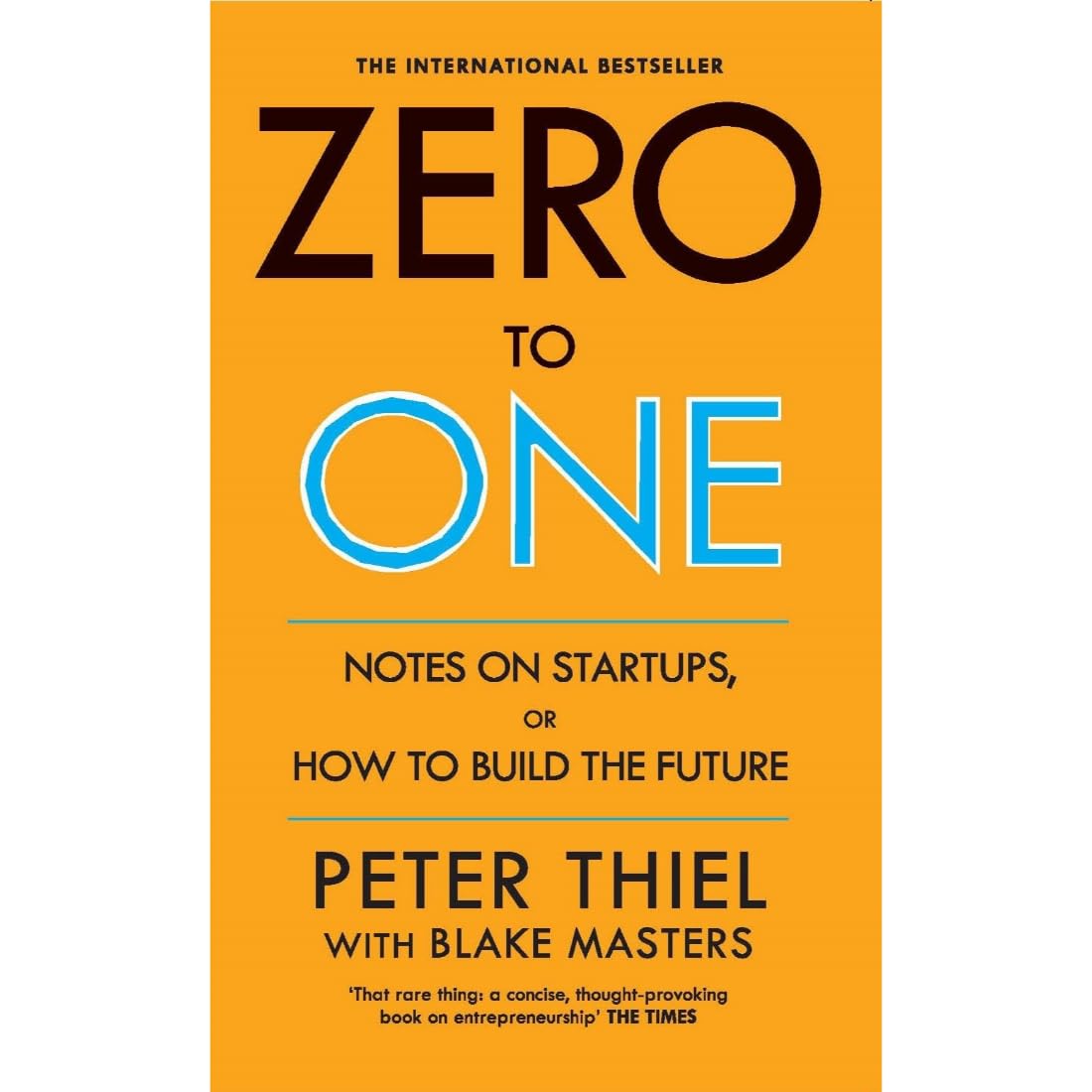
Zero to One: Notes on Start Ups, or How to Build the Future | International Bestseller by Peter Thiel and Blake Masters : Masters, Blake,Thiel, Peter: desertcart.in: Books Review: best for startup’s - This book provide you knowledge about the business activities works So what is your need understand the points and learn Review: this book (or better to say a compilation of notes) is about how ... - In the words of Peter, this book (or better to say a compilation of notes) is about how to build companies that create new things. Personally, I would say this book gives a good window into the mind of a great entrepreneur like Peter, which may give solace to other entrepreneurs with out of box idea and who are not getting support from near quarters. This is not a book which will detail out the steps in the journey, but it can tell you about what to expect in the journey. And nothing about the destination – that is for each to define as their own. In the process, there are some gems I collected. Like the contra learnings from the dot com bust – 1. Make incremental advances 2. Stay lean and flexible 3. Improve on competition 4. Focus on product , not sale OR what Peter professes a) It is better to risk boldness than triviality b) A bad plan is better than no plan c) Competitive market destroys profits d) Sales matter as much as the product Which one to choose – all upto you. Peter is unapologetic about monopoly – as he views that every business is successful exactly to the extent it does what others cannot, this making monopoly the condition for every successful business. All happy companies are those who have earned a monopoly by solving a unique problem, all failed companies are those who failed to escape competition In order to get to the monopoly, Peter suggests to analyse the business within some parameters: a) Proprietary technology – should be 10 times better than closest substitute b) Network effects – an expanding network of users will bring in more users. A product is viral if its core functionality encourages users to invite their friends to become users too. c) Economies of scale – the model should have a great potential to scale in its design d) Branding – control the customer experience Peter prefers to start small – target a small group of particular people concentrated together and served by few or no competitors. Dominate a small market than a large one. And then scale up. Peter also serves some words of caution - some of which may not find universal resonance, like a) Don’t Disrupt: focus on the act of creation. Disruptors often attract undue attention and take away substantial time b) Last will be first : Moving first is a tactic, not a goal. Focus on cash flows. It may be better to be the last mover - to make the last great development in a specific market and enjoy years of monopoly profits c) Full time involvement: Everyone you involve with your start up company should be involved full time – even remote working should be avoided to avoid any misalignment. d) Do one thing : Make every person in the company responsible for doing just one thing e) Human beings are irreplaceable: Complementarity between computers and human beings is the path to building a great business (e.g. LinkedIn helping recruiters than aiming to replace them) Using the case of large scale failure of greentech companies, Peter lays out a set of seven questions that every business must answer: 1. The Engineering Question- Can you create breakthrough technology instead of incremental improvements? 2. The Timing Question- Is now the right time to start your particular business? 3. The Monopoly Question -Are you starting with a big share of a small market? 4. The People Question- Do you have the right team? 5. The Distribution Question- Do you have a way to not just create but deliver your product? 6. The Durability Question -Will your market position be defensible 10 and 20 years into the future? 7. The Secret Question - Have you identified a unique opportunity that others don’t see? At the end, Peter addresses the question about the importance of founders. He agrees on the need to have and tolerate founders who seem strange and extreme. They are important as they can bring out the best work from everybody in the company. He also agrees that it can get dangerous when the founder is so certain of his myth that he loses his mind but he feels it is equally dangerous for a business to lose all sense of myth and mistake disenchantment for wisdom There are many other areas on which Peter gives his views like control over future, the power law of venture capital, the case for having secrets etc. He focusses on finding singular ways to create new things that will make future not just different , but better – to go from zero to one, for which the essential step is to think for yourself. His closing comment “Only by seeing the world anew and as strange as it was to the ancients who saw it first, can we both re-create it and preserve it for the future” The book is a recommended read as it is rare to get insights into some great minds. However, as I said in the beginning, don’t mistake this for a handbook for building a great business.
| Best Sellers Rank | #175 in Books ( See Top 100 in Books ) #3 in Entrepreneurship (Books) #7 in Economics Books #9 in Analysis & Strategy |
| Customer Reviews | 4.5 out of 5 stars 33,289 Reviews |
S**R
best for startup’s
This book provide you knowledge about the business activities works So what is your need understand the points and learn
H**R
this book (or better to say a compilation of notes) is about how ...
In the words of Peter, this book (or better to say a compilation of notes) is about how to build companies that create new things. Personally, I would say this book gives a good window into the mind of a great entrepreneur like Peter, which may give solace to other entrepreneurs with out of box idea and who are not getting support from near quarters. This is not a book which will detail out the steps in the journey, but it can tell you about what to expect in the journey. And nothing about the destination – that is for each to define as their own. In the process, there are some gems I collected. Like the contra learnings from the dot com bust – 1. Make incremental advances 2. Stay lean and flexible 3. Improve on competition 4. Focus on product , not sale OR what Peter professes a) It is better to risk boldness than triviality b) A bad plan is better than no plan c) Competitive market destroys profits d) Sales matter as much as the product Which one to choose – all upto you. Peter is unapologetic about monopoly – as he views that every business is successful exactly to the extent it does what others cannot, this making monopoly the condition for every successful business. All happy companies are those who have earned a monopoly by solving a unique problem, all failed companies are those who failed to escape competition In order to get to the monopoly, Peter suggests to analyse the business within some parameters: a) Proprietary technology – should be 10 times better than closest substitute b) Network effects – an expanding network of users will bring in more users. A product is viral if its core functionality encourages users to invite their friends to become users too. c) Economies of scale – the model should have a great potential to scale in its design d) Branding – control the customer experience Peter prefers to start small – target a small group of particular people concentrated together and served by few or no competitors. Dominate a small market than a large one. And then scale up. Peter also serves some words of caution - some of which may not find universal resonance, like a) Don’t Disrupt: focus on the act of creation. Disruptors often attract undue attention and take away substantial time b) Last will be first : Moving first is a tactic, not a goal. Focus on cash flows. It may be better to be the last mover - to make the last great development in a specific market and enjoy years of monopoly profits c) Full time involvement: Everyone you involve with your start up company should be involved full time – even remote working should be avoided to avoid any misalignment. d) Do one thing : Make every person in the company responsible for doing just one thing e) Human beings are irreplaceable: Complementarity between computers and human beings is the path to building a great business (e.g. LinkedIn helping recruiters than aiming to replace them) Using the case of large scale failure of greentech companies, Peter lays out a set of seven questions that every business must answer: 1. The Engineering Question- Can you create breakthrough technology instead of incremental improvements? 2. The Timing Question- Is now the right time to start your particular business? 3. The Monopoly Question -Are you starting with a big share of a small market? 4. The People Question- Do you have the right team? 5. The Distribution Question- Do you have a way to not just create but deliver your product? 6. The Durability Question -Will your market position be defensible 10 and 20 years into the future? 7. The Secret Question - Have you identified a unique opportunity that others don’t see? At the end, Peter addresses the question about the importance of founders. He agrees on the need to have and tolerate founders who seem strange and extreme. They are important as they can bring out the best work from everybody in the company. He also agrees that it can get dangerous when the founder is so certain of his myth that he loses his mind but he feels it is equally dangerous for a business to lose all sense of myth and mistake disenchantment for wisdom There are many other areas on which Peter gives his views like control over future, the power law of venture capital, the case for having secrets etc. He focusses on finding singular ways to create new things that will make future not just different , but better – to go from zero to one, for which the essential step is to think for yourself. His closing comment “Only by seeing the world anew and as strange as it was to the ancients who saw it first, can we both re-create it and preserve it for the future” The book is a recommended read as it is rare to get insights into some great minds. However, as I said in the beginning, don’t mistake this for a handbook for building a great business.
R**H
Awesome book
Great book to read , although at few places the concepts needs to be simplified. Go for it if you want to have some startup or entrepreneur journey .
A**R
This is a very good read for any person who wants to be an ...
This book is written by Peter Theil who is a venture capitalist, co-founder of Paypal and Palantir, an early investor in Facebook etc. This book is co-authored by Blake Masters who is an entrepreneur. Blake Masters was a student at Stanford and took detailed class notes of the course CS183: Startup taught by Peter Theil. They both worked on the notes and modified the content for a wider audience. This is a very good read for any person who wants to be an entrepreneur. Being interested in entrepreneurship, i chose this book after reading the reviews of other people. This was my first book on entrepreneurship and i really loved this book. This book taught me a lot of new things. Peter Theil emphasises on making something new rather than modifying another idea, which he calls going from zero to one. Modifying a currently existing idea can work in a local area but won't be able to profit much in bigger market because of competition which would eventually reduce the profits of each company. The book discusses a lot of scenarios of building a successful company with its merits and demerits. Peter also mentioned seven questions which one person should ask himself before starting a company which covers different aspects such as Engineering, Timing, Monopoly, People, Distribution, Duration and Uniqueness which i found to be very important. He discussed these aspects in great details with great examples. Moreover, the way he explained all the important things is easily understandable to even people having little to no knowledge in entrepreneurship. He also emphaises on the importance of the marketing of the product which is generally overlooked by technology startups these days. The book also encourages readers to ask "What valuable company is nobody building?" and "If I build it, will they (i.e. investors, customers) come?" before starting a new company and justifies the importance of these questions. The opening lines of the book mentions "the next Bill Gates will not build an operating system, the next Larry Page or Sergy Brin wont make a search engine and the next Mark Zuckerberg wont create a social network. If you are copying these guys, you aren't learning from them". These opening lines covers one of the most important essence for a startup to succeed. Overall this book is a very good read for everyone. This book is not just for people who are/willing to be an entrepreneur, but for everyone. This book discusses a lot of things which are important for us to build a better future. For example, Peter Theil focused on importance of green energy startups as renewable energy is a very important factor for betterment of humans on earth. The books also covers some basic but important aspects of business which benefits everyone. The book also covers some important startups of the past with the key people involved in them. Overall, this is a very good read for everyone
M**A
Great Learning!
Book has immense insights and very helpful for anyone who is thinking of beginning a start up👏
S**N
Serious buyer
Ok ok page quality… bcz zyada clear page hota to psychologically increase your reading interest… but kam chal jayega bro kharid le…
A**B
Nice perspectives. Random Notes.Easy weekend read.
Is it possible to evaluate a Book without the conscious & unconscious bias, either positive or negative, you may have for the Author? When the book is on startups and the author a well known serial entrepreneur, its a difficult task to separate the two. With Peter Thiel, founder of Paypal , Palantir and a serial investor, as the author, you would be fair to expect a glimpse of his learnings and wisdom in this book. The book itself is a compilation of lectures he had given at Stanford in 2012 and based on the notes taken by a student (and coauthor of this book, Blake Masters). Personally I am fond of such books. These give an opportunity to broaden your point of view the easy way while the author would have learned the same lessons the hard way, over years of iterations of what works. The book Cover mentions ‘Notes on Startups or How to build the future’. I read this book as ’Notes’ and suggest the reader do the same. Moment you start seeing this as ‘How to’ book, you would start expecting a deeper corroboration of various philosophies, management ideas and processes. The book has its share of contrarian ideas, philosophical articulations with somewhat weak narrative. The chapters may sound disjointed at times, making you wonder where are you headed. So keep it to ‘Notes’ and if you can add the imagery of being in Peter’s class while he delivers the lecture, you would feel happier. Read this book necessarily for author’s perspective on various things ‘startup’. Here are some of bright spots Should a startup rather look for a large market or explore a niche instead? Should the founders be similar or different? Is sales necessary even if you have a winner product? Would a 2x improvement be incremental and sufficient or do you need 10x paradigm shift to enter the market? Would you be better disrupting or without it? Do you need a secret for a real startup idea? I wouldn’t answer in this review but the author does in the book. There is more. The case studies on renewable energy and Tesla make for an interesting read and so does a matrix plotting optimism-pessimism against definite-indefinite future. He then explores countries and domains on this scale of Definite Optimism, Indefinite optimism et al. There is an interesting comparative of Biotech startups vs Software Startups to draw the contrast on definite v/s indefinite view of future. The investor side of Peter Thiel also talks about VCs , portfolio lifecycle, his own experiences and investment philosophy. The book is written in simple lucid style and should appeal more to students and those just starting into their own ventures. You may not, like me, take the articulations as gospel truths, but may want to spend more time in thinking, evaluating and experimenting with them. It is very likely that there is more to Peter Thiel than these 195 pages would indicate. The books leaves you wanting for more. In nutshell, the positive of the book is the perspectives. And for me the bigger let down was it didn’t inspire (now that’s subjective!) But again, I guess it would have been much more a pleasure to hear these lectures live, with the advantage of articulation and aura of struggles and success of Mr. Thiel. Easy weekend read.
B**I
Original thinking
Zero to one is master piece in my veiw,I may not agree but zero to one is doing something new and one to ten is to work in already establish field .This is putting something totaly new. There are many things in book like this.So a material which gives your mind freshness to get something
Trustpilot
2 weeks ago
1 month ago