
DOWNLOAD THE APP


Customer Services
Copyright © 2025 Desertcart Holdings Limited
DOWNLOAD THE APP
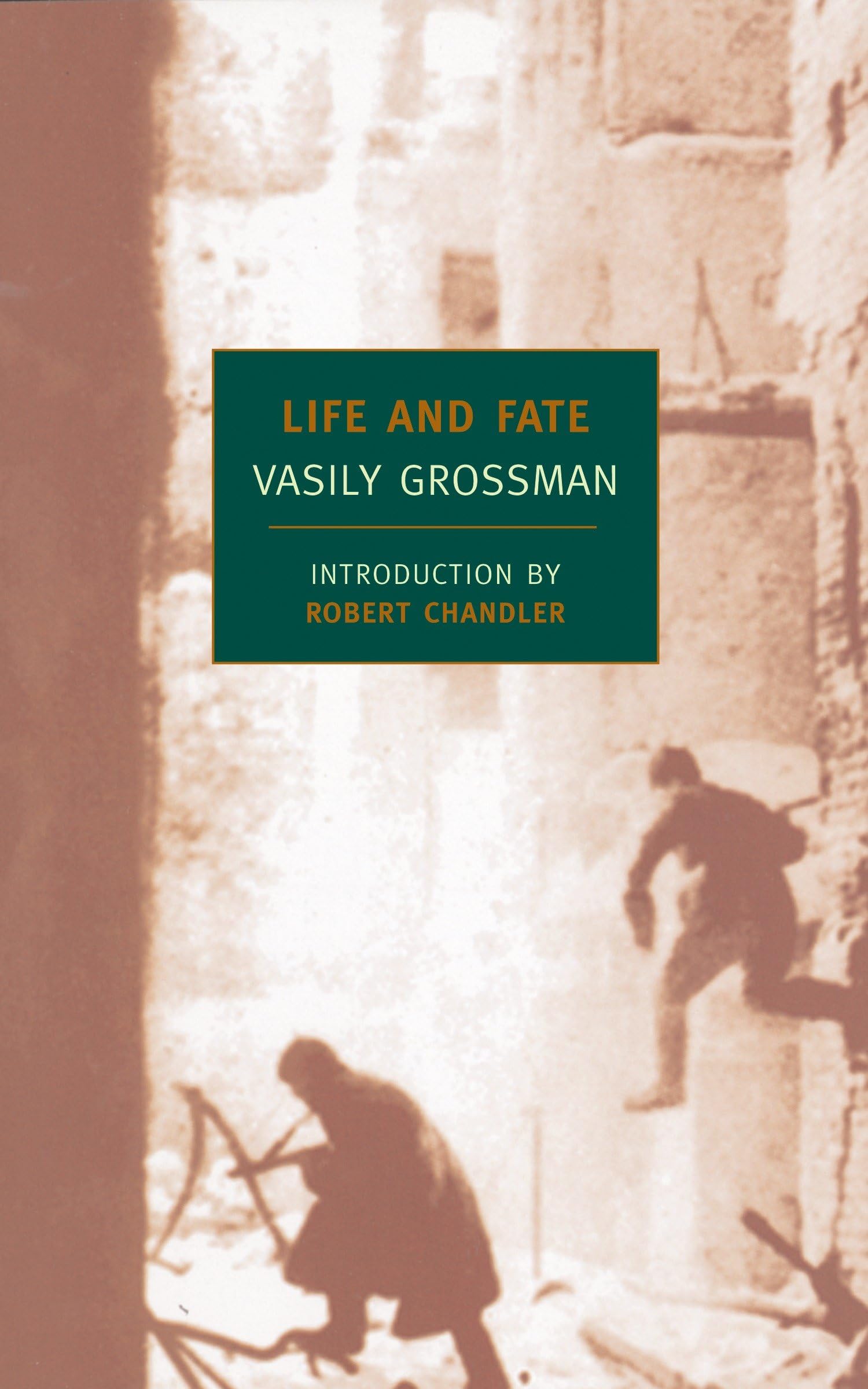
📖 Unlock the banned epic that redefines war, humanity, and courage.
Life and Fate by Vasily Grossman is a 900-page literary classic that chronicles the brutal realities of WWII, the Holocaust, and Soviet totalitarianism through a vast cast of characters. Banned and confiscated by Soviet authorities, this posthumously published masterpiece blends historical narrative with deep philosophical insights on kindness, individuality, and oppression. Praised for its emotional power and timeless relevance, it remains a must-read for those seeking profound understanding of humanity amid conflict.


| Best Sellers Rank | #40,700 in Books ( See Top 100 in Books ) #214 in War Fiction (Books) #329 in Contemporary Literature & Fiction #1,905 in Literary Fiction (Books) |
| Customer Reviews | 4.7 4.7 out of 5 stars (2,646) |
| Dimensions | 5.23 x 1.78 x 7.99 inches |
| Edition | First edition, first printing (full number line) |
| ISBN-10 | 1590172019 |
| ISBN-13 | 978-1590172018 |
| Item Weight | 2.1 pounds |
| Language | English |
| Print length | 896 pages |
| Publication date | May 16, 2006 |
| Publisher | NYRB Classics |
A**R
The case for dumb kindness
On June 22, 1941, Nazi Germany attacked the Soviet Union in a typhoon of steel and firepower without precedent in history. In spite of telltale signs and repeated warnings, Joseph Stalin who had indulged in wishful thinking was caught completely off guard. He was so stunned that he became almost catatonic, shutting himself in his dacha, not even coming out to make a formal announcement. It was days later that he regained his composure and spoke to the nation from the heart, awakening a decrepit albeit enormous war machine that would change the fate of tens of millions forever. By this time, the German juggernaut had advanced almost to the doors of Moscow, and the Soviet Union threw everything that it had to stop Hitler from breaking down the door and bringing the whole rotten structure on the Russian people’s heads, as the Führer had boasted of doing. Among the multitudes of citizens and soldiers mobilized was a shortsighted, overweight Jewish journalist named Vasily Grossman. Grossman had been declared unfit for regular duty because of his physical shortcomings, but he somehow squeezed himself all the way to the front through connections. During the next four years, he became one of the most celebrated war correspondents of all time, witnessing human conflict whose sheer brutality beggared belief. To pass the time in this most unreal of landscapes, Grossman had a single novel to keep him company – War and Peace. It was to prove to be a prophetic choice. Not only was Grossman present during the siege and eventual victory at Stalingrad – a single battle in which more Soviet soldiers and citizens died than American soldiers during all of World War 2 – but he was also part of the Soviet advance into the occupied territories in which the Nazis had waged a racial war of extermination that would almost annihilate an entire race of people. While forward-deployed units of Nazi Einsatzgruppen killed more than a million Jews in Ukraine, Lithuania and other countries, this “holocaust by bullets” was only a precursor to the horror of Auschwitz and Treblinka. Grossman became the first journalist to enter Treblinka and describe what words could scarcely bring themselves to describe. Most of all, the Holocaust hit home for him in a devastatingly personal way – Grossman’s own mother was murdered by the Nazis in the village of Berdychiv; the prewar Jewish population of this small town numbering more than 40,000 was completely annihilated. This singular episode shaped Grossman’s worldview for the rest of his life. Over the next ten years Grossman who had seen Stalin’s 1937 purges and the postwar takeover of Europe became witness to his own country’s descent into oppression, conquest and genocidal aspirations. The words that proclaimed liberty and brotherhood during the fight against the Nazis started sounding hollow. In 1960 he put the finishing touches to what was the culmination of his career and thinking – Life and Fate, a 900-page magnum opus that was on par with some of the greatest fiction of all time. Today Life and Fate stands shoulder to shoulder with the great novels. And similar to the great novels, it takes in the entire world and nothing seems to be missing from its pages. Love, hatred, war, peace, childhood, motherhood, jealousy, bravery, cowardice, introspection, economics, politics, science, philosophy…everything is contained in its universe. More importantly, like the great works of literature, like Shakespeare and Dante, Dickens and Hemingway, like Grossman’s compatriots Tolstoy and Dostoevsky, the themes in Life and Fate are timeless, transcending nationality, race, gender and even its wartime setting. It will be relevant two hundred years from now when men and women will still be fighting and killing and discussing and loving. The novel speaks to human beings struggling with common problems across the gulf of time. And it speaks doggedly against the identity politics that riddles our discourse so widely. Like War and Peace, Life and Fate straddles almost a hundred and fifty characters spread over a variety of times and locations, from the quiet warmth of a matriarch’s dwelling to the absolute nihilism of an extermination camp to several battle locations on the front spread around Stalingrad. Here we encounter characters whose views of life have been forced to be stripped down to their bare bones because of the sheer bleak brutality around them and forced minimalism of their existence. While there are hundreds of major and minor characters, a few key ones stand out. Broadly speaking, the characters fan out from the person of Alexandra Vladimirovna, a factory worker and steely matriarch who had lived in Stalingrad before moving out because of the war, and her two daughters Lyudmila and Yevgenia. The action also centers on Yevgenia’s old husband Krymov who has been an important party official and her new lover Novikov who is a tank commander. Meanwhile, Lyudmila lives with her husband Victor Shtrum, who in many ways speaks for the conscience of the various other characters in the novel. At least in one sense the most interesting person is Mikhail Mostovskoy, a friend of the family who has ended up in a German concentration camp. It’s hard to keep track of all the characters, but one of the most remarkable things is how even some of the minor, intermittent players leave an indelible memory because of their pronunciations and ideas. There are some extraordinarily poignant moments, such as when Lyudmila’s son Tolya is wounded on the front and she hurries to visit him in the hospital, only to find that he has died shortly before. She asks to be escorted to his grave and spends a moment of hauntingly beautiful, ethereal and yet earthly tragedy mourning at his side, covering him with his shawl so that he won’t be cold. It takes her several minutes to realize the bare truth of Tolya’s non-existence: “The water of life, the water that had gushed over the ice and brought Tolya back from the darkness, had disappeared; the world created by the mother’s despair, the world that for a moment had broken its fetters and become reality, was no more.” Perhaps there is no story more emotionally devastating in the book than the story of Sofya Levinton, a Jewish friend of Lyudmila’s who has the misfortune of being snared by the Nazis and put on a cattle train to Auschwitz. On the train Sofya runs into David, a six or seven year-old boy who also shared the misfortune of being cut off from his mother and put in a ghetto with his grandmother. When his grandmother died of disease, the woman she had entrusted David to was too busy trying to save herself. Like two atomic particles randomly bumping into each other by accident, David and Sofya bump into each other on the train. They have no one else, so they have each other. They accompany each other into the camp, into the dressing room, and finally into the gas chamber where there is no light, no life, no meaning. As the Zyklon B starts hissing from the openings above, David clings to the unmarried, childless Sofya: “Sofya Levinton felt the boy’s body subside in her hands. Once again she had fallen behind him. In mineshafts where the air becomes poisoned, it is always the little creatures, the birds and mice, that die first. This boy, with his slight, bird-like body, had left before her. ‘I’ve become a mother,’ she thought. That was her last thought.” In another German concentration camp, Mikhail Mostovskoy has philosophical disputes with a few prisoners who are trying to shake his confidence in communism and are also trying to organize an escape. Mostovskoy is a true believer and is keeping the flame burning bright. But reality is not so easy. The denouement comes when he is called to the office of the camp commandant. His name is Liss. Liss is interested in certain documents which a dissident named Ikkonikov has thrust into Mostovskoy’s hands, right before refusing to help build a gas chamber and being executed as a result. But that is not Liss’s main concern, and he is not here to punish Mostovskoy. Instead he does something worse than provide an easy death: he brings the hammer down on Mostovskoy’s entire worldview when he tells him how similar Nazism and Stalinism are, how they are built on the backs of oppressed and murdered people, how true believers in both ideologies should ideally stand shoulder to shoulder with each other, how this whole war is therefore an unnecessary farce. Mostovskoy is shaken, and his loss of faith very much mirrors Grossman’s own by the time he wrote the book: with its murder and suppression of all dissent, complete control of people’s lives and total disregard for individual freedom, were fascism and communism that different? But if Mostovskoy had any lingering doubts about whether his faith in collective action has been built on a house of cards, it collapses completely when he reads Ikkonikov’s pamphlets and hears him speaking from the grave. It’s strange: Ikkonikov is a minor character who appears perhaps in four or five pages of the volume, and the transcript of his documents occupies not more than ten pages in a book numbering almost a thousand pages, and yet in many ways his pamphlet is the single-most important part of the book, communicating as it does the overwhelming significance of individual kindness and action in the face of utter, unending conflict. Individual kindness is the only thing that remains when all humanity has been stripped away from both oppressor and oppressed; when every trace of nationality, race, gender and political views has been obliterated by sheer terror and murder, this kindness is the only elemental thing connecting all human beings simply because they are human beings and nothing else, it is this kindness, this dumb, senseless kindness, that will keep propelling humanity onwards when all else is lost. It is this kindness that goes by the name of ‘good’. As Ikkonikov says, “Good is to be found neither in the sermons of religious teachers and prophets, nor in the teachings of sociologists and popular leaders, nor in the ethical systems of philosophers… And yet ordinary people bear love in their hearts, are naturally full of love and pity for any living thing. At the end of the day’s work they prefer the warmth of the hearth to a bonfire in the public square. Yes, as well as this terrible Good with a capital ‘G’, there is everyday human kindness. The kindness of an old woman carrying a piece of bread to a prisoner, the kindness of a soldier allowing a wounded enemy to drink from his water-flask, the kindness of youth towards age, the kindness of a peasant hiding an old Jew in his loft. The kindness of a prison guard who risks his own liberty to pass on letters written by a prisoner not to his ideological comrades, but to his wife and mother. The private kindness of one individual towards another; a petty, thoughtless kindness; an unwitnessed kindness. Something we could call senseless kindness. A kindness outside any system of social or religious good. But if we think about it, we realize that this private, senseless, incidental kindness is in fact eternal. It is extended to everything living, even to a mouse, even to a bent branch that a man straightens as he walks by. Even at the most terrible times, through all the mad acts carried out in the name of Universal Good and the glory of States, times when people were tossed about like branches in the wind, filling ditches and gullies like stones in an avalanche – even then this senseless, pathetic kindness remained scattered throughout life like atom… This kindness, this stupid kindness, is what is most truly human in a human being. It is what sets man apart, the highest achievement of his soul. No, it says, life is not evil!” And who promotes this kindness? Not religion with its conditional acceptance and demands to conform. Not the state which also imposes its own demands for conformity. Not even capitalism which makes kindness conditional on the invisible hand of selfish actions. In fact no system of organization can impose this kindness, no matter how much it speaks of it in glowing terms. It can only come about when all systems of organization have been obliterated, when humanity’s bare existence compels its members to recognize a quality in each other that is completely independent of every group identification, every kind of “ism”. And who spoke of this kindness? Not the religious prophets who sought salvation in the one true God and heaven, not the commissars whose mind-numbing bureaucratic machinations threatened to grind every human particle of unique identity into the featureless dust of one level playing field, not even the scientific rationalists whose discoveries can only describe, not prescribe. No, to describe senseless, stupid, all-encompassing kindness one must look to the great poets and writers, not the philosophers. And through everyday characters and conversations, nobody demonstrates the timeless nature of individual kindness as well as Chekhov: “Chekhov said: let’s put God – and all these grand progressive ideas – to one side. Let’s begin with man; let’s be kind and attentive to the individual man – whether he’s a bishop, a peasant, an industrial magnate, a convict in the Sakhalin Islands or a waiter in a restaurant. Let’s begin with respect, compassion and love for the individual – or we’ll never get anywhere.” If you haven’t already, dear reader, I cannot exhort you enough to read Chekhov. Read his plays, read especially his short stories, read anything by him. Throughout Life and Fate the nature of indivisible, immutable bonds between human beings – whether it is a commander and his aide, an aging communist and her son-in-law, and of course the more common and enduring sets of relationships between sons and mothers, daughters and fathers – stand above and beyond the basic essentials of the narrative. Another character, in a completely different set of circumstances on the Stalingrad front: “Human groupings have one main purpose: to assert everyone’s right to be different, to be special, to think, feel and live in his or her own way. People join together in order to win or defend this right. But this is where a terrible, fateful error is born: the belief that these groupings in the name of a race, a God, a party or a State are the very purpose of life and not simply a means to an end. No! The only true and lasting meaning of the struggle for life lies in the individual, in his modest peculiarities and in his right to these peculiarities.” If that is not a soaring counterpoint to and a damning indictment of the identity politics that has completely taken over our discourse today, I do not know what is. When word of Grossman’s magnum opus got out the KGB stormed his apartment. They considered the novel so dangerous that they confiscated not only the manuscript but also the typewriter ribbons which were used to craft the novel. This level of paranoia could only exist in the Soviet Union. Why they did this is clear after reading it. Not only does Life and Fate show, through devastatingly understated examples of indelible characters who gradually become disillusioned, the hollow nature of the Soviet system’s promises and its similarity with the fascism that its patriotic adherents thought they were fighting, but it also demonstrated through the character of physicist Victor Shtrum, the anti-Semitism that while not as fatal as that in Nazi Germany, was slowly but surely brewing in the country’s corridors and the hearts and minds of its people. Even before the war ended it was clear that the Germans’ campaign of Jewish cleansing in Ukraine and parts of Russia could not have been carried out without the complicity of local populations who held grudges against Jews for decades. Grossman’s personal motivation because of his mother’s murder brought to his depiction of the Soviet Union’s initially “benign” and then increasingly oppressive anti-Semitism particularly strident and urgent force. The party line in the country refused to have writers like Grossman single out Jewish victims of the Holocaust because they knew that doing so would shine a mirror into their own faces. The combination of Grossman’s expose of the Soviets as being little different from the Nazis and anti-Semites to boot sealed his novel’s fate. When Grossman asked when his book might see the light of day, a high-ranking party official named Suslov said there was no question of the volume being published for another two hundred years; by announcing such a draconian sentence on Grossman’s work, he inadvertently announced the novel’s incendiary nature. Grossman died in 1964 without seeing his book smuggled out and translated by Robert Chandler, a sad and lonely man in a Moscow apartment battling stomach cancer. But his act of defiance, expressed in this profound book as an assertion of the fundamental nature of the individual and a rejection of collectivism of all kinds, spoke to the ages, escaped the fetters of its two hundred-year oppressors and brought about the collapse of the Soviet Union. And it could well bring about the collapse of the systems we take so much pride in because we fail to see how they are turning us into inchoate groups. So let us now practice thoughtless, stupid, unwitnessed kindness. It’s the one constant in life and fate.
D**P
Among the greatest of literary works that I've read; I would give this 6 stars out of 5, if possible
"Life and Fate" is the second half of a dilogy written by Vasily Grossman (Soviet author, and WW2 military reporter). I've already posted a review of his first book, "Stalingrad." First of all, I would recommend that you read "Stalingrad" before "Life and Fate." Some readers feel that you can read this book, without reading the first book. I disagree. "Life and Fate" continues the storylines, and themes of "Stalingrad". In my opinion, skipping "Stalingrad" and just reading "Life and Fate" would be the equivalent of starting The Brothers Karamazov" after the murder, or "Lord of the Rings" halfway through "The Two Towers." Not only will you miss out on events alluded to or referenced in the first book (for example, one of the last chapters of "Life" parallels and references one of the first chapters of "Stalingrad"); but you will also miss out on the changing beliefs of the characters, and the author's evolution, as well. "Life and Fate" is famous for being "arrested" by the Soviet government. Not only were the manuscripts confiscated, but the typewriter ribbons were, too. The book was deemed to not follow the dictates of socialist realism. My version of the first book, "Stalingrad", was published in 2019. The earliest published version, entitled "For a Just Cause" was an emasculated version, published in the USSR in the early 1950s while Stalin was still alive; it had the parts deemed anathema to socialist realism removed.(The 2019 version, has the offending sections, and characters, edited back in.) For "Life and Fate", Grossman would not remove the Soviet unapproved sections. He mistakenly believed that the Soviet censors under Khrushchev would be more open minded. The book was published years after the death of the writer. Other Soviet authors has smuggled microfilm of the text out of the country, or we would have never seen this masterpiece. And these books are masterpieces. Grossman's writing is so compelling, that you cannot not read every word. It doesn't make a difference what he's writing about: a dinner party, a military engagement (Vasily covered WW2 for a variety of Soviet newspapers and magazines), a mother's last letter to her son before she's murdered in a Nazi concentration camp, the thoughts and feelings of a young boy and an elderly doctor, as they are in line for a Nazi gas chamber, the torture and imprisonment of a former true believer in a Soviet Gulag; it all becomes real to the reader. "Life and Fate" follows more than a hundred characters, military and civilian, throughout the timeframe of most of the Battle of Stalingrad. While there is action, there are also many profound philosophical discussions and contemplations in the novel that reveal one of Grossman's strengths. You will read the philosophical segments with as much attention as you will the harrowing battle scenes. Reviewers of this novel have claimed that reading it changed their lives. I believe it was mostly due to the contemplative portions of the novel. One of the author's main themes was that there were strong parallels between national socialism, and communist socialism. Both raise the State (and certain groups) above the individual (a common characteristic of totalitarianism). One of the core discussions of the book is between the old Bolshevik, Mostovskoy, who is a prisoner in a concentration camp, and SS officer Liss. The German officer points out to the Bolshevik that "what you hate is yourselves--yourselves in us." Mostovsky will not acknowledge the parallels between the two systems (prison camps, their leaders, their delusions, their condemnation of dissenting opinions, citizens policing and reporting those that dissent, coerced confessions and apologies). Mostovskoy is discomforted because, even though he will never admit it, part of him realizes the similarities. Other characters who experience the abuses of totalitarian systems, in the novel, are Viktor Schtrum, a physicist who believes scientific knowledge should be shared (Grossman, who studied physics, was inspired by Soviet physicist Lev Strum, who first postulated the tachyon, and was arrested by the Soviet government); Zhenya Shapshnikova, ex-wife of Commissar Nikolay Krymov (a true believer), and Col. Pyotr Novikov (a hero of the battle of Stalingrad). I will not supply any spoilers for these characters, or the dozen others who populate, exist, and move through the narrative. As I read these two novels, I could see how some of these totalitarian characteristics exist in the supposed democratic countries of the world in our current time. During the Covid years, people reported on their neighbors and colleagues who they felt weren't following the rules for the collective. I personally heard a women in a restaurant bragging to her friends that she reported a bar because its patrons were only 5-1/2 feet apart. People are fired or "cancelled" for saying something deemed politically incorrect or having an "offending" opinion about certain beliefs or policies. Those same "offenders" are coerced/shamed/pressured into renouncing, and apologizing for said opinions. Hopefully, reading these novels may open up some readers eyes before we start locking people away for different, unapproved opinions. As you can guess, I give these two novels my highest recommendation. They are among the best literature that I've had the pleasure of reading. Not only for the narrative, and the philosophical concepts, but for the beautiful writing, as well. The two books total about 2000 pages. It took me almost three weeks to read the two. For comparison, a couple months ago, I read sixteen 400 page novels in the same amount of time. You will not want to skip one word of Grossman's masterpieces.
A**S
This is a large novel, extremely ambitious in scope, covering a large canvas, with deep insights into totalitarianism, politics and human psychology. It is unfortunately also just a bit patchy in places. Personally, I found many parts striking a chord. For example, somewhere at the beginning, the description of how the camp is run reminded me of India under British rule. Likewise, much of the political action seems to ring true, (based on other peoples' writings), and in comparing communists to Nazis, the author had both great clarity of vision and great courage to even think of making the comparison. There are one or two places where the thread seems to be lost, and the ending seems a trifle abrupt, but considering the history behind this novel, it can be understood that some parts of it may have been lost. However, the parts which seemed relatively unrealistic pertain to the war itself, which is ironic considering that the author was a war correspondent. It seems like a typically sanitized, jingoistic, glorified version, which sticks out like the proverbial sore thumb, because it is in such stark contrast to the rest of the work, where, in general, the author is extremely clear sighted and even handed in his treatment of both the Russians and the Germans. (Note: the translator also refers to a related point: i.e. the debate about the true motivations of the defenders of Stalingrad.) Possibly, these issues might have been rectified in the due process, had the author been able to review the book. Even so, this is an exceptional work.
M**N
Excellent
S**T
僕がこの本を手にとったのは、FinancialTimes紙の編集長が2011年の読書の中で最高の作品だと絶讃していたからだ。この本は、1960年に当時のソ連の作家によって書かれたものだが、体制批判の内容であるがためにKGBによって没収され、長く陽の目を見なかったところ、1980年に西側に密かに持ち出されて、喝采を浴びたとの経緯がある。 物凄く内容の濃い作品だ。1942-3年、第二次世界大戦の重大な転換点となった独ソ間のスターリングラード攻防が繰り広げられる中、ある家族を焦点に据え、親兄弟、その妻、夫、親戚、友人など一人一人がどのように生きていくかが丁寧に描かれている。 登場人物は様々だ。主人公の一人の科学者は、スターリン圧政が進む世相において良心を貫こうとする中、研究所では彼の業績評価は歪められ、完全な孤立といつ逮捕されるかもしれないとの不安に苛まれる。一方で、自分の地位を護るためにどうしようもなく体制側のいかさまレターにサインをさせられるともに、これまで大事にしてきた誇りを失い、失意にひしがれる。筋金入り共産党政治教員は、これまで勇猛に戦列を率いてきたのに、ある時、言われなき密告を受けて、政治犯として逮捕され、秘密警察から苛烈で不条理な尋問を受ける身に転落する。スターリングラードの市街戦においてドイツ軍の激烈な砲火攻撃を受けながら地下壕や工場跡で耐え忍ぶソ連軍人の荒々しい息づかいがとても細やかに描かれている(そんな時でも必ずヴォッカを飲んでいるのはおもしろい)。ソ連戦車部隊を率いる指揮官は、戦闘の最中にあって、政治的功名心から軍事ロジックに横槍を入れようとする部隊付きの共産党政治教員を相手にしなければならない。そしてそのような政治教員に抗うことがどんなに勇気のいることか。ドイツに占領されたウクライナでは、ユダヤ人が迫害を受け、動物同然の扱いで収容所に運び込まれ、毒ガス室で殺される。このプロセスを管理し、死体処理を行わせられるのもユダヤ人だ。その一人一人の思いはどうなのか、とても身に染みる。ドイツと戦い、ソ連に自由を勝ち取ろうとして自らの命を犠牲にするロシア戦士。でも、彼らが守るソ連はスターリンの専制によって自由が失われているというのはなんたる皮肉なのか。 登場人物は百人を超え、様々なプロットに分かれた構成になっているので、正直、読みづらいし、ロシア革命の変遷に無知な僕にとってはその迫真をどれ位十分に噛み締められたかは不安もある。だが、その分ストーリーが重層的で、これまで知らなかった当時のソ連社会の様子が市民個々人のレベルまで非常によく伝わってくる。とても読む価値のある貴重な作品である。
P**L
Classic read
P**S
Amazingly good book, albeit demanding to read.
Trustpilot
2 weeks ago
1 month ago