
DOWNLOAD THE APP


Customer Services
Copyright © 2025 Desertcart Holdings Limited
DOWNLOAD THE APP
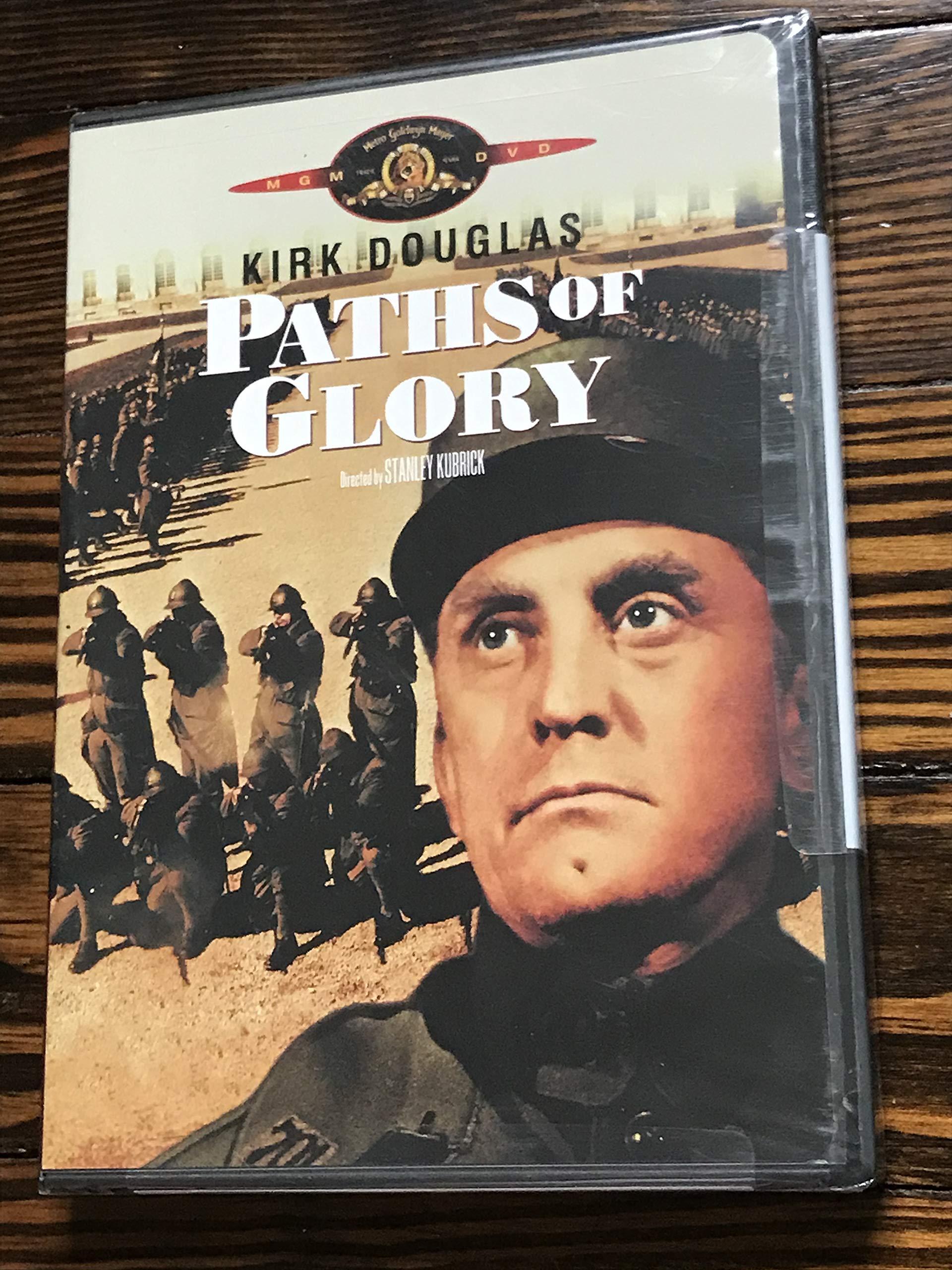
A World War I French colonel defends three soldiers picked to be shot for a general's blunder. Directed by Stanley Kubrick. Review: the greatest, most worthwhile double feature of movies ever - I just treated myself to watching, quite possibly, the greatest, most worthwhile double feature of movies ever: PATHS OF GLORY and Dr. Strangelove (Strangelove NOT on this disc) both directed by Stanley Kubrick. PATHS OF GLORY is agreed by many to be the greatest anti-war movie ever filmed. It looks like a documentary (especially the battlefield and stunning 'bunker' footage) while also acted with top-tier professionalism. PATHS OF GLORY is one of those rare, ahead of its time movies that is/was made so well and is so realized that (you) forget it was released in 1957. It just feels modern and improves upon seeing again. This film is so anti-war and so damaging to the hierarchy of the French military that they banned PATHS OF GLORY from their own viewing public for over a decade. The extras contain many interviews from the 2 minute audio by recluse Kubrick; to the British talk show half-an-hour interview with Kirk Douglass himself via 1979. He is a very proud nice guy. Kirk really is; adding some effective comments about being an artist such as "If you want to tell the truth ... write a novel ... if you want to lie ... write an autobiography ..." Laughs seem genuine from studio audience. There is also a well done essay booklet in this fine Criterion Collection of PATHS OF GLORY (again, Strangelove NOT included) Within this detailed booklet I learned the German girl who is forced to sing to the rowdy French soldiers (WW1) became Stanley Kubrick's wife (Christiane Kubrick also gives ‘extras’ interview). The song she sang in the pub that turned the rowdy soldiers into the solemn reminder that war is not where they want to be is "The Faithful Hussar", a Napoleonic-era song which states "Oh please mother bring a light/ My sweetheart is going to die." Amen French soldiers drink up and leave the poor German girl alone. This is truly classic Kubrick cinema and World War history - as well as movie history - at its best. If a fan of Kubrick you NEED to see this one too. Review: A German Song Solidifies a Thesis! - Oh the insanity of war! Paths of Glory exclaims and underlines that the settlement of differences by means of violent actions has nothing to do with glory. In this well done movie depicting the sad separation of the privileged and ruling class as opposed to the common slug barely making through the travails of life we see a sad symphony played out in all too real detail. The plot of the movie revolves around the depiction of the French Army fighting in the fields of Flanders stalemated in the trenches of the third year of the Great War. The main characters in this movie revolve around Colonel Dax (Kirk Douglas), General George Broulard (Adolphe Menjou) and General Mireau (George Macready.) At this time in the war each side was trying to gain any advantage possible to advance forward and break the interminable stalemate. With this in mind General Broulard approaches General Mireau and orders him to attack the well-fortified German position labeled the “Anthill.” Mireau selects his best regimental commander Colonel Dax to attack and overtake the “Anthill.” As Colonel Dax receives his orders he sends out a patrol to assess the situation and the next morning goes over the top in leading his men across no man’s land in the assault of the 701st Regiment on the “Anthill.” Subsequent withering indirect and direct fire completely disseminates the regiment and the retreat begins. The impossible cannot be done and the attack fails to capture the cherished objective. During the attack General Mireau witnesses the retreat and is angered by the defeat and immediately orders artillery to fire upon the retreating 701st Regiment. Mireau declares the retreating soldiers are cowards of which he has no use for. According to the General these men failed in their mission only because of cowardice. As a rear echelon General officer he has deemed that it was through cowardice that caused the failure to achieve defeating the Germans on the “Anthill.” Hence Mireau decides that this failure was not his fault in ordering this absurd operation and demands retribution in court-martialing random soldier to stand trial for cowardice. Upon this decision he orders Colonel Dax to select three men to face the court martial and subsequent death by a firing squad. Retribution will be taken on a select few as opposed to all who survived this unfortunate debacle. Suffice to say, Colonel Dax who in civilian life is a very successful lawyer takes up the defense in the already fixed court martial. Known to all the men are condemned to death in this rather disgusting display of hubris of the power elite. The basis of the thesis for all this is that all wars are controlled from those in power and the rules of these conflicts emanate from the top and those who are among the servitude must abide by the rules. The modus operandi applies to all participants of the game we call war. Such is the message of Paths of Glory. At the end of the movie came a very moving scene in which in a French Café attended by Dax’s men of the 701st Regiment finds a very young German fraulein brought forth to sing a song. Among the jeers of the men she still sings a very moving German song which quells the jeering and brings the soldiers to hum along to a very moving and passionate song which ends the movie. The significance of this touching scene is that in the end Germans and the French are indeed the same and that in this life war signifies the wants of the elite rulers and not that of the common person. Remember war is not glory, in fact if you look at it in very human terms, war is a crime!
| Contributor | Adolphe Menjou, Bert Freed, Calder Willingham, Christiane Kubrick, Emile Meyer, George Macready, Humphrey Cobb, Jerry Hausner, Jim Thompson, Joe Turkel, Kirk Douglas, Peter Capell, Ralph Meeker, Richard Anderson, Stanley Kubrick, Wayne Morris Contributor Adolphe Menjou, Bert Freed, Calder Willingham, Christiane Kubrick, Emile Meyer, George Macready, Humphrey Cobb, Jerry Hausner, Jim Thompson, Joe Turkel, Kirk Douglas, Peter Capell, Ralph Meeker, Richard Anderson, Stanley Kubrick, Wayne Morris See more |
| Customer Reviews | 4.8 out of 5 stars 1,973 Reviews |
| Format | Black & White, Closed-captioned, Dolby, NTSC |
| Genre | Drama |
| Language | English, French |
| Runtime | 1 hour and 27 minutes |
A**R
the greatest, most worthwhile double feature of movies ever
I just treated myself to watching, quite possibly, the greatest, most worthwhile double feature of movies ever: PATHS OF GLORY and Dr. Strangelove (Strangelove NOT on this disc) both directed by Stanley Kubrick. PATHS OF GLORY is agreed by many to be the greatest anti-war movie ever filmed. It looks like a documentary (especially the battlefield and stunning 'bunker' footage) while also acted with top-tier professionalism. PATHS OF GLORY is one of those rare, ahead of its time movies that is/was made so well and is so realized that (you) forget it was released in 1957. It just feels modern and improves upon seeing again. This film is so anti-war and so damaging to the hierarchy of the French military that they banned PATHS OF GLORY from their own viewing public for over a decade. The extras contain many interviews from the 2 minute audio by recluse Kubrick; to the British talk show half-an-hour interview with Kirk Douglass himself via 1979. He is a very proud nice guy. Kirk really is; adding some effective comments about being an artist such as "If you want to tell the truth ... write a novel ... if you want to lie ... write an autobiography ..." Laughs seem genuine from studio audience. There is also a well done essay booklet in this fine Criterion Collection of PATHS OF GLORY (again, Strangelove NOT included) Within this detailed booklet I learned the German girl who is forced to sing to the rowdy French soldiers (WW1) became Stanley Kubrick's wife (Christiane Kubrick also gives ‘extras’ interview). The song she sang in the pub that turned the rowdy soldiers into the solemn reminder that war is not where they want to be is "The Faithful Hussar", a Napoleonic-era song which states "Oh please mother bring a light/ My sweetheart is going to die." Amen French soldiers drink up and leave the poor German girl alone. This is truly classic Kubrick cinema and World War history - as well as movie history - at its best. If a fan of Kubrick you NEED to see this one too.
R**E
A German Song Solidifies a Thesis!
Oh the insanity of war! Paths of Glory exclaims and underlines that the settlement of differences by means of violent actions has nothing to do with glory. In this well done movie depicting the sad separation of the privileged and ruling class as opposed to the common slug barely making through the travails of life we see a sad symphony played out in all too real detail. The plot of the movie revolves around the depiction of the French Army fighting in the fields of Flanders stalemated in the trenches of the third year of the Great War. The main characters in this movie revolve around Colonel Dax (Kirk Douglas), General George Broulard (Adolphe Menjou) and General Mireau (George Macready.) At this time in the war each side was trying to gain any advantage possible to advance forward and break the interminable stalemate. With this in mind General Broulard approaches General Mireau and orders him to attack the well-fortified German position labeled the “Anthill.” Mireau selects his best regimental commander Colonel Dax to attack and overtake the “Anthill.” As Colonel Dax receives his orders he sends out a patrol to assess the situation and the next morning goes over the top in leading his men across no man’s land in the assault of the 701st Regiment on the “Anthill.” Subsequent withering indirect and direct fire completely disseminates the regiment and the retreat begins. The impossible cannot be done and the attack fails to capture the cherished objective. During the attack General Mireau witnesses the retreat and is angered by the defeat and immediately orders artillery to fire upon the retreating 701st Regiment. Mireau declares the retreating soldiers are cowards of which he has no use for. According to the General these men failed in their mission only because of cowardice. As a rear echelon General officer he has deemed that it was through cowardice that caused the failure to achieve defeating the Germans on the “Anthill.” Hence Mireau decides that this failure was not his fault in ordering this absurd operation and demands retribution in court-martialing random soldier to stand trial for cowardice. Upon this decision he orders Colonel Dax to select three men to face the court martial and subsequent death by a firing squad. Retribution will be taken on a select few as opposed to all who survived this unfortunate debacle. Suffice to say, Colonel Dax who in civilian life is a very successful lawyer takes up the defense in the already fixed court martial. Known to all the men are condemned to death in this rather disgusting display of hubris of the power elite. The basis of the thesis for all this is that all wars are controlled from those in power and the rules of these conflicts emanate from the top and those who are among the servitude must abide by the rules. The modus operandi applies to all participants of the game we call war. Such is the message of Paths of Glory. At the end of the movie came a very moving scene in which in a French Café attended by Dax’s men of the 701st Regiment finds a very young German fraulein brought forth to sing a song. Among the jeers of the men she still sings a very moving German song which quells the jeering and brings the soldiers to hum along to a very moving and passionate song which ends the movie. The significance of this touching scene is that in the end Germans and the French are indeed the same and that in this life war signifies the wants of the elite rulers and not that of the common person. Remember war is not glory, in fact if you look at it in very human terms, war is a crime!
J**N
A Glorious Film
I have seen The Longest Day and Saving Private Ryan. Paths of Glory surpasses both. Kirk Douglas at the top of his game. Not going to discuss any of the key details except to simply say a must see. A film for war veterans not afflicted with PTSD. The army in question is supposedly French but nobody has a French accent. Oh well, poetic license. The film covers WWI occupied France. War at its barest, its simplest, its reality. Makes me thankful I missed the Viet Nam war. Who is the true enemy? Who is the hero, the true patriot?
J**Y
A soldier's rights
I was extremely pleased to purchase this Criterion DVD copy of Stanley Kubrick's all-around best film, PATHS OF GLORY. The film is excellent, and I was surprised at how excellent this DVD is. For one thing, it's a restoration in widescreen. One major production company's DVD edition--at least, the one I know of--is full-screen, and the cover implies that the 1:33:1 aspect ratio is the original theatrical format. Once I found out that this was not true, and I discovered the Criterion disc, I bought it immediately. The restoration is visually clean. And the sound! The sound is amazingly clear, especially for a 1957 film. The movie is a powerful advocation of the rights of the individual in a military context. All of the performances in this important film are perfect. For me, the stand-outs are George Macready as General Mireau, always out-of-breath and anxious about promotion; Ralph Meeker as Corporal Paris, ready to face the reality of the court-martial's verdict but at the same time hoping for a chance for acquittal; and Wayne Morris as Lieutenant Roget, a self-made idiot without a clue as to the gravity of situations until he's face-to-face with them. This motion picture makes such a good case for the rights of the soldier that I wouldn't be surprised if it were shown as a training film today for junior officers of my country's army, even though the movie involves the French Army during World War I. The lesson such young men would learn from PATHS OF GLORY would be that the soldiers they lead into battle are not animals.
C**A
Classic Anti-War Movie
This is an absorbing anti-war movie about the French army on the Western Front in WWI. There are moments of complete brilliance. The shot of Kirk Douglas as the attacking French colonel walking the length of the trench before going "over the top" and the reactions of his regiment as he passes them is one of the best and most moving pieces of film making I've ever seen. The firing squad scene and the bar scene at the end of the movie are also simply perfect. Douglas is excellent in his role, as is the supporting cast. I deduct one star for the lack of subtlety in portraying the French generals. Yes, generals in WWI were out of touch and were even criminally negligent in their tactics. But Kubrick does not attempt to portray the generals' point of view as having any legitimacy. The film is shot in black & white, which captures the dirt and lack of romance of the battles fought at the time. I highly recommend this great film.
C**S
a visual anti-war parable
A film with a strong message requires a skillful presentation in order not to become overbearing. Paths of Glory, while having a strong anti-war theme, rises to the top due to the exceptional photography, editing, and straightforward narrative structure coupled with the tension that arises from social injustice and poor leadership. Kubrick treats the story as a parable, allow us to see a range of actions under a shared experience. We see front line solders at their best and worst and we also see the French officers under similar but a bit more sophisticated situations. Paths of Glory is probably based on an event in World War I during the French Nivelle Offensive whereby the men on the front lines were pushed to remain on the offensive and overtake points of no strategic worth while losing considerable lives. The offensive objective here is tellingly called "The Ant Hill". The men refused to attack but remained on the offensive in the trenches. The French officers fired thier artillery upon their own men. This incredible historic event lays the groundwork for this fictitious film. Wisely the film narrows down the number of characters to basic types and individual concerns and conflicts. Thus we have careerist incompetent leadership negligently wasting the lives of their men on poorly developed plans and objectives. The film is tragic in that after the men refused to attack, men were selected at random to be executed for cowardice and executed before the troops as examples and to encourage more enthusiasm in the future. Kirk Douglas plays the moral center for the film, playing Colonel Dax, a public prosecutor who joined the army. He defends the three men selected to represent the troops in a military judicial kangaroo court. Douglas is in top form and top shape. His performance is powerful and made more powerful by the subtle performances of his canny superior officers and the simple basic emotional responses of the men under his command. Kubrick's film-making is superb and the careful photography of interiors reveals his early mastery of this art form. Kubrick recognized the ability of the context of action to cradle the narrative and give added dimension. Thus his shots of the trenches with long twisting tracking shots give one of the best impressions of World War I front line. The scenes of the court martial are high drama, revealing a stage with all the high drama of Greek tragedy. The execution scene is perfectly developed, revealing how the symetry of the troops in a geometric courtyard contrasts against the injustice that is about to occur. The scene of a captured German girl singing in a cafe is a bit overplayed but makes its point about the amazing manner in which men can be swayed from wrong to right and back again for in the end we are vastly limited.
J**R
Review
Classic WWI movie. Looking forward to watching it on Blu-ray.
Q**S
Very good
Great product
Trustpilot
2 days ago
2 months ago