
DOWNLOAD THE APP


Customer Services
Copyright © 2025 Desertcart Holdings Limited
DOWNLOAD THE APP


🔆 Charge smarter, live brighter — the future of solar control is here!
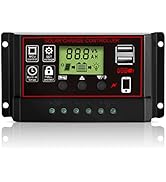
The WERCHTAY 60A MPPT Solar Charge Controller is a versatile, high-capacity regulator designed for 12V and 24V solar systems. Featuring advanced MPPT technology, it enhances solar energy conversion efficiency by up to 30%. Its dual USB ports and an intuitive LCD display provide real-time system monitoring and easy configuration. Built with industrial-grade components and multiple intelligent protections, it ensures reliable, safe operation for home, commercial, and industrial solar setups. Backed by responsive customer service, it’s a cost-effective solution for maximizing your solar investment.

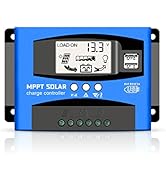
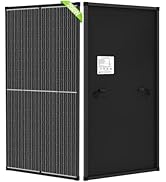

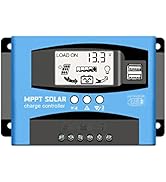

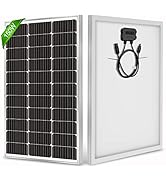


| Best Sellers Rank | #319,221 in Patio, Lawn & Garden ( See Top 100 in Patio, Lawn & Garden ) #392 in Renewable Energy Controllers |
| Brand | WERCHTAY |
| Color | Blue |
| Customer Reviews | 3.9 out of 5 stars 369 Reviews |
| Item Weight | 9.76 ounces |
| Material | Plastic |
| Product Dimensions | 3.62"L x 1.77"W x 6.69"H |
| Voltage | 24 Volts |
A**R
Better then the Renogy 30 Amp Wanderer Charge Controller But…..
In this review I will be comparing the “Best Seller” Renogy 30 Amp PWM Wanderer Charge Controller to the “Amazon Choice” Werchtay 60 amp MPPT charge controller. I have purchased both. I was dissatisfied with Renogy and hoped Werchtay would be a better option. I believe it is. COMPARISON BASIS Keep in mind that both of these charge controllers are inexpensive, mostly plastic, and made in China. Renogy is an American Owned Company who designs their own charge controllers and Werchtay is a Chinese owned company that distributes charge controllers that are also sold by other companies. Werchtay is open about it’s Chinese mfg. where Renogy provides no information about where it's product is made. I personally don’t think the nationality of the manufacturer makes any difference in the product; it is the management controls and engineering that determines product performance. I believe both these controllers are targeted to people with 100 to 400 watt systems and it isn’t fair to compare them to controllers used for full scale solar conversions that easily cost over 5X more. RELIABILITY Even though my Renogy failed within one month, I would say that Renogy is more reliable based on frequency of 1 star reviews for product failure. Renogy has a 4.4 overall rating and Werchtay has a 4.0 overall rating. CUSTOMER SERVICE Renogy customer service is HORRIBLE. This is based on my own experience, the one star ratings on Amazon, and comments made about the company on other solar power web sites. The Renogy controller has a 3.4 star Technical Support rating on Amazon compared to the Werchtay rating of 4.4 stars. When I read a review where Werchtay proactively replaced a charge controller for a customer, I knew that they would be my next choice. With Renogy, if your product goes bad you are basically out of luck. Renogy’s reliability and “Best Seller” designation allows them to treat unsatisfied customers badly and get away with it. At least for now. My advice to Werchtay is to implement their own quality check before sending out these generic controllers and to advertise a free, no questions asked, 3 month replacement policy. Raise your price a little if you need to, but my understanding is that the profit margins on these generic devices are huge. SYSTEM MONITORING AND CONTROL The Renogy has no quantitative system monitoring parameters or battery adjustment controls (other than battery type), however, a Bluetooth connected BT-1 module can be connected to provide this capability. The cost of the Renogy charge controller is $32 and the Module is $30. This total cost of $62 needs to be compared against the Werchtay cost of $27 which does provide multiple quantitative monitoring parameters with the choice of which will be on the main display. The Werchtay also allows adjustment of battery float, reconnect, and stop discharge voltage. TECHNOLOGY There is no doubt that the advertised 60 amp MPPT technology (Werchtay) is superior to the 30 AMP PWM technology (Renogy). Theoretically the Werchtay will capture more energy from the sun and be able to handle higher wattage than the Renogy. I personally would seriously doubt that the Werchtay device is really MPPT for two reasons. 1) Most proven MPPT devices are well over $100 2) I saw this generic charge controller being taken apart on Youtube and they found no induction coil needed for a MPPT controller. That being said, I am not personally in a position to assess to verify or refute the MPPT claim for the Werchtay device. My advice to Werchtay would be to clear up the confusion and if it is a PWM controller, label it as such. For a 100 to 400 watt system, I don’t think that saying this is a PWM controller (like the Renogy) would matter that much for your target market, People thinking you are liars will kill your reputation, as I believe Renogy poor customer service is killing their reputation. FEATURES The Werchtay includes 2 USB ports, an easy to read display window with 8 screens, and the ability to attach a direct current load to the controller. The Renogy has three LED lights indicating panel status, battery status and battery type. DOCUMENTATION Because there is no adjustment other than setting battery type, Renogy documentation is fine. The Werchtay documentation, which provides more system status information and has more adjustments is just marginally adequate. That is being charitable. The information needed is all there, but it is hard to read and you need some background knowledge to use it. An additional concern for the Werchtay is that the manual covers controllers with Bluetooth capability. This controller doesn’t and Werchtay doesn’t claim it does, but the documentation indicates it does. My advice to Werchtay is to upgrade their instructions (either themselves or ask the manufacturer). Specifically, Werchtay needs to increase the type size and clarify Bluetooth capability (or lack of Bluetooth). SUMMARY There appears to be good reasons why the Werchtay is the “Amazon Choice” for Charge Controller and not the Renogy “Best Selling” Charge Controller. I am giving this product 5 stars in comparison to the Renogy for the following reasons 1) I have monitored how the Werchtay controller has worked for 3 days and it appears I got one that works. It provides the amps and volts I would expect during the day based on conditions, and doesn’t drain my battery at night. If the charger didn’t work (or fails in the near future), I feel confident Werchtay will give me a new one free of charge. 2). It is an inexpensive product with a lot of features, if you can figure them out from documentation that needs upgrading. Werchtay will lose future business If they don’t upgrade their documentation, minimize the number of faulty chargers being sent to customers, and clarify their MPPT / Blue tooth capability (or lack of). If they do address these items, they have a great chance to be Amazon’s “Best Seller” AND Amazon’s Choice for Charge controllers for this target market. If my future experience with the Werchtay charge controller drastically changes in the future, I will upgrade this review. REVIEW UPDATE ============= I don’t usually update a review this close to the first review, but I either missed it, or Werchtay has recently made HUGE improvements to their Amazon Product Page. I would now give this product 6 stars for the following reasons: 1) Documentation: The “marginally adequate” product instructions included with the product are now included on their Amazon product page in an easy to read and easy to understand manner. 2) MPPT Capability: The Amazon product page refers to this as a “new” type of MPPT technology (One that doesn’t need an Induction coil?) that provides 10% to 30% improved conversion efficiency over PWM. Werchtay asks for people to “use and compare” their product against this claim. I am now willing to give Werchtay the benefit of the doubt on this claim until someone smarter than me can provide evidence to refute it. The one star reviews for Werchtay are all due to getting a defective product. Perfectly reasonable response. Until (if ever) Werchtay improves their outgoing quality, give them a chance to replace the unit that didn’t work. If I start to see a lot of one star reviews because Werchtay won’t honor their warranty, this would change my rating to one star. Unfortunately, Renogy is not the only Solar component seller with poor customer service. The one star reviews of most solar companies are filled with complaints because the company fails to honor their warranty.
C**.
Get this with an open mind - it works for my 30amp setup just fine.
This is a new style of MPPT controller, not PWM or traditional MPPT as it states in the online and included manual. I can and does manage the inrush and output values effectively, and is better than PWM all the way around. If the readings from VOM are not as expected, that may be due to the way the unit works, remember it is a new way of doing MPPT style operations, so do not expect it to work like either PWM or MPPT.
T**O
60A Controller Severely Overheats at 30A Input.
First, this product is titled: 60A MPPT Solar Charge Controller 12v/24v. This leads you to assume it can handle a continuous charging current of 60 A. I wanted this as a backup to my ZAMP ZS-60A The good: controller worked and sent current to the 12 V battery. The bad: 1. The solar panels were delivering 30 A to the controller. Controller said current to the battery was 16-17 A. In fact, the battery was receiving only 12 A. 2. Where was the current going? Into the controller generating lots of heat!!! Within 5 min the back plate was 50 C, in 10 min it was 60 C and rising. After 15 min the FETS were only 70 C but temp at the solar input lead was 95 C. The hottest traces on the board were 115 C. I shut down before a fire started. I felt that this controller was dangerous to operate after only 15 min. I can't imagine running this controller for any extended period of time. Also, the manual (which should come with a magnifying glass) talks about a Bluetooth control. It is very confusing. I didn't trust it enough to try it. It would be very helpful if they posted the manual on the Amazon page. I'm still looking for a temporary backup for the ZS-60A but I think I am done with the cheap controllers. They can control the voltage and current but just can't manage the power without overheating.
K**R
Good experience with seller
UPDATE: (see original review below) Ok, the seller did not ask me to do a second review but I had a good experience with them and thought it fair to do so. From my original review below you see where I said the item is easy to set up but unfortunately it didn't work. After seeing my review the seller reached out and agreed to send me another charge controller free of cost. It arrived, we set it up and it is working as described. The first was probably just faulty. Give it a try if you want an affordable charge controller. ORIGINAL REVIEW: Pro: the set up is easy. Con: the item might be faulty because it did not work. It would not read the solar panels and charge my batteries. It kept showing us the moon symbol instead of the solar panel symbol even after we did a reset. I'm confident that the wiring and set up was done right because we already have a charge controller set up but it was old so we wanted a new one. It's disappointing because returning goods from Jamaica is such a hassle. Should you buy this? It's hard to say because it could just be a faulty item but I'd be careful. If you've used a charge controller before then just find that brand and buy that one.
J**S
It matches the description.
So far it has worked very well,
P**E
SMOKER
For 9 months the 60 amp unit charged the 24 volt system ok at 15 or 18 amps and a very small load. Recently I added a solar panel to bring my amps up to 20 or 24 thats when I noticed the unit was heating up alot above 20 amps below 20 amps it run normal with no heat then as summer came closer my amp at high noon hits 24 amps and I see and smell burning thermal grease .Also the solar panels where outright short circuited to the battery potentialy destroying everything atached totally no safety so I shut unit down and remove metal plate on back and resting on the other side of the plate are 4 power transisters one was burnt and the circuit board too .So the transistor most likely had thermal runaway at 22 amps. also there is no thermal runaway if the battery is charged and the charger is duty cycling so yea it could handle alot more amps like that .however my heavily discharged batteries prevented the charger from cycling thus litterally short cuirciting 24 amps across this lowly power transister. I definately would not trust this unit at all and only my constant surveilance of the unit prevented catostrophic damage to equipment and building. I will buid an fully automatic electronic surveilance system in the future to interrupt the unit upon failure I got new one for maybe 10 bucks and measure voltage drop across the unit so at 17.5 amps the voltage drop inside the units power switch is .5 V accross the ground and .1 across the + side kanow .5 volt times 17.5 amps=power loss in watts of the internal switching logic about 8 watts is being burnt up inside unit generating heat and unit is warm to the touch but not point of failure *************************** 9/11/2025***************************** added new unit to make my batteries charger 3 phased new units power transister have much less resistance this make for less power loss cooler unit and longer charge of collosill leaded acitic battery that eat as much power as you can give it also lowered amperage through each mmpt charge controller to 10 amp now units work like symphony.And battery happily run stove ,air conditioner,fridge,50 inch tv air filter all at same time also george foreman grill make me snacks all day long thats cloudy day on sunny day i run 600 watt speaker to make tv sound crispy. new unit not smoking and run cool thank you
P**O
A better option than cheaper ones.
Better quality than the cheaper one I tried first. Recommend. I have just a small 2 100w panel system connected to a 12v battery and inverter that I use to keep my refrigerator running during power outages.
F**O
Works good with one caveat
This product works well and is well documented and fairly easy to use. However, keep in mind that this does not include a low-voltage cut off so you wanna buy a separate board… Which generally cost about 10 or $15 to handle the low-voltage cut off so that you don’t overuse your batteries… This product basically make sure that you don’t overcharge your batteries… But it doesn’t prevent you from over discharging them… So you need a low-voltage cut off board between your batteries and your inverter to ensure that your batteries never get too low… There are many available and they are not expensive… But this product works exceptionally well for what it does.
Trustpilot
1 month ago
1 month ago