
DOWNLOAD THE APP


Customer Services
Copyright © 2025 Desertcart Holdings Limited
DOWNLOAD THE APP
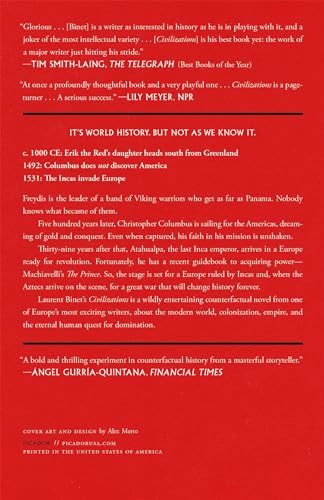
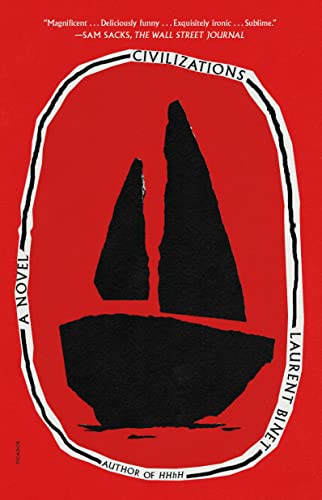
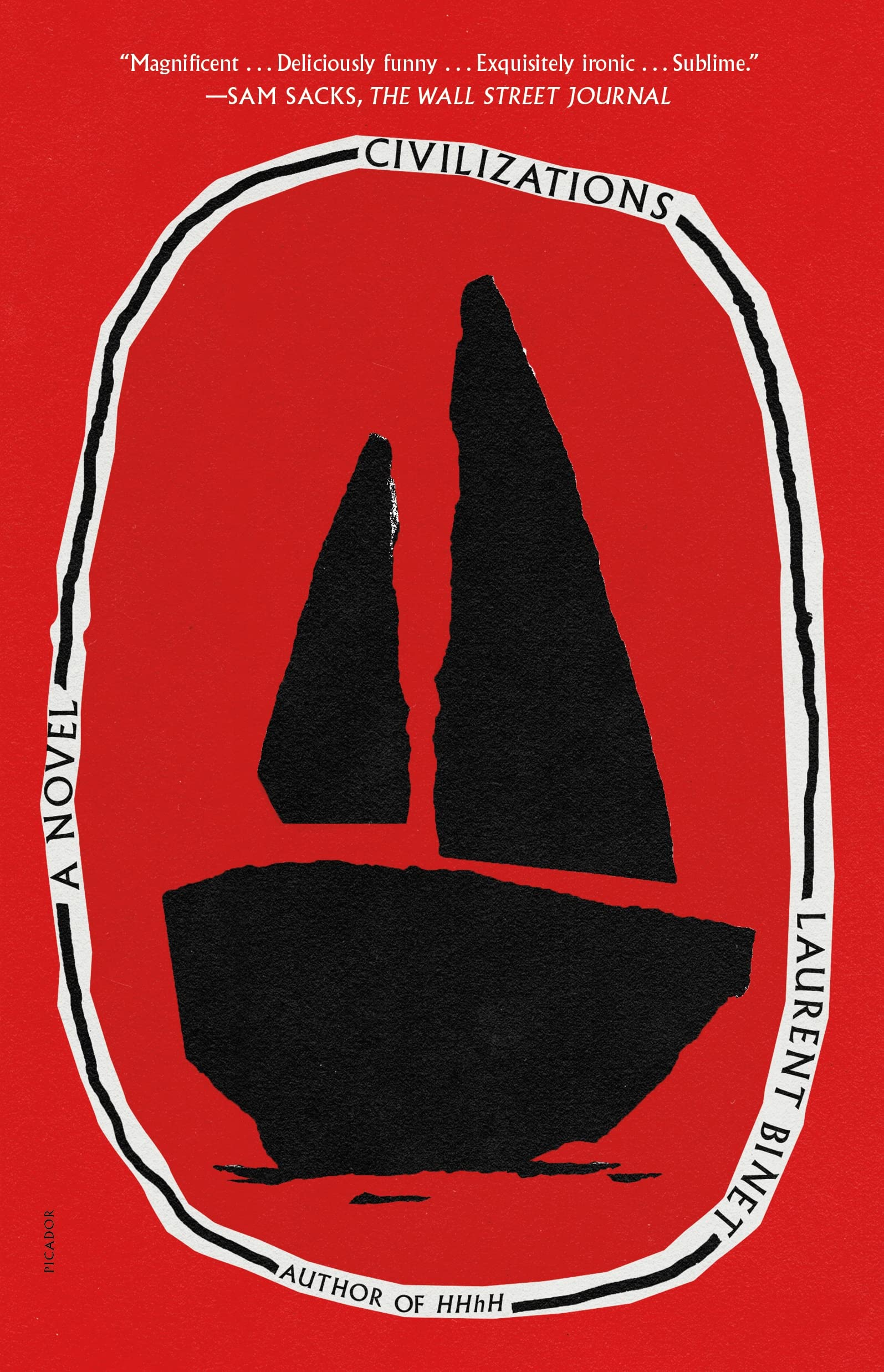
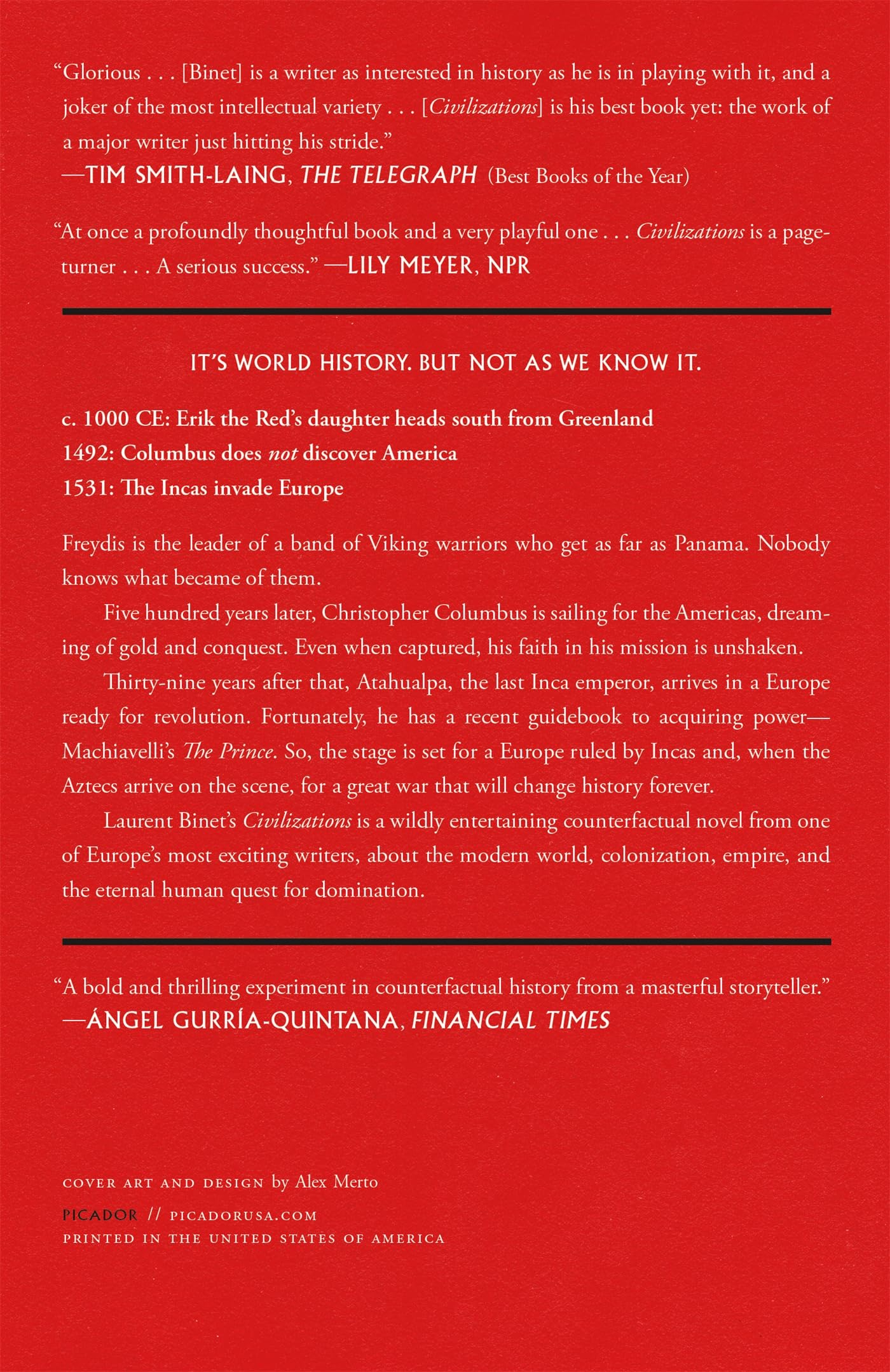
desertcart.com: Civilizations: A Novel: 9781250858870: Binet, Laurent, Taylor, Sam: Books Review: Entertaining, Clever and Subtle - [Attempting to avoid spoilers] Counterfactual history usually goes like this...What if the Nazis had won World War II? What if the South had won the US Civil War? Etc. In other words, what if one big event had been different? And what would the world look like. A lot of these sorts of counterfactuals are well done, especially Philip K Dick's Man in the High Castle. However, they tend to keep a tight focus around the implications of the one major difference. Binet not so much. Inspired by the Butterfly Effect and an appreciation for Jared Diamond, he takes a different approach. The initial changes to history are small and relatively subtle...some readers might not even notice a few of them. By the time the small changes accumulate to result in a "major" shift, almost a 1,000 years have gone by. And from that point, everything is different, but also similar, e.g. [spoiler] a pyramid ends up in the courtyard of the Louvre in both realities. A lot of other events in this new reality echo events in our own and twist them slightly, usually in a way that is thought provoking and satirical, sometimes even laugh out loud funny. By the time it ends, Binet has built a rich history of a new place, a place that I was excited to visit, disappointed to have to leave, and desirous for more of. A sequel is probably unlikely and unnecessary, but I would read it immediately just the same. Review: Clever book, based on an intriguing idea. - Clever book, based on an intriguing idea


| Best Sellers Rank | #252,561 in Books ( See Top 100 in Books ) #421 in Biographical Historical Fiction #760 in Alternate History Science Fiction (Books) #9,100 in Literary Fiction (Books) |
| Customer Reviews | 4.1 4.1 out of 5 stars (607) |
| Dimensions | 5.4 x 0.85 x 8.25 inches |
| Edition | Reprint |
| ISBN-10 | 1250858879 |
| ISBN-13 | 978-1250858870 |
| Item Weight | 9.8 ounces |
| Language | English |
| Print length | 320 pages |
| Publication date | September 13, 2022 |
| Publisher | Picador |
D**Y
Entertaining, Clever and Subtle
[Attempting to avoid spoilers] Counterfactual history usually goes like this...What if the Nazis had won World War II? What if the South had won the US Civil War? Etc. In other words, what if one big event had been different? And what would the world look like. A lot of these sorts of counterfactuals are well done, especially Philip K Dick's Man in the High Castle. However, they tend to keep a tight focus around the implications of the one major difference. Binet not so much. Inspired by the Butterfly Effect and an appreciation for Jared Diamond, he takes a different approach. The initial changes to history are small and relatively subtle...some readers might not even notice a few of them. By the time the small changes accumulate to result in a "major" shift, almost a 1,000 years have gone by. And from that point, everything is different, but also similar, e.g. [spoiler] a pyramid ends up in the courtyard of the Louvre in both realities. A lot of other events in this new reality echo events in our own and twist them slightly, usually in a way that is thought provoking and satirical, sometimes even laugh out loud funny. By the time it ends, Binet has built a rich history of a new place, a place that I was excited to visit, disappointed to have to leave, and desirous for more of. A sequel is probably unlikely and unnecessary, but I would read it immediately just the same.
A**X
Clever book, based on an intriguing idea.
Clever book, based on an intriguing idea
R**S
Not What I Expected
I had entirely different expectations regarding this book. Apparently, I misinterpreted its review wherever I read it. My belief was that there was a lesson to be learned here by the European powers in their aim to colonize the New World. However, never did I think it was going to be accomplished by the means the author details. It is quite an involved and detailed tale. There is no lack of astonishment that takes place here. I don't want to reveal any spoilers but get set for the "willing suspension of disbelief" on a vast scale. Not quite the adventure I had read into the review but an adventure nonetheless.
M**A
Intriguing
I enjoyed it, but it ends abruptly, and rather oddly, but the concept was intriguing...just left me sort of...."What?"
D**O
The New World Conquers the Old
Alternate histories suppose that if a few things went differently we would find ourselves living in a changed world, and this seems to forever fascinate many of us. What would have happened if the Vikings had continued past Greenland, past the present U.S., and into Cuba and South America? In Laurent Binet’s telling, they would have exchanged ideas and the tech of the day with the Inca’s, putting them in a better position to fend off Columbus and thus forestall the Spanish invasion and destruction of the Inca civilization. Then, due to internal conflicts with his brother, the last Sapa (Emperor) Inca Atahualpa, with no Spanish to contend with, would have fled with his entourage across the ocean to Lisbon, landing just after the 1531 earthquake, finding there not only Portugal but a continent in conflict and turmoil, and ripe for a revolution. In the novel, Atahualpa provides that change in culture, social class, politics, and religion. In the end, you’re left wondering how the Inca’s changes would have shaped history up to the present. (Maybe Binet will indulge us curious readers someday.) Atahualpa proves himself a clever fellow. He recognizes not only the need for but the advantages of winning over the oppressed people with egalitarian, some might call them socialist, reforms. Yet, he doesn’t go so far as to alienate the old ruling class, giving them their status. He gains other allegiances by eliminating religious persecution of Jews and Islamists, allowing all to believe as they wish, while also propagating his own religion of the Sun god. He and his Inca comrades amusingly puzzle over some core Catholic and Protestant beliefs, mysteries that the faithful accept fervently but which when observed cooly from the distance of another culture appear as bizarre as cutting out a heart in the Inca tradition. As ideal as it might sound, his new world is anything but, packed as it is with treachery and war between the New World and the Old, and the New and the New with the arrival of the Aztecs, who form their own Old World alliances. Though Civilizations is relatively short for a novel covering so much territory, it could take diligent readers a while to work through it. That is, if they ardently look up the vast parade of historical figures, political, religious, and artistic, who gambol from page to page. Some of the major ones live different destinies in the new version of the Old World, as the final section of the novel richly illustrates. An enjoyable adventure in imagination that really does deserve a sequel set closer to modern times, just because readers will wonder what our own times would look like if Erik the Red’s daughter took that long voyage that opens the novel.
W**L
A Genuine and Thoughtful Delight
I’m not usually one for historical fiction, but Laurent Binet’s Civilizations easily takes the cake as my favorite. His brilliant use of tone and meter in delivering a range of stories where the worlds collide captures the essence of the rich cultures he focuses on. The Vikings, the Inca, and a certain Spanish author form the backbone of a new history for Europe and the Americas, no less fraught but certainly no worse off. Imagining meetings between grand figures like Atahualpa and Charles the Fifth or Martin Luther are amazing tapestries high roughing how interconnected we all truly are. I loved this novel and I hope for more in the same vein. If you like history with a twist, this is the book for you!
O**R
A wonderful, funny read, retelling“a what if” the Incas had actually invaded and colonised Europe instead of the European conquest of the New World. And what a much nicer Europe it would have been! It is hard to believe the whole thing is fiction, as it reads ( an easy read where you chuckle a lot) as a proper history book, complete with primary sources, ie letters from Christopher Columbus, correspondence between Erasmus and Cardinal Worley and other famous characters from European history. Highly recommended to history buffs( remember, it is fiction,) and to those who like a satirical look at our modern society as well. Haven’t enjoyed and laughed so much in a long time.
G**B
Laurent Binet’s ”Civilisations“ belongs to that kind of inspiring (also, unfortunately, often ridiculed) books that deal with the question of what might have been the consequences if historic events had happened differently. Of course, one might ask: why bother since the historic events dealt with cannot be changed anymore. But then, again, the what if-questions get their particular importance from the fact that they underline the implications of the decisions actually taken and the events that they led to. Binot succeeds brilliantly with his attempt when he has Columbus sail to and discover America, only to die there. Following the unhappy trail of Columbus’s adventures in the new world, the author then has the indigenous population (under the leadership of the Inca Athahualpa) embark on a tour of discovery and eventually conquest of Europe – using as their point of departure the city of Lisbon in Portugal. The events lead us through the following decades of 16th-century European history, addressing all the important political and religious conflicts that characterized that century. Even considering the occasional inconsistencies that a counterfactual history of Europa must almost of necessity contain, Laurent Binet shows us convincingly that things might have happened differently if certain decisions had not been taken. A caveat: Reading the book is a tour de force covering the events of the Europe of that tumultuous century. The reader should be familiar with all major (and a lot of minor) characters and events to fully appreciate the book. Just two examples of what the reader has to deal with: Athahualpa: ”The Empire is worth a Mass.” (ch. 57) – a reference to the Henry IV’s alleged statement “Paris is well worth a mass.”; or the legal principle “cuius regio, eius religio” indirectly referred to in ch. 60 “…to each region, its religion.”. Still, a good read.
D**Y
Entregue em boa forma no tempo. Obrigado
K**.
Fantastic book. Well researched, skillfully written, engaging, funny and totally believable alternative history romp.
T**S
Loved the story and the interesting way an alternative history has been shaped in the narrative.
Trustpilot
2 months ago
5 days ago