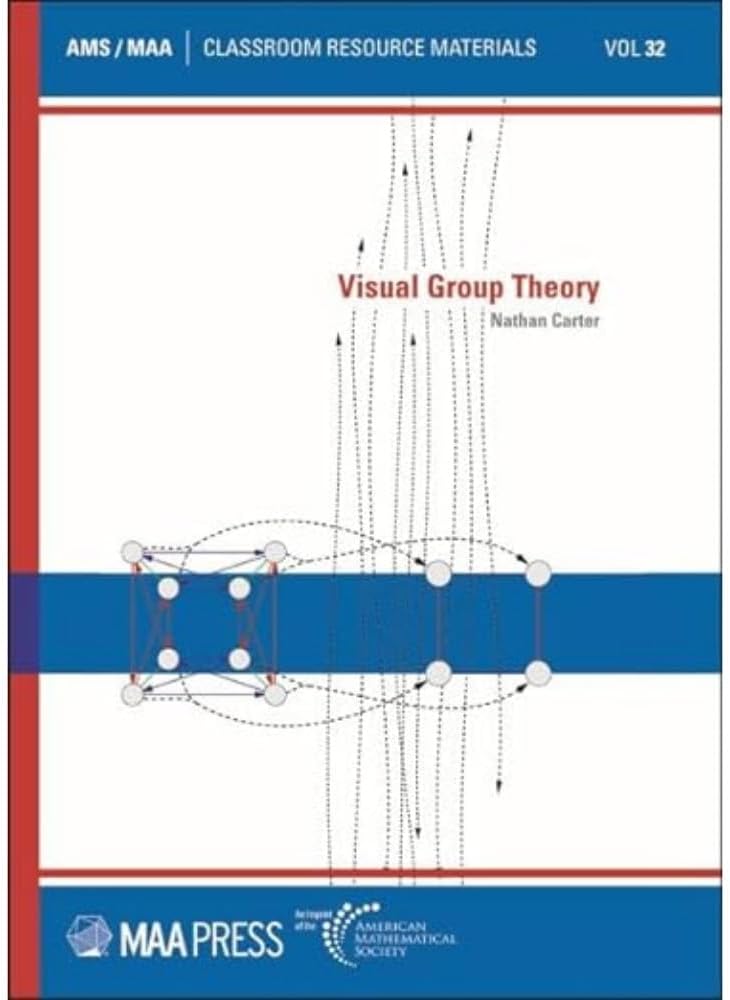
Visual Group Theory, Volume 32 (Classroom Resource Materials)
Product ID: 395297482
Desertcart purchases this item on your behalf and handles shipping, customs, and support to Indonesia.
Recipient of the Mathematical Association of America's Beckenbach Book Prize in 2012! Group theory is the branch of mathematics that studies symmetry, found in crystals, art, architecture, music and many other contexts, but its beauty is lost on students when it is taught in a technical style that is difficult to understand. Visual Group Theory assumes only a high school mathematics background and covers a typical undergraduate course in group theory from a thoroughly visual perspective. The more than 300 illustrations in Visual Group Theory bring groups, subgroups, homomorphisms, products, and quotients into clear view. Every topic and theorem is accompanied with a visual demonstration of its meaning and import, from the basics of groups and subgroups through advanced structural concepts such as semidirect products and Sylow theory. Review: Very nice introduction to group theory- helps build the readers intuition - Really nice introduction to groups and their applications in abstract algebra. Abstract algebra or analysis are usually a student's first introduction to having to write proofs and higher mathematics. They are typically very challenging as it requires training under a new regime, this book makes the transition relatively easy, and illustrates an often challenging subject with much ease. The book covers most material in a group theory course and ends with an overview of Galois Theory. It is accessible, digestible and illuminating look into abstract algebra for the beginner, though parts of it can be considered useful for those already familiar. The book is split into 10 chapters starting with bringing up the concept of a group in the context of simple games with strict rules and reversible moves. From there the author highlights how such simple games constitute a group and how each of the moves is a group action and develops the idea of a group from simple intuitive phenomenon. The author then moves into techniques of visualization and introduces Cayley diagrams, he does it in simple forms that illustrate the essential ideas clearly to the reader. The approach of the author focuses at first on elements of the group representing actions rather than elements of a set, but explains the natural correspondence between the ideas. The author then gets into where groups come up and how they can be seen everywhere. The focus on symmetry properties is pronounced as finite groups or discrete groups representing symmetries have highly tangible visual representations in Cayley diagram form. The author then highlights the algebraic properties of groups and their consequences when looked at in multiplication table form. By clever use of coloring one can see how patterns can be found in groups via looking at the multiplication table. Such techniques are novel and give a quick deeper appreciation of the properties of a group. Such multiplication table graphics lead to a quicker understanding of things like subgroups and quotient groups. The author moves onto characterizing finite groups and effectively communicate properties of symmetric and alternating groups and present cayley diagrams in A5 which set the stage for Galois theory. The author tackles typical elementary topics like subgroups and cosets and illustrates key results like Lagrange's Theorem. The proofs are not terse, to some extent they are too conversational rather than straight to the point but for the uninitiated it makes the text very approachable. The author gets into other core topics like products and quotient groups and highlights the importance of normal subgroups for forming quotients. These ideas fall naturally into explaining homomorphisms, a central concept of group theory. The author then tackles some of the main undergraduate results of finite group theory, namely Sylow Theory. The author moves from Lagrange's theorem to Cauchy's theorem and then finally to Sylow's theorems. The author then spends a chapter on Galois theory which is light but illustrates the key idea of the Galois group of a polynomial. In particular the author weaves back in that A5 doesn't have a normal subgroup and so the quintic won't have a solution by radicals. Though this introduction to Galois theory is intuitive it does not cover the topic that thoroughly and leaves out material on symmetric polynomials for example. Really nice relatively light introduction to abstract algebra. This isn't a great textbook as it misses a lot of key topics like Rings and Fields, but overall if one is looking for a different approach to algebra or some relatively light math reading, this is a really nice book which builds good intuiting. There are other undergraduate books which are much more complete but the novelty of the approach makes this a worthwhile addition to one's library. Review: A Method that Worked for me. - I've had lots of math but group theory is a bit different. It uses some of the same terms but their meaning can differ and some are completely different. When I got this book, it was an attempt to understand the use of group theory in particle physics. Upon studying the subject, I decided that group theory needed to be studied as a stand-alone subject and then after that, see about how it applies. Nathan Carter's approach to group theory using visual demonstrations as he goes along and adding in the more traditional symbolic or as it is called algebraic method worked to give me a way into understanding this subject. This approach was diminished as I got to the last part of the book. The subjects became more complex so didn't lend themselves as much to a visual approach but not entirely. All-in-all the only negative for this book is that answers needed to be provided for all the exercises. And not just answers, how the problems were worked would greatly help. I tried to work them but not knowing if I got them correct was less than helpful. YouTube has a video series that parallels this book presented by Professor Matthew Macauley. His course varies a bit but they complement each other quite well. I'm far from an expert on the subject now, but I can at least understand a significant portion of its use. It has served well as a great starting point.
| Best Sellers Rank | #198,165 in Books ( See Top 100 in Books ) #16 in Algebraic Geometry (Books) #64 in Geometry #269 in Algebra & Trigonometry |
| Customer Reviews | 4.9 out of 5 stars 43 Reviews |
A**N
Very nice introduction to group theory- helps build the readers intuition
Really nice introduction to groups and their applications in abstract algebra. Abstract algebra or analysis are usually a student's first introduction to having to write proofs and higher mathematics. They are typically very challenging as it requires training under a new regime, this book makes the transition relatively easy, and illustrates an often challenging subject with much ease. The book covers most material in a group theory course and ends with an overview of Galois Theory. It is accessible, digestible and illuminating look into abstract algebra for the beginner, though parts of it can be considered useful for those already familiar. The book is split into 10 chapters starting with bringing up the concept of a group in the context of simple games with strict rules and reversible moves. From there the author highlights how such simple games constitute a group and how each of the moves is a group action and develops the idea of a group from simple intuitive phenomenon. The author then moves into techniques of visualization and introduces Cayley diagrams, he does it in simple forms that illustrate the essential ideas clearly to the reader. The approach of the author focuses at first on elements of the group representing actions rather than elements of a set, but explains the natural correspondence between the ideas. The author then gets into where groups come up and how they can be seen everywhere. The focus on symmetry properties is pronounced as finite groups or discrete groups representing symmetries have highly tangible visual representations in Cayley diagram form. The author then highlights the algebraic properties of groups and their consequences when looked at in multiplication table form. By clever use of coloring one can see how patterns can be found in groups via looking at the multiplication table. Such techniques are novel and give a quick deeper appreciation of the properties of a group. Such multiplication table graphics lead to a quicker understanding of things like subgroups and quotient groups. The author moves onto characterizing finite groups and effectively communicate properties of symmetric and alternating groups and present cayley diagrams in A5 which set the stage for Galois theory. The author tackles typical elementary topics like subgroups and cosets and illustrates key results like Lagrange's Theorem. The proofs are not terse, to some extent they are too conversational rather than straight to the point but for the uninitiated it makes the text very approachable. The author gets into other core topics like products and quotient groups and highlights the importance of normal subgroups for forming quotients. These ideas fall naturally into explaining homomorphisms, a central concept of group theory. The author then tackles some of the main undergraduate results of finite group theory, namely Sylow Theory. The author moves from Lagrange's theorem to Cauchy's theorem and then finally to Sylow's theorems. The author then spends a chapter on Galois theory which is light but illustrates the key idea of the Galois group of a polynomial. In particular the author weaves back in that A5 doesn't have a normal subgroup and so the quintic won't have a solution by radicals. Though this introduction to Galois theory is intuitive it does not cover the topic that thoroughly and leaves out material on symmetric polynomials for example. Really nice relatively light introduction to abstract algebra. This isn't a great textbook as it misses a lot of key topics like Rings and Fields, but overall if one is looking for a different approach to algebra or some relatively light math reading, this is a really nice book which builds good intuiting. There are other undergraduate books which are much more complete but the novelty of the approach makes this a worthwhile addition to one's library.
R**E
A Method that Worked for me.
I've had lots of math but group theory is a bit different. It uses some of the same terms but their meaning can differ and some are completely different. When I got this book, it was an attempt to understand the use of group theory in particle physics. Upon studying the subject, I decided that group theory needed to be studied as a stand-alone subject and then after that, see about how it applies. Nathan Carter's approach to group theory using visual demonstrations as he goes along and adding in the more traditional symbolic or as it is called algebraic method worked to give me a way into understanding this subject. This approach was diminished as I got to the last part of the book. The subjects became more complex so didn't lend themselves as much to a visual approach but not entirely. All-in-all the only negative for this book is that answers needed to be provided for all the exercises. And not just answers, how the problems were worked would greatly help. I tried to work them but not knowing if I got them correct was less than helpful. YouTube has a video series that parallels this book presented by Professor Matthew Macauley. His course varies a bit but they complement each other quite well. I'm far from an expert on the subject now, but I can at least understand a significant portion of its use. It has served well as a great starting point.
A**W
Great so far, through ~5/6 chapters
I was a physics B.S. who is now pursuing a Ph.D. in applied physics. Was very intimidated by the very math-y and formal books on group theory. Have been working through all the problems through the first 5/6 chapters so far, the ones whose answers are in the back of the book. Already feel much more confident about the fundamentals of group theory. The referenced software the author created is also very helpful and creative. Plan to continue to work problems all the way to the end, after which I'm confident I'll feel like I've got a solid grasp on group theory.
J**O
Great Intro to Group Theory
I am a self study student of mathematics having acquired a taste for it later in life. I only had 1st year calculus and linear algebra in university nearly 20 years ago. This book is a very readable introduction to group theory. I suppose it lacks some of the rigor a truly dedicated mathematician might require, but I have really been enjoying teaching myself group theory from this book. There are lots of examples to think about and many problems to work through. Very readable.
M**M
My favorite abstract math book
There’s a mistaken assumption that algebraic proofs are more rigorous than visual ones. Just read Elements of Euclid by Byrne to convince yourself otherwise in the simple case of Euclidean Geometry. That said the Visual approach also applies to much more complicated mathematical structures and Visual Group Theory will give you beautiful diagrams which you can also play around with online.
A**R
A great read for the mathematics hobbiest
This is a great book for anyone interested in mathematics. I bought it just to read after reading about it in another text but find myself returning to it again and again to sharpen my understanding with the examples.
L**P
Great for develiping intuition and even for self-learning
An outstanding introduction to the theory of groups. Great for develiping intuition and even for self-learning. An enjoyable book overall, very good editing with a nice visual appeal onevery page.
T**.
Impressive book
Met with universal praise within the house.
D**O
Mathematics for human beings
I think this book can be enjoyed by anyone. Starting from the Rubik cube it sets his way to theory groups up to Sylow theorems and elements of Galois theory on algebraic equations, among really beautiful and useful diagrams and explanations very easy to follow but not at all stupid. I recommend this especially to teenagers for inspiration on mathematics, and to their teachers too.
R**H
Wonderful book
I really enjoyed reading this book. It is an introduction to group theory, and could be read and enjoyed by anyone with minimal background in mathematics. I studied Group Theory for my PhD (although that was more than ten years ago now) but even so, I still learnt things from this book. The tool most used in the book are Cayley diagrams, and the diagrams in the book are wonderfully clear. The goal is to explain the basic concepts of group theory, and to build up the reader's intuition about groups - essential in what can often be a very dry and abstract subject. The book achieves this goal brilliantly, and several ideas and results become essentially obvious. The introduction of semi-direct products is the best I have ever read, and why the fundamental theorem of abelian groups is true is made so obvious it is almost trivial. The final two chapters cover Sylow's Theorems and Galois Theory. The Sylow Theorems are clearly proved and groups up to order 15 are classified. The final chapter gives a brief introduction to Galois Theory. Little is proved in this chapter, but the reader is given a sketch of what the theory is about and roughly how it works. It is an excellent taster for further study. The book contains a multitude of exercises which are mostly fairly straight forward, and if I had to criticise the book it would be for the lack of stretching exercises, but this is a very minor criticism; there are many other books which can stretch a keen student of group theory. This is an excellent book, and would be perfect reading for anyone beginning their study of group theory.
A**R
fantastic
Excellent! After searching so long for a good book that takes you from zero to significant understanding but in an intelligent way (visual here) I've found a book that does it. Writing is clear. Exercises are very well thought out and not there just to add volume to the book. You should do them. So much of mathematical/scientific writing is almost deliberately obscured by jargon or bad writing. In fact much of the material can be expressed to most intelligent or curious readers .. if it's presented and written well. Great book - and unlike some books this is printed very well on good materials. If I could have more I'd ask for more material on the symmetries in number theory.
P**R
Good book as a stepping stone.
Although the author tells us that the book is written from a (free to download) program, there is no interaction between the book and the program. The term 'visual' means there are a lot of drawings. Many of them are not functional for the explanation. They are presented - and that is all. In the beginning the book is too slow, in the end too fast. Definitions are not always clear. The diagrams in the book are however a treasure. They could be used by many books on group theory. And it is for this that the book can be recommended. This book can be a stepping stone to other, not so visual, introductions to group theory. But one must be prepared to take this next step.
P**H
Enables an intuitive grasp of Group Theory
I managed to pass the Group Theory module at the Open University but still hadn't got an intuitive feel for what cosets/ normal groups etc. were. This book really helps you get a gut feeling as to what the various aspects of group theory are and how they are useful. One point to readers: even if you think you know group theory, it is well worth (essential?) to got through the exercises.
Trustpilot
2 months ago
1 month ago