⚡ Elevate your electronics game with DEVMO’s high-voltage boost — power that commands attention!
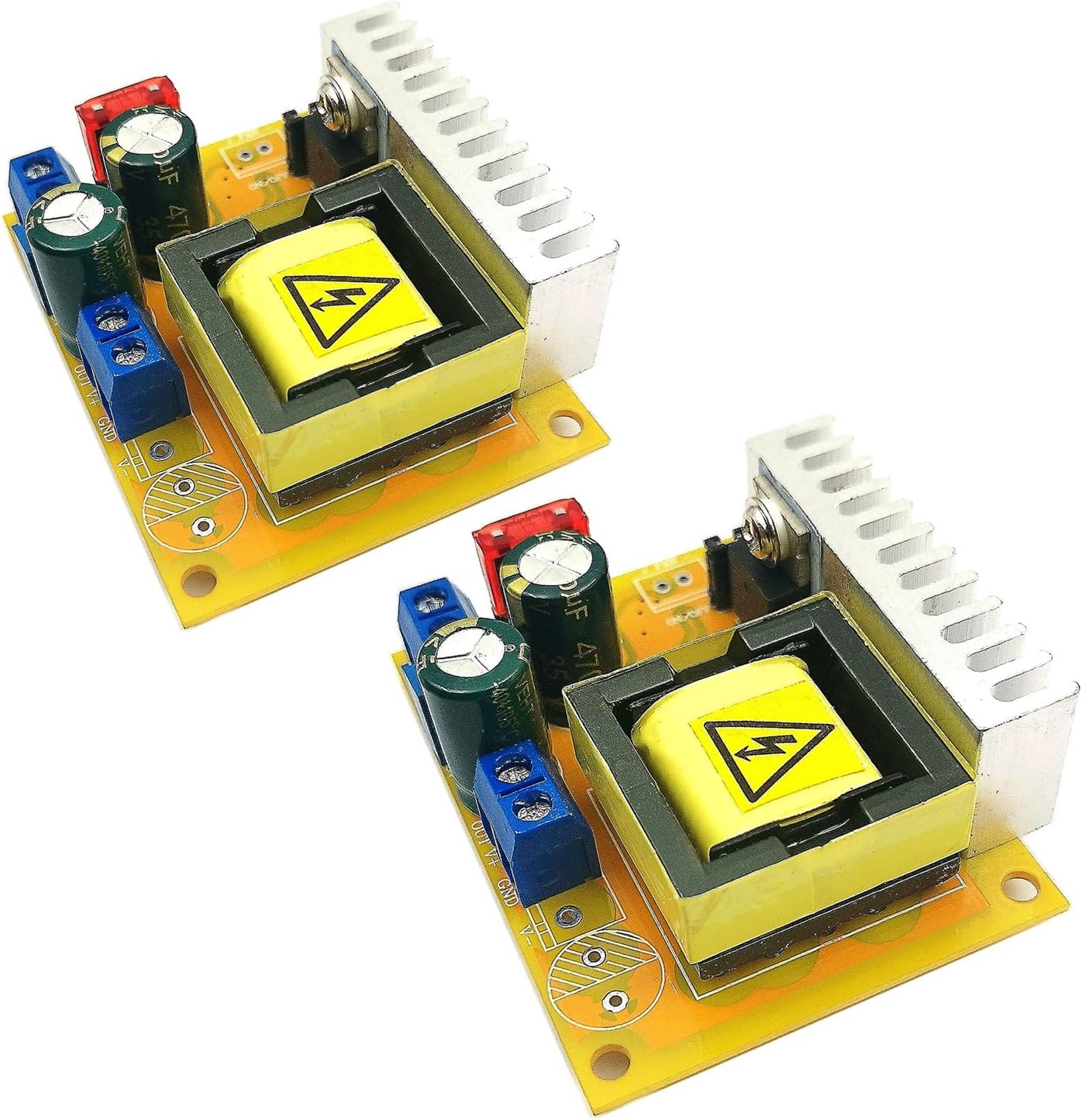
The DEVMO 2 Pcs High Voltage Boost Converter is a compact, non-isolated DC-DC step-up module designed for professionals and enthusiasts who demand adjustable high voltage outputs from 45V up to 390V. It supports an input voltage range of 8-32V, delivers up to 40W continuous power (70W peak), and features comprehensive protections including short circuit, overcurrent, overvoltage, and reverse polarity safeguards. With a high operating frequency of 75kHz and up to 88% efficiency, this module is ideal for precision electronics projects requiring reliable, adjustable high voltage in a compact form factor.
| ASIN | B08RRQ6Q3T |
| Best Sellers Rank | #502,095 in Tools & Home Improvement ( See Top 100 in Tools & Home Improvement ) #2,277 in Power Converters |
| Customer Reviews | 3.9 3.9 out of 5 stars (104) |
| Date First Available | June 12, 2019 |
| Item Weight | 5.6 ounces |
| Item model number | 0dfb9cff-2c59-4607-b3e2-399bd4597721 |
| Manufacturer | DEVMO |
| Package Dimensions | 4.69 x 3.7 x 1.93 inches |
S**H
Positive and Negative Outputs; Nice Unit!
Though this power supply says it is 45-390 Volts, it actually delivers two equal outputs: +45 to +390VDC and -45 to -390VDC at the same time, a max differential of 780 volts. The two outputs track, more or less. A precision 25-turn pot sets the output voltage. Output is not floated, but is tied to the common input ground. The two 10-uF aluminum electrolytic caps on the two outputs are rated 400V, so it is probably best to operate this thing at 300V or less. If you are using only the positive (+) output, it might be a good idea to lightly load the minus (-) output to keep it from floating up too high and popping the cap on the negative rail - may be unnecessary - just good HV practice. The unit does have bleeder resistors on the output, so that when you turn it off, the output voltages drain off within 10 seconds or so to safe levels. This is a regulated switching power supply. Output voltage does not track input voltage, but rather is independent of input voltage so long as supply voltage is sufficient. One reviewer stated that he wanted high voltage and 700 mA for plating; assuming 300 VDC or so, that would be 210 watts, well above the rated and fairly respectable 40W. Another (3-star) stated that it took him a while to figure out that output voltage is adjusted by a tiny screw. Please, people. This product is for folks who have a basic familiarity with electronics or aren't afraid to do a little googling to figure out what they may not know. Yes, documentation could be a little better, but then they'd have to charge more. The trimpot on this unit is a look-alike of the 25-turn Bourns unit; just the trimpot here in the US runs $14.66. Go figure. I recommend this unit, plan to use it to supply +200V to power an old 6E5 fluorescent "tuning eye," bought on eBay, if you remember those from old AM radios. I think it will do just fine. Just don't lick the output when it's set to 300V to test if it's on. Ouch! Use a voltmeter instead. If you don't have a voltmeter, buy a voltmeter first. If you aren't sure what a volt is, maybe you should start with lower voltages. 1.5 volts, for instance. Buy a AA battery and measure that. Electricity and electronics isn't that hard. But learn a little before you start fiddling with hundreds of volts. Learn, live long and prosper. In that order.
B**B
Good enough for non-demanding applications, but not a low-noise power supply. 40W continuous output.
No documentation, but doing a search for YH11068A turned up some info, including a reverse-engineered schematic diagram, and some noise analysis. As delivered, this is configured to operate on 10-32vdc. To reconfigure for 8-16v, a soldered jumper evidently must be moved, but there is no clear indication of what to move, and everything is surface-mounted. Continuous output power is said to be 40W, with up to 70W peak. Output voltages, both positive and negative, are independent of input voltage, and set via a 10-turn pot. This operates at 75kHz, and uses half-wave rectifiers, so don’t expect it to be especially quiet, electrically. It’s good enough for what I need.
J**W
This is a load resistor melting machine
I've toasted several 2, 3, and 5W resistors with this thing and it keeps going. Does well at maintaining the set voltage from no load to about 10W ( the max I have). Only negative is with no load the output voltage cycles up and down by 3-5V (at 170V) every 0.5 to 1 second... slow enough I can see it on a 500V analog meter, and I confirmed 2 different DVMs. Nice bonus: They have a 12V output to drive a constant voltage fan except it's always on even when the "enable" / shorting jumper is removed and the output voltage goes to zero. I replaced the 10-turn trimming pot with a outboard full size 50K 10-turn POT and it does well, just not linear. Slow change at the lower voltage, quick change at 150V and above.
B**B
This DC to DC converter comes with no information how to use or how it function
A week ago I wrote a review that 3 units that I received would not get above 185 volts. Thinking that as you increased the input voltage the output volts would increase. Wrong! I purchased 2 new units thinking that all of these units cannot be bad. When I tried the new units I got the same results. Looking at the units more carefully I finally notice the very small screw on a component next to the inputs terminals. Turning this screw clockwise many turns I started to get the voltage to increase. I stopped at 250 volts which is what I wanted. Changing the input voltage did not change the output voltage. It appears that when you go from 0 to the voltage you had set (the 250 volts) it acted as a switch. No variable input control, just off to the full output setting. All this is because I did not understand DC to DC converters. It would be great if there were some directions how use the converters. Bob Wilson
F**Z
Worked for 5 seconds.
Hooked up to a 12v DC power supply. It powered up and delivered 190v DC. I adjusted the pot to get it to 170v and it failed. It produced 170v for all of 5 seconds. I did not hook up a load.
D**S
It works!
This module worked just fine. The documentation is poor, but an average person should be able to figure it out. The labels on the input and the output are very small, but they are there, near the terminals. A single screw, not labeled, adjusts the output voltage. We were able to generate about 225 Volts, which is what we needed for our application. Came quickly, bubble wrapped. Reasonable price. Overall, happy customer.
J**N
Good unit for the money
Unit works well once the operation is figured out. Instructions are almost non-existant. I am using it to run 2 48 volt fans from my 12V supply. It is working great.
J**N
Works well with good regulation at 250v under 100mA. The transformer gets hot after 30 minutes. See the gm measurement for a 6L6 below
N**E
I'm not sure if this is standard but my board has an extra capacitor and output for a negative rail! I measured a maximum 815VDC between them! That's a lot of voltage from such a tiny package :)
T**R
DEVMO 2 Pcs 8-32V to 45-390V DC-DC High Voltage Boost Converter ZVS Step-up Booster Module $28.98. Some schematics and documentation would help this product a lot. Before connecting it, I always inspect the PCB. The soldering was done by some kind of chimpanzee. There were solder bridges and several not soldered points that were not making a connection. Some cleanup of the board was done before applying power. There are pins for a fan, so if you don't add a fan, keep the power down low as the spec assumes a fan on the MOSFET heatsink. Forget it. I set it up on the test bench. 10 volts in for 153 volts out. Looks OK. While starting to write the review, it stopped working. No smoke. No reason apparent. Nothing moved. Just hooked to a power supply and a voltmeter. If I really needed this right now, I might do some debugging. I would say, don't bother.
C**L
Works just as advertised just be careful as instead of the fuse blowing it almost always killed the mosfet whenever it got over powered, luckily I had mosfets that worked with this but it dose kinda defeat the point of the fuse
M**.
Where is the how to use instructions?
Trustpilot
1 month ago
4 days ago