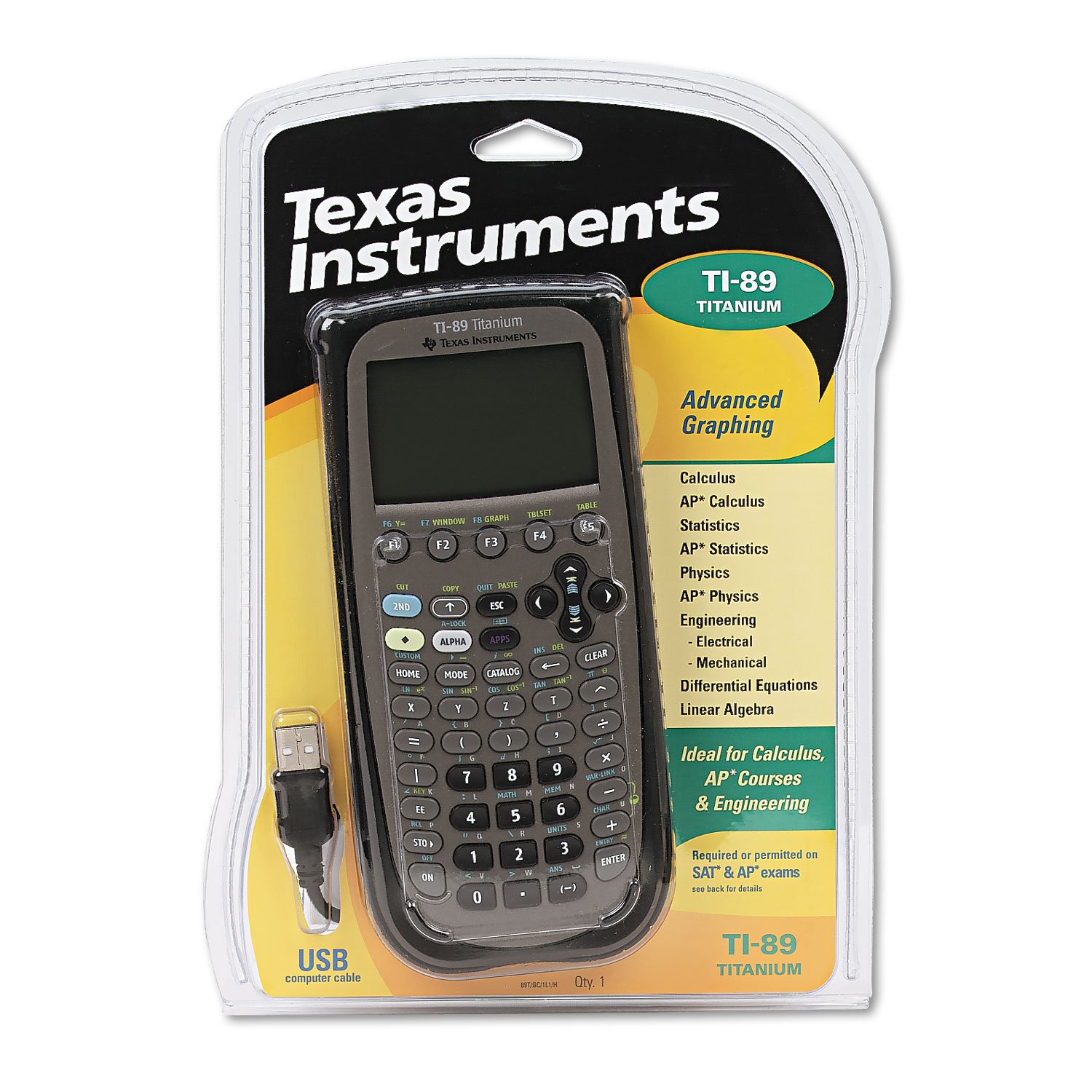
📈 Elevate your problem-solving game with TI-89 Titanium — the ultimate graphing powerhouse!
The Texas Instruments TI-89 Titanium is a high-performance graphing calculator designed for advanced math, engineering, and science professionals and students. Featuring 2.7MB flash memory and 188KB RAM, it supports complex calculus, algebra, matrices, and statistical functions with a crisp 100x160 pixel display. Its USB connectivity and compatibility with various data collection systems enable seamless data transfer and real-world analysis. Preloaded with professional-grade apps and a programmable editor, it’s built to grow with your academic and career needs, backed by a 1-year warranty.


| ASIN | B0001EMLZ2 |
| Best Sellers Rank | #32,257 in Office Products ( See Top 100 in Office Products ) #23 in Graphing Office Calculators |
| Brand | Texas Instruments |
| Calculator Type | Graphing |
| Color | gray |
| Compatible Devices | Texas Instruments CBL 2 system, CBR 2 motion sensor, vernier easylink, vernier easytemp systems, TI-89, Voyage 200, TI-92 Plus, and TI-92 |
| Customer Reviews | 4.6 out of 5 stars 2,538 Reviews |
| Display Type | LCD |
| Enclosure Material | Plastic |
| Global Trade Identification Number | 00033317192038, 03243480015431, 03243480104821, 20033317192032 |
| Item Dimensions L x W | 7.5"L x 3.3"W |
| Item Height | 3.3 inches |
| Item Weight | 0.64 Pounds |
| Manufacturer | Texas Instruments |
| Model Name | TI-89 |
| Number of Batteries | 4 A batteries required. (included) |
| Power Source | Battery Powered |
| Screen Size | 2.8 Inches |
| UPC | 151903615348 638458758350 601000803259 777780515856 999994048597 696747420654 999997687328 732235277840 702658633004 999992231656 641438713539 999992231854 490800100329 012304273493 021112855081 999997571115 956259238711 804993663675 617407488975 012302291628 638084872314 795327732504 041239864896 031113292945 031112376653 799916115426 012300768375 840356591155 999993472843 638865696559 0123060970… |
| Unit Count | 1.0 Count |
| Warranty Description | One-year limited warranty |
G**A
One of the most powerful algebraic graphing calculators, with a superb command/edit line.
I bought the TI-89 Titanium to be compatible with a fellow engineer--it is great to be able to share code and math solutions for the same model of calculator. This is a switch for me, since I have always been a Hewlett-Packard fan. I have at least one of almost every model of HP graphing calculator, and many other models, going all the way back to 1972 and the HP 35. It never occurred to me that the TI-89 series could actually be competitive with HP. Well, it is! This calculator has some very nice features, and a few features that the similarly capable HP 49G does not. I'll leave it to the buyer to explore the manuals and figure some of that out for themselves. But I will definitely note that the Home screen edit/command line has superior behavior in several ways to the HP 49G. One of those is the retention of the last problem, equation or expression entered by the user. That means you can simply solve the first problem, then move the cursor around in the problem, replace a variable, change a sign, or make any other edit needed to evaluate the problem in different ways, without having to copy the equation/expression from the history (as you would have to do with the HP 49G). The HP 49G has more memory than the TI-89 Titanium (mine is a HW4 edition), and a more feature-rich file system (more like a PC). TI partially compensates for simpler filesystem by having apps show only files appropriate for the app you are using at the time, which helps avoid visual clutter. The TI-89 Titanium has a lot of useful, very high quality apps, preinstalled. Both models have a CAS and about 800 scientific functions, constants, and unit conversions but, while unit conversions are faster and easier on the HP 49G, unit math is better on the TI 89 Titanium if what you expect the calculator to do is simplify units to the most practical SI or SAE unit. As an example, if you multiply 200,000_Pa by 1_l, the simple answer is 200e3_Pa*l, but the most practical SI unit resulting from that product is the Joule. The TI-89 Titanium correctly substitutes units and answers with 200e3_J, while the HP 49G (and later RPL graphers) renders the easiest, but least helpful, answer of 200_kPa*l--the correct answer, but left in inconvenient units. (The 49G does have the advantage of having metric/engineering power-of-3 prefixes, such as k, M, G, m, n, etc.) In a way, the TI-89 series is as much a personal digital assistant (PDA) as it is a graphing calculator. This is the result of having numerous useful record-keeping applications, a clock/calendar, event scheduler, task manager, personal contact database, etc. The Titanium also comes preloaded with EE*Pro, a professional-quality problem solver app aimed primarily at electrical engineering professionals. The closest preloaded application HP shipped with a later model of the 49G series, the HP 50g, was a library of powerful equations copied from the HP 48G series, and an interactive Periodic Table of the Elements for chemistry. Don't get me wrong, those are very useful, and the Periodic Table app is better than ones I've seen for TI. But, the TI-89 series was marketed to students and professionals alike as more than just a graphing calculator with a CAS. It is a PDA. In 2020, that seems a silly point to make, given smartphones of today. But in 1999, when both the HP 49G and the TI-89 series were made, the TI appears to have been a better fit for students and, depending on the disciplines, maybe better for engineers. In most respects, the I prefer the HP, but some features of the TI are eye-opening ideas that explain to me why TI is still making graphing calculators for the US market today, while HP has fallen out of the business in the US, even after the release of the formidable and capable HP Prime (which is, in my opinion, superior to the TI-Nspire CX series). TI showed a better design balance with the 89 series, making the flagship graphing calculators fit either the student or the professional technical user, and most apps for the TI-89 series are of very high quality. One more point I will make, is that both are programmable; the TI-89 Titanium is natively programmable in TI BASIC, while the HP 49G is natively programmable in HP Basic and in UserRPL. HP Basic (not BASIC) is limited compared with TI's M68000 BASIC, but HP RPL is more powerful, more elegant, faster for most programs, and more efficient than TI's BASIC. However, TI BASIC is pretty intuitive, while RPL is considerably harder to learn if the user is not already familiar with Reverse Polish Notation and the HP stack or the Forth programming language (and its stack). Overall it is quite a toss up between the two. But if one were to ask me which brand to go with today, my answer would most probably be, "Go with TI. Get one of the TI-Nspire CX models if you are in high school or college and don't plan to use the calculator in a career, but get the TI-89 Titanium if you plan to keep using it beyond school and into your career." I am pleased with the design, speed, and ease of learning on the TI.
Q**N
Texas Instrument Ti-89 is a pretty powerful tool can help you
An effect and powerful tool for career! If you engage in the field about engineering, mathematic, statistics or business, Texas Instrument Ti-89 is a pretty powerful tool can help you. It combined almost all the functions if you need process calculation. You can use it to do simply calculation and work through calculus. It provides powerful assistance if you learn. Functions: It provides multiple functions such as calculus, finance and statistics, etc. You can access different functions in easy way. You can obtain various forms of answer as you need. For example, in mathematic field, you can select to get answer form as numerical, matrix and liner algebra when you enter simple numerical equation. For finance field, you can use its program to get rate of interest, NPV easily. You can use it in simple way whatever you study in finance, engineering or statistics. It has covered all the functions you desire as a calculator. Quality: It seems a little expensive than other calculators and some people choose another due to price consideration. But if you own it, you will know the benefit you get more than money. It does not have any malfunction since I owned it about four years ago. It was fell to floor several times and nothing happen. The clear screen with comprehensive steps also offer you opportunity to see how you go through your questions previously. Convenience: I intended to studied engineering before and I took calculus class. Ti-89 provided me the way to test my answers with matrix, graph and integral. I changed my mind to study finance finally and it required financial calculator. I took statistics class at the same time and Ti-89 was useful in that class. I discovered Ti-89 also has finance function so I do not need buy new calculator and bring those together every day. Every time you want to do calculation, Ti-89 can satisfy all you need and you do not need seek another. Ti-89 is a product that gather wisdom of Ti-89 to satisfy the daily use. You can obtain impeccable function, good quality and convenience with one-time payment. It will define help you with study and career and you cannot miss that.
B**S
Amazing calculator, can do anything
This calculator really can do anything, its like a magic wand on any exam. Let me first start off by saying, check to see that your teachers allow you to use this. I of course purchased this back in my senior year of HighSchool where I was allowed to use it, then silly me. I expected that going to Clemson University as an engineer, I would be allowed to use it... I was wrong (at least for the first year you aren't) However I switched to Corporate Finance and I have yet to be able to use the TI-89 on an exam, I've been forced to settle for the TI-83. As with all TI calculators, the TI-89 seems indestructible, you can drop this thing multiple times and it won't break, its quite amazing just how good a job TI did making this thing strong. The features are countless, you can solve equations right on the main screen, do derivations, integrals, etc... My favorite part of the calculator is the Home Screen though, it has Applications listed out in icon form, which wouldn't work on a TI-83, but luckily the TI-89 has what seems to be 3 or 4 times the number of pixels that the TI-83 has (you can view a Black and white picture on the TI-89 and you'd actually be able to tell what it was). The learning curve for the TI-89 is steep, I don't think in all my years of new technology I have ever had a device that took more time learning how to use all the functions. Part of the reason the TI-89 is not allowed on most exams is that it has a notepad, that you can actually connect the calculator to your computer and write out a note sheet viewable on your calculator (or you could do it on the calculator but it takes much longer). All in all, I love this TI-89, it knows no boundaries, and I really wish I were allowed to use this on a daily basis, because its quite remarkably all the things it can do. I've owned this for 4 years or so and its still going strong, its a great quality product!
R**T
Great calculator for physicist or engineer
Before owning this calculator, I was using an ancient TI-81. This calculator is quite an upgrade from that. The TI-89 is the most powerful calculator you can buy. It is packed with tons of useful features, comes with a ton of programs, and room for more. As a physicist, I use this calculator all the time to work out calculations. It would be especially useful for engineering as it has features designed specifically for engineering problems. The calculator is capable of doing symbolic calculations. This includes derivatives, integrals, Fourier expansion, partial fraction decomposition, Euler's identities, trig simplifications, complex simplifications, series (including infinite series), limits, finding minimums and maximums of functions, arc lengths, Taylor series, differential equations, algebra, matrices, and much, much, more. The nicest part about it is that all the functionality of the calculator supports symbolic calculations. For example, finding the determinant of an nxn matrix with variable or symbolic terms. Even if you input decimals the calculator can be set to "exact mode", and will output the answer as an exact fraction. You can then force an approximation to get a decimal answer. Overall the TI-89 is a fantastic machine with many features that are useful to people who work with higher mathematics. A common complaint with these devices are that the numbers are sometimes a little hard to read. The 2nd key uses light blue and the function key uses light green. While these aren't the best choice of colors, I haven't had any problem with reading them. The screen also has sufficient contrast to use in most lighting conditions.
J**N
Around Since 2004, it's Still a Good Workhorse
Bought three years ago in 2016 to retire a TI-85 that was 21 years old. Still going strong but the means and data link technology to connect it to a PC was designed in the era of Windows 3.1 and just beginning to transition to Windows 95. The TI-89 has been everything I expected and more in supplanting the TI-85. For some beginning and younger students it might be a bit of overkill. Consider the features and functions this one has compared to one of the several TI-84 still in production and make a cost effectiveness decision. The more complex and feature laden, the bigger the learning curve. Also be aware that a TI-89 of any type cannot be used on an ACT exam (as of my writing this in 2019). HS students preparing to take the ACT will need a calculator that is allowed and it should be one they're sufficiently familiar with to use on the exam without fumbling around with it. Shouldn't deter getting this calculator, but they'll need a different one and should practice with it for the ACT. A calculator is still handy for use out of the office when hauling a laptop around isn't very convenient. Even then, my laptop is often tied up with other tasks using a browser and MS Office when I need to use the calculator. Pulling out the TI-89 Titanium (or an HP 50g I also have) is much easier than fussing around with Excel. The case is quite robust and after three years the keyboard is very responsive without sticking keys, key bounce, or non-responsive keys. Keycap labels are still as legible as when it was new. Take care of it without sliming it with food, or spilling beverages on it and it will last for many years. I'm giving it four stars overall as the technology under the hood with a B/W screen is 15 years old now. Its gets 5 stars for sturdiness, value and durability as those don't consider the technology inside. Those needing high end speed and sophistication for advanced applications should look at the TI-Nspire and HP Prime models. (The HP equivalent to this one is the 50g.) One drawback for the color backlit screens on the Nspire and Prime models is use in bright sun. Reflective B/W LCD panels are easier to see and read in direct sunlight.
M**N
The titanium choice!--well it kinda sounded like a good slogan...
There isn't alot I can say about this calculator which hasn't been discussed by previous reviewers. I, like the majority of them, and probably you the reader, have an 83 and got into a calculus course, or calculus-intensive course, and realized that the 83 was no longer going to cut it. Well I got the 89 from amazon and since that day the 83 began to look more and more primitive...sigh...The 89 can factor, differentiate, integrate, sum, products, binomials, solve systems and matrix operations, etc. It can also graph in 3d, polar, or differential field (what you may have seen in the promo shots). It even has the option of exact or approximate answers. A very helpful option I've found is the stored units of measurement you can use in the cases where you need to work problems in physics, engineering or even chemistry. After about two months of use I'm still learning just how much this graphic utility has to offer, but the user-interface has long since become completely intuitive for me. But the buyer should beware if they are making the transition to this right before the final--its menu style interface takes a day or so to get used to, and the manual while long isn't as comprehensive or as clear as it could be, relying heavily on abbreviations. Perhaps the most frustrating thing to learn is the exact sequence various commands need to be entered in, in order to get to the graphing utility to something other than say TOO FEW ARGUMENTS or SYNTAX ERROR. (Using the onboard catalog of functions, gives you an entry guide at the bottom of the screen.) What I didn't expect to use, but find very useful is the USB cable and software which allows me to upload screen shots, ie graphs, which I can then attach for homework and lab assignments when I dont have access to either Derive, Excel, or my mac's Grapher. It is also possible to download additional programs and apps but I can't see me, or most of the potential buyers, of this utility actually needing to do this. It can be programmed as well, but again I have hard time imagining when the need to do this would actually arise. This graphing utiltity is a little larger than the 83-85 line (already bordering on the cartoonish) but it is significantly smaller than the 92 (with which it shares the exact same Derive software and which has a full-qwerty keyboard.) However, this is an altogether much more powerful device than the 83 and an equal to the more cumbersome 92. So its a good compromise. One small question in the back of my mind is that with the advances in LCD screens particularly in cellphones why isn't possible to give this utility a better screen? If a device can be built which relays phone and text messages, has a 2mp camera, can stream video, has an MP3 player on it, and a backlit color screen capable of video playback, all in a space volumetrically equivalent to my wallet it seems like the 89, computing power and all, could be built significantly smaller and with a much nicer display. I realize that the market for graphing utilities is no where near as competitive nor as profit tempting to justify enormous outlays in r/d for enhancements, but you would think some of the technology could be licensed by TI for use in their future utilities. In a world of $200 textbooks an additional $50 or so for a tool like this is pretty insignificant. It's not too hard to imagine this thing having at least a backlit LCD, finer resolution (the 3d graphs are borderline useless), and a rechargeable battery. As futuristic as this utility is compared to earlier ones, a quick comparison with my cell phone or my iPod, already nearly 3yr old, and the contrast looks like technology from two different century's. Well, I suppose they are in fact... The utility, like all other TI, utilities is surprisingly well-built--the durability of these is a credit to TI, who with a market consisting entirely of lucrative bulk school contracts and parents supply-shopping for often careless students, could like textbooks publishers make them as cheaply as possible. I've only seen one of these 89 broken and it was only part of the screen: they are made impressively tough. This rant of mine notwithstanding, as graphing utilities go the 89 is great; although I haven't used the Hewlett-Packards, I can say that the 89 is the standard I've encountered for all undergrad math and science courses. If you're intending to take advances courses in any of the latter you will probably have to buy one of these eventually; accepting the inevitable early you might as well become familiar with it as soon as possible.
P**R
Excellent Calculator for Engineering
At first I was a little apprehensive about upgrading from my TI84 Silver to the 89 Titanium. For somebody very accustomed to the 83/84 layout there's a few changes, for example some keys being on the other side, and some functions (trig for example) that are now accessible via the 2nd key instead of being primary buttons. On the other hand, it's been built to make working with multivariable systems significantly easier, and the higher-resolution screen makes viewing things a lot more precise. The TI89 has a CAS (Computer Algebra System) built in, and although I haven't used it too much I've found its basic solving function to be quite the timesaver in my electrical engineering class, and I know it would have made chemistry easier in the past. There are so many things that this calculator can do it's almost at a ridiculous level. That said, I would recommend this calculator for anybody taking advanced Calculus and higher-level math classes in college, or for anybody taking math-intensive science classes (AP Chem could have used some of this calculator's features), or for anybody planning on getting an engineering degree. For any math before college calculus (including AP Calc), this calculator is not at all necessary, and in fact you would be better off with an 84. If you might be using data probes in conjunction with your calculator (chemistry, physics) then you might want to consider the 84 Silver edition, which can process the data a little faster. As somebody who has used 83's and 84's for years, I can honestly say that switching over hasn't been bad. After only a few days of intermittent use I already knew where most things were. It's a very solid calculator, with more features than most people need. Then again, I don't use half the features on my cell phone, either. Definitely a good calculator to consider if you're thinking of an upgrade or replacement.
J**S
Found my mistress!
From slide rulers to Ti-89's, let me tell you! Even my proessor wanted to use it! Long story short, I have never owned a graphing calculator until now. I am auditing a calculus class this summer and needed something more powerful than my Casio fx-115ES (which is sweet, BTW). My Casio can integrate, but not do diff Q's. Well, let me start by price. My friends all suggested I bought and used a Ti-86 or even a Ti-85 unless I was going into a technical major. Surprise, surprise, I'm an engineer major. I figured if I was going to shell out over $100 on a calculator, I should choose the best available. Needless to say, everyone knew about the Ti-89. I showed it to my math professor who had the same reaction as me (think a kid on Christmas morning opening his gifts). The first thing he asked was "How much was it?" I told him I paid $140 clams and he said "Wow! How'd you get it so cheap?" It wasn't just him though. I showed my buddy in AutoCAD and he was astonished by the price as well. Next is features. I loved the fact that it came with an instruction booklet and the batteries. It let me jump into playing with it the minute I got it. The book is about the size of a video game manual (assuming a modern-day RPG). There is a lot to read and I am still reading it. It's not too hard to figure some things out assuming you're rather savvy with electronics and have some free time on your hands. I learned to graph polynomial functions while walking to class! Italready has pre-loaded apps, but I will ask around and get some more when I finally have a chance (and some sleep), since several apps are useful for certain classes. Next is size. I know graphing calculators are big, but wow! It doesn't fit in my pockets, that's for sure! I usually stick it in my backpack or in my cargo pockets on days when I have those kinds of pants. Finally, utility. As I am still using it and figuring it out, it seems to do basically anything I need it to do. I am contemplating buying the Dummies' book for it since that might tell me something the instruction booklet omits, plus they often have tips within! Overall, I would say it is a must-buy. Most of my friends (90% engineer majors) have older models and would kill for a Ti-89. It is a steal at some prices and I love the fact that even my math professor was impressed and asked me if I could bring it by his office sometime. I love calculators and this seems to be the best out there. If you don't want to break the bank, but want something good, try the aforementioned calculator (Casio) since it worked great for me!
Trustpilot
1 day ago
1 month ago