We remain fully operational. Our teams are working around the clock to ensure your deliveries continue safely.

DOWNLOAD THE APP


Customer Services
Copyright © 2025 Desertcart Holdings Limited
DOWNLOAD THE APP
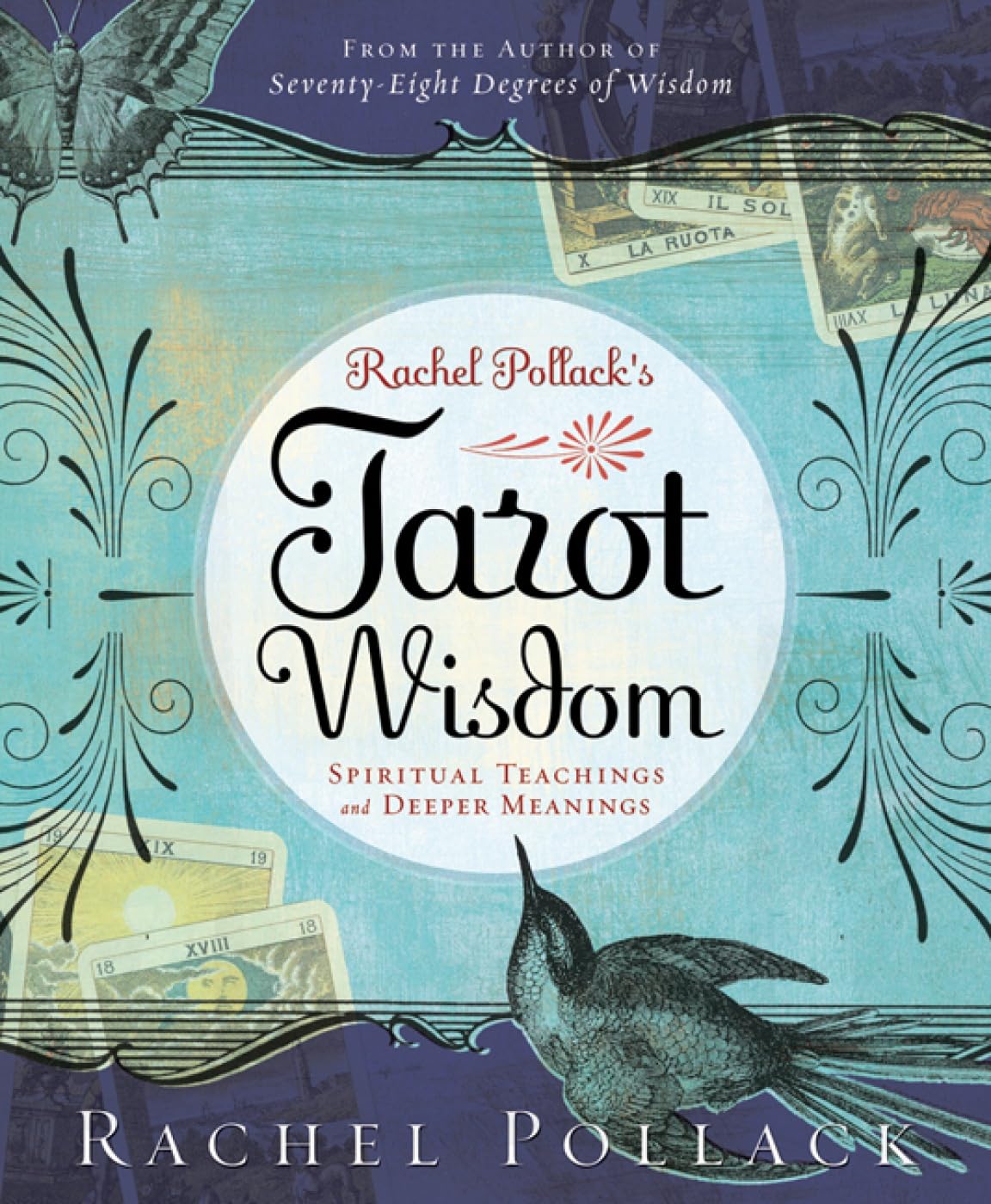
Buy Rachel Pollack's Tarot Wisdom: Spiritual Teachings and Deeper Meanings Illustrated by Pollack, Rachel (ISBN: 9780738713090) from desertcart's Book Store. Everyday low prices and free delivery on eligible orders. Review: Well-written, covers history and lots of great spreads, too! - From the back: "Offering an abundant array of new ideas mixed in with enlightening discussions about Tarot's checkered past, this guidebook features innovative ways to interpret and use Tarot...All seventy-eight cards are explored from fresh angles: history, art, psychology, and a variety of spiritual and occult traditions, using cards from seven diverse decks so you can easily contrast and compare." Touted as the follow-up to "Seventy-Eight Degrees of Wisdom", in most ways I think this book actually goes way beyond the original. "Seventy-Eight Degrees" will remain a "bible" because it takes a clear look at the Rider Waite deck, while also examining psychological aspects and offering practical and insightful approaches to a number of spreads. "Tarot Wisdom", though it is certainly accessible to the beginner, is more a book to grow with. There is much here even for the knowledgeable and experienced tarot reader. The book is divided into four main sections: The Major Arcana, The Minor Arcana, The Court Cards, and Readings, as well as having a 25 page introduction. Each of the seventy eight cards is given from 2 pages (the Minors and Court cards) to 16 pages (for the Fool), with most of the Majors having at least 10 pages each. As the blurb states, illustrations from seven different decks are shown, in black and white, to give a feel for the variety of meaning that has been expressed in each card. In fact, the same six decks are used to illustrate the majority of the Majors: the Marseille, Rider, Golden Dawn Ritual, Egyptian, Visconti and Shining Tribe (Rachel's own deck). Meanwhile, the Minors are illustrated with the Marseille, Rider, Golden Dawn, Visconti, Sola Busca and Shining Tribe. The Sola Busca is considered the first deck historically to have had illustrated pips, so its inclusion for the Minors makes sense, trying to show the development over time of the meanings attributed to and illustrations used for them. Finally, the Court cards show the Marseille, Rider, Golden Dawn, Visconti and Shining Tribe. I love this aspect of the book - it's not just academic information and lists, but also beautiful images and really seeing what she's talking about, and perhaps making your own new connections in the light of these comparative images. This use of multiple images matches up with the fact that the book gives a wide variety of attributions for each card, including, but not limited to: Astrological, Kabbalistic, Pythagorean, Picatrix (from an arabic esoteric text), Elemental, Sephirah, Golden Dawn Title (for the Courts), Rider physical quality (for the Courts), Rider theme and associated Majors (for the Minors). The bulk of the book is made up of a discussion of each card - including history, esoteric aspects, personal anecdotes, some questions it may raise - a whole spread for each of the Majors, and a spread for each suit, as well as a spread for the Court cards. There are also a number of one card and two card spreads, and six multiple card more general spreads. "Tarot Wisdom" also talks about, and gives some examples of, wisdom readings. Basically, you use the tarot to ask philosophical questions - divination in the sense of talking with the divine - rather than simply trying to find out more about your own, or someone else's life. This is a concept Rachel Pollack introduced in "The Forest of Souls", and which I find quite profound - I've always gotten a lot out of the wisdom readings I've done. As well as a general introduction, the book gives an introduction to each of the sections. For the Majors, this discusses the correspondences that Rachel Pollack chooses to highlight: it's a non-systematic approach, focusing on what she personally considers most relevant. So, this may seem rather eclectic or opinionated to those who have a preferred system. However, this is partly explained by her discussion of the Majors as a path to spiritual enlightenment - as such it is a personal path, and also a mystery. The book is designed to give pointers to possible paths for different people, rather than claiming to give any definitive answers. In this respect, Pollack talks about the esoteric history of the Tarot, but argues for there being no "scientific" or correct interpretation. She explains her own structural approach to the Majors, dividing them into three lines of seven, representing three different phases in people's lives, but also looking at these as columns of three - the common threads that return at different levels and in different ways at various times. Although she offers "divinatory" meanings, Pollack mainly wants to open up the interpretation of the cards, rather than narrow it down. The Minor Arcana introduction has a sub-section on the suits: their history; mythological, biblical, kabbalistic and elemental attributions; their relation to the Majors and the Virtues. Another sub-section on numbers: general numerology; Rider Themes (comparing all the Rider aces, all the Rider twos etc); Pythagorean and Kabbalistic numerology; and astrological decans. As for the Court cards, Pollack offers a number of ways to explore them, including drawing a house for each "family" and asking questions about what they're like, where they'd live, and what it would be like if they swapped houses for the weekend with another Court (very a la Mary K.Greer - not surprising as they've been teaching together for nearly two decades). The section on "Permutations" uses a formula to create different "families" of the Court cards, for example Page of Cups, Knight of Swords, Queen of Pentacles, King of Wands, asking how this court would be different than if all the members were from the same suit, or from other permutations. There are also sections titled: "If Court Cards Are People, Who Are They?", and a discussion of "Significators", giving Waite's approach, and Pollack's own. Then, my favourite: "Movie Stars, Fairytales, Superheroes, and Noble Worthies" - exploring who each Court card could be from any area of interest, and suggesting a fun superhero quaternity method of looking at them (Hero, Partner, Nemesis, Sidekick). There are also sections on elemental attributions, the various name changes that have been made regarding the Courts (in particular by the Golden Dawn), and the Court Cards on the Tree of Life. Finally, she looks at the Courts as "A Progression of Qualities" - once again a structural, developmental approach. So, there's plenty to help deepen understanding of the Courts - and that's before we even get to the discussion of each card and related images! As well as offering the spreads described above, the "Readings" chapter has a section discussing some "rules" about tarot reading - mainly to disclaim them. This was the most "beginner"ish section of the book, and one I feel it could have done without. However, I imagine it was felt necessary in order to be able to sell this as a book for every level. Altogether, "Tarot Wisdom" is both academic and accessible, profound, yet profoundly readable. Whether you want to study it from cover to cover or dip in and out to find what you want at any given time, it's a wonderful, fascinating book, full of insight, anecdote, and information. Review: Great in depth book for beginners & advanced - Fantastic book for experienced and beginner level in tarot The level of knowledge within this nook is great Rachel puts together the explanations beautifully There is even a section at the end of each major card section & the suits to pull cards for yourself to help to learn more in depth All round a great book Treat yourself Learning something new each day is a gift to yourself





| Best Sellers Rank | 145,732 in Books ( See Top 100 in Books ) 425 in Tarot 3,535 in Spiritual Thought & Practice |
| Customer reviews | 4.7 4.7 out of 5 stars (432) |
| Dimensions | 19.05 x 3.18 x 22.86 cm |
| Edition | Illustrated |
| ISBN-10 | 0738713090 |
| ISBN-13 | 978-0738713090 |
| Item weight | 998 g |
| Language | English |
| Print length | 408 pages |
| Publication date | 1 Nov. 2008 |
| Publisher | Llewellyn Publications,U.S. |
C**E
Well-written, covers history and lots of great spreads, too!
From the back: "Offering an abundant array of new ideas mixed in with enlightening discussions about Tarot's checkered past, this guidebook features innovative ways to interpret and use Tarot...All seventy-eight cards are explored from fresh angles: history, art, psychology, and a variety of spiritual and occult traditions, using cards from seven diverse decks so you can easily contrast and compare." Touted as the follow-up to "Seventy-Eight Degrees of Wisdom", in most ways I think this book actually goes way beyond the original. "Seventy-Eight Degrees" will remain a "bible" because it takes a clear look at the Rider Waite deck, while also examining psychological aspects and offering practical and insightful approaches to a number of spreads. "Tarot Wisdom", though it is certainly accessible to the beginner, is more a book to grow with. There is much here even for the knowledgeable and experienced tarot reader. The book is divided into four main sections: The Major Arcana, The Minor Arcana, The Court Cards, and Readings, as well as having a 25 page introduction. Each of the seventy eight cards is given from 2 pages (the Minors and Court cards) to 16 pages (for the Fool), with most of the Majors having at least 10 pages each. As the blurb states, illustrations from seven different decks are shown, in black and white, to give a feel for the variety of meaning that has been expressed in each card. In fact, the same six decks are used to illustrate the majority of the Majors: the Marseille, Rider, Golden Dawn Ritual, Egyptian, Visconti and Shining Tribe (Rachel's own deck). Meanwhile, the Minors are illustrated with the Marseille, Rider, Golden Dawn, Visconti, Sola Busca and Shining Tribe. The Sola Busca is considered the first deck historically to have had illustrated pips, so its inclusion for the Minors makes sense, trying to show the development over time of the meanings attributed to and illustrations used for them. Finally, the Court cards show the Marseille, Rider, Golden Dawn, Visconti and Shining Tribe. I love this aspect of the book - it's not just academic information and lists, but also beautiful images and really seeing what she's talking about, and perhaps making your own new connections in the light of these comparative images. This use of multiple images matches up with the fact that the book gives a wide variety of attributions for each card, including, but not limited to: Astrological, Kabbalistic, Pythagorean, Picatrix (from an arabic esoteric text), Elemental, Sephirah, Golden Dawn Title (for the Courts), Rider physical quality (for the Courts), Rider theme and associated Majors (for the Minors). The bulk of the book is made up of a discussion of each card - including history, esoteric aspects, personal anecdotes, some questions it may raise - a whole spread for each of the Majors, and a spread for each suit, as well as a spread for the Court cards. There are also a number of one card and two card spreads, and six multiple card more general spreads. "Tarot Wisdom" also talks about, and gives some examples of, wisdom readings. Basically, you use the tarot to ask philosophical questions - divination in the sense of talking with the divine - rather than simply trying to find out more about your own, or someone else's life. This is a concept Rachel Pollack introduced in "The Forest of Souls", and which I find quite profound - I've always gotten a lot out of the wisdom readings I've done. As well as a general introduction, the book gives an introduction to each of the sections. For the Majors, this discusses the correspondences that Rachel Pollack chooses to highlight: it's a non-systematic approach, focusing on what she personally considers most relevant. So, this may seem rather eclectic or opinionated to those who have a preferred system. However, this is partly explained by her discussion of the Majors as a path to spiritual enlightenment - as such it is a personal path, and also a mystery. The book is designed to give pointers to possible paths for different people, rather than claiming to give any definitive answers. In this respect, Pollack talks about the esoteric history of the Tarot, but argues for there being no "scientific" or correct interpretation. She explains her own structural approach to the Majors, dividing them into three lines of seven, representing three different phases in people's lives, but also looking at these as columns of three - the common threads that return at different levels and in different ways at various times. Although she offers "divinatory" meanings, Pollack mainly wants to open up the interpretation of the cards, rather than narrow it down. The Minor Arcana introduction has a sub-section on the suits: their history; mythological, biblical, kabbalistic and elemental attributions; their relation to the Majors and the Virtues. Another sub-section on numbers: general numerology; Rider Themes (comparing all the Rider aces, all the Rider twos etc); Pythagorean and Kabbalistic numerology; and astrological decans. As for the Court cards, Pollack offers a number of ways to explore them, including drawing a house for each "family" and asking questions about what they're like, where they'd live, and what it would be like if they swapped houses for the weekend with another Court (very a la Mary K.Greer - not surprising as they've been teaching together for nearly two decades). The section on "Permutations" uses a formula to create different "families" of the Court cards, for example Page of Cups, Knight of Swords, Queen of Pentacles, King of Wands, asking how this court would be different than if all the members were from the same suit, or from other permutations. There are also sections titled: "If Court Cards Are People, Who Are They?", and a discussion of "Significators", giving Waite's approach, and Pollack's own. Then, my favourite: "Movie Stars, Fairytales, Superheroes, and Noble Worthies" - exploring who each Court card could be from any area of interest, and suggesting a fun superhero quaternity method of looking at them (Hero, Partner, Nemesis, Sidekick). There are also sections on elemental attributions, the various name changes that have been made regarding the Courts (in particular by the Golden Dawn), and the Court Cards on the Tree of Life. Finally, she looks at the Courts as "A Progression of Qualities" - once again a structural, developmental approach. So, there's plenty to help deepen understanding of the Courts - and that's before we even get to the discussion of each card and related images! As well as offering the spreads described above, the "Readings" chapter has a section discussing some "rules" about tarot reading - mainly to disclaim them. This was the most "beginner"ish section of the book, and one I feel it could have done without. However, I imagine it was felt necessary in order to be able to sell this as a book for every level. Altogether, "Tarot Wisdom" is both academic and accessible, profound, yet profoundly readable. Whether you want to study it from cover to cover or dip in and out to find what you want at any given time, it's a wonderful, fascinating book, full of insight, anecdote, and information.
N**N
Great in depth book for beginners & advanced
Fantastic book for experienced and beginner level in tarot The level of knowledge within this nook is great Rachel puts together the explanations beautifully There is even a section at the end of each major card section & the suits to pull cards for yourself to help to learn more in depth All round a great book Treat yourself Learning something new each day is a gift to yourself
C**N
Very precise and detailed book
Great book. It has all the elements of the cards, comparisons. I loved it.
T**D
This book is invaluable
I love reading Rachael's books, it feels like sitting and having a chat with a kind and wise friend. This book is overflowing with fresh ideas ( to me anyway) and thoughts about the tarot. I read it from cover to cover initially but now dib in and out of it regularly and always find something of value to learn from or think about. The main thing though is my tarot readings have improved since reading this book because my mind is so much more open. Rachael was a marvel, I wish I could thank her for all she has done for me.
S**S
interesting book
it is a nice book but l personally don't love it .... however l dont regreat buying it as it is still insightful
B**E
Fabulous Tarot Book
If you are interested in mythology and the history of the tarot cards I would recommend this book. It is my absolute favourite tarot book so far. It shows pictures from various decks and gives a summary of different meanings for each card and how they have changed over the years. The author explains the links to the Kabbalah and I have found the whole book is like a course in itself. I still use other books too but this seems to bring the cards to life!
P**T
Tarot is always interesting to follow
Its basically to do with Karma is tarot I am pretty sure. It is a very empowering subject to get to know. Intuition is also key with this subject. I practice Tarot, Astrology and Numerology - great subjects to get to know.
R**A
A must read if you are interested in tarot readings.
I absolutely love this book. Well written and interesting.
D**I
Super
F**A
Se você busca uma visão multicultural e interdisciplinar do tarô, este é o seu livro! Aqui, Rachel Pollack explora as várias histórias, significados e tradições por trás de cada uma das 78 cartas do tarô, comparando os baralhos de Waite, Marselha, Visconti, Egípcio, Golden Dawn e o Shinning Tribe, criado por ela mesma. Para cada carta, Pollack explora referências da mitologia grega e egípcia, contos de fadas, histórias da Bíblia, tradições da Europa medieval, arquétipos psicológicos de Jung, astrologia, numerologia, cabala e taoismo. Você encontra os significados dados à cada carta por estudiosos do tarô famosos dos séculos 18 e 19 e, claro, interpretações práticas para leituras do dia-a-dia. O que eu gosto nesse livro é o equilíbrio entre significados profundos, que nos fazem refletir sobre cada carta, e significados mais "pés no chão", para leituras referentes a amor, trabalho, autoconhecimento, etc. Super recomendado para quem tem um conhecimento inicial de tarô já bem definido e deseja se aprofundar mais. Um bom conhecimento de Inglês é bem necessário.
出**柳
かなりのボリュームのある本(480頁)ですが、著者Rachel Pollackは作家でもあるので文章は流麗です。 著者の以前の著作の"Seventy-Eight Degrees of Wisdom"のUpdate版という感じを受けました。 大アルカナ1枚の解説には約8-10頁ほど費やしています。ただ、その解説については冗長な感じをうけました。 大アルカナカードについては、Paul Husonの著作からの引用ですが、正位置の意味だけA.E.Waite、Levi、Mathers、黄金の夜明け団などのカード解釈の意味を掲げています。逆位置の意味は各大アルカナカードの説明文書の最後のほうに書かれています。 小アルカナのほうですが、小アルカナの数札の解説は1頁、コートカードの解説も実質1頁です。小アルカナには前述のA.E.Waite、Levi、Mathers、黄金の夜明け団などのカード解釈の意味は記されていません。ただし、正位置・逆位置の意味が端的に記されているので、大アルカナよりは理解しやすいと思います。 Rachel Pollackの著作の中で、大アルカナカードの1枚1枚を深く知りたいという点では本書は有益だと思いますが、単にタロットを占うという点だけでは鏡リュウジ氏訳の「タロットバイブル(原著名"The New Tarot Handbook" 朝日新聞出版)」の方が、カードを端的に説明しているため良いのではないかと思います。
E**S
Le carte di tarot fatte molto bene, come da descrizione
S**.
I'm new to reading Tarot. I started with Joan Bunning's Learning the Tarot, and while that book is fantastic for getting your toes wet, and remains a useful resource, it didn't offer enough depth for me. Rachel Pollack's Tarot Wisdom is exactly what I was looking for -- an in-depth look at each card, its history, and its meanings that I will be able to use for years. The thoroughness really helps me get a feel for each of the cards, and the more esoteric info about the Kabbalah, numerology, etc, will be useful as I gain more practice and familiarity with the cards. This is one of those books that you can read and re-read, and get something new with each reading. For each card, several different versions are shown: Visconti, Marseille, Rider, Golden Dawn Ritual, Egyptian, and Shining Tribe. The comparative approach is very useful as an accompaniment to the discussions of symbology, and helps to show how the cards and their meanings have progressed over time. Also useful are the lists of historical interpretations of the Major Arcana cards, and how those have differed from and/or influenced contemporary meanings. I also really enjoy the Wisdom Readings that are included throughout the book. Each of the Major Arcana has a reading, as well as one each for the Court Cards, Wands, Cups, Swords, and Pentacles. The Wisdom Readings help to reinforce the meanings of the cards, and what those cards signify to me personally. For example, a few of the questions from A Fool Reading are: How have I been a Fool in my life? Where in my life do I need to be more Foolish? Where do I find the Fool outside myself? One note: the book includes the author's personal experiences with and interpretations of the cards, as well as the more academic information. The personal anecdotes, while interesting, aren't for everyone. I would also have preferred not to have the inclusion and explanations of the author's Shining Tribe cards. However, these two drawbacks don't lessen the overall usefulness of the book. This book would not be suitable for a beginner who just wants an overview of Tarot, who wants to keep things simple at first and memorize a few keywords for each card. However, for a beginner who wants to immerse themselves in layers of meaning and symbolism for each card, this book is outstanding.
Trustpilot
5 days ago
3 weeks ago