

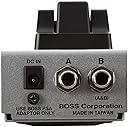
BOSS FS-7 Space Saving Dual Foot Switch
Product ID: 49977045
Details
- BrandBOSS
- ColourBlack with
- Item weight0.69 Pounds
- StyleFS-7
- Voltage9 Volts
⚡Latch & momentary switching modes
👣Dual footswitch in compact size
🔋Battery-free, pedalboard-friendly
Buy anything from 5,000+ international stores. One checkout price. No surprise fees. Join 2M+ shoppers on Desertcart.
Desertcart purchases this item on your behalf and handles shipping, customs, and support to Indonesia.
👣 Step up your sound game with the ultimate space-saving footswitch!
The BOSS FS-7 is a compact, dual footswitch designed for professional musicians seeking versatile control. Featuring both latch and momentary switching modes, it operates battery-free for pedalboard convenience and durability. Compatible with a wide range of Boss gear, it delivers quiet, reliable foot-activated switching in a sleek, space-saving footprint.


| ASIN | B00OB7KP0S |
| Amperage | 20 Milliamps |
| Audio Output Effects | Delay |
| Brand Name | BOSS |
| Colour | Black with Silver Accents |
| Connector Type | Straight 1/4" |
| Controls Type | Footswitch |
| Country of Origin | Taiwan |
| Customer Reviews | 4.6 4.6 out of 5 stars (2,549) |
| Global Trade Identification Number | 00761294506585, 04957054506582 |
| Hardware Interface | 1/4-inch Audio |
| Included Components | BOSS FS-7, User Manual |
| Item Dimensions | 13.2 x 6.4 x 6 centimetres |
| Item Type Name | Boss FS-7 Dual Foot Switch |
| Item Weight | 0.69 Pounds |
| Manufacturer | Roland |
| Manufacturer Part Number | FS-7 |
| Model Name | FS-7 |
| Model Number | FS-7 |
| Power Source | Corded Electric |
| Product Warranty | 1 year. |
| Set Name | 3 |
| Signal Format | Analog |
| Style | FS-7 |
| UPC | 761294506585 750408391490 |
| Unit Count | 1.0 count |
| Voltage | 9 Volts |
A**N
A Great footswitch!
Decided to go for the Boss FS-5U based on Boss' history of quality and reliability. The footswitch is well made and sturdy as it should be as you are going to be activating it with your foot. For my application, I am using the FS-5U as a tap tempo for my Boss DD-20. The FS-5U has a fairly small foot print and it's size can be compared against the rest of the effects pedals on my board. The switching action is very quiet. All I had to do is make up patch cable of correct length. I would highly recommend the FS-5U as an unlatch footswitch. You can't go wrong with Boss products, I've owned and used them for years.
P**L
Versatile and well made switch pedal
Got this for boss katana 50 to switch by foot between the four presets. Works perfectly. Also will work well with boss looper RC1 and RC3 so you don’t have to use a double tap to stop loops etc. I wanted the switch pedal to be as hassle free as possible so mains powered is best for me. A bit expensive but apparently they last many years.
V**.
The right option for me and my rc300.
I got this to use with a boss rc300. This review is based on my specific requirements, and may not be relevant to those with other equipment. It’s unapologetically long and detailed in the hope it will help others with the same needs. I got this to use as external controllers for the rc300 loopstation. The rc300 requires external switches with momentary non latching compatibility, or always closed options...mostly. The rc300 has the capacity to assign specific and customisable tasks to external foot switches and expression pedals, and these can be specified and saved to each individual memory preset. In other words, for one song, I might want my foot switch to turn my mic input on or off. For the next song in my set, I may want the same foot switch to act as an undo/redo switch. Crucially, you can also set whether the foot switch acts in a toggle or momentary capacity, which is where the latching/nonlatching issues arise. The result of so much customisability at the loopstation end of things is that a foot switch has to do an awful lot of work. Unless I missed something, I know of no other unit that provides all the features of the fs6 in one place, and I looked. Pushing £60, though, this is not cheap for what is ultimately just a foot switch. However, I came to the conclusion that I had to go for it over all the competition for the following reasons. One of the biggest deciding factors was that I couldn’t find another non-latching always closed unit with LEDs. This may sound like a minor point, but given the complexity of my live rig, I need to be able to see at a glance if my settings are on or off. Sounds simple, but getting it wrong could be disastrous in a live siltation. If you only need a toggle for an amp channel, or your rig only has a couple of stompers on it, another option may be fine. For me it’s a deal breaker. The trade-off for having LEDs is that the fs6 is larger than some other options. Obviously, this means pedal board space, which for me is always a consideration. However, this brings me to the first of my two grumbles- It’s battery only. Yep, no 9volt input. I have tested a work around by hooking up a battery adaptor (widely available for a few pounds) to my pedal board power supply, and it works fine, but it means I would have to leave the battery cover off. For now I’m using a Duracell battery, and it’s lasted a good 20 hours and still going strong, but do remember that it will drain power when the connector jack is in. My only other slight grumble is the battery panel is a bit fiddly. Going back to the dimensions of the unit-it’s not that big (think the width of two standard boss stompboxes), and I’m not sure how it could be a lot smaller- it’s important to remember that the fs6 is actually two independent foot switches in one housing. Each side can be set to be latching or non-latching- it really couldn’t be more versatile. The other thing you need to be aware of is what connecting cables you will need. You can either use two jack to jack mono’s, or one jack to jack stereo. Getting the set-up right with this required a bit of manual reference, but I got there… For the rc300 the stereo option is a no-brainer- for me it means my second external pedal jack can run another expression pedal, or if I wanted, another fs6. For other uses, you could set the fs6 to control two separate units- say a clean/dirty switch on two amps. Again, the point is that you have a lot of options and your personal set-up will determine what you need. So, am I glad I bought it? Yes. It is a lot of money, but after spending some time with it, I’m happy that that extra outlay has given me the ability to make the most of the rc300’s external controller features. I use my loopstation as the heart of my live setup and I want to wring every last drop of performance out of it- more casual users may get by on less feature-heavy kit. On balance, and putting asside the grumbles about power, I’m very happy with it, and feel that I made the right choice.
M**S
Useful Footswitch for the Waza Air Headphone
The FS-1-WL features in Boss's promotional material for the Waza Air wireless guitar headphone amplifer system, this, along with the opportunity to quickly change patch or booster could make hands-free flipping from clean verse to some heavy distortion on the chorus or intro a possibility. I found it possible to achieve the goal of connecting the switch to my Waza Air after carefully reading the downloadable guide from the Boss support site. The guide can be found on the Boss support site under user manuals: Using Boss Tone Studio for Waza-Air/EV-1WL/FS-1-WL Connection Guide I'm a lockdown learner so not particularly into the technicalities of midi or other interfaces, this is the main area I think Boss could improve on, the connections and possibilities seem bit obfuscated in technical guides, and a level of interface knowledge assumed. Anyway, the process involves first connecting the Waza Air to a phone or tablet, then pressing down on the Waza Air's on/off swith to pair the FS-1-WL to the the headphone using the footswitch's power switch set to midi followed by a tap of the bluetooth button. Once connected, moving up and down patches is easy using the first two switches, the final switch is assigned to toggling the boost set on each patch. A second benefit is connecting the switch to a computer, it is possible to use the middle switch to pause/continue tutorial videos, again no need to take you hands off the guitar. The Waza setup means guitar practice in an apartment can be achieved without annoying neighbours, this is helped further by the build of the FS-1-WL, a tough, very thick, nylon type plastic case with rubber damped switches mean the unit is silent and will not send loud clicks through the floor. While the materials couldn't be described as premium, the unit is extremely well made. Overall, a great addition to a Waza Air setup but Boss should include more printed quick start guides for beginners.
M**K
A great basic pedal.
I'd been need a more-reliable sustain pedal for a while (particularly for live performance), & my old JHS sustain had seen better days. I decided to go this Boss pedal as I've always been pleased with their products & this seemed to be built-to-last. It was, & it still is. Very robust. It does the job perfectly.
A**R
Good quality
Well made as you'd expect from Boss. Use it with our mixer to mute effects.
H**7
Delivery fast and ahead of expected time. One the things i rate highly is the item works straight out of the box and that is exactly what the Boss fs 1 ws did. Very impressed. Turn it on, select memory 1, pair with samsung tablet and turning pages back and forth no messing around. Much more to explore!!!!!
B**N
Bonjour. Il semble y avoir un problème avec cette pedale. J ai un ampli Roland même marqué que La pedale Boss. Je suis obligé dem appuyer deux fois pour basculer du son clear au son distorsion !!
D**O
Secondo me uno dei pedali switch migliori sul Mercato, lo utilizzo per il mio Bbeat per mandare le basi, top
B**R
Exactly what I was looking for, solid.. heavy we’ll made
N**Ò
Ottimo pedale. Boss è una garanzia di qualità e solidità. Funziona molto bene ed è estremamente compatto. L'unico problema è che nella pagina del prodotto l'immagine non è corretta.
Trustpilot
3 days ago
4 days ago