We remain fully operational. Our teams are working around the clock to ensure your deliveries continue safely.

DOWNLOAD THE APP


Customer Services
Copyright © 2025 Desertcart Holdings Limited
DOWNLOAD THE APP
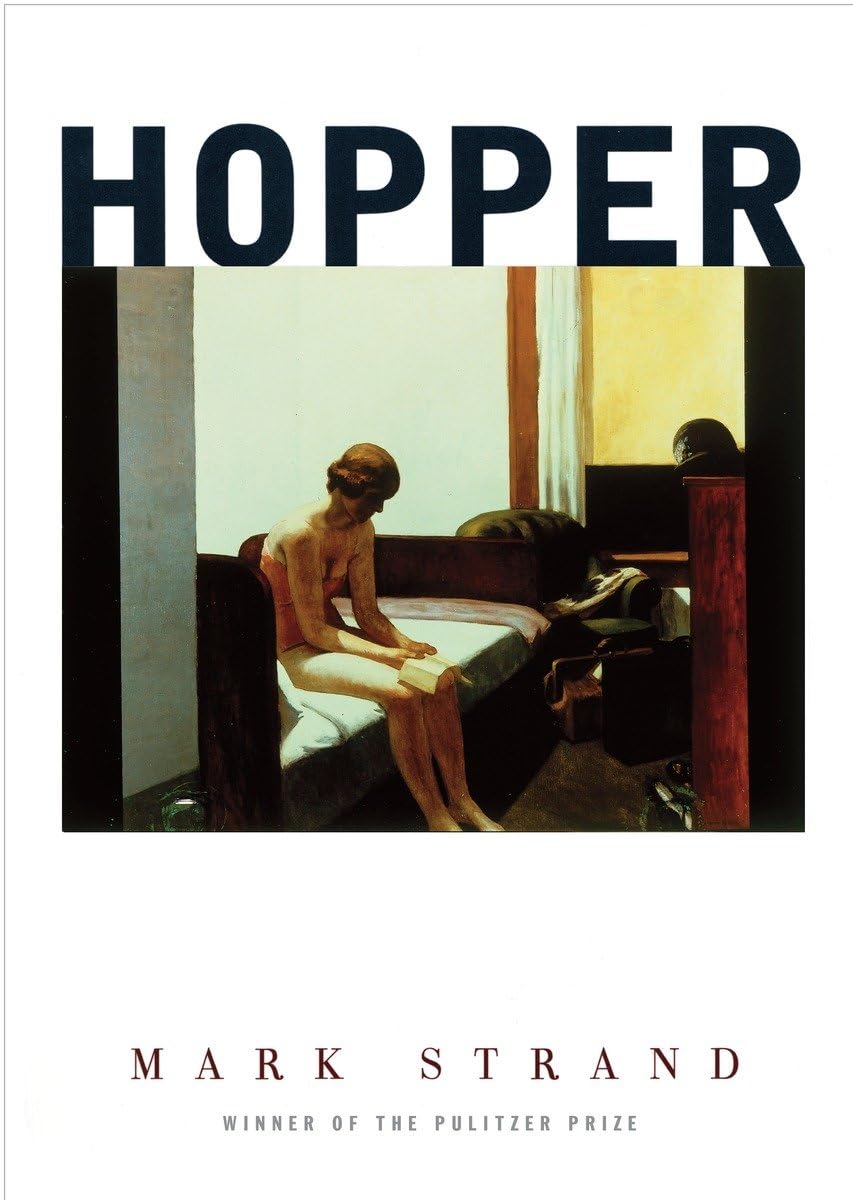
Hopper [Strand, Mark] on desertcart.com. *FREE* shipping on qualifying offers. Hopper Review: Shedding the Poet's Light of Hopper's Use of Artistic Light! - Mark Strand is a prose poet extraordinaire who I enjoy in reading his insightful prose in f poetic form. When I saw that he had a book in which he reviews the works of my most favorite American artist in Edward Hopper, I just had to delve into this work. Strand notes Hopper's use of light in all his painting, something that I was well aware of before I read this book. He expands on Hopper's use of light and his use of painting of subjects that are inside and in many cases looking onto the outside world. Many of the people used in Hopper's paintings are looking outward outside the canvas sightlines which Strand notes on many of the paintings where the human subject is prevalent. He notes the total indifference of the subjects in the painting in which they are concerned only in their world. Strand also notes that Hopper uses in his paintings the mysteries of what lies beyond his triangular spatial picture. One always looks at a Hopper painting and wonders what lies beyond the art we see in front of us. The lines which lead down the road of things not seen in the painting prove to be a mystery which Hopper creates. Just what does lie beyond the sight lines of the painting? The way Hopper uses light, his constant creation of looking from the outside inward and the sense of solitude are explained in detail by Strand. With Strand, we can look at the paintings of Hopper in a visceral form and see the uses of light, loneliness and a complete sense of calmness and solitude. Hopper uses the basic tenants of everyday life and shows to all that solitude and introspective thought in a good and calming way of viewing life in general. Strand studies the simplest nuances of Hopper's offerings and simply tells a basic and good way of looking at art. Strand does this without the extravagant intellectual exercises which neither helps the art student nor serves to merely confuse the student in the real intentions offered by the artist. Mark Strand breaks down the basics of the art style in which Hopper had developed over much of the 20th century. We see from Strand the innermost workings of the mindset of a great American artist. Review: Less Criticism than Ekphrasis -- and That's a Good Thing! - Kudos to Knopf for reissuing this brilliant little book by Mark Strand. The original's paintings were in black and white, though I still loved it, the writing was so good -- prose poems, you'd want to call the critiques, or rather appreciations, if the material weren't so technical (though also accessible) -- and of course the paintings were all easily available online. This edition's paintings are in color; the whole slim volume is gorgeous, in fact: an example of what Kindles and the like, much as I love mine, will never be able to replace. The chief reason for the kudos, however, is that this book was never a big hit, and even in this dying, big-hit industry (publishers lose money on well over 90% of the books they publish, or so I've been told by people who would know), Knopf spent considerable money on a new edition of this book, for no other reason than that it deserves it, it's that good -- beautiful, ingenious.
| Best Sellers Rank | #2,361,261 in Books ( See Top 100 in Books ) #3,882 in Arts & Photography Criticism #4,308 in Individual Artists (Books) |
| Customer Reviews | 4.4 4.4 out of 5 stars (64) |
| Dimensions | 6.2 x 0.5 x 8.6 inches |
| Edition | Reissue |
| ISBN-10 | 0307701247 |
| ISBN-13 | 978-0307701244 |
| Item Weight | 10.5 ounces |
| Language | English |
| Part of series | Writers on Art |
| Print length | 96 pages |
| Publication date | November 29, 2011 |
| Publisher | Knopf |
R**E
Shedding the Poet's Light of Hopper's Use of Artistic Light!
Mark Strand is a prose poet extraordinaire who I enjoy in reading his insightful prose in f poetic form. When I saw that he had a book in which he reviews the works of my most favorite American artist in Edward Hopper, I just had to delve into this work. Strand notes Hopper's use of light in all his painting, something that I was well aware of before I read this book. He expands on Hopper's use of light and his use of painting of subjects that are inside and in many cases looking onto the outside world. Many of the people used in Hopper's paintings are looking outward outside the canvas sightlines which Strand notes on many of the paintings where the human subject is prevalent. He notes the total indifference of the subjects in the painting in which they are concerned only in their world. Strand also notes that Hopper uses in his paintings the mysteries of what lies beyond his triangular spatial picture. One always looks at a Hopper painting and wonders what lies beyond the art we see in front of us. The lines which lead down the road of things not seen in the painting prove to be a mystery which Hopper creates. Just what does lie beyond the sight lines of the painting? The way Hopper uses light, his constant creation of looking from the outside inward and the sense of solitude are explained in detail by Strand. With Strand, we can look at the paintings of Hopper in a visceral form and see the uses of light, loneliness and a complete sense of calmness and solitude. Hopper uses the basic tenants of everyday life and shows to all that solitude and introspective thought in a good and calming way of viewing life in general. Strand studies the simplest nuances of Hopper's offerings and simply tells a basic and good way of looking at art. Strand does this without the extravagant intellectual exercises which neither helps the art student nor serves to merely confuse the student in the real intentions offered by the artist. Mark Strand breaks down the basics of the art style in which Hopper had developed over much of the 20th century. We see from Strand the innermost workings of the mindset of a great American artist.
R**Y
Less Criticism than Ekphrasis -- and That's a Good Thing!
Kudos to Knopf for reissuing this brilliant little book by Mark Strand. The original's paintings were in black and white, though I still loved it, the writing was so good -- prose poems, you'd want to call the critiques, or rather appreciations, if the material weren't so technical (though also accessible) -- and of course the paintings were all easily available online. This edition's paintings are in color; the whole slim volume is gorgeous, in fact: an example of what Kindles and the like, much as I love mine, will never be able to replace. The chief reason for the kudos, however, is that this book was never a big hit, and even in this dying, big-hit industry (publishers lose money on well over 90% of the books they publish, or so I've been told by people who would know), Knopf spent considerable money on a new edition of this book, for no other reason than that it deserves it, it's that good -- beautiful, ingenious.
S**1
Four Stars
Nice pics and good detail on the origins of the pictures
A**S
Interesting take on Edward Hopper paintings
Strand makes the story behind the paintings in essay form. Interesting reading and contemplation. We enjoyed it.
R**G
Find out why you like what you like
That Mark Strand is a terrific poet is not breaking news, but what may surprise some are his insights into Hopper's paintings. But first: the book is gorgeous. The reproductions alone are worth the cost. But Strand's explications of the works are the best I've read. He is lucid and precise. I actually became excited as I would read a passage and then apply it to the painting juxtaposed against Stand's prose. Not as excited as seeing a Hopper in the Smithsonian's Gallery West, but excited nevertheless. Fans of either Strand or Hopper will embrace the book. Fans of both want to send me large amounts of money for recommending HOPPER.
A**R
The Best Hopper Book I've read ever!
I've never got in more touch with this artist until I read Strand's strong, informative and interesting writing on him. Hopper truly shines in this book as many of his pieces are analyzed with great detail and care. You might even end up liking Hopper's work more than Hopper himself because of how much this book emphasizes on each of his pieces. Would highly recommend this for any artists out there especially Hopper fans.
E**R
A thoughtful introduction to Hopper
I had heard of hopper because of his painting of the poeple at a restaurant counter. Recently some allusions to his work in fiction prompted my curiosity and this is a good way to satisfy some of that curiosity and deepen it at the same tim. The author was poet laurete in 1990. Now i need to read his work as well. I read this book as a Kindle edition on an ipad. The illustration are adequately reproduced. Not long but thought provoking.
H**N
Only a poet could produce these insights on Hopper
Hopper's work is simple at first glance, but my eye is inevitably pulled into the depths the their uncertain world. Mark Strand's talent and capabilities as a poet leap to the foreground in this guidebook to looking at Hoppers paintings. Each of the thirty chapters is a response to a single Hopper painting which is shown in a small black and white photo. The lack of color simply doesn't matter. The simple power of Hopper's images and the strength of Strand's insight carry this small book over the top. The small books in this "writers on artists" series are treasures.
A**G
¡Maravilloso! Realmente recomendable.
D**A
Enjoyed read very much. It’s the first time to see Hopper ‘s painting in BW. Painting and literature, their two great souls met.
Trustpilot
2 weeks ago
1 month ago