⚡ Empower your power game with precision and safety!
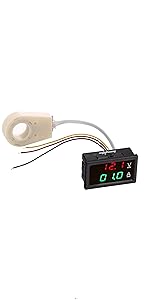
The bayite DC 5-120V 100A Mini Digital Ammeter Gauge features a Hall Effect sensor with a 3/4 inch through-hole, enabling safe, isolated, and accurate measurement of DC voltage and current. Its compact ABS design supports large wire diameters and multi-loop wiring for enhanced signal strength, while a bright digital display offers easy monitoring of voltage and current in real-time.


| ASIN | B01DDQM6Z4 |
| Best Sellers Rank | #116,499 in Automotive ( See Top 100 in Automotive ) #15 in Automotive Replacement Amp Meter Gauges |
| Brand | bayite |
| Brand Name | bayite |
| Customer Reviews | 4.4 out of 5 stars 775 Reviews |
| Item Dimensions | 1.89 x 1.14 x 0.9 inches |
| Item Weight | 6.7 Ounces |
| Item dimensions L x W x H | 1.89 x 1.14 x 0.9 inches |
| Manufacturer | bayite |
| Material | Acrylonitrile Butadiene Styrene (ABS) |
| Material Type | Acrylonitrile Butadiene Styrene (ABS) |
A**S
GREAT LITTLE UNIT WORKS WELL
GREAT LITTLE UNIT WITH CURRENT DO-NUT. Works great; easy to install, stable electronics, even has an extension cable to remote the donut! WILL BUY AGAIN!!
H**R
Works great. Excellent value. Easy to read display
I wired in a refrigerator in the trunk of my electric car. (too many over buying trips to Costco) The refrigerator is very quiet and it’s hard to tell when it’s on let alone how much current it’s drawing. This handy little device lets me know. Large bright green digits for my old eyeballs. No current sensing resistor to deal with or cause a voltage drop problem under high currents. I took advantage of the included extension cable for the Hall effect sensor, but had to make another one for the DC power. The button on the bottom works fine to switch between the voltage, current, volt-current display modes. I only monitor current though. I did use the zero calibration for the current feature. I also did some bench tests to see how accurate the measurements were. While not important for my application they were within specs.
R**.
Useful meter, easy to calibrate if you wire it up correctly, selector button awkward
I was installing these meters (4 off) in a boat electrical system to measure the volts (circa 12 volts DC) and amperes (up to +/- 150A) in the charging and supply circuits (multiple batteries and charging systems). I used three 0-100A meters and one 0-400A meter. Unfortunately the 0-100A meters display 3 digits to one decimal place (stated accuracy +/- 0.2 Amps) but the 0-400A meter displays only two digits (unless the current exceeds 100A) with no decimal place so accuracy +/- 1 Amp. I could live with the accuracy but aesthetically the four meters, when mounted together, look a little odd; but this is only a cosmetic problem. When operating, the meters continuously take a small supply current so I ran all the neutral wires through a simple on/off switch so that I could switch them all off and avoid permanent current drain on the boat batteries. A more serious problem was the location of the selector switch hidden at the back of the meter and out of reach once the meter is panel mounted. I solved this by wiring a switch in parallel for each meter and surface mounting the new switches in an accessible position. Calibration is straightforward, however, once installed the only realistic calibration method is to ensure that zero current is running in the measured cable....this means that the wire for the power supply for the meter must bypass the Hall effect sensor. You need to figure that into your basic circuit design. Negative voltages are displayed not by a negative sign but by an additional illuminated 'second decimal point' at the end of the display reading. I'd prefer a negative sign but once you get used to it it is fine. The meter comes with an extended connector lead for the Hall effect sensor which I found essential for the installation. The voltage tails are short but extending them to suit the installation was easy and would have been necessary anyway. Overall the system, as installed, is working well and I have already been able to use the meter readings to trouble-shoot a battery failure that was previously hidden. Operating in a marine environment, I was careful to locate the meter panel in a well protected (dry and shaded) position; essential given the display type and the need to protect the electronics. Of course the meters have only just been installed so I cannot comment on long term reliability but so far so good.
S**Y
Device is exactly as advertised, works well.
This device is exactly as advertised, and instructions are clear. Some reviews say things like: "The instructions say to remove the current coil connection and then press the button until CCC appears and the unit is supposed to be calibrated." But that's not at all what the instructions say. The instructions say: "Take the wire out of the sensor. Or you can leave the wire in but make sure there is no current flowing through it.", Then it says "Press and hold the button for 2 seconds, then release the button.", Finally it says "It displays CCC on screen." There is a HUGE difference between "removing the connection to the Current Transformer" and "Taking the wire OUT OF the Current Transformer. Of course the CT must be connected for calibration. One must simply make sure there is no current flowing. Further the instructions DON'T say to hold the button UNTIL CCC appears, it says hold for 2 seconds, and release, THEN CCC will appear. Users will have no issues if they read the directions carefully, even if the grammar isn't perfect. My only disappointment is that the Resolution is only 200mA. It's a very useful device as long as that resolution is small enough for you. There are also three display modes: Voltage Only: Displays the power supply voltage. Current Only: Displays the current through the Current Transformer Voltage and Current: Shows one for a couple seconds, then the other. The odd thing here is that the current reading "flickers", presumably so that you know you are looking at the current. But it seems unnecessary, I'll bet that the current and the voltage aren't normally so similar that one can't tell the difference. A better approach would be to just flicker the decimal point or something.
C**P
Very great solution for my current and voltage monitoring
I have a 2005 Porsche Boxster with an intermittent voltage draw when the car was off. I did the standard amperage test with a DVOM and removing fuses to trace the draw, but that was difficult to do and was inconclusive. I searched for an 'automotive ammeter' and found this. Reading the description, decided to buy it. I did disconnect the negative terminal and cable. This was pretty easy on the Boxster. The Hall effect sensor slipped over the cable easy and there was a very convenient plug right behind the battery for the cable to route through the firewall. It was an easy connection. I also fabricated an aluminum frame for the meter. I like the button control to switch modes but it was useless on the back. I soldered 2 wires to the switch contacts and mounted a small push button on the face of the bezel I made for front panel control of the modes. It works great. I can check battery voltage easily from the driver's seat when I first insert the key. Then using the mode that switches between amperage and voltage, I can see current draw while driving or easily check current draw when at seats. I did find my leak this way also. Looks like the stereo system is the culprit. The amp is staying on! This works great.
C**E
Impressive little device....
this was very simple to connect.... it only has a pos and neg 12 volt power wire, and the inductive signal ring.... the signal ring simply slips over the wire that is carrying the amps you want to monitor..... it comes with a 4ft extension wire for the inductive pickup ring, so the monitor can be mounted remotely from the current carrying wire if desired. I have one in my RV, and one in my boat, reading the amps going thru the main battery cable to the house battery banks. it shows my incoming amps, and when the charging sources are off and not working, the meter shows my outgoing amps... I connected the power wire thru a small rocker switch so the display can be shut off when not needed... it cant really show the power draw of 2 LED RV interior lighting bulbs, but when one gets a few more LED bulbs going, or runs a fan or other device that shows at least 0.5 of an amp, it becomes accurate... it will easily show the amp draw of a single incandescent bulb, as these type of bulbs generally have a power draw of at least an amp... this is NOT an accumulative amp COUNTER, but only an amp meter, which will show in real time the amps either going OUT thru the wire, or IN thru the wire at the moment its being viewed.
W**N
High quality gauge.
Worked perfectly for my project.
C**S
Could be much better
The hall sensor made this easy to install, and it is reasonably accurate, considering it only goes one decimal point. The negatives are 1. Only 1 decimal point for volt meter. Imo this is next to useless for voltage — 12.55 and 12.64 will read 12.6, and that's a big difference in battery percentage. 2. The display is way too bright. Even for middle of the day time it's very bright. At night in my RV it lights up the whole RV. 3. The button is in the back which makes it impossible to permanently mount. Would be perfect if it had 5 digits for the volt meter, reduced brightness by 70%, solid back with terminals for the wires, and the button in the front. Longevity?
Trustpilot
1 month ago
2 months ago