Some deliveries may take a little longer than usual due to regional shipping conditions.

DOWNLOAD THE APP


Customer Services
Copyright © 2025 Desertcart Holdings Limited
DOWNLOAD THE APP
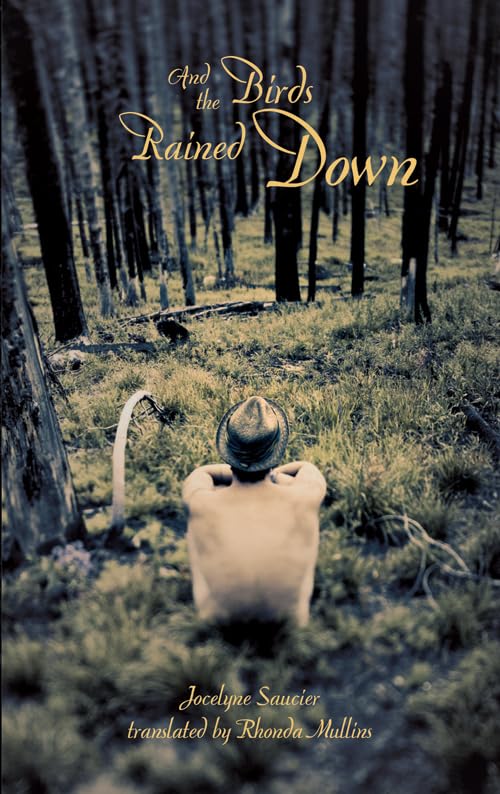
And the Birds Rained Down [Saucier, Jocelyne, Mullins, Rhonda] on desertcart.com. *FREE* shipping on qualifying offers. And the Birds Rained Down Review: Hermits? Not so much. - This short French Canadian novel, translated by Rhoda Mullins into an English that you would take for its original language, is a delightful sleeper of a book. Unprepossessing cover, slow start… do I really want to read about a bunch of old men in their eighties and above, living in the Northern Ontario forest and not washing for months at a time? But author Jocelyne Saucier introduces her chapters in a sly, deliberately old-fashioned way that is a joy in itself. "In which people go missing, a death pact adds spice to life, and the lure of the forest and of love makes life worth living…". All right, I'll give it a try. And am so glad I did. The first voice we hear is that of a female photographer who, in the mid-1990s, is tracking down survivors of the great fires that ravaged Northern Ontario between 1911 and 1922. The man she hopes to see, Ed or Ted Boychuck, has just died, but she manages to reach an understanding with his neighbors, Charlie and Tom. A chapter at a time, Saucier introduces three other characters: the manager of the run-down hotel at the head of the lake, the younger man who keeps them all in funds by farming pot on their territory, and his elderly aunt, whom he has sprited away from the mental facility where she has been unjustly confined for 66 years. Hermits? Not so much. One of the chapters is even headed "The Community by the Lake." And the love promised at the start will soon make an appearance. There have been a number of novels recently about old people; the two examples that most immediately come to mind are both English: MAJOR PETTIGREW'S LAST STAND by Helen Simonson, and THE UNLIKELY PILGRIMAGE OF HAROLD FRY by Rachel Joyce. I think the attraction is the reassurance that old age does not necessarily mean the end of life, and that the mistakes of the past can sometimes be rectified in surprising ways. And so it is here; "Charlie's Third Life" is the heading of another chapter. (But in case you think it gets too sappy, "Two Graves" is the title of yet another.) Yet Saucier has a deeper center of gravity than those two British examples. She reminds me a little of fellow Canadian Jane Urquhart, especially in the latter's novel A MAP OF GLASS , for the scope of her historical awareness and the importance given to art. For the Great Fires, although historical fact, have also become the source of rich folk myth, and it is the intersection between the two that the photographer is tracking. It turns out that Boychuck, surviving but scarred, left a vast collection of almost abstract paintings in his shack when he died, and these provide a personal commentary on the events of so long before. Saucier's trip into the lives of these isolated old men not only ends as a celebration of friendship, but her archaeology of the past opens a glowing window onto the possibilities of the present. Review: “She Smiled With Every Wrinkle On Her Face” - Every once in a while you come across a book for which a genre is is not easily found. “And the Birds Rained Down” ('Il pleuvait des oiseaux') by Jocelyne Saucier, translated from the French by Rhonda Mullins, is such a book. It’s a quiet, sometimes meditative book, which I would generally put in “gentle reads” with books like Major Pettigrew’s Last Stand by Helen Simonson and Jim the Boy by Tony Early. In the end this may be the appropriate genre for And the Birds Rained Down. Often this genre includes themes of love, nature, philosophy, tender meditation, age and interpersonal relationships, i.e. the meaningful connections forged between people, all themes which definitely fit the bill for And the Birds Rained Down. Literary language, though not a theme, is a must for the books I call gentle reads. The title, And the Birds Rained Down, is part of the draw of the book. “But we must (first) pause and introduce the Great Fires that ravaged Northern Ontario at the beginning of the twentieth century”. One of the main characters, the Photographer is looking for the survivors of the fires. She comes across “The little old lady (who) was a survivor of the Great Matheson Fire”. The little old lady told the photographer about ‘the sky black as night and the birds that were falling from it like flies’... ‘It was raining birds,’ she told her”…’and you couldn’t breathe for the heat and the smoke, neither the people nor the birds, and they fell like rain at our feet.’ Ultimately the photographer was to put on an Exhibition and she would recall how the little old lady had described the fire and knew then that ‘It was raining birds,’ would be the title for her exhibition, as And the Birds Rained Down became the title of Saucier’s book. At its heart, this is a story of three old men who choose to live out their twilight years hidden away in the Canadian wilds without modern day amenities and without other people. Their simple shacks were near to one another, making the three men neighbors in the woods. Charlie and Tom, as well as the third man, Ted, presumably all made up names to keep their identities unknown to the outside world, particularly the police and pesky social workers, are ‘three souls in love with freedom’. ‘Freedom is being able to choose your life’…‘And your death.’ The third man, Ted or Ed or Edward – known also as Boychuck (a name I personally played with throughout the novel because it so reminded me of the Yiddish word, “boytshik, a Jewish term of endearment for a boy or a son; this had no bearing on the story whatsoever, I just enjoyed pronouncing it that way in my mind’s ear)— though very much a part of the story is also very much dead when the book begins. When the photographer continues to pry into Boychuck’s life and death, she is told by Tom, ‘He just reached his expiration date. ‘At our age, that’s how you die.’ A great line that comes up more than once in the book. There are other secondary characters in the novel and one other very major one I’ve yet to mention. She was my favorite. Her name was Marie-Desneige (I read in an author interview that the character of Marie Desneige is based on a real person whom the book is dedicated, Marie-Ange Saucier). Marie Desneige was brought to Charlie and Tom’s camp by a minor character, Bruno who tells them her wretched history. His aunt had come to be admitted to a psychiatric hospital and lingered in the asylum for ‘Sixty-six years of internment, a devil’s cauldron of emotions’. As the story progresses an octogenarian love affair is created as Charlie takes Marie Desneige under his wing and shows her a whole new life, not just of stolen, old-folk kisses but of full-blown sensuality. I loved the description of their developing love story. It was so unlike any other I have ever read. The love between these two 80-something individuals was tender and the lovemaking was both sensual and sexual. ‘She smiled with every wrinkle on her face.’ An award winning line if ever there was one. A few final notes. Marijuana plays a small but ultimately significant role in the story. An example, as Marie Desniege settles in, the others “went down to the great hall where a tasty joint and a good discussion awaited them”. I came upon this book in a circuitous way on Goodreads. In fact, it is what makes Goodreads Great-reads. One book review and reviewer leads to another and then another and so on. Diane Barne’s excellent review of And the Birds Rained Down inspired Karen and Betsy Robinson to read and review it which inspired Antoinette, who’s wonderful review I happened upon and I was inspired and intrigued enough to buy my kindle edition. This chain of reciprocity led me to learn about a book and an author hitherto unknown to me, to read it and finally to review it. I can only hope that some reader will happen upon my review, become inspired and continue the chain. And the reading goes round and round. And the Birds Rained Down was a contender for Canada Reads in 2015 and it was made into a movie released in March 2020. It looks to be a wonderful rendition of a wonderful book.
| Customer Reviews | 4.1 4.1 out of 5 stars (426) |
| Dimensions | 5 x 0.75 x 8 inches |
| ISBN-10 | 1552452689 |
| ISBN-13 | 978-1552452684 |
| Item Weight | 8 ounces |
| Language | English |
| Print length | 176 pages |
| Publication date | April 30, 2013 |
| Publisher | Coach House Books |
R**E
Hermits? Not so much.
This short French Canadian novel, translated by Rhoda Mullins into an English that you would take for its original language, is a delightful sleeper of a book. Unprepossessing cover, slow start… do I really want to read about a bunch of old men in their eighties and above, living in the Northern Ontario forest and not washing for months at a time? But author Jocelyne Saucier introduces her chapters in a sly, deliberately old-fashioned way that is a joy in itself. "In which people go missing, a death pact adds spice to life, and the lure of the forest and of love makes life worth living…". All right, I'll give it a try. And am so glad I did. The first voice we hear is that of a female photographer who, in the mid-1990s, is tracking down survivors of the great fires that ravaged Northern Ontario between 1911 and 1922. The man she hopes to see, Ed or Ted Boychuck, has just died, but she manages to reach an understanding with his neighbors, Charlie and Tom. A chapter at a time, Saucier introduces three other characters: the manager of the run-down hotel at the head of the lake, the younger man who keeps them all in funds by farming pot on their territory, and his elderly aunt, whom he has sprited away from the mental facility where she has been unjustly confined for 66 years. Hermits? Not so much. One of the chapters is even headed "The Community by the Lake." And the love promised at the start will soon make an appearance. There have been a number of novels recently about old people; the two examples that most immediately come to mind are both English: MAJOR PETTIGREW'S LAST STAND by Helen Simonson, and THE UNLIKELY PILGRIMAGE OF HAROLD FRY by Rachel Joyce. I think the attraction is the reassurance that old age does not necessarily mean the end of life, and that the mistakes of the past can sometimes be rectified in surprising ways. And so it is here; "Charlie's Third Life" is the heading of another chapter. (But in case you think it gets too sappy, "Two Graves" is the title of yet another.) Yet Saucier has a deeper center of gravity than those two British examples. She reminds me a little of fellow Canadian Jane Urquhart, especially in the latter's novel A MAP OF GLASS , for the scope of her historical awareness and the importance given to art. For the Great Fires, although historical fact, have also become the source of rich folk myth, and it is the intersection between the two that the photographer is tracking. It turns out that Boychuck, surviving but scarred, left a vast collection of almost abstract paintings in his shack when he died, and these provide a personal commentary on the events of so long before. Saucier's trip into the lives of these isolated old men not only ends as a celebration of friendship, but her archaeology of the past opens a glowing window onto the possibilities of the present.
S**K
“She Smiled With Every Wrinkle On Her Face”
Every once in a while you come across a book for which a genre is is not easily found. “And the Birds Rained Down” ('Il pleuvait des oiseaux') by Jocelyne Saucier, translated from the French by Rhonda Mullins, is such a book. It’s a quiet, sometimes meditative book, which I would generally put in “gentle reads” with books like Major Pettigrew’s Last Stand by Helen Simonson and Jim the Boy by Tony Early. In the end this may be the appropriate genre for And the Birds Rained Down. Often this genre includes themes of love, nature, philosophy, tender meditation, age and interpersonal relationships, i.e. the meaningful connections forged between people, all themes which definitely fit the bill for And the Birds Rained Down. Literary language, though not a theme, is a must for the books I call gentle reads. The title, And the Birds Rained Down, is part of the draw of the book. “But we must (first) pause and introduce the Great Fires that ravaged Northern Ontario at the beginning of the twentieth century”. One of the main characters, the Photographer is looking for the survivors of the fires. She comes across “The little old lady (who) was a survivor of the Great Matheson Fire”. The little old lady told the photographer about ‘the sky black as night and the birds that were falling from it like flies’... ‘It was raining birds,’ she told her”…’and you couldn’t breathe for the heat and the smoke, neither the people nor the birds, and they fell like rain at our feet.’ Ultimately the photographer was to put on an Exhibition and she would recall how the little old lady had described the fire and knew then that ‘It was raining birds,’ would be the title for her exhibition, as And the Birds Rained Down became the title of Saucier’s book. At its heart, this is a story of three old men who choose to live out their twilight years hidden away in the Canadian wilds without modern day amenities and without other people. Their simple shacks were near to one another, making the three men neighbors in the woods. Charlie and Tom, as well as the third man, Ted, presumably all made up names to keep their identities unknown to the outside world, particularly the police and pesky social workers, are ‘three souls in love with freedom’. ‘Freedom is being able to choose your life’…‘And your death.’ The third man, Ted or Ed or Edward – known also as Boychuck (a name I personally played with throughout the novel because it so reminded me of the Yiddish word, “boytshik, a Jewish term of endearment for a boy or a son; this had no bearing on the story whatsoever, I just enjoyed pronouncing it that way in my mind’s ear)— though very much a part of the story is also very much dead when the book begins. When the photographer continues to pry into Boychuck’s life and death, she is told by Tom, ‘He just reached his expiration date. ‘At our age, that’s how you die.’ A great line that comes up more than once in the book. There are other secondary characters in the novel and one other very major one I’ve yet to mention. She was my favorite. Her name was Marie-Desneige (I read in an author interview that the character of Marie Desneige is based on a real person whom the book is dedicated, Marie-Ange Saucier). Marie Desneige was brought to Charlie and Tom’s camp by a minor character, Bruno who tells them her wretched history. His aunt had come to be admitted to a psychiatric hospital and lingered in the asylum for ‘Sixty-six years of internment, a devil’s cauldron of emotions’. As the story progresses an octogenarian love affair is created as Charlie takes Marie Desneige under his wing and shows her a whole new life, not just of stolen, old-folk kisses but of full-blown sensuality. I loved the description of their developing love story. It was so unlike any other I have ever read. The love between these two 80-something individuals was tender and the lovemaking was both sensual and sexual. ‘She smiled with every wrinkle on her face.’ An award winning line if ever there was one. A few final notes. Marijuana plays a small but ultimately significant role in the story. An example, as Marie Desniege settles in, the others “went down to the great hall where a tasty joint and a good discussion awaited them”. I came upon this book in a circuitous way on Goodreads. In fact, it is what makes Goodreads Great-reads. One book review and reviewer leads to another and then another and so on. Diane Barne’s excellent review of And the Birds Rained Down inspired Karen and Betsy Robinson to read and review it which inspired Antoinette, who’s wonderful review I happened upon and I was inspired and intrigued enough to buy my kindle edition. This chain of reciprocity led me to learn about a book and an author hitherto unknown to me, to read it and finally to review it. I can only hope that some reader will happen upon my review, become inspired and continue the chain. And the reading goes round and round. And the Birds Rained Down was a contender for Canada Reads in 2015 and it was made into a movie released in March 2020. It looks to be a wonderful rendition of a wonderful book.
J**B
A Bad Story Gone Good
This is a story of several tragedies really; the fire(s), the abandon hotel, the seemingly meaningless lives of some characters, the abuse of a sweet young girl, now an old woman. But out of the ashes comes friendships, deep love, purpose and promises kept. It is a fascinating read.
A**R
Three Stars
A nice summer read
L**X
Excellent book. This story is very unusual because it ...
Excellent book. This story is very unusual because it introduces us to a stade of life that we don't want to face . But being old can be viewed differently and it was uplifting to see how people can deal with it...
J**G
And the Birds Rained Down did not disappoint. It was a touching character study and at ...
I chose this book because I am approaching life's end, by age, and want to think about it and talk about it. And the Birds Rained Down did not disappoint. It was a touching character study and at one point brought a tear. I recommend it to those older readers who are thinking about their own death and the people of any age who are close to them - a tender topic.
A**W
A touching love story and so much more
Beautiful book. Loved the imagery. Having recently lived through devastating fires in Knysna it was particularly relevant. It was a touching love story but so much more.
K**2
Beautiful Book
This book was A CBC Canada Reads 2015 Selection, and a Finalist for the 2013 Governor General's Literary Award for French-to-English Translation. It deserved it. What a beautiful novel, and kudos to the translator as well. This book has become a favourite and will be added to my "read again" shelf, which has at most 10 books.
C**O
e-book free with this book, which I got. excellent.
L**B
Wird gelegentlich noch einmal gelesen, das Ende ist nicht ganz zufriedenstellend
H**Y
I order this book for my mom for Christmas. It came with a large print download so I was also able to read it. Fantastic story, well written, and good for parents and adult kids.
C**L
Saucier's book worked very well in our book club, prompting discussion on both structure and themes. It would be difficult to avoid discussing the central issue of the right to choose time and method of death but other topics such as mental health and friendship also surfaced. Particularly intriguing, too, is the book's structure, with various characters taking center stage for each chapter. We praised the use of language in the novel and pondered how the writer and translator worked together in achieving a satisfying read.
J**B
Jocelyne Saucier was awarded the Prix des Cinq Continents de la Francophonie making her the first Canadian to win the award. Rhonda Mullins was the finalist for the Governor General's Literary Award for French to English translation. In a Northern Ontario forest lived Charlie and Tom, two octogenarians. Charlie is 89 years old and Tom is 86 years old. Charlie is married and has two children. He is now retired from the post office. He loved the country and was a weekend trapper. After a visit with his doctor, he was told he had kidney failure and needed dialysis. Now that his children were gone and his wife had a pension, he put his affairs in order with the bank and notary and he headed for the woods to live his life on his own terms, freely and without responsibilities. There he met up with an old man named Ted, who let him move into a cabin near him with a view of the lake. Charlie lived in his well-organized cabin with his dog, Chummy. Tom arrived a few years after and he had cabin of his own. Tom was a Scotch drinker and his binges lasted for days and nights and ended in delirium, which led to a coma. His social worker tried to get him into a residence, but he refused. He, too, wanted his freedom. He was a shady character. He was a gold smuggler who crossed borders with cocaine hidden in his guitar. He was a musician, as well. When he tried to go behind the back of the high grader who hired him, goons arrived and broke his ribs and bashed in one eye leaving him blind in that eye. Ted was the third old man, but he died of natural causes. He was a painter and spent days in his cabin painting. They didn't see Ted for months and suddenly he would appear. No one knew anything about Ted. He was a broken soul. His cabin was between Tom and Charlie's cabins. One morning, when the men didn't see smoke coming out of his chimney, they knew Ted had passed. Charlie and Tom entered his home, removed him and buried him. The men had a buddy system. Over Charlie's bed was a box of salt, known as strychnine. It kills a man in ten seconds. Each man had his own box of salt, if they needed it. Charlie said he would use it when he could no longer walk. The others would use it if they were in a lot of pain. They also made a promise to bury the other, when the time came. There were two young men, Bruno and Steve. They were marijuana growers. They were the only link the old men had to the outside world. In the winter, Bruno would come in his snowmobile and would bring them a sack of supplies like fruits and vegetables and winter clothes for the very cold months. He brought Charlie an auger to make a hole in the lake, so that he could fish for trout. In the summer, their solitude is disrupted with the arrival of two women. The first is a photographer, unnamed in the story, who is in search of survivors of the Great Fires that took place in Northern Ontario a century ago. She stumbles upon this community of old men. She is in search of a man named Boychuck, but finds out that he is dead. The photographer is gathering stories and taking pictures. The fires took the lives of people and destroyed homes. If you didn't burn to death, the lack of oxygen would get you. Birds came down like rain, hence the title of the book. The second woman is the elderly aunt of Bruno. She is an escapee of a mental institution, where she had spent 66 years. Her father had put her there saying she was insane, but she was sane. Her name is Gertrude, but Bruno had lied to authorities and told his aunt to change her name, so she won't be found. He drove her to the woods to live the rest of her life. She changed her name to Marie-Desneige. In time, a friendship and a romantic relationship is formed between Charlie and Marie-Desneige,, the little old lady with the white hair. Jocelyne Saucier has written a book with so much charm, tenderness and wisdom. The characters will steal your heart. Seeing them interact is so touching. Jocelyne Saucier's story is breathtaking. What I received from this book is to treasure the time you have and how friendship plays an important part in one's life. The translation by Rhonda Mullins was outstanding. And the Birds Rained Down stands out as one of my favourite reads. I loved it.
Trustpilot
1 month ago
1 month ago