Buy anything from 5,000+ international stores. One checkout price. No surprise fees. Join 2M+ shoppers on Desertcart.
Desertcart purchases this item on your behalf and handles shipping, customs, and support to Indonesia.
⚡ Power up your cable game with precision and style!
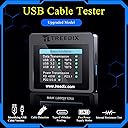
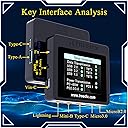
The Treedix USB Cable Tester is a professional-grade tool featuring a vibrant 2.4-inch color display that provides detailed diagnostics including USB cable continuity, internal resistance, and PD 3.0/3.1 fast charging support. It uniquely reads Type-C eMarker chips to reveal exact cable capabilities, ensuring compatibility with Lightning, Type-C, Micro-B, and Mini-B cables across USB 2.0 to 3.2 standards. Designed for tech-savvy professionals, it offers flexible power options and an intuitive interface to quickly identify high-quality cables and avoid subpar charging or data transfer performance.


| ASIN | B0DYJL5Z67 |
| Best Sellers Rank | #2,093 in Industrial & Scientific ( See Top 100 in Industrial & Scientific ) #2 in Network & Cable Testers |
| Brand | Treedix |
| Brand Name | Treedix |
| Color | black |
| Compatible Devices | usb cable |
| Customer Reviews | 4.6 out of 5 stars 425 Reviews |
| Included Components | usb cable tester |
| Item Weight | 0.09 Kilograms |
| Manufacturer | Treedix |
| Measurement Type | Ohms, Percentage |
| Min. Operating Voltage | 5 Volts |
| Minimum Operating Voltage | 5 Volts |
| Model | TRX5-0816 |
| Part Number | TRX5-0816-AC |
| Power Source | Battery Powered, Corded Electric |
| UPC | 644197778283 |
B**L
A Great Tool for Testing and Identifying All Types of USB Cables
Cables, Cables, Cables! Cables have gotten a lot more sophisticated over the years. It’s no longer just wires connecting two ends. Many modern cables include internal circuitry, chips, and e-markers that tell your devices what they can handle in terms of charging and data transfer. This little tester removes the uncertainty of trusting cable descriptions. It works with USB-C, Micro-B, and Mini-B cables, and can check continuity, data capability, and resistance. It also reads USB-C e-markers to show power delivery and data transfer capabilities, which is very helpful when sorting through a drawer full of mixed cables. What I like: - Works with more than just USB-C cables, including Micro-B and Mini-B - Reads USB-C e-markers to identify supported charging and data specs - Checks for continuity and resistance to verify cable integrity - Compact, easy to power with either USB or AAA batteries - The color screen is bright and clear, with an intuitive menu system It doesn’t test real-time charging performance, and that’s fine since that’s not what it’s designed for. I use another simple tester for that. This one is for verifying specs and quality, and it does that job perfectly (see pictures). If you have lots of cables and want to know exactly which ones are high-quality or support fast charging, this is an excellent tool to have on your bench or desk.
D**E
A very useful and easy to use tool
This is a very nice device and provides a lot of useful information. It is easy to use and easy to read. It comes with a small instruction booklet that is quite clear. The basic process is to connect both ends of your cable to the device and slide a small switch to the desired power source (included AA battery or external USB C power source). There are four pages of information and you step through them by pressing a small button. The first page gives you a summary of the protocols supported (e.g., USB 2.0, 3.2, 4 and Thunderbolt). Note that it does not report the "generation" of USB 3.2. Your computer might have USB 3.0, 3.1, 3.1 gen 1, or 3.2 gen 1 interfaces - these are all equivalent to 3.2 gen 1 (5 Gbps) and the "USB 3.2" indicator that will light for cables that support that. However, it also will light for USB 3.1 gen 2 and USB 3.2 gen 2 (10 Gbps), and for USB 3.2 gen 2x2 (20 Gbps) cables. The fact that 3.2 lights up indicates it's at least 5 Gbps but might be more. The second page shows the wire connection list between the two ends of the cable. The third page shows some resistance and latency information. The fourth page shows data from the "e-marker" chip, if present. These chips are embedded in some USB C cables. If present, the e-marker will report the max data rate and the max charging power supported. If you have USB A-A or USB A-C cables, or USB C-C cables without e-marker chips, you won't be able to tell whether they are rated for 5 (gen 1) or 10 (gen 2) or 20 Gbps (gen 2x2). If you have a cable with a chip, you will see the maximum data rate on the fourth page. Note also that if you want to evaluate a USB A-A cable, you'll need a USB A to C adapter plug. The unit has a wide variety of USB 2.0 connectors but only one Type A USB 3 connector. To perform the tests, both ends of the cable have to be connected to the device so you must be able to adapt a Type A connector on one end of the cable to a Type C. Overall I recommend this, but I wish it could tell which USB A-A 3.x cables support 5 (gen1) or 10 Gbps (gen 2) interfaces. I suspect it is technically impractical to determine that in a low cost device. I found that almost all of the USB C "charging" cables I have lying around have no e-marker chip and no data capability at all or just USB 2.0 480 Mbps. An e-marker chip is required for any cable that supports 60W or greater charging; any cable lacking the chip must necessarily be rated for <60 Watts, but you cannot tell whether it's 15, 20, 30W, etc. Lastly, the device comes with an AA battery. You can use that to power it, or you can plug in a power source via a USB C cable.
D**N
a magic wand to help you sort out your mess of cables
Informative and easy-to-use. Don't assume that just because the cable is new, it will be fast and support high power. Are you wondering why that Samsung cable that came with the power adapter transfers photos so slowly from your phone? It might be USB 2.0. Yes, even name brands cut corners on USB cables. They typically provide only the features they believe are essential to what the cables will most be used for. So, similarly, that USB 3.0 cable that came with your new external drive may not have Power Delivery and be able to handle higher watts. New doesn't mean full-featured. (Along these lines, you might want to invest in a USB power tester, such as the StarTech one I reviewed, and trying yours cables with an adapter and device that support high power, to see what the cable maxes out at.) Even though we think of USB as being all-purpose, in reality we wind up with this mish-mash of cables very few of which are all-purpose. Nor are the chargers. You can use a cable that is over-capable (with few exceptions), but you can't use a cable that is slow or underpowered if you want good results. With the help of this device, you can start to separate your cables into piles, so that you know what should be used for what! (And what should not be used for what!) Treedix fills a nice little niche with its USB cable testers in particular. They make a cheaper one that also works well, though this one is more powerful and easier to read, especially for figuring out speeds. Even with this thing, you're not going to learn everything about a cable, and if a cable is frayed or too small for the current, this is not gonna save you. But this is a very good starting point as you embark on that quixotic, continuing quest of trying to make sense of that infernal pile of similar-looking cables that you have accumulated in the Age of USB.
L**K
Tells which cables support high speed data and power delivery !
For those with a pile of USB-C cables that look alike... this little device is VERY handy for telling which cables support high speed data / power delivery. Also identifies bad cables. Extremely easy to use and works great. Device is powered by an AAA battery or USB-C - It uses up AAA batteries quickly - but that's OK. Recommended.
J**E
Overall, I'm happy with this.
So far, it has been working just fine for me. I like how easy it is to use. Another pro is it comes with an actual, well written, physical manual, not a QR code I have to read to download a manual. It uses a single, replaceable AAA battery to power it although an external power supply can also be used (I prefer battery operation over having a restrictive "umbilical cord" to a power supply. it ships in a well protected, reusable cardboard box. The one i received was obviously an open box (not sealed in plastic wrap like ones in review videos I've seen) but was probably unused since the included battery was still in its factory plastic seal. The box looked like it had been stomped on (thank you, Amazon, for shipping it in a flimsy envelope) but the tester itself looked just fine. Thanks to the plastic insert the tester was nestled into, the box is still in good enough shape to safely store the tester and its manual. I have four cons, though. The cover over the battery compartment was so tight it needed three men and a boy (which I didn't have handy) or a knife (which I did have handy) to get it opened (possibly the reason it had been returned). The included AAA battery was garbage. It provided power for my initial testing for around 30 minutes, then, after sitting in a drawer for a week, it was dead (yes, the tester was turned off and even if it wasn't, it turns itself off long before it can discharge a battery, another pro). I didn't take off stars in the rating for this because I have a herd of rechargeable AA and AAA batteries and had planned on using those once the original battery died. The third con is the location of the USB ports on the tester's case. The Type A and Type C output ports (actually, I would call them input ports) are located on one short side of the case and the input ports (I would call them output ports since some are Type B) are on the bottom of the case. That makes it impossible to test short cables. For example, I have a 4 inch USB 4.0 cable. it is impossible to test on this tester. I haven't checked to see what the minimum length of a cable that can be tested with this tester is but I would say it would be 6-8 inches, depending on the length of the connectors on the cable. If all the USB ports had been located on one side, it would have been possible to test shorter cables. Even though it would cause the case of the tester to be longer, it would have been worth it. The last con (and the least significant one) is not all USB connector types can be tested on this. On the "input" side, there are ports for USB Type C, micro B, and mini B (there is also a Lightning port). USB 2.0 and USB 3.2 Gen 1 Type A and B ports are missing. I have a lot of USB 3.2 Gen 1 Type A to Type A cables so it would be nice to at least check them for continuity when there is a problem or when sorting them out. Fortunately, I have only two devices that use USB 2.0 Type A to Type B cables—a flatbed scanner and my UPS— and only one USB 3.2 Gen 1 Type A to Type B—a duplexing ADF scanner. It would have been handy to have had a tester to test the latter cable when I had an issue with the scanner dropping out instead of having to order another cable and wait for it to be delivered to see if the cable was the problem (it was).
C**.
Put your USB cables to the speed and power tesr
Very helpful. It tells you everything about the cable, not only power specs but also data transmission standards. Easy to operate. Powered by 1x 1.5V AA battery (included)
J**.
Handy tester when dealing with multiple cables.
This tester is ESSENTIAL when you’re trying to find out which cables are good and which ones are junk. Not too expensive for what it is, I use mine multiple times a month. Screen is bright and legible and so far it has accurately read all of the cables I’ve tested it on. If you do tech repair, you need this.
A**R
Easy to use and flexible
This is a handy little tester that helps you determine the properties of a cable, which often aren't obvious just by looking at the cable. It's very easy to use and although the display is fairly small, it is easy to read because the information is presented in an organized fashion. This tester supports cables with USB A or USSB C on one end, and either USB C, Micro USB, Mini USB, or Micro USB "3.0". Unfortunately it does not support USB B ("printer style") connections or USB B 3.0 style cables. Since those connectors are larger, I believe it would require the tester to be thicker. Additionally, this tester does not support lightning cables. There are 4 "screens" of information which you cycle through by pressing a (very) small button. The first screen is an overshowing if the cable can transmit data and power, and which type(s). The second screen shows the actual wire connections and their status. The third screen shows the cable resistance and can estimate the cable length, and the 4th screen will show the details of an active chip if there is one in the cable. Every computer technician or enthusiast should have one of these in their bag! PROS: * Small and easy to use * Gives you all of the details you need to know about a cable * Flexible and supports a number of common cable types and configurations CONS: * Does not support USB B, USB B 3.0, or lightning * Button to move between screens is a bit small
E**C
It just works
Works as advertised.
M**E
USB Cable Tester
Excellent USB lead tester for routing out those poor quality usb leads you may have with details of power or data or both.
O**.
wow superó mis expectativas
Es una excelente herramienta, tengo demasiados cables en casa y pues ya con éste equipo ya podré clasificar si es para datos de baja velocidad, alta velocidad o simplemente cable de carga.
T**R
Works well and easy to test cables.
Works very well. I am going through every USB cable in the house. If broken it gets recycled. Anything lower than USB 2 gets recycled. They all get labelled and marked if it can handle PD.
C**G
Useful device for USB-C cable info.
Item is as described. Fast delivery. It is a bit expensive but display the necessary info about the cables. I wished the device can update future firmware when technology evolved. Thank you very much.
Trustpilot
2 months ago
1 month ago