
Buy anything from 5,000+ international stores. One checkout price. No surprise fees. Join 2M+ shoppers on Desertcart.
Desertcart purchases this item on your behalf and handles shipping, customs, and support to Indonesia.
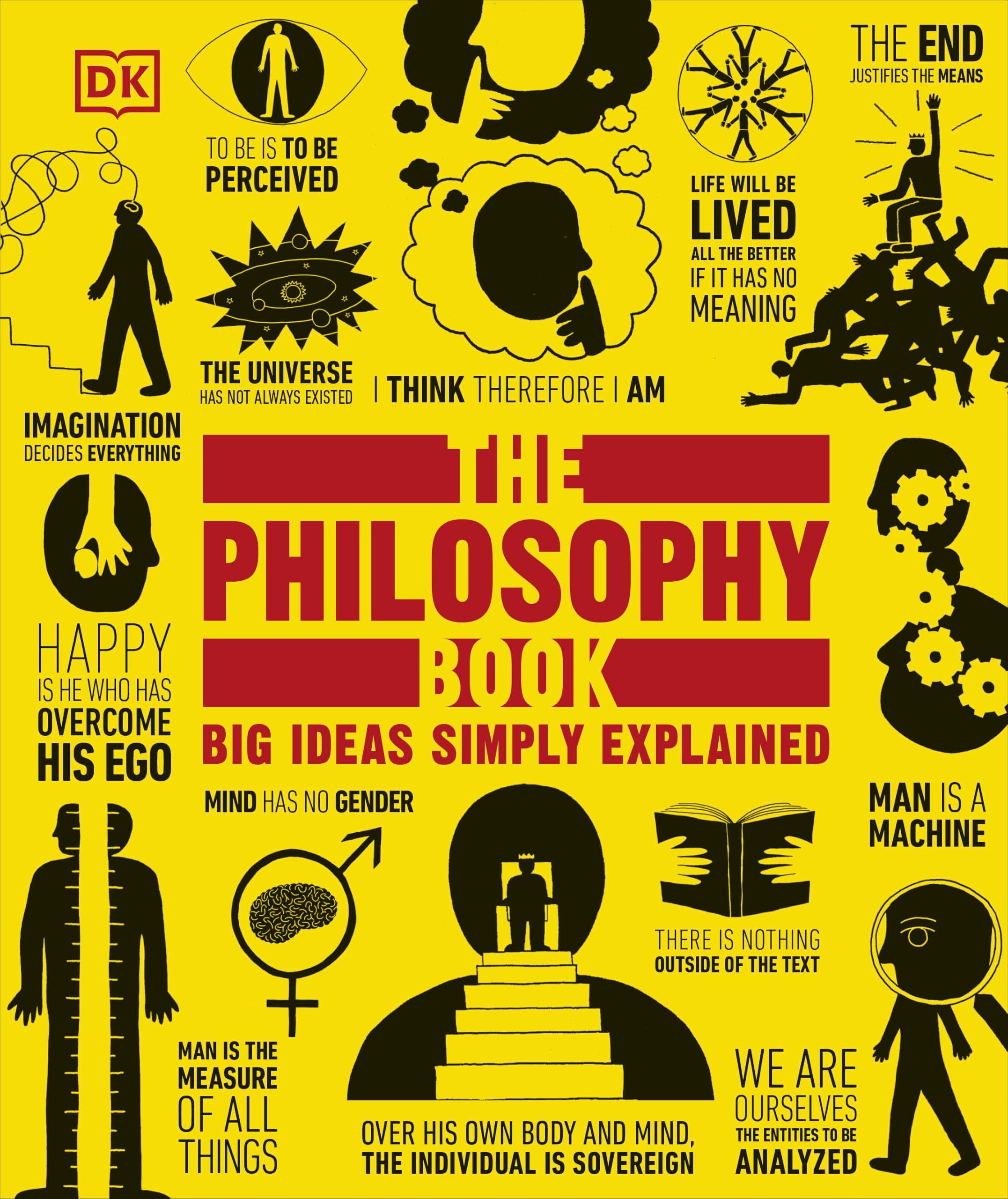
Get to grips with the concepts that shaped the way we think about ethics, politics, and our place in the universe. Explaining the big ideas and groundbreaking theories of key philosophers clearly and simply, The Philosophy Book is the perfect one-stop guide to philosophy and the history of how we think. Untangling knotty theories and shedding light on abstract concepts, entries explore and explain each complex idea with easy-to-follow explanations and innovative visuals. Explore the history of philosophy, from ancient Greece and China to today, and find out how theories from over 2,000 years ago are still relevant to our modern lives. Follow the progression of human ideas and meet the world's most influential philosophers – from Plato and Confucius through René Descartes and Mary Wollstonecraft to Ludwig Wittgenstein and Judith Butler. Dive into this phenomenal philosophy book to discover: -An accessible guide to philosophy, covering every major school and movement throughout history. -The clear and detailed text explains the most groundbreaking philosophical concepts and theories ever devised, while bold illustrations and pull-out quotes bring each idea to life. -Fully revised and updated to cover any developments in the field over the last 5–10 years. -Biography and context boxes place each idea in its wider historical, cultural, and social context. Your Philosophical Questions, Simply Explained If you thought it was difficult to learn philosophy and its many concepts, The Philosophy Book presents the key ideas in a clear layout. Find out what philosophers thought about the nature of reality and the fundamental questions we ask ourselves: What is the meaning of life? What is the Universe made of? And work your way through the different branches of philosophy, such as metaphysics and ethics, from ancient and modern thinkers. The Big Ideas Series With millions of copies sold worldwide, The Philosophy Book is part of the award-winning Big Ideas series from DK. The series uses striking visuals and engaging writing, making big topics easy to understand. Review: Easy to get hooked with. - Although I can’t speak to the nature of the e-book on any device, The Philosophy Book: Big Ideas Simply Explained is a very entertaining introduction to various historically significant philosophical minds. It includes images as well as a light amount of biographical information which is important for gathering the context through which these people were developing their thoughts. The intention of the book is be an overview of an entire subject since its inception in ancient times, so personally I find it difficult to fault for being brief considering how much content it aims to tackle. The segregation of time from section to section is fine given, once again, what a large time-span the book seeks to cover. In addition, this book is tailored to be appealing to youths who probably aren’t yet enabled to take a formalized philosophy course so there’s little cause to make it hyper-informative of individuals or get into the weeds of specific time periods. It is not a history book after all. If someone wants to learn more about a specific philosopher’s ideas this book provides a litany of paths to go down and without a publishing like this, it’s hard to have a significant awareness of the breadth of what is out there. However, there are some things it seems like the book could benefit from. Dedicated passages describing concepts of empiricism and rationalism would be a big plus since a lot of philosophers consider themselves to be decidedly one or the other. Without defining these terms the book’s intended audience, being people who are potentially reading their first book about philosophy, might come to feel like they were in the dark if they learn these things later. As well as this a page or two dedicated to the various formations of logic-based arguments you can make would have been instructive since that is where most meaningful philosophical dialogue is derived from. One more thing that may have been worthwhile would be a page indicating the various ethical theories in brief definition and who was able to first formally publish works regarding them such as utilitarianism, feminism, Kantian ethics, etc. It also needs to detail that although science does explain many things about the universe it cannot begin to explain everything, such as life after death or the nature of “God”. This is especially relevant to any of the stoic philosophers since their conception of God was pantheistic and radically different to any sort of self-centered human looking creation that many people today are inclined to conceptualize it as. All things considered the book is highly informative and more than intriguing enough to get someone more interested in the original subject. It could use more expansive discussion of what many of the cornerstones of basic philosophy courses are. It also quite crudely brushes by conceptions of “God” and takes no time describing the basics of forming an argument. I still am giving it the highest rating just because the interest it generates overwhelms all other deficiencies in it, especially given most people don’t receive a philosophy class in high-school and in terms of daily life it’s definitely critical to be able to contemplate things on a deeper level. Review: A good basis for understanding philosophy - This book is a great primer for anyone interested in delving into philosophy. I've read a fair amount of classic philosophical texts but realize it's often hard to understand the terminology or references that philosophers make. This book is great because it succinctly explains basic concepts of many thinkers and traditions and explains how they fit in the timeline of ideas, making things much more accessible. A friend told me he was interested in philosophy but didn't know where to start so I gave him this book. He got through it relatively quickly and said it greatly strengthened his base understanding of the philosophical tradition. It's really a great resource for getting an overview before diving into deeper concepts. I have more confidence now that someday I'll successfully tackle Hegel to impress a dinner party: the ultimate goal of philosophy.


| Best Sellers Rank | #19,703 in Books ( See Top 100 in Books ) #1 in Individual Philosophers (Books) #1 in Philosophy Reference (Books) #932 in Reference (Books) |


| Customer Reviews | 4.6 out of 5 stars 3,998 Reviews |
J**G
Easy to get hooked with.
Although I can’t speak to the nature of the e-book on any device, The Philosophy Book: Big Ideas Simply Explained is a very entertaining introduction to various historically significant philosophical minds. It includes images as well as a light amount of biographical information which is important for gathering the context through which these people were developing their thoughts. The intention of the book is be an overview of an entire subject since its inception in ancient times, so personally I find it difficult to fault for being brief considering how much content it aims to tackle. The segregation of time from section to section is fine given, once again, what a large time-span the book seeks to cover. In addition, this book is tailored to be appealing to youths who probably aren’t yet enabled to take a formalized philosophy course so there’s little cause to make it hyper-informative of individuals or get into the weeds of specific time periods. It is not a history book after all. If someone wants to learn more about a specific philosopher’s ideas this book provides a litany of paths to go down and without a publishing like this, it’s hard to have a significant awareness of the breadth of what is out there. However, there are some things it seems like the book could benefit from. Dedicated passages describing concepts of empiricism and rationalism would be a big plus since a lot of philosophers consider themselves to be decidedly one or the other. Without defining these terms the book’s intended audience, being people who are potentially reading their first book about philosophy, might come to feel like they were in the dark if they learn these things later. As well as this a page or two dedicated to the various formations of logic-based arguments you can make would have been instructive since that is where most meaningful philosophical dialogue is derived from. One more thing that may have been worthwhile would be a page indicating the various ethical theories in brief definition and who was able to first formally publish works regarding them such as utilitarianism, feminism, Kantian ethics, etc. It also needs to detail that although science does explain many things about the universe it cannot begin to explain everything, such as life after death or the nature of “God”. This is especially relevant to any of the stoic philosophers since their conception of God was pantheistic and radically different to any sort of self-centered human looking creation that many people today are inclined to conceptualize it as. All things considered the book is highly informative and more than intriguing enough to get someone more interested in the original subject. It could use more expansive discussion of what many of the cornerstones of basic philosophy courses are. It also quite crudely brushes by conceptions of “God” and takes no time describing the basics of forming an argument. I still am giving it the highest rating just because the interest it generates overwhelms all other deficiencies in it, especially given most people don’t receive a philosophy class in high-school and in terms of daily life it’s definitely critical to be able to contemplate things on a deeper level.
K**B
A good basis for understanding philosophy
This book is a great primer for anyone interested in delving into philosophy. I've read a fair amount of classic philosophical texts but realize it's often hard to understand the terminology or references that philosophers make. This book is great because it succinctly explains basic concepts of many thinkers and traditions and explains how they fit in the timeline of ideas, making things much more accessible. A friend told me he was interested in philosophy but didn't know where to start so I gave him this book. He got through it relatively quickly and said it greatly strengthened his base understanding of the philosophical tradition. It's really a great resource for getting an overview before diving into deeper concepts. I have more confidence now that someday I'll successfully tackle Hegel to impress a dinner party: the ultimate goal of philosophy.
H**H
Better than expected.
Bought without nearly any photos to base this purchase on and I’m glad I did. Who should buy this? ✅ Students in seminary ✅ College Students Studying Liberal Arts ✅ High School English or Social Studies Teachers ✅ Anyone curious about worldviews, life philosophies, and adaptations of thinking My experience: Awesome book for my new Christian Apologetics courses. It would have also been a benefit for me while teaching 11th & 12th grade English for American and British history. It would have better helped me to frame the units around the framework or lens people saw through during specific eras.
C**E
Interesting review.
Gave very short shrift to more recent philosophers from mid 20th century forward. Since many of these worked on ethical stances towards women. minorities, and animals it skipped significant information. Still, better than nothing and offers reasonable clarity of earlier philosophy.
D**Y
This is the most stunning, magnificent, and elegant works of literary art I have ever purchased
I will begin by saying I am completely new to the world of philosophy. I purchased this book along with Philosophy 101 by Paul Kleinman which I highly recommend. Ok where do I even start? This "book", if you can call such an amazing work of art that, is absolutely stellar and I am proud to own it (FYI I got the hardcover version which you should too). This is not a traditional book in the sense of needing to read the text in chronological order. The introduction is only about 8 pages long and rest of the book is comprised of short bios of famous philosophers, explaining who they were, and their philosophies. You could certainly read the book in chronological order, but I consider it to be something more of a reference book with greater flexibility in how you utilize it. You can flip to a random page and read about a staggeringly amazing human being or you can seek out specific philosophers/areas of interest. I cannot explain in words just how exemplary and profound the illustrations/graphics are in this book, succinctly explaining complex philosophical topics in an understandable manner. Do NOT buy this book to put on your coffee table and to look like an intellectual. Actually read it and you and those around you will become just a tad bit wiser. ***FYI: This entire book is available online for free in PDF form but I highly suggest you buy the physical copy instead. Reading a book on a screen just isn't the same especially for a book in this format. Having said that I mention this because you can print out pages to highlight/take notes if you're interested.
E**S
Excellent book ~ Everything is clearly spelled out and heavily illustrated
This book does an outstanding job of breaking down the history of philosophy into language that everyone can understand. Nothing could be more important than knowing how mankind has evolved through the ages, and the details of our thought process and ideology are clearly spelled out in this heavily illustrated text. 'The Philosophy Book' starts out with the very earliest of thinkers, and proceeds to cover the subject and its evolution to the present day. It not only explains the history of philosophy, but it delves deeply into the thought processes of the world's greatest thinkers, covering their viewpoints on subjects such as ethics, morality, scientific principles, religion, politics, etc. An understanding of philosophy and its principles is essential to mankinds existence. This masterpiece of a book takes a subject that can be very hard to understand, and breaks it down into bite sized pieces. The use of diagrams, timelines and comprehensive illustrations makes the subject matter much easier to comprehend. I only wish that a book such as this were available when I was in college. At the time, philosophy was a very difficult subject for me to understand. Had this book been in print, I not only would have had a clear understanding of the subject, but I would have enjoyed the learning process as well. Based on my experience with this exceptional volume, I'm eager to submerse myself in some of the other books in this series.
R**E
A Good Place to Explore, But Not a Place to Park
I give this book a five-star rating for being a great example of what it seeks to be - a simplified summary of a complex field of study. The main value of this book is that it summarizes the entire history of philosophy in easy-to-grasp terms, with pictures and quotes combined with a narration of historical periods. It leaves out some important things, but for the beginning explorer, it's a fine place to start. I would not, however, recommend that this book become one's "only" reference for a field of study that covers such a long time in history, and yet is constantly changing and evolving. It won't turn you into a college level professor of philosophy. Read it, or refer to it, as a kind of road map. Get some landmarks and travel information from it, identify some of the world-renowned leaders in philosophy, and then enter into a personal quest for more knowledge. Read some definitive books on one or more of the best names in philosophy, such as Socrates and Plato, Thomas Aquinas, Blaise Pascal, John Locke (how did he influence the development of modern democracy?), Immanuel Kant, all the way down to recent times, names such as Jean-Paul Sartre and Martin Heidegger, to name a few. Explore some current era writers such as Peter Singer. Philosophy is far too important and diverse to be limited to one book, no matter how excellent. For this unique book, its best quality, simplification, is perhaps its main fault as well. So for that reason, start here, drive around the "turf" of this book, but don't park your vehicle there.
P**A
Informative but poor layout
As someone completely new to philosophy, this book does give a light introduction to prominent philosophers and philosophies. I would have preferred a bit more info. Also, I found that the layout interferes with a smooth reading experience.
1**B
parfait pour les personnes curieuses mais qui n'ont pas le temps
très bien fait, simple à lire et à comprendre, surtout pour des personnes comme moi toujours pris par le temps (boulot et enfant) - et avec le confinement en ce moment je prend le temps de bien le lire, y compris la notice de ma TV.
P**R
Well Done!
Clearly the product of considerable efforts, this book superbly succeeds in attractively presenting major philosophers and their chief ideas in chronological order from Antiquity to the 21st century. One to six pages are devoted to each philosopher. In addition to a short but significant essay, each of these sections includes: • a ‘context’ box pointing out the applicable philosophical branch and approach as well as main predecessors and followers; • a short biography; • a list of key works; • references to linked thinkers discussed elsewhere in the book; • short quotations in bold script. The colourful and lively lay-out is fully worthy of current technological possibilities. Illustrations are abundant: cartoons, diagrams, photos of paintings or of philosophers’ portraits, etc. The book also includes timelines, a glossary, an index and a ‘directory’ of noteworthy truth-seekers who are not covered in individual sections. This work is warmly recommended to all: those familiar with philosophy will benefit from a unique synthesis and others will be stimulated to further their exploration of the topic.
R**G
I think therefore I read
A fascinating book to read through or delve into randomly. The chronological layout makes sense for readers new to the subject. The book presents the subject in a manner which has sufficient detail without making it heavy going and boggling the mind. Plenty of clear and illuminating diagrams augment the text. The lightly glossed paper has a quality feel and with the sturdy hardcover the book is good to hold and read. I buy most of my books on Kindle these days, but this is one of those which is definitely better to have in the hard copy.
M**S
Buen resumen de la historia de la Filosofía
Este libro es un buen compendio en inglés de la historia de la filosofía. Es sintético, claro y viene muy bien para tener una idea genérica de los principales pensadores occidentales y orientales también. No se necesita tener un nivel muy alto de inglés para entenderlo y tampoco de filosofía. Ideal para docentes y alumnos no universitarios y para toda aquella persona que esté interesada en tener un primer contacto con nuestra historia del pensamiento.
A**N
Good book, poor packaging
Book is great, looks appealing yet has a school / manual kind of feel. The book was to be a present but came bent. What is more, it squished the small box it was packed with so I had to restick seals and reinsert contents - that was a completely different order and meant for a different child. Box and book were not packed with foresight, either by seller or repacking facility. They both ended up smashed around corners and in an embarrassing state
Trustpilot
2 weeks ago
2 weeks ago