

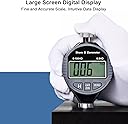


Hardness Tester, Durometer Shore Type D 0-100HD, Digital Durometer 0.1HD Resolution, with Large LCD Display for Rubber, Plastic, Tire, Flooring
Product ID: 612370630
📏0-100HA range
📺Large LCD display
🔢0.1HA digital precision
Buy anything from 5,000+ international stores. One checkout price. No surprise fees. Join 2M+ shoppers on Desertcart.
Desertcart purchases this item on your behalf and handles shipping, customs, and support to Indonesia.
📊 Precision in your palm—test smarter, not harder!
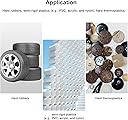
The Uharbour Digital Durometer Shore Type A offers highly accurate hardness measurements from 0 to 100HA with a fine 0.1HA resolution. Featuring a large LCD display for effortless reading, it’s engineered for versatile use on rubber, plastic, tire, leather, and wax. Lightweight yet durable, this tester combines ergonomic design with industrial reliability, making it an essential tool for quality control, manufacturing, and material research professionals.


| Customer Reviews | 4.7 out of 5 stars 20 Reviews |
T**S
worked great for me for measuring poly/rubber bushings
easy to use
C**K
good functioning meter
looks good work as suppose to nice big letter i just did not need this item
M**N
Nice for testing hardness of rubber, etc.
I often replace gaskets, o-rings, etc, and often need to know the hardness of the material so I can order the right part. This durometer tester is perfect for that. Just note: this is a Type D tester, which the instructions say is for harder material (not great for testing under 20).
D**N
Testing go kart tires
Use this for our dirt go kart tires, works well
Z**Q
Great identification tool
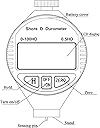
Review of B0DG8CQ6PR - Uharbour Hardness Tester, Digital Durometer Shore Type D In one of my prior lives I was a gemologist. As a gemologist, I had to identify gemstones. For identifying transparent gemstones, one of the clues was the refractive index (how much the gemstone bent light passing through it). The refractive index is measured by a refractometer. A refractometer is a critically necessary piece of equipment in a gemologist's toolbox. The refractometer didn't tell me want a gemstone was, but more what it wasn't. Identifying a gemstone is a process of elimination. So, in trying to identify plastics, I thought I'd try this Durometer to tell me the Shore-D hardness of plastics, which wouldn't tell me what the plastic is, but what it isn't. In one photo I've taken the Shore-D hardness of its case, which as you see, is 75.5 on the Shore D hardness scale. Not being a materials scientist, I didn't realize that each plastic has such a wide range of hardness due to possible additives. The 75.5 measurement is not as definitive as I had hoped. A materials specialist can probably identify this plastic just by looking at it and feeling it, but I can't. At least not yet... this Shore hardness tester may help with that. For example, 75.5 rules out LDPE (40-50), PTFE (50-65), CPVC (83-90), PET (85-95), PC (90-95), ABS (100), etc. This Shore D hardness tester will help rule out some plastics and narrow the possibilities, just as the refractometer did with gemstones. The manufacture of this device is excellent and its value to be high. It takes a standard 2032 coin cell. The knurled knob on top unscrews to expose what looks like an adjustment, but it mainly provides a solid press point. I consider this to be a great tool in my toolbox.
C**W
Useful tool
I’ve been using this digital Shore D durometer for basic hardness checks on rigid plastics and composite materials, and it’s done a decent job overall. The housing is lightweight, mostly plastic, but doesn’t feel flimsy. The buttons are responsive, though I found myself occasionally pressing them twice to register an input. Measurements appear consistent when taken correctly. Like most durometers, technique matters. You need to apply the same pressure and angle each time, and for better accuracy, a stand is recommended. Without a test stand, handheld readings can still be useful for quick comparisons, but there’s going to be some variation. I checked the device on a few known materials with published Shore D values, and it was reasonably close, though not lab-grade precise. One thing I did notice is that the auto-off feature kicks in fairly quickly. That’s not necessarily a bad thing, especially if you want to conserve battery life, but it might catch you off guard if you’re doing a series of tests and step away for a few minutes. Just something to be aware of if you’re mid-process. I’ll keep using it for casual evaluations and project development. Just remember that your technique matters as much as the tool.
R**G
Seems to work fine
I need one of these every once and a while for injury investigations and it's nice to have in my kit. The unit is small and doesn't take up much space. The controls are intuitive and it seems to work just fine for measuring hardness. Nice unit.
F**Y
Good meter , logical price
I've had a Shore A meter for a long while and just recently found myself testing harder materials regularly . I checked this against the meter I had borrowed from a friend and they appear to agree with each other . So , either they are both wrong or this one works as it should , haha .
Trustpilot
2 weeks ago
2 months ago