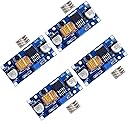
![D-Planet [4-Pack] 5A DC-DC Adjustable Buck Converter 4~38v to 1.25-36v Step Down Power Supply High Efficiency Voltage Regulator Module](https://m.media-amazon.com/images/I/71hsjeaahRL.jpg)


⚡ Power up smartly — efficiency and safety in one sleek module!
The D-Planet 4-Pack 5A DC-DC Adjustable Buck Converters deliver versatile step-down voltage regulation from 4-38V input to a finely tunable 1.25-36V output. With a robust 5A current capacity and up to 96% conversion efficiency, these compact modules feature advanced protections including over-temperature, short-circuit, and reverse voltage safeguards. Ideal for millennial makers and professionals seeking reliable, efficient power solutions for electronics, battery charging, and custom projects.
| ASIN | B079N9BFZC |
| Best Sellers Rank | #104,499 in Tools & Home Improvement ( See Top 100 in Tools & Home Improvement ) #381 in Power Converters |
| Date First Available | February 6, 2018 |
| Is Discontinued By Manufacturer | No |
| Item Weight | 0.564 ounces |
| Item model number | 5864305253 |
| Manufacturer | D-PLANET |
| Product Dimensions | 3.15 x 1.57 x 0.67 inches |
| UPC | 721968030648 |
C**T
Great value, easy to setup, voltage drifts a little bit as load increases.
I'm building an Arduino-based lithium battery charging rig, mostly for fun and learning, but also so that I can recycle old laptop batteries into solar power storage. I'm using these buck converters to step 12v supply down to 5v for powering TP4056 charge controller boards that charge 18650 batteries. Each of the 'battery modules' in the picture handles 4 batteries, and could draw up to 20 watts. So putting one of these buck converters on each module lets me distribute power at 12v instead of 5v, significantly reducing current flow, wire size, and voltage drop. The output voltage of the buck converter stays fairly steady, but it does drop as load increases. Adjusting the output voltage is straightforward, but make sure you turn the pot down before connecting anything. The units ship with the pot adjusted to full output voltage! With 12v input, and adjusted to 5v output with no load, here are the drops I saw as load was applied: 0.0a - 5.0v 0.5a - 4.93 1a - 4.86v 2a - 4.70v 3a - 4.55v Abruptly disconnecting the 3a load, voltage returned to the initial 5v setting. Using the 'max' function of my multimeter, I did not see any spike or overcorrection. These work really well for making a big step down ahead of anything that uses a linear regulator for final voltage regulation. The closer you can tune these to the final voltage you need for the anticipated load, the less energy the linear regulator will need to dissipate. From my measurements, these appear to use a common ground. So the negative output isn't really necessary as it is the same as the negative input. These are great little devices, with lots of uses. Definitely recommended.
C**S
They work!
I just received these today. Bearing in mind that the seller offers a refund for any non-functional units, I tested them all right away to see if any were DOA. None were! I'll update if any fail in use. They're pretty nice units overall, based on XLSEMI's XL4015 chip. The circuit seems to be pretty much straight out of the datasheet's application notes, with the exception that the output capacitor is 220uF instead of 330uF as suggested on the datasheet. The boards all appear clean, undamaged, and well soldered. In testing, their output regulation versus load and input voltage seems excellent. Output voltage remained solid at 5.0V from ~9-14V input voltage and 0-0.5A output current. At 0.5A, only the toroidal inductor got vaguely warm. All other components remained cool to the touch after several minutes, even without installing the included heat sink. Low current efficiency isn't great, but that's to be expected. Even at ~9V in, 5V @ 51mA out, though, I measured just short of 70% efficiency, which saves about 10mA current drain versus a linear regulator. A simple modification to slightly boost low current performance would be to remove the power LED from the board. At 5V out, I measured a current consumption of 0.65mA by the LED. The only downside? I didn't get the pictured standoffs. It's a minor complaint, as I'm probably not going to be using them, but it would have been nice to receive everything as pictured. --- In case it's of any use to anybody, here's a summary of the notes I took while testing all four units. It's not a broad battery of tests, since I mostly just wanted to make sure they'd work in my lower-current application, but maybe they'll be of use to someone. Results: No load output voltage: 5.00V, 5.00V, 5.00V, 5.00V 10 ohm load output voltage: 4.99V, 5.00V, 5.00V, 5.00V No load input current (@13.6V): 5.0mA, 4.9mA, 4.8mA, 4.6mA 10 ohm load input current (@13.6V): 210mA, 220mA, 210mA, 210mA Average efficiency: 86.5% Additional efficiency testing on one unit only: With 97.7 ohm load and output set to 5.00V (51.1mA out): 13.6V in: 31.4mA draw, 59.9% efficiency 8.84V in: 41.6mA draw, 69.6% efficiency LED current consumption: 0.65mA (3.32V across 5.1k resistor)
J**N
Working well so far!
I'm using one of these in a custom light setup, converting down from a 20v Porter Cable battery pack to 12v. These seem to work pretty well so far. The mounting holes are oddly placed, but I'm attaching a pic of the dimensions in case you want to 3d print your own tray or mounting enclosure.
N**O
This item works as described and works exactly for what I need it for. YAY. But the following is what is missing in the description: 1) The holes to hookup wires will not accept 18 gauge because the hole is too small. Here's what they did wrong: since the item can do 5 amps, and if you have a wire that is some length, then 18 gauge is far too thin. Plus, it's a plate-through hole so if you drill it wider, you are removing the electrical connection between top and bottom - and you just might introduce an un-intended consequence. 2) There is a small LED which lights when it is on. Nice touch. 3) -Vin is electrically identical as -Vout. 4) A little heat sink is provided separately. It's in the picture, but I now understand the picture showing the heat sink off to the side of the board. 5) There are two mounting holes. I didn't notice them in the pictures.
Trustpilot
3 weeks ago
1 month ago