
Number Theory (Dover Books on Mathematics)
Product ID: 5227105
Desertcart purchases this item on your behalf and handles shipping, customs, and support to Indonesia.
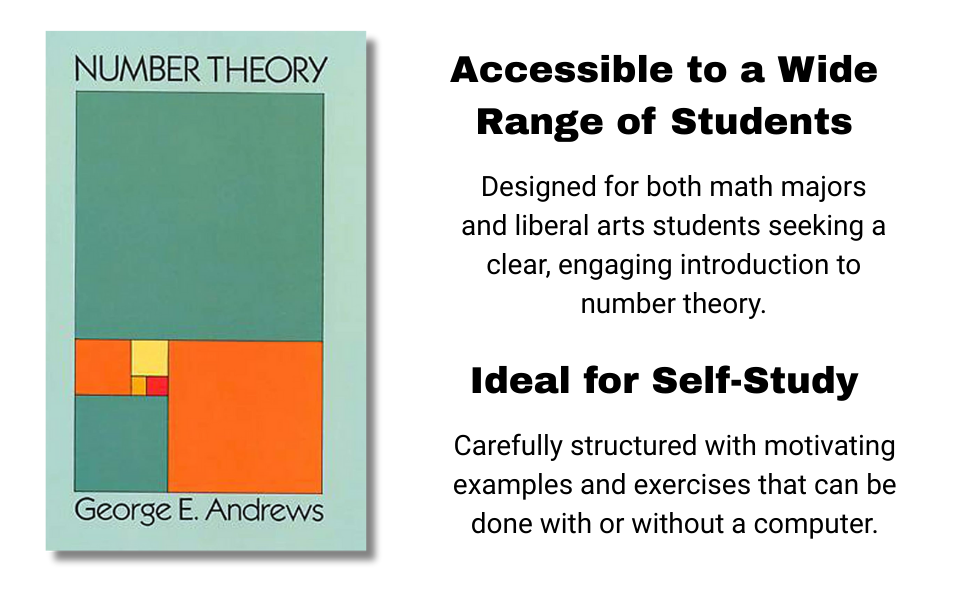
In this book, the author solves the problem of maintaining students' interest by offering a combinatorial approach to elementary number theory. Written by a distinguished mathematician and teacher, this undergraduate text uses a combinatorial approach to accommodate both math majors and liberal arts students. In addition to covering the basics of number theory, it offers an outstanding introduction to partitions, plus chapters on multiplicativity-divisibility, quadratic congruences, additivity, and more. Accessible Introduction : This book offers a comprehensive and accessible introduction to number theory, catering to both mathematics majors and students in education and liberal arts who require a more basic understanding of the topic. Combinatorial Approach : By taking a combinatorial approach to elementary number theory, this book offers new insights to mathematics majors while providing simple proofs for many theorems to other students. Wide Range of Topics : The book covers multiplicativity-divisibility, fundamental theorem of arithmetic, combinatorial and computational number theory, congruences, arithmetic functions, primitive roots, prime numbers, quadratic congruences, additivity, partition theory, and geometric number theory. Emphasis on Numerical Examples : The author emphasizes the value of numerical examples in number theory and demonstrates the role of computers in obtaining such examples, allowing students to derive conjectures and develop a deeper understanding of the theorems. Opportunities for Practical Application : Exercises throughout the book allow students to construct numerical tables with or without a computer, encouraging them to explore the concepts through hands-on practice. Review: Fresh Air - I recently took a one-semester course using this text. I found it to be one of the best textbooks I've used so far. The exposition was clear and easy to digest, with just the right number of clarifications and examples. The exercises were numerous, challenging and illuminating. No background beyond very basic set theory is assumed, and in fact the writer goes very far out of his way to keep his exposition separate from abstract algebra. This is most evident in the chapter on primitive roots. I can't speak for the second half of the book, on additivity, but I can say with certainty that the first nine chapters are worth the effort. Review: Excellent text by expert in the field - George Andrews is the reigning expert on partitions in the mathematical community who has written many seminal papers on the subject over the past half-century! If you don't know what partitions are in the theoretical sense, don't worry, the text provides ample introduction. I don't think you can find a more elementary introduction to the difficult, but extraordinarily powerful and elegant theory of partitions. The book covers the basics of number theory well, but it is the chapters on partitions that make this text stand out. It covers the Rogers-Ramanujan identities as well as the Jacobi triple product identity. It is rare in the mathematical community that an expert in a subject also writes a ground-level introductory text - but that's what you have here. Thanks to the dover edition, it's now quite affordable.
| Best Sellers Rank | #361,872 in Books ( See Top 100 in Books ) #62 in Number Theory (Books) #1,297 in Mathematics (Books) |
| Customer Reviews | 4.6 out of 5 stars 409 Reviews |
J**R
Fresh Air
I recently took a one-semester course using this text. I found it to be one of the best textbooks I've used so far. The exposition was clear and easy to digest, with just the right number of clarifications and examples. The exercises were numerous, challenging and illuminating. No background beyond very basic set theory is assumed, and in fact the writer goes very far out of his way to keep his exposition separate from abstract algebra. This is most evident in the chapter on primitive roots. I can't speak for the second half of the book, on additivity, but I can say with certainty that the first nine chapters are worth the effort.
D**R
Excellent text by expert in the field
George Andrews is the reigning expert on partitions in the mathematical community who has written many seminal papers on the subject over the past half-century! If you don't know what partitions are in the theoretical sense, don't worry, the text provides ample introduction. I don't think you can find a more elementary introduction to the difficult, but extraordinarily powerful and elegant theory of partitions. The book covers the basics of number theory well, but it is the chapters on partitions that make this text stand out. It covers the Rogers-Ramanujan identities as well as the Jacobi triple product identity. It is rare in the mathematical community that an expert in a subject also writes a ground-level introductory text - but that's what you have here. Thanks to the dover edition, it's now quite affordable.
P**.
Good Introductory Text for the Mathematically Inclined
As a retired statistician and teacher, I never had the opportunity to formally study number theory. Over the years I was exposed to the topic and learned some of the basics -- sort of the tip of the iceberg. I learned enough to want to know more; hence, the acquisition of this book. I am quite familiar with Dover Publications and a big fan of their libary. Dover typically publishes comprehensive texts at reasonable prices. So when I was looking for a book on this subject and saw this one, I decided to buy it. I am glad I did. I am working my way through it -- problems and all -- and have finished the first three chapters. I find the material well presented and satisfying my needs. As a statistician I appreciate the fact that Dr. Andrews elected to take a combinatorial approach to the topic. Being familiar with this type of reasoning makes certain topics easier for me to comprehend. The book is not for the layman and takes an individual with a solid mathematical background to get through it in its entirety. However, if you're interested in the topic and willing to put in the effort, the book will pay off.
A**R
BUEN LIBRO
EXCELENTE!!
J**A
Fun to read
Definitely not an easy read, but it was lots of fun and I liked it.
T**I
Interesting inclusion of computers
Number theory is both easy and difficult. This book does a good job of highlighting some of these aspects in a clear and straightforward way. It also does a good job of discussing the role technology is playing for some in the field today.
K**Y
Take this with salt
Good book if you have someone with you but it has a really hard introduction. The proof is not for the faint of heart and is beautiful if you understand it but I would recommend a different book (probably not from springer either if you are self teaching lol)./
T**D
Number Theory from a Different Viewpoint
I had a number theory class back in the dark ages when i was studying Mathematics at OSU. Before I started this book I reviewed another number theory book. It was like deja vu - the method was exactly what I had seen before. In fact, it may have been the same book. Then I picked this up to go a little more in depth. I was a little thrown off at first. Pretty much the same things were covered but from such a vastly different angle it almost seemed like a whole different field of mathematics. I can't say which viewpoint is the correct one (they both are, I guess) but, since the books are so inexpensive, I would suggest try each or using both. It is often eye-opening to see the same conclusion derived from attacking the problem from more than one angle.
ア**イ
分かりやすく、モダンな初学者向けの整数論
いわゆる平方剰余までの初等整数論の解説書であるが、数学専攻の学生を視野においた組み合わせ数学も随所に取り入れている。記述はふんだんに実例を取り上げて丁寧であるが定理等は簡潔にまとめられている。日本では、高木貞治の初等整数論が名著とされてはいるが、これは数学専攻の学生を対象としたかなり難解な書で、初学者にはハードルは高い。その点Number theoryは初学者には取っ付きやすく、高校の数学Aで学んだ学生にはスムーズに接続されるであろう。整数論は理科系の学生には基礎科目としては、通常カリキュラムには入っていない。しかし昨今ネットの暗号化、仮想通貨のブロックチェーンなどの時代の要請を鑑みると、整数論を学ぶことは理科系学生には必須と考えられる。その点で、このNumber theoryは英語も平易であるから整数論を学ぶ教科書として、十分選択肢になりうる。
M**A
Great introductory book on Number Theory
A classic book that covers elementary number theory and some advanced topics as well. The author used a "discovery" approach that it's not common in most modern texts on Number Theory. Each chapter and section is about a "question" that the author explores, and then uses to establish the theorems and proofs. The exercises aren't too difficult, but they are good enough to keep you engaged. As a downside, I should say that the approach is not as easy to revisit as other books that go directly into "theorem/proof" without too much exposure.
A**R
Excellent Supplementary Text for a Course on Number Theory
Excellent supplementary text to course I was taking!! Useful when I needed it the most!
F**A
Interessante
Livro de leitura interessante
T**N
Five Stars
very good introduction to number theory
Trustpilot
2 months ago
2 days ago