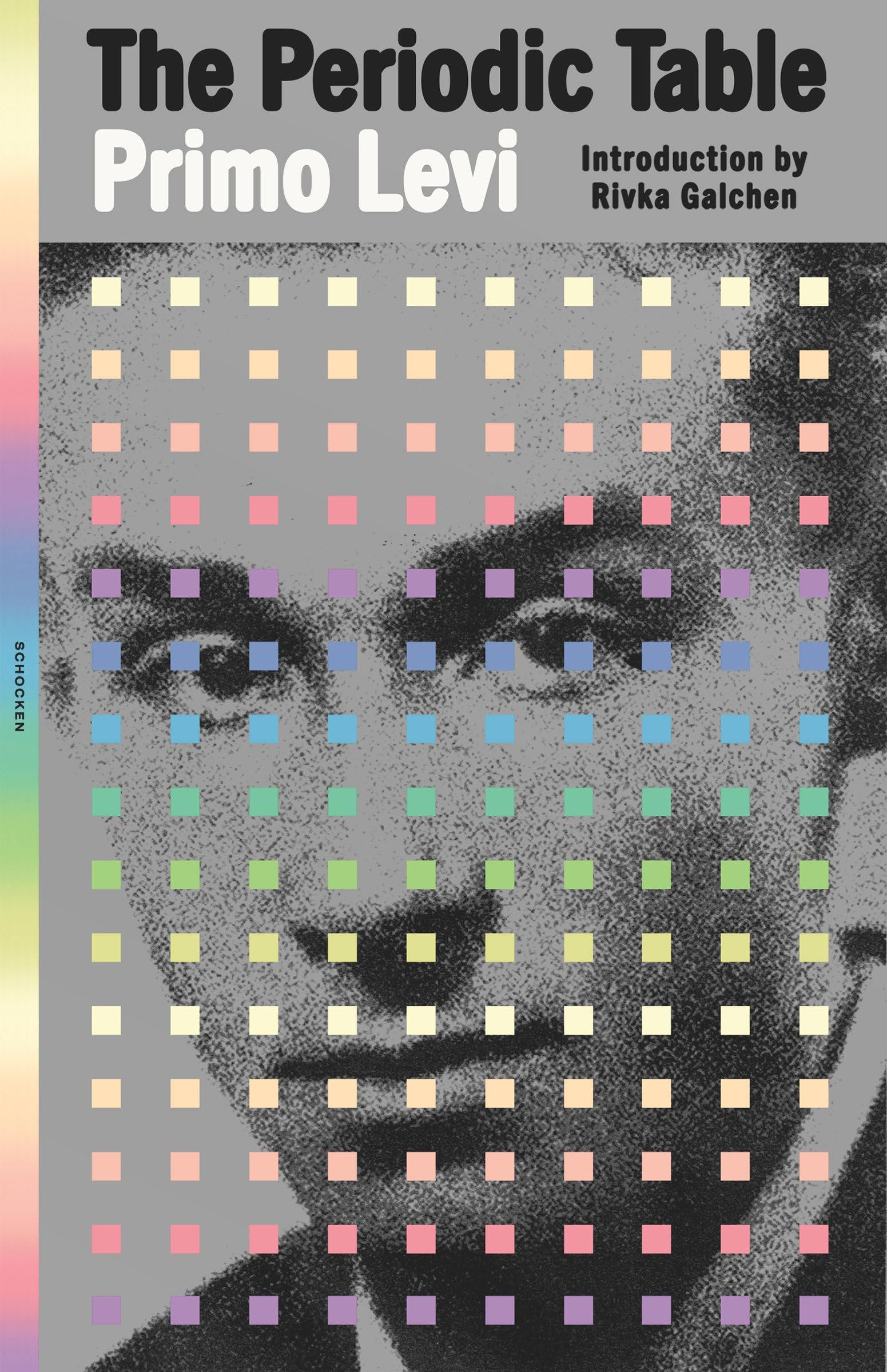
The Periodic Table
Product ID: 5001837
Buy anything from 5,000+ international stores. One checkout price. No surprise fees. Join 2M+ shoppers on Desertcart.
Desertcart purchases this item on your behalf and handles shipping, customs, and support to Indonesia.
In this literary masterpiece, one of the twentieth century’s most significant writers reflects on his life before and after the Holocaust, merging the scientific and the humane into a profound “work of healing” ( New York Times Book Review ) • Fiftieth anniversary edition, with a new introduction by Rivka Galchen As a youth, Primo Levi became fascinated by the laboratory, a site where the mysteries of the material world are unlocked and substances reveal their deepest truths. In this graceful, vital book—originally published in Italian in 1975—his passion for chemistry spans his extraordinary life story, with each chapter’s theme anchored in a different element of the periodic table. Beginning with his childhood in Italy’s Piedmontese Jewish community, Levi narrates his years as a student and fledgling scientist, before the descent of World War II, when he fought as an anti-fascist partisan until his arrest and transportation to Auschwitz. After surviving captivity, he returned to his work as a chemist and as a writer, striving in both realms to transmute matter into meaning. An artistic masterpiece of the highest order, The Periodic Table champions the power of friendship and curiosity to transcend times of tyranny and testifies to the fundamental interconnectedness of all the stuff of the universe—including us. Review: Elements of living - The Periodic Table is a remarkable analysis of units of living, making a living and re-living. It is a series of essays, each regarding a specific element in the periodic table which is a springboard for digressions on their surprising roles in the world of the author and for metaphors about the relationships that matter to us as human beings. The lyrical quality of Primo Levi's prose comes through its elegant translation and each essay stands well on its own but together they build an observatory of human experience well worth being shared It transports the reader to times and places of significance which are conducive to sober reflection and understanding. A great read. Review: Funny, poetic. - This book does not disappoint. The device of the periodic table is loose rather than restrictive. It is structured as a series of tales or short stories, unusual for a novel, but is unified by the persona of the chemist, as he moves through people, places and things he has known and studied. There are few references to the holocaust, as this has been fully addressed in his other novels, but he states that the writing experience was healing for him. Read it for its language if for nothing else, it is rightly celebrated.


| Best Sellers Rank | #63,312 in Books ( See Top 100 in Books ) #28 in Italian History (Books) #252 in Author Biographies #1,865 in Memoirs (Books) |
| Customer Reviews | 4.6 out of 5 stars 653 Reviews |
F**R
Elements of living
The Periodic Table is a remarkable analysis of units of living, making a living and re-living. It is a series of essays, each regarding a specific element in the periodic table which is a springboard for digressions on their surprising roles in the world of the author and for metaphors about the relationships that matter to us as human beings. The lyrical quality of Primo Levi's prose comes through its elegant translation and each essay stands well on its own but together they build an observatory of human experience well worth being shared It transports the reader to times and places of significance which are conducive to sober reflection and understanding. A great read.
G**M
Funny, poetic.
This book does not disappoint. The device of the periodic table is loose rather than restrictive. It is structured as a series of tales or short stories, unusual for a novel, but is unified by the persona of the chemist, as he moves through people, places and things he has known and studied. There are few references to the holocaust, as this has been fully addressed in his other novels, but he states that the writing experience was healing for him. Read it for its language if for nothing else, it is rightly celebrated.
B**D
Intriguing
Primo Levi, similar to Elie Wiesel, is so closely associated in my mind with The Holocaust, and Holocaust literature, that I was surprised to find that in THE PERIODIC TABLE, Levi rarely touches on it directly. And yet, as a memoir of his life as a chemist both before and after Auschwitz, the entire book is freighted with the knowledge of his time in the camps; similar, perhaps, to a biography of a man born with a serious birth defect, and how this background knowledge forces the reader to reevaluate the simple tasks of living that he'd previously taken for granted. Simultaneously, as a part of Levi's entire oeuvre, I also had the feeling that THE PERIODIC TABLE was a statement, an affirmation by Levi, who HAD become associated so closely with The Holocaust, saying, in effect, `I am not Auschwitz. I am a chemist.' Regardless, as others have noted, THE PERIODIC TABLE is a collection of stories--some true and some fiction, and each tied to one of the elements of the Periodic Table by some detail in the story. For instance, the first chapter, titled `Argon', contains a brief explanation of the group of gases that Argon belongs to--The Noble Gases: "There are the so-called inert gases...They bear curious Greek names of erudite derivation which mean `the New,' `the Hidden,' `the Inactive,' and `the Alien.' They are indeed so inert, so satisfied with their condition, that they do not interfere in any chemical reaction, do not combine with any other element, and for precisely this reason have gone undetected for centuries." Levi then goes on to interweave anecdotes about the Jewish community he knew growing up as a child in Italy, and one quickly picks up on the association between the Noble gases and this community. Most of the rest of the stories are not quite so allegorically tied to the elemental heading, though there always remains a hint of it. The early chapters I thought were dense and philosophical, which surprised me for some reason, though I either grew accustomed to Levi's style, or the stories became more straightforward as the book went on. I also found that after the initial pages, I thought the book captivating--which, again, given the episodic nature of the stories, was surprising. The long and the short of it is that, although I expected to enjoy the book, I enjoyed it for none of the reasons I suspected I would. It is not an easy book to categorize. Part fiction, part memoir; little direct mention of The Holocaust, and yet the book is entirely infused with it--I hesitate to call it unique, but I do think it stands apart. A very intriguing book.
C**3
The Periodic table littles stories in this man's life.
Extremely well written book, one that I will read again.
S**E
magnificent memoir
No, this book will not teach you what you missed in Chem 101. It is instead a stirring memoir of an Italian Jew ,a chemist, who survived the years of Italian Fascism and the subsequent Nazi occupation, by the the force of his creativity and sensitivity to the harrowing events that befell him. The memoir feels like a set of short stories. Each chapter is named for a chemical element. The use of this device was incredibly creative. In one case, Chapter 2 Hydrogen, the author recounts his teenage adventure with a friend, that generated hydrogen from water. In another chapter, Iron, the author describes his best friend and their mountain adventures. The friend seemed to have the qualities of Iron. Just as the elements have personalities- that is, they share, steal or give up electrons to form bonds with other elements, people also have personalities- resilient, affiliative, inert- and Dr. Levi draws parallels between these chemical and human personalities. And what stories he has to tell. A romance that might have been. Surviving a death camp by making flints for cigarette lighters. Uncovering a Nazi in a postwar business relationship. 3 amazing chapters which are wholly works of fantasy- not biography at all. The last chapter is a chemical story, the story of one element without a human subtext, the most important element to life on earth. The book is a tour de force, and a tribute to the fascination of scientific inquiry and experiment.
W**W
Funny, insightful memoir of a chemist
Quirky and insightful stories tied to elements describe Levi's life as a chemistry student and industrial chemist (skipping his experience in Auschwitz, which is described in his other books). Surprising, funny, and brilliant, with extraordinary language. A quiet masterpiece.
S**7
A chemist's tryst with elements
Periodic table' is a chemist's blueprint of the fascinating elements that make up our world. It was insightful to read this biographical account by Primo Levi, a Jewish chemist in Auschwitz, both during and thankfully after Nazi atrocity. True to its name, the focus is on his adventures with chemistry - chemistry as a man's passion, as well as a means to sustain in a big bad world. Reading about chapters on different elements definitely piqued this organic chemist's interest. It was a down memory lane on archaic inorganic analysis from B.Sc. days. Admittedly decades back during the author's time, exposure awareness and safety concerns were near non-existant and some of Levi's trysts were jaw-dropping to me as a modern practitioner (much akin to walking a tightrope without safety net!). Life of a chemist in a very difficult historical period, synthesized out of various "element"al chapters - awesome!
C**N
Interesting read, but I'm not sure who this book is for
Primo Levi is best known for his writings on surviving Auschwitz (which I have actually not yet read). However, before becoming a prisoner of war or an author, he trained and worked as a chemist. I chose to read this book under the pretense that it was his way of connecting his understanding of fundamental, elemental chemistry and relating it to his learnings on the experience of human life. I have to admit, I was a bit confused by this book. And it seems that Levi himself likely foresaw this, as he dedicates a subsection of a later chapter to detailing his intentions with writing it. It seems that his own descriptions are a bit less lofty (and indeed more humble) than the proclamations of the book's jacket. His stated purpose is simply to capture and retell stories experienced by himself and others that detail the life of a chemist and the role of chemistry as told through their eyes. The reality of this book lands somewhere in between those two extremes. Each chapter is dedicated to an element. The element in question typically makes an appearance in some way, shape, or form in the recollection being captured. Some of these have clear and profound implications. Others seem to just be vignettes, whose inclusion in this text I can't really make sense of. And, for some unknown reason, two of the chapters appear to be completely fictional short stories which, while quite pleasant to read, do not seem to fit with the rest of the book. Aside from these two chapters, the rest are autobiographical, insofar as they are either Levi's own personal stories or stories told to him directly. They are compiled chronologically, and reflect on his changing relations with the practice of chemistry before, during, and after his imprisonment. All told, the book is erudite, well-written, and decently interesting. Though I really can't say I have any idea who this book is for.
D**H
Not really science but compelling nonetheless
I came to this book expecting a more traditional nonfiction science book based on various elements that compose the periodic table. It was after all voted as the best science book ever in 2006 by the respected Royal Institution of Great Britain. In this respect I have to admit I was rather disappointed. The book comprises a series of autobiographical stories from Levi’s life. Each of these stories are inspired in some way by an element from the table. Nickel, for instance, tells the story of the chemical laboratories of a mine, Arsenic (a personal favourite) examines the analysis of a sugar sample (perhaps laced with arsenic) and silver the story of faulty photographic plates. While the majority of these stories are autobiographical in nature several, such as those of mercury and lead, are fictional. While some of the links to the periodic table are clear and front-centre others are more subtle. It is for this reason I was disappointed with the book as a science book in the strictest of definitions. That said, though I expected something entirely different the book makes for a compelling, thoughtful and interesting read which gives an intimate insight into Levi’s life, identity and experiences, especially that of being a Jew living under Fascist rule during the war and its aftermath. The quality of the work is astounding and the stories are each incredibly moving in their own way. I don’t know whether I can recommend this as a science book in the manner of the Royal Institution but I can wholeheartedly recommend it as the compelling collection of autobiographical stories with a scientific theme it is. This book really does give you a lot to think about and is one that I think has the potential to have a profound emotional impact.
B**T
bel libro
ottimo servizio sia per prezzo che per spedizione
L**A
Five Stars
Got it for a class, didn't read the whole book but very interesting
R**L
An enchanting autobiography
Note: This review is for the hardcover edition (ISBN: 9781857152180) About the Book: A witty, humane and life-affirming book. I had picked it up as many websites had extolled it as the best science book ever, based on a poll conducted in 2006 ([...]). Anyways, I guess I had started this book with totally different expectations. After all, it had beaten Charles Darwin's magnum opus, and with a title like this, the book should spit out serious top-notch chemistry trivia, right? Well, time to dampen those expectations a bit. So, I found it really fast that this is not a pop-sci book, no no.... This is basically a science-themed autobiography and memoir based on experiences of author during and after the Facist regime of Italy, where he was captured by Germans (his memoir on experiences in concentration camp is titled 'If this is a man'). As ignorant as I am, I got to know a great deal about Mussolini's regime and Fascism through this book, which was a plus. The 21 chapters of this book are each organised around an element, which features in the chapter itself. The writing is pretty smooth, not pretentious at all. What I really liked about the book was its matter-of-fact attitude, and the personality of the author. I mean, Primo Levi is one hell of a character!! He is hopeful, romantic, self-deprecating, resourceful, humorous, nerdy... Man, he would make such a wonderful dinner companion. I am not sure whether this is the all-time best Science book or not, but this is definitely a gem of a book. Glad to know such a person walked on this planet. About the Edition: The Hardcover I bought is from Everyman's Library, which is a bit pricier than the paperback version. But it is very much worth the modest increase, considering this is a classic that you may very well revisit. The binding is just lovely.
A**A
Damaged cover
Book is fine but packaging is a problem obviously. It was supposed to be a gift. Careless!
Trustpilot
5 days ago
1 month ago