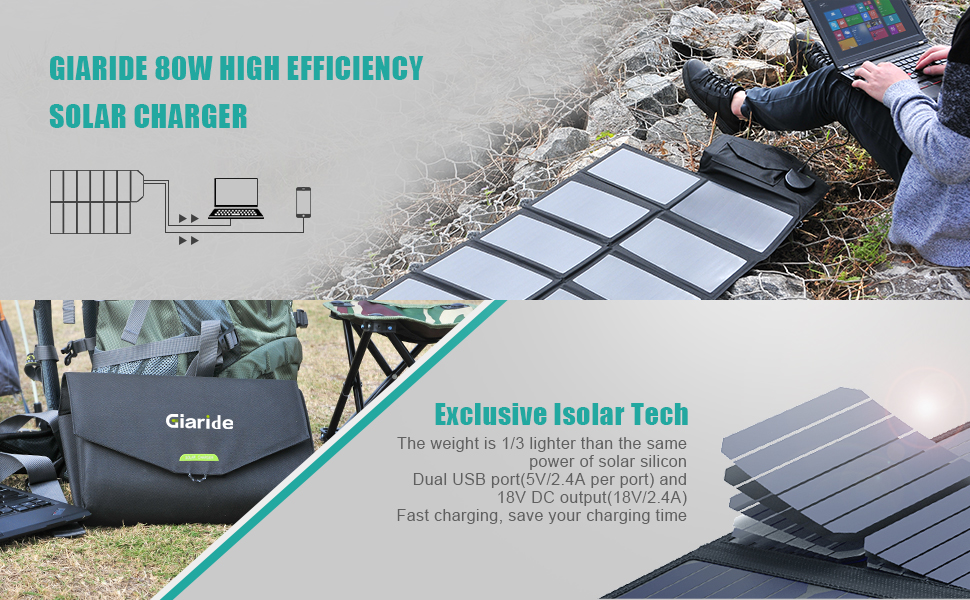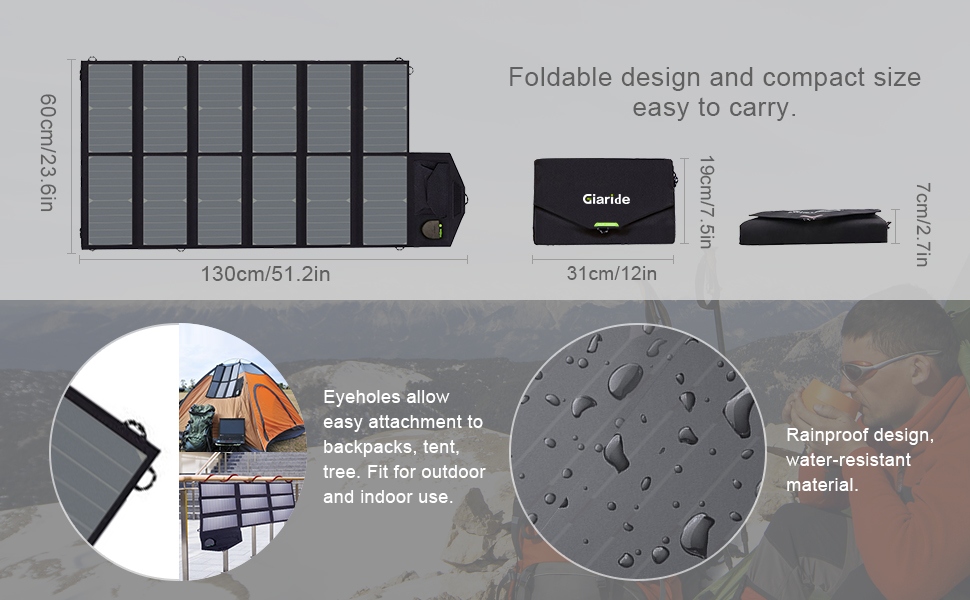


desertcart.com: GIARIDE Foldable Solar Panel USB/DC Solar Panel Charger 18V Portable Solar Panel 80W for Laptop Solar Battery Charger for Camping Portable Solar Panels for Rv Portable Solar Charger for Car Battery : Patio, Lawn & Garden Review: 185 percent more power at 40 percent less weight of my 5 year old foldable solar panel - This is a review of the Giaride 80-watt foldable solar charger. I believe this is the same item as the AllPowers 80-watt foldable solar panel, as the charge controller on mine says “AllPowers” even though the outside fabric say Giaride. I saw a comment somewhere that both companies’ solar panels are made at the same factory. First, I’ve noticed in some of the reviews that people were having problems with the 12v/19v DC output from the charge controller. The specs say that this is a DC5521 output. This means that the DC output is for a 5.5mm inside diameter outer barrel and a 2.1mm diameter inner plug. The spec is wrong, as the DC output is a DC5525, meaning that it’s measurements are 5.5mm and 2.5mm, respectively. I double checked that this was true with my micrometer. Adapters between the two sizes are available on desertcart. Second, the cigarette lighter plug provided is the male end. This makes no sense to me, as one doesn’t want to charge the solar panel. So you’ll need to buy the cigarette lighter female end if you want to charge other items with the 12/19 volt output. Make sure it is a 5525 connection or buy the adaptor to use a 5521 connection. Third, I used my multimeter to check the output of the solar panel and compared the results to a 5 year old 40-watt foldable solar panel that I am replacing. For the test, I used a TES 1333 Solar Power Meter to determine the light intensity. The light intensity when I ran my test was 1,050 watts/square meter (the meter and solar panel were both at the same inclination to the sun) which is very close the 1,000 watts/square meter that is used to standardize the output measurement of solar panels. For the Giaride, I measured an output at the DC connection of 22.46 volt & 3.46 amps for a total of ~77.7 watts, which is very close to the advertised 80 watts; for my old 40 watt solar foldable solar panel, I measured an output at the DC connection of 19.0 volts & 2.2 amps for a total of ~41.8 watts, which is also very close to what it was rated. Fourth, I tested the 5 volt usb outputs on my tablet and got an output of 4.9 volts & 1.05 amps for 5 watts. I then tested it through the dc output to a 12 volt factory Samsung cigarette adaptor and got an output of 5.3 volts & 1.63 amps for 8.64 watts. I got the same result with a wall charger as the 12 volt adaptor. I then ran this same test on a couple of backup batteries that I have that also have 12 volt dc outputs and 5 volt USB outputs. These batteries performed about about exactly the same as the Giaride solar charger for both the 5 volt and 12/19 volt outputs. So if you want to minimize your charge time it’s probably best to charge through a 12 volt adaptor. If charging as quickly as possible isn’t critical, I’m sure the 5 volt USB outputs are fine. Fifth, I measured the area of the 12 Giaride solar panels at ~0.397 square meters and measured my old 40 watt panel at ~0.278 square meters. Calculating the efficiency of the panels using my data, I arrived at an efficiency of ~18.6% for the Giaride and ~14.3% for my old solar panels. The efficiency value of the older panel, I believe, is typical for panels of that time, and while that 18.6 percent efficiency for the Giaride was below the advertised value, it is still significantly better than my old panel. Sixth, I weighed the Gliaride solar panel at 3lb 10oz/ 1.65kg; I weighed my old solar panel at 6lbs 3oz/ 2.8kg. Both are dimensionally pretty similar. Bottom line is that I get 185 percent of the power at 40 percent less weight and approximately the same volume with my new Giaride over my 5 year old solar panels. Review: Good Charge - I haven't used it a lot yet, but plan on using it at outdoor craft shows I do to charge my portable battery pack. I was surprised that it charged my phone on a hazy day, when the sun wasn't bright. The one drawback is the pouch on the inside is too small. If you put all the assessories in it, you can't fold it up. So I have to figure out something to keep it all together and not lose anything.


| ASIN | B072KD4XCD |
| Customer Reviews | 3.5 3.5 out of 5 stars (145) |
| Is Discontinued By Manufacturer | No |
| Item Weight | 4.97 pounds |
| Item model number | APXTDYL-170612-SPF-18v80w |
| Manufacturer | GiarideDirect |
| Package Dimensions | 13.07 x 6.54 x 3.78 inches |
A**R
185 percent more power at 40 percent less weight of my 5 year old foldable solar panel
This is a review of the Giaride 80-watt foldable solar charger. I believe this is the same item as the AllPowers 80-watt foldable solar panel, as the charge controller on mine says “AllPowers” even though the outside fabric say Giaride. I saw a comment somewhere that both companies’ solar panels are made at the same factory. First, I’ve noticed in some of the reviews that people were having problems with the 12v/19v DC output from the charge controller. The specs say that this is a DC5521 output. This means that the DC output is for a 5.5mm inside diameter outer barrel and a 2.1mm diameter inner plug. The spec is wrong, as the DC output is a DC5525, meaning that it’s measurements are 5.5mm and 2.5mm, respectively. I double checked that this was true with my micrometer. Adapters between the two sizes are available on Amazon. Second, the cigarette lighter plug provided is the male end. This makes no sense to me, as one doesn’t want to charge the solar panel. So you’ll need to buy the cigarette lighter female end if you want to charge other items with the 12/19 volt output. Make sure it is a 5525 connection or buy the adaptor to use a 5521 connection. Third, I used my multimeter to check the output of the solar panel and compared the results to a 5 year old 40-watt foldable solar panel that I am replacing. For the test, I used a TES 1333 Solar Power Meter to determine the light intensity. The light intensity when I ran my test was 1,050 watts/square meter (the meter and solar panel were both at the same inclination to the sun) which is very close the 1,000 watts/square meter that is used to standardize the output measurement of solar panels. For the Giaride, I measured an output at the DC connection of 22.46 volt & 3.46 amps for a total of ~77.7 watts, which is very close to the advertised 80 watts; for my old 40 watt solar foldable solar panel, I measured an output at the DC connection of 19.0 volts & 2.2 amps for a total of ~41.8 watts, which is also very close to what it was rated. Fourth, I tested the 5 volt usb outputs on my tablet and got an output of 4.9 volts & 1.05 amps for 5 watts. I then tested it through the dc output to a 12 volt factory Samsung cigarette adaptor and got an output of 5.3 volts & 1.63 amps for 8.64 watts. I got the same result with a wall charger as the 12 volt adaptor. I then ran this same test on a couple of backup batteries that I have that also have 12 volt dc outputs and 5 volt USB outputs. These batteries performed about about exactly the same as the Giaride solar charger for both the 5 volt and 12/19 volt outputs. So if you want to minimize your charge time it’s probably best to charge through a 12 volt adaptor. If charging as quickly as possible isn’t critical, I’m sure the 5 volt USB outputs are fine. Fifth, I measured the area of the 12 Giaride solar panels at ~0.397 square meters and measured my old 40 watt panel at ~0.278 square meters. Calculating the efficiency of the panels using my data, I arrived at an efficiency of ~18.6% for the Giaride and ~14.3% for my old solar panels. The efficiency value of the older panel, I believe, is typical for panels of that time, and while that 18.6 percent efficiency for the Giaride was below the advertised value, it is still significantly better than my old panel. Sixth, I weighed the Gliaride solar panel at 3lb 10oz/ 1.65kg; I weighed my old solar panel at 6lbs 3oz/ 2.8kg. Both are dimensionally pretty similar. Bottom line is that I get 185 percent of the power at 40 percent less weight and approximately the same volume with my new Giaride over my 5 year old solar panels.
S**I
Good Charge
I haven't used it a lot yet, but plan on using it at outdoor craft shows I do to charge my portable battery pack. I was surprised that it charged my phone on a hazy day, when the sun wasn't bright. The one drawback is the pouch on the inside is too small. If you put all the assessories in it, you can't fold it up. So I have to figure out something to keep it all together and not lose anything.
S**X
A lot of power in a small package.
80 Watts in a small fold up package. I tested with a meter after arrival and it performed very well.
D**D
Wish there were bypass diodes
Firstly, for the price, this is a decent panel. It uses SunPower cells (probably Maxeon C60) and it's well built. I'm not a fan of the barrel connector for raw panel output but it's not the end of the world. 3 stars because of the barrel connector and because I can't seem to get more than ~50w out of it. In addition to using the entire panel while stationary, I was hoping this panel was more versatile in its uses. It would be nice to use it folded lengthwise draping off of a backpack while hiking, for instance. Unfortunately, due to the connection of individual cells, this will produce no power. For the same reason, partial shade will significantly lower power output of the entire panel. You'll notice that, rather than using whole Maxeon cells, they use 6 slices. This is because a whole cell produces ~0.65 volts (open voltage) and wiring them up in series (24 x 0.65 = 15.6v open voltage) would produce less than the 12-18v most people look for under load. Instead, each slice of the cell produces ~0.65v but 1/6 of the current and all 6 are connected in series to produce ~3.9v. They wire two 6-slice cells in series as well to get ~7.8v. This allows the manufacturer versatility in building different size panels while keeping the voltage up to something useful (their 21 watt panel has 3 windows of 2 cells each = 7.8 x 3 = 23.4v open = ~18v under load). This panel has 12 windows of 2 cells each. 4 windows (8 cells) are wired in parallel and those are wired in series to produce ~23.4v open. I can't be certain if there are no bypass diodes at any of the series connection without significant testing or disassembling the entire thing but because half the panel lengthwise produces no power, I am fairly certain that there is not a bypass diode between the 2 series connections of the 3 parallel groups. I'm not sure if any 100w or weaker panel is manufactured with bypass diodes due to voltage drop which lowers the total power output but it's something that I personally would like to have. edit: Took it apart. No bypass diodes. I added my own and can now use it folded lengthwise. Not the most ideal diodes but I had them on hand. FDH444TR
A**N
Missing cables and amazon removed the item from amazon
item no more listed
A**N
Works well when cloudy can charge dead car battery in 4hrs
Good value and works very well on everything including car battery
L**S
Love this for my bug out bag
outstanding!!! Love this for my bug out bag.
V**A
Funciona de maravilla, he estado un mes y medio en la furgo y he podido cargar todos mis dispositivos sin problema, incluso cuando no brillaba mucho el Sol. Muy contenta con la compra.
T**U
Ich hab das Solarmodul deswegen gewählt, weil in der Beschreibung steht es stelle sich selbst auf die zu speisenden Stromabnehmer richtig ein. Stimmt wirklich! Leerlaufspannung gemessen 19 Volt bei Sonne um 12:00, dann einfach mal im Auto angestöpselt und wieder gemessen, siehe da - Spannung ca 12,5 bis 14,0 Volt je nachdem wie man das Modul zur Sonne dreht. Danach erstmal Härtetest, den Verteiler im Auto (an dem steckte auch das Solarmodul) vom Bordnetz abgekoppelt - und ich staunte nicht schlecht, Funkgerät, Kühlbox und kleiner Notebook (zuerst bei dem den Akku rausgenommen) liefen immer noch weiter. Also dürfte die Leistungsangabe stimmen. Jedenfalls alles in allem praktisch, funktioniert und besonders hervorzuheben: Vorinfos beim Verkäufer eingeholt, Antwort kam prompt nach kurzer Zeit. Nette Kommunikation, wenn auch nicht in perfektem Deutsch, was aber dem guten Service keinen Abbruch tut. Ich werde dieses Teil also auch für die zwei anderen Fahrzeuge anschaffen. Ich würd's empfehlen, auch zum Rumtragen (Berg gehen usw.) weil es leicht und wirklich klein zusammenlegbar ist. Auch die Autobatterie nachladen, wenn auch langsam, aber immerhin, nach 2 Stunden konnte ein Auto wieder starten - geht!
S**O
Ottimo per chi non dispone di elettricità per ricaricare il cellulare o altri utilizzatori, ricarica velocissima anche con poco sole, possibilità di ricaricare 2 utilizzatori in contemporanea
P**S
Very good. Charges a battery quite quickly if in direct sunshine. I'm happy with this product.
M**S
Ce panneau délivre bien les 80W annoncé, avec une pleine exposition et un grand soleil. Ce qui est bien pour ce type de panneau pliable, et par rapport à ce qui est annoncé. J’ai mesuré la tension à 24,1V au maximum avec une pleine exposition vers le soleil, et 23,5V avec le soleil a 45°. J’ai mesuré l’ampèrage à 3,5A au maximum, la aussi avec une parfaite exposition et au heures de pointes. Avec le soleil à 45° j’ai mesuré 1,5A. Donc en pratique : Ce panneau en plein soleil parfaitement orienté peut délivrer 3,5A à une tension de 24V soit 84W. Avec soleil mal orienté (+ de 45°) et si le panneau reste à plat, il peut délivrer 1,5A à une tension de 23,5V, soit 35W. Donc très variable en fonction de l’inclinaison. Je recommande ce panneau qui délivre bien la puissance annoncée, il est bien fait, bien fini, dispose de prise usb, et peut être branché sur une power bank. Attention cependant si vous voulez charger des appareils qui fonctionne habituellement avec du 12V, ce n’est pas possible directement car le panneau délivre 24V.
Trustpilot
2 days ago
1 month ago