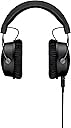
You know what the pro's and con's of an open-back are? ...great separation, depth and reality, yet is more likely to distort when driven hard - and does leak sound in and out! That said, *on balance* this is THE best headphone out there. You do need an amp or audio-interface to drive it though. / HIGHS : airy, elevated from flat but no troublesome spikes, involving and revealing. Slightly grainy - which masks some detail & reality. Possibly too metallic to be positively refreshing. The clarity stands above the MT8 (which is similarly elevated) though the highs at times can be a tad brash and lack a width of frequency separation. The highs are a tricky area, it’s where you hear the material of the driver cone, and it’s coating, here it’s titanium, and that’s what I hear - and not a lot of instruments sound like titanium. By comparison the DT770 are slightly slower in the highs yet have a very very prominent sibilance spike - making the high freq response wavy, not settled; the DT1990 don't have the sibilance issue - so do win out. The B pads help to soften the highs (and everything) a touch, and the extra bass of the B pads means you’ll run the ‘phones at a lower volume - which will also lower the highs (but also lower the mids!). Overall, slightly elevated, very detailed and no unwelcome surprises. HIGH-MIDS : can sound rather papery against the metallic highs, in general there is a lack of reality to the highs, instruments become ‘reproduced sounds’. The subtler qualities and magic they have in themselves, is somewhat lost. Comparing to the MT5’s, such as with dark cymbals (gently tapped) the MT5’s have real forward presence here - which the DT1990’s lack. That said, I am being critical here; I still think these have some of the best highs I've heard, for inspection more than total pleasure. MIDS : slightly recessed (relative to the elevated and detailed highs and lows), far ‘thicker’ than the DT770 with more detail - so more present (towards the MT5), just a dip down from flat, nothing drastic but can push vocals and acoustic instruments slightly back from what might be familiar. For mastering this acts inversely, and encourages you to increase the presence of your mids - which is not a bad thing at all. For listening you may feel like you are missing out, but then everything in the whole freq range is so detailed you would rarely be dissatisfied though certainly in the low mids does lack definition and some thwack (which is so perfectly present in the MT5’s). As with the lows at higher volumes there can distortion - a warbling of continuous notes, just not holding the delivery (with the lows distortion is a pop); this characteristic is the same as the DT770’s even though they have different drivers. LOWS : deep, powerful, fairly detailed (slightly wooly) and lacks some warmth - but then that is an overall characteristic of this headphone - not that it’s cold or clinical but it’s not the most embracing of listens (A pads are a bit too thin & dry for my liking, so I’m using the B-pads). The v.forward highs and soft lows creates a unsettling hole in the mids. Higher lows (towards the mids) such as woody kick drum sounds, disappear into a bass sogginess, whereas the MT5 everything in the lows is amazingly defined, has super presence, clarity and is spread out over a wide freq response. Definition of the lows by the DT1990’s is better than most, but falls just short of the MT5’s (the MT5's lows are not as deep or wide though). In complex passages at high volume the bass distorts - pops; adding EQ, a 20Hz HPF -6dB shelf, stops this popping and in anycase as anything below 20Hz is not audible the EQ has little adverse affects (in fact I wish the headphones incorporated a gentle <20Hz HPF, as EQ in software or players is not always possible). GENERAL OBSERVATIONS : what's the big issue? - the above mentioned distortion, at higher volumes in the mids a warbling and in the lows a pop, you will hear this, it’s a negative for studio use - as you won’t be trusting your source material. This isn’t at super high volumes, but starts at ‘just right’ high-ish volume (or maybe I listen for inspection louder than most!). As a comparison, the MT8 do not distort nor do the MT5’s, though many headphones do distort at high volumes, especially open-backs (due to 'freer' driver throw) so this isn't a specific issue with the DT1990, but if you need to avoid it, go for either the HD6xx range or MT5. DESIGN : despite these headphone being 250 ohm, their high sensitively Tesla drivers means in terms of driving they are similar to the DT770 80 ohm, possibly slightly easier to drive in fact. On a MacBook Pro you’ll be at 100% for an low to average listening level. So just as the DT770 they NEED an amp - or audio interface with a HP out. / This is based on years of studio use ...and pleasure ...of A/B comparisons between : CLOSED BACK : Yamaha HPH-MT5 Yamaha HPH-MT8 Beyerdynamic DT770 PRO 80ohm Audio Technica ATH-A990Z AKG K550 MkIII Sennheiser HD25-1 II OPEN BACK : Beyerdynamic DT1990 PRO Sennheiser HD600 Koss PortaPro Philips Fidelio X2HR / So ok, what about a closed-back? - driven from your portable device / laptop : I recommend the Yamaha HPH-MT5. Yes that is the 2nd greatest headphone out there. Surprising I know (for it's price) but it's such a reliable tool, no distortion driven hard, fast & accurate, super tight & powerful, but slightly dark, it's 90% great, nothing else can touch it, except the DT1990. Which is why I recommend both. Which headphone do I use the most, the MT5. Each are valid in their own way, not least one is closed-back the other open-back. Both have the best presence and power of the lot, are for studio use are the most balanced over their frequency range - no unusual spikes or wavy EQ. That said they have different characters: the MT5 is non-fatiguing and fairly ‘dark’ (yet still fast and detailed), the DT1990 is higher resolution, brighter, more clinical (still flat but bitingly critical). The DT1990 certainly reveals if highs scream in your mix (useful as part of the studio process) - whereas the MT5 is more velvety - with punch but not as much aggression. As a result the MT5 can be used at higher volumes for deep immersion without ear strain, the DT1990 can run at lower volumes and retain all it’s detail - but is not as listenable at high volumes. In overall audio terms the MT5 (for me) is like a step up from Sennheiser’s renowned HD600/650, I’d say it’s better in every way though of course it’s closed back - so is not quite as ‘open’ in the mids, yet just as forward. The DT1990 is a different animal, I have the DT770 as well, and that relationship is similar to the HD600 > MT5, the DT1990 is a step up from the DT770. Immediately swapping headphones exposes their differences, it takes a while for your ear/brain to settle in, and ‘normalise’ the signature, in this respect I prefer the MT5’s as they are closed back so I can use them everywhere. With the DT1990’s I have to swap to the MT5’s when I need isolation, so swapping is not ideal, I guess the DT1770 closed-back might be an option, but I like the airiness of the DT1990 and love the confident though unexaggerated signature of the MT5. So that’s my twin pick. For pure listening the ATH-A990Z’s are the choice, everything there, no oddities, they lack the grating immediacy demanded of a studio headphone, but if you don’t want that, the 990Z are a good choice (though I’m not a fan of their fussy build). The DT1990’s are supplied with two different types of pad, A & B. B are fitted by default, they have slightly deeper, firmer foam and more entrance holes at the back - intended result is to increase bass. This they do, which relatively reduces the mid and highs, though also there’s more to their sound than that. I’d say the highs are not as confused as with A pads, as with the A pads there’s a push that clumps the high-mids into the highs and also a slight messy confusion in the highs - lack of space. I know many will hear the extra highs as definition - but it isn’t, it’s like an EQ on top of an EQ, things get ‘over-processed’ or sound like 8 bit. With the B-pads as the bass is larger, you can run the headphones with slightly less amp, which cuts the highs and relaxes them a touch, and reduces bass distortion - which is an issue with the DT1990’s. The B’s reducing highs is good, as they are already v.elevated, reducing the mids is not good as they are already recessive! So putting the A pads on, the bass recedes - too much, the mids pick up slightly though are still recessive, and highs get far too high. So here we have the issue, the pads do alter the sonic characteristics but neither has the best blend (and between both wouldn’t help either), basically you’ll have to accept either a rich bass but recessive mids, or recessive bass & mids and v.aggressive highs. What’s the outcome, which pads have I chosen - as an audio engineer, unlike everything else you might read, I’ve gone for the B pads - despite the slightly ‘blooming’ bass - they give a truer representation of a delivery mix and are less fatiguing - which actually means your brain can adapt to the DT1990 signature rather than fighting it, as a result you do start hearing further into a mix. The A pads while super-precise keep you at arms length and not close to end reproduced delivery. / COMPARATIVE SCORES : 1- 10, higher the number the better. 1st score : BODY (Presence - Power) / 2nd score : DETAIL (Speed - Accuracy) . . . . . . . . . . . . . . . . MT5. . . . . . MT8 . . . . . . DT770 . . . . DT1990 . . . . A990Z . . . . PORTA . . . HD25-1II High. . . . . . . . . . . . 9 / 8. . . . . .10 / 8 . . . .10 / 9 . . . . .10 / 8 . . . . . . 9 / 0 . . . . . .6 / 6 . . . . . 4 / 3 High-Mid. . . . . . . . 7 / 8. . . . . . 9 / 7. . . . . . 8 / 9. . . . . . 8 / 8 . . . . . . .8 / 9 . . . . . 7 / 6. . . . . . 4 / 4 Mid. . . . . . . . . . . . . 9 / 8 . . . . . 10 / 7. . . . . 5 / 8 . . . . . . 6 / 8 . . . . . . 6 / 7 . . . . . .7 / 5 . . . . . 4 / 4 Low . . . . . . . . . . . .10 / 10. . . . 6 / 8. . . . . . 8 / 7. . . . . . 9 / 8. . . . . 10 / 6 . . . . . 9 / 5. . . . . 11 / 7 V.Low. . . . . . . . . . . 8 / 6. . . . . . 9 / 7. . . . . . 7 / 6 . . . . . . 9 / 9 . . . . . . 8 / 5. . . . . . 4 / 4 . . . . . 9 / 7 Soundstage. . . . . . 6 . . . . . . . . 6. . . . . . . . . 8 . . . . . . . . . 8 . . . . . . . . . 9 . . . . . . . . . 3 . . . . . . . . 1 Stereo width. . . . . 9 . . . . . . . . 8 . . . . . . . . . 9 . . . . . . . . . 7 . . . . . . . . .5 . . . . . . . . . 4 . . . . . . . . 3 Efficiency. . . . . . . . 9. . . . . . . . 10 . . . . . . . . 5. . . . . . . . . . 5 . . . . . . . . .9 . . . . . . . . . 8 . . . . . . . . 7 Isolation . . . . . . . . 8 . . . . . . . . 9 . . . . . . . . . 7. . . . . . . . . . 3 . . . . . . . . .7 . . . . . . . . . 1 . . . . . . . . 5 Portability. . . . . . . 8 . . . . . . . . 7. . . . . . . . . .5. . . . . . . . . . 4 . . . . . . . . 3 . . . . . . . . . 10 . . . . . . . 8 Comfort. . . . . . . . . 9 . . . . . . . . 6. . . . . . . . . 10. . . . . . . . . 8. . . . . . . . . 7 . . . . . . . . . 7 . . . . . . . . 4