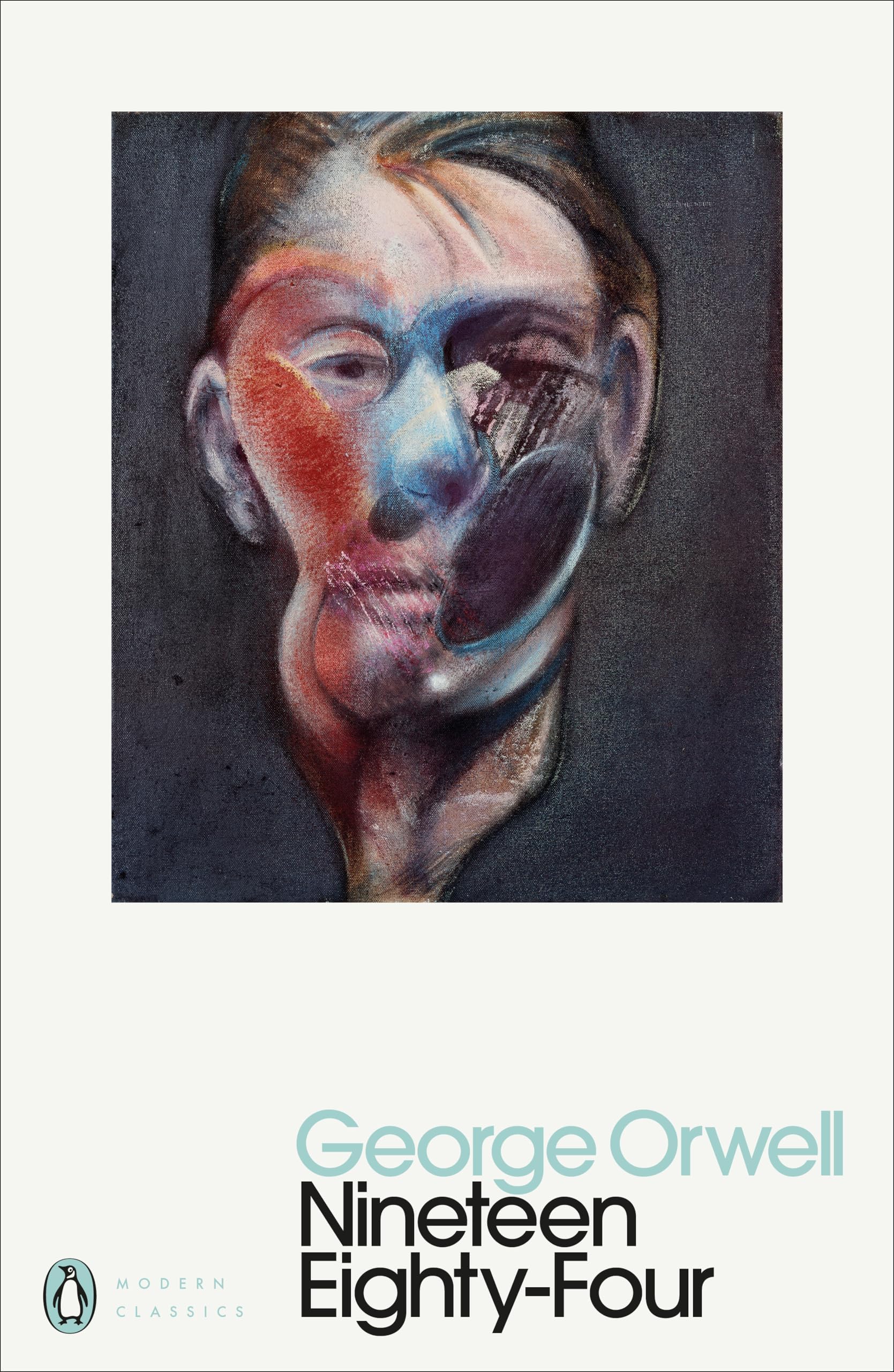
1984 Nineteen Eighty-Four (Penguin Modern Classics)
Product ID: 48033112
📚Classic dystopian novel
🔥Top-ranked political fiction
🕵️♂️Themes of surveillance & control
Buy anything from 5,000+ international stores. One checkout price. No surprise fees. Join 2M+ shoppers on Desertcart.
Desertcart purchases this item on your behalf and handles shipping, customs, and support to Indonesia.
📖 Own the book that predicted the future — don’t get left behind in 1984!
1984 by George Orwell is a seminal dystopian novel exploring themes of totalitarianism, mass surveillance, and thought control. This Penguin Modern Classics edition offers high-quality print and paper, making it a must-have for politically and culturally engaged readers. With over 15,000 reviews and top rankings in political fiction, it remains a powerful, relevant read that continues to influence modern language and pop culture.


| Best Sellers Rank | 5,144 in Books ( See Top 100 in Books ) 3 in Political & Protest Poetry (Books) 24 in Science Fiction History & Criticism 80 in Political Fiction (Books) |
| Customer Reviews | 4.6 out of 5 stars 15,442 Reviews |
N**N
Came in good time and perfect quality.
Came in perfect time. Excellent quality. No damage. Pristine from new. Excellent cost for quality - highly recommend the seller
L**S
Still powerful, still relevant — a chilling classic
1984 is one of those rare novels that feels just as urgent today as when it was written. Orwell’s vision of a dystopian future — complete with mass surveillance, thought control, and rewritten history — is both unsettling and thought-provoking. The prose is direct and stark, but never dull. The world-building is incredibly detailed, and the character of Winston Smith gives the story an emotional weight that makes the philosophical ideas hit harder. "Big Brother," "doublethink," and "thoughtcrime" have become part of modern language for a reason. The Penguin edition is well-printed and comfortable to read, with good paper quality and clear type. An essential read for anyone interested in politics, media, or the psychology of control.
M**H
Not the best of its kind, Just a little more obvious
The book itself? Overall - Not bad and yes kind of an interesting concept but I personally didn't care for the end or the initial build up (however necessary it was). More immediately/obviously relevant than other Sci-fi of its kind but I still prefer Brave New World and Fahrenheit 451. Why? Picking up and reading this book I almost felt like the characters in it, in so much as there was an opinion preceding this book and to think anything other was impossible. It is in popular and educated opinion highly held and significant, though I'd bet most of those who read and reviewed / shared that opinion probably felt that way before they'd even turned a page. I found it terribly bleak. The first half of the story is depressing and at times boring (How do you create character and interest in a grey mundane scenario / existence?). It does pick up and then ends suddenly followed by a drawn out (though not uninteresting) aftermath - I do not wish to give too much away. The meaning, its relevance, well sure it's there and yes it's timeless more so because its themes of inequality will resonate with anyone living in a class system or working the 9-5 when we would rather be living it up. Its his world view which was smart enough to reflect closely enough the prevailing world powers and their divisions that pulls it together and gives it the credit its due. Its interpretation will forever change, subtly, like any good prophecy without discredit. Im sure plenty will disagree.
L**K
The joke's on Big Brother
Good political writing is rare and the political novel, let alone a good political novel, is even rarer. Orwell considered this the case even in his own time when he was reading politcal fantasy novels written by conservatives about storing sufficient coal to beat the miners (a prospect Orwell thought was ludicrous but which became historical fact following the election of the Thatcher government). It became Orwell's mission to make political writing an art, his collosal output in investigative journalism, literary reviews and polemical essays is tribute to the fact. However Orwell is remembered for his political fiction, Animal Farm and 1984, which he turned to as the next most popular medium to the radio show. Of the two books 1984 is the more complex, at least this was Orwell's intent but he spent much of his time bemoaning popular misconceptions about his books. While he considered Animal Farm a failure in conveying a simple message about revolution betrayed, with reviewers and the public seizing on passages which supported a more cynical conservatism, 1984 was the greater disappointment. 1984 is a future dystopia but it was also a novel about his day and age, for instance the generic Victory gin and cigarettes a depiction of post war shortages and "Prolefeed", that mix of crime story and sex scandals, the tabloid press (then and now). People often read 1984 as a glooming, "end of the world is nye" style novel, warning that once freedom is gone it wont ever be recovered and everyone breaks under pressure. There is an element of truth in so far that Orwell struggled with what he considered his own propensity for u turns (the "no war but class war" war resistor who became a "revolutionary patriot" at the time of writing "The Lion and The Unicorn"). However 1984 is a grand satire on both authoritarianism per se and authoritarian personalities in particular, the joke is on Big Brother. The regime is horrific but its doomed to failure and the writing is on the wall for Big Brother. All they can produce with their best efforts and unscrupulous schemes is a gibbering wreck, less than a man. There is entirely nothing enduring about the regime itself, amnesia hasnt stopped at foreign policy since Smith cant recall his own up bringing too well. Basic societal building blocks, such as the family are going to pieces, strange Malthusian ethics prevail and everyone, friend and foe, is miserable, insecure and wretched. This is a book which can be enjoyed on a number of levels, its well written the pace is good, characterisation believeable and sympathetic and everyone will have their own memorable passages to talk over with friends (I personally remember the secret police smashing the snow globe as significant). It is good political writing but it has been considered equally good science fiction or simply a good book. I recommend it to any reader.
B**T
Affecting and dark
In 1984, Orwell relates the depressing story of Winston Smith, a doomed citizen living in Airstrip One (formerly known as London), a poverty-ridden dystopia ruled over by The Party: a city where those who show signs of independent thought vanish in the night, where gigantic telescreens monitor Winston's every move, where he must scratch a living on what The Party provides, working a job rewriting old newspapers in The Party's favour while clinging to his sanity through tiny acts of secret rebellion. The first of these acts is to purchase and write in a diary, and later to meet a female Party member in private (marriage is formally controlled by The Party, and is strictly for the sole purpose of reproduction). It is only when he finds true happiness and apparent haven from the eyes of the Thought Police that The Party choose to act, arresting him and subjecting him to a torture too cruel and lasting to imagine: one that destroys him in a more important way than death ever could. As harrowing as Winston's despair-ridden tale is, it's the sheer relevance of the world he inhabits that makes the book such a joy to read in the 21st century. With our highly-filtered and biased news reports, a network of CCTV cameras watching us in city centres, tax on our products feeding the government money and censoring laws and activists stifling free speech, comparisons to 1984 are inevitable. In the world of 1984, people are robbed of personal freedom, brainwashed, abducted, tortured, gradually starved, lied to and killed, and the truly terrifying result of The Party's efforts is that there exists no material proof of their crimes. The book illuminates the darkest eventuality of politics and government control, and makes it feel that bit too real for comfort. Orwell's writing has not aged noticeably - I had no problem reading it, and I'm all of seventeen, so most readers will fly through it. If anything, however, some may find the writing style too coarse or simple: Orwell never entirely escapes the analytical style so well-suited to his essays, and in places the book lacks emotion and descriptive flair. In particular, the female protagonist is painfully shallow, never extending very far beyond a "Hello, Dear!" persona. At one point, Orwell also diverts away from the main story and dedicates a large portion of writing to a book within the story, one that Winston is reading, which should be interesting but is annoyingly long-winded and detracts from the main story. Overall, though, 1984 is profound and chilling. It is a timeless tale of man vs state, and may be uplifting or depressing depending on the individual reader. At any rate, the countless parallels to modern culture make it interesting, and the arguments of logic between Winston and an Inner Party Member will give budding philosophers food for thought. Political enthusiasts will also find issues to chew over, and fans of popular culture may pick up on some unlikely links; musicians, authors and directors in years since have taken heaps of inspiration from the book: the iconic expression "a rebel from the waist down", made famous by a Marilyn Manson song, finds its roots here, alongside the concept of Big Brother and the inspiration of the video game Half-Life 2. Something for everybody.
O**S
Nineteen Eighty-Four
A dystopian society set in the future (well, technically the past, but it was the future when it was written, obviously) where Big Brother watches and controls everything you do etc, I'm pretty sure the majority of people know what 1984 is about. I found the first half of the book, where the relationship between Julia and Winston begins, slightly contrived. I wasn't believing that in the society that Orwell has created, that such a relationship could've existed. Especially numerous relationships like this that one person could've had without being caught. But, I guess that the whole relationship was merely figurative and not literal. They didn't actually love each other, it was a coming together through common ideals, it was their small way of rebelling against the system.. so I guess it doesn't really matter that it was somewhat contrived. Also, they appeared far too naive when first meeting O'Brien. That said, I really enjoyed reading this and the second part of the book and onwards in particular was excellent. I only wish that there was more of Goldstein's book to read, as that was fascinating. And the conversations between O'Brien and Winston were also exceptionally crafted, although after reading Darkness At Noon, I can't help feeling that perhaps it was a little more than just inspired by Arthur Koestler's book. Still enjoyed it, though. The bit about the party breaking you down both physically and mentally, and then rebuilding you, was chilling. As was the "if you want an image of the future, imagine a human face being repeatedly stomped on, for ever" bit. Just to go back to my point about Koestler's Darkness At Noon seemingly being quite influential on 1984, so was a lot of We by Yevgeny Zamyatin. Especially for the first part of 1984, anyway. I don't think 1984 particularly eclipsed either of those books, but it was still brilliant in its own way and one of the best books I have ever read.
A**N
Fantastic edition
Gorgeous, fantastic quality, sticker on back peeled fine
T**E
Eerily modern and surprisingly relevant under both oppressed and liberal regimes! Take heed.
Warning: contains spoiler This perhaps is not a book to be loved as the purpose of a dystopian novel is to warn us of what it could have been before it is too late. That is to say the story does not try to appeal to us but to repel us. The book does have its momentum and it is quite easy to turn the pages till the end. The world, though in simplified caricature, bears resemblance to our reality in some parts of the world, even today. It does highlights what is necessary for a totalitarian regime to survive. Whether they are universal features it is hard to establish. But from what we can observe in experience, what are highlighted in the book seem to match. The book calls for lamentation of our world. The degeneration and deterioration, and the final abolition of man is startling. Yet the mass can be sleepwalking into it, and a couple of generations down the line, the mass would not even have the ability to discern what has been done. This is because the "authority" does not just try to control the mind but seeks to mould the thinking process that will ultimately eliminate our intellectual power to think independent. This tyranny does not just come from a totalitarian regime but ironically in today's ultra-liberal post-modern world which serves the function of dismantling the objective truth that exists out there, and replaces it with relative and subjective truth that exists in our mind. Will it be one day personally too painful or too costly to try to insist on the truth and to reconcile the contradictory systems of values? The key conflict confronted a sane mind as embodied in the main protagonist Winston is this erasure of absolute objective truth that exists outside our mind. It seems to argue that the existence of such unwavering truths, known or unknown, are crucial to our well-being. They are our anchor points, being cut off from which we would become floating ghosts who could be erased as if we had never existed because we could be erased from records and memory. There is no longer any standard to arbitrate the truth. There is also the conflict arising from the non-reconcilable concepts that exist side by side to be held as truth. It gives us a feeling of queasiness. Our mind does not naturally accepts that, unless we give up thinking and perceiving - this is the end point where the regime was forcing upon its population eventually, as this will be the only way to stay sane in the insane world. This social schizophrenia happens around us not just in totalitarian regime but also in ultra pluralist society when internally contradictory values are hailed side by side, and tolerance does not mean an attitude to live with different opinions but to coerce public opinion into conformity. Are we heading to a dystopian state anyhow, whether in the free world or under the authoritarian regimes? The mutilation of language is an effective tool to make people dumb. The author expends quite a lot of effort to strike home this point. As a writer, Orwell must love and master the language. He shows us his insights into the relationship between language and the thinking power. The deteriorating language ability of any population therefore is a worrying sign. He points out that reducing the size of vocabulary will purge concepts and ideas; without the words, people can't think them. That is true, and Orwell made a concerted effort in deriving the Newspeak to illustrate the point. However, in the modern day, we see another trend that will reduce people's power to think - that is the ability to string words together. As the argument goes, disjointed and choppy sentences are not conducive to developing thought or a probing mind. Modern form of communication which relies on text messages, social media posting, which stresses images more than words could have far more long-lasting, damaging impact on the reasoning power of the general public than at first glance. The last part of the book is on the process of brainwashing. As Orwell had no first hand experience (I assume), I believe the depiction was from his conjecture. I personally do not know how realistic it is. I do not know whether it was successful brainwashing techniques or just PTSD at the end of the day, after a lengthy period of gruesome trauma and torment - physical, psychological, emotional, mental, intellectual and finally metaphysical. Winston was hard to break, as his tormentor said. I could follow the internal struggle upto the point before Room 101. I understand what happened in Room 101. But how did he turn from hating Big Brother to loving him is unclear to me. The swap was not clear except that he was totally broken. How then was the positive affection generated? I can understand why Winston might hate himself, but is it the same as loving Big Brother?Or loving Big Brother (and believing his values and function) makes it easier not to hate himself? Or simply when one was so broke, it did not matter who is right who is wrong what is true and what is false? Or was the execution that came as a release after such a horrendous struggle that he love Big Brother for granting the merciful bullet into his head? I don't know.
K**E
Good feeling book.
High quality book manufacturing. Very aesthetically pleasing.
M**E
Amazing book.
Quality is good too but the drawings on cover are wearing a little, but hey! Don't judge book by it's cover right? 😉 seriously though, good novel.
S**H
Brilliant
I've read it a few times but didn't have a copy of it and decided to get this beautiful edition. Really well bound and the book quality is great. * this I consider to be a book that everyone must read at least once!!! * It is brilliant and quite scary!
T**N
Je suis très content
Le livre est beau, comme j'ai espéré. Je suis content
J**G
Applies to the modern day.
You can never go wrong with reading about dystopian societies as pictured from a post-WWII era. This is becoming all too common in the modern day. Especially in Europe and Asia.
Trustpilot
4 days ago
1 month ago