
Buy anything from 5,000+ international stores. One checkout price. No surprise fees. Join 2M+ shoppers on Desertcart.
Desertcart purchases this item on your behalf and handles shipping, customs, and support to Indonesia.
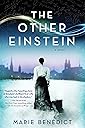
desertcart.com: The Other Einstein: A Novel: 9781492647584: Benedict, Marie: Books Review: Magnificent! - Knowing very little about the Einsteins, I dove into these pages! The author is so easy to read, so interesting the way she captures raw emotion. I found myself despising Albert for his dishonesty & deception. This book will rile up many women in many roles, as it should! A very enjoyable, albeit sad, story. Review: Behind every great man is an even greater woman - I thoroughly enjoyed this book! One of my favorite book styles is to take a lesser known character or event from history and develop a story around it. I enjoy an in-depth researched story, whether it is fiction or non-fiction. The Other Einstein is historical fiction. Warning: if you are a major fan of Albert Einstein, he is not very appealing in this book. Actually, he is portrayed as quite an ass! This book follows the life and career of Mileva Maric, who will eventually become Mrs. Einstein. She is a Serbian girl who has great skill in mathematics and physics. Her father encourages her education, partly because she was born with a limp and the family believes no one will marry her. With her father's help and encouragement, she is accepted at university in Zurich Switzerland. She lives in a pension with three other brilliant girls who are in the city to attend universities. She is the only female in her physics class and the professor does not hide his contempt. Mileva works hard and excels beyond her male peers. Albert Einstein is one of her classmates and he is clearly smitten with her. She resists at first because she wants to be taken seriously as a scholar and because she does not want to derail her education. Albert wears her down, despite the warnings of her best friend Helene. Also, Helene meets and eventually marries a man, thus breaking their pact to remain single and career focused. Albert and Mileva have a wonderful courtship and he treats her as an intellectual equal. They work together. He also pressures her to adopt a Bohemian lifestyle. By Bohemian, he means have sex out of wedlock. She becomes pregnant and has a daughter. She is unable to graduate and does not earn her degree. At this point their relationship slowly disintegrates. Albert is unable to find work, partly due to his arrogant attitude. He refuses to meet his daughter and she dies very young. The death deeply affects Mileva. Albert later marries her, despite the opposition of his family and they have two sons. The relationship sours further. The premise of this story is that Mileva is the one who actually discovered and articulated the Theory of Relativity while she was mourning for her daughter. Albert and Mileva co-write the paper, though he removes her name without her knowledge. He publishes all their work under his name and gives her no credit. He also becomes an increasingly bitter, nasty, egotistical, and vindictive man. Mileva wants a divorce, but that is not an easy thing in the early 1900's. Mileva's real role in the Theory of Relativity is unknown. Among scientists and scholars, some believe she was a sounding board for Albert, others believe that she did the mathematical equations for his theories, and some believe she is the author. I enjoyed this book because I learned about science at the turn of the 20th century. I was enraged at the treatment of women, especially the way that intelligent women were belittled and looked upon with suspicion. There were several times when I was internally screaming at Mileva to grow a spine or at least bash Albert in the head with a book! In other words, the characters and the story evoked strong feelings for me. And that is a sign of a good book!


| ASIN | 1492647586 |
| Best Sellers Rank | #19,039 in Books ( See Top 100 in Books ) #29 in Biographical Historical Fiction #40 in Biographical & Autofiction #674 in Literary Fiction (Books) |
| Customer Reviews | 4.3 4.3 out of 5 stars (16,351) |
| Dimensions | 5.51 x 0.83 x 8.27 inches |
| Edition | Reprint |
| ISBN-10 | 9781492647584 |
| ISBN-13 | 978-1492647584 |
| Item Weight | 12.1 ounces |
| Language | English |
| Print length | 336 pages |
| Publication date | August 29, 2017 |
| Publisher | Sourcebooks Landmark |
S**L
Magnificent!
Knowing very little about the Einsteins, I dove into these pages! The author is so easy to read, so interesting the way she captures raw emotion. I found myself despising Albert for his dishonesty & deception. This book will rile up many women in many roles, as it should! A very enjoyable, albeit sad, story.
S**S
Behind every great man is an even greater woman
I thoroughly enjoyed this book! One of my favorite book styles is to take a lesser known character or event from history and develop a story around it. I enjoy an in-depth researched story, whether it is fiction or non-fiction. The Other Einstein is historical fiction. Warning: if you are a major fan of Albert Einstein, he is not very appealing in this book. Actually, he is portrayed as quite an ass! This book follows the life and career of Mileva Maric, who will eventually become Mrs. Einstein. She is a Serbian girl who has great skill in mathematics and physics. Her father encourages her education, partly because she was born with a limp and the family believes no one will marry her. With her father's help and encouragement, she is accepted at university in Zurich Switzerland. She lives in a pension with three other brilliant girls who are in the city to attend universities. She is the only female in her physics class and the professor does not hide his contempt. Mileva works hard and excels beyond her male peers. Albert Einstein is one of her classmates and he is clearly smitten with her. She resists at first because she wants to be taken seriously as a scholar and because she does not want to derail her education. Albert wears her down, despite the warnings of her best friend Helene. Also, Helene meets and eventually marries a man, thus breaking their pact to remain single and career focused. Albert and Mileva have a wonderful courtship and he treats her as an intellectual equal. They work together. He also pressures her to adopt a Bohemian lifestyle. By Bohemian, he means have sex out of wedlock. She becomes pregnant and has a daughter. She is unable to graduate and does not earn her degree. At this point their relationship slowly disintegrates. Albert is unable to find work, partly due to his arrogant attitude. He refuses to meet his daughter and she dies very young. The death deeply affects Mileva. Albert later marries her, despite the opposition of his family and they have two sons. The relationship sours further. The premise of this story is that Mileva is the one who actually discovered and articulated the Theory of Relativity while she was mourning for her daughter. Albert and Mileva co-write the paper, though he removes her name without her knowledge. He publishes all their work under his name and gives her no credit. He also becomes an increasingly bitter, nasty, egotistical, and vindictive man. Mileva wants a divorce, but that is not an easy thing in the early 1900's. Mileva's real role in the Theory of Relativity is unknown. Among scientists and scholars, some believe she was a sounding board for Albert, others believe that she did the mathematical equations for his theories, and some believe she is the author. I enjoyed this book because I learned about science at the turn of the 20th century. I was enraged at the treatment of women, especially the way that intelligent women were belittled and looked upon with suspicion. There were several times when I was internally screaming at Mileva to grow a spine or at least bash Albert in the head with a book! In other words, the characters and the story evoked strong feelings for me. And that is a sign of a good book!
L**R
Emotional, Engaging
I listened to the audiobook for this engaging story. Between Mozhan Marno’s narration and Marie Benedict’s words, I was glued to the story of another “woman behind the man,” Albert Einstein’s wife, a physicist in her own right, who was basically erased from history. As with all historical fiction, the author played with some facts for the sake of the story, yet the basics are true. Read the novel and meet an incredible woman who finally has her due, thanks to Marie Benedict.
S**L
Great Potential, Yet Slow
April 2021 has been a month of firsts for me as far as authors. The Other Einstein was my first Marie Benedict book, and I so wanted to love it. I expected something akin to The Paris Library, which I did enjoy very much. And in fact, Marie Benedict does a lot of things well in The Other Einstein. For me, the novel's biggest draw was main character Mileva "Mitza" Maric. I adored her and considered her a fictional sister from our first meeting. From her scholarly bent to her mild disability, I felt like Mileva and I were almost twins from different eras. My heart broke for her as she was marginalized based on disability and sex, but I cheered for her gumption, determination, and intelligence. Better, Mileva is a three-dimensional and fully human character. She is not an "inspiration" just because she happens to be a disabled woman in a time period inhospitable to both those distinctions. Although I will admit, to a person with a literature brain instead of a science brain, Mileva certainly inspired me with her acumen for and dedication to physics. I also loved the scenes with Ruzica, Milana, and especially Helene. They are the kinds of friends I wish I'd had growing up and while pursuing advanced degrees. And while I knew the point of The Other Einstein was to take a look at well, Einstein's wife, I kind of rooted for the quartet to somehow stay "together," single and pursuing their careers in an early twentieth-century example of feminism. But if I couldn't have that, the friendships and dialogue are wonderful enough. Mileva's relationship with Helene is particularly interesting, feminine without being silly and sometimes painful without being full of angst. I also applaud Marie for delving, at least somewhat, into the social climate of Germany, Switzerland, and the Austro-Hungarian empire of the time. I wasn't familiar with Eastern European culture before reading this book, and while I knew a little of the prejudice ethnic groups like Serbians faced, I didn't know much about that, either. Marie taught me a lot without being pedantic or dry, and without driving it into my head that bigotry was a huge obstacle for the Einsteins. In fact, the constant presence and "normality" of anti-Serbian attitudes, anti-Semitism, anti-feminism and the rest made it all the more jarring. I even caught glimpses of what Germany, Austria, and fellow countries would face in the ensuing half-century. Finally, I appreciate Marie's work in delving into a character, a real person, about whom history tells us almost nothing. Under her hand, Mileva Maric Einstein becomes relatable. She enjoys the same things modern women do, like hanging out at coffee houses or visiting beautiful forest haunts, with her own spin on that enjoyment thanks to her prodigy status. She looks for God in science and science in God, and has to struggle to form her own identity and philosophy after being told, "You can only do certain things, fit into certain places, accomplish what is approved." Not only Mileva herself, but the people and settings around her, written with such detail, carried the story for me. Okay, so what's the problem? Well, "problem" kind of depends on who you ask. For me, about halfway through and even before that, The Other Einstein became tediously slow. Mileva was growing, events were happening...and yet she always seemed acted upon, not like a self-determined person. Part of that is probably her time period; no such thing as politically correct history, after all. But also, her character voice became bogged down. Telling over showing, a hazard of first-person POV, eventually became a problem, as did some obvious and sensory phrases. For example, during a scene where Mileva is infuriated, she straight up says, "I felt rage." Additionally, it seems odd, but I didn't like the presence of Einstein in this story. I don't know much about him personally, so Marie's portrait may well have been accurate. That wasn't my issue. My issue was that I could see where his and Mileva's relationship was going a mile away, and thus, what the lesson or point of the book would be. Combine that with the ever-slowing pace, and I got bored and disappointed. With this said, the things I didn't like about The Other Einstein were probably down to Marie's stylistic choices. If you're a fan of her writing style, you'll probably love the book, and as noted, there's a lot to like regardless. I'm disappointed The Other Einstein wasn't a favorite, but willing to try more like it and recommend it to particular audiences. My recommendation is stronger if, like me, you enjoy stories of smart or prodigy women, or women with unusual talents or circumstances, making their way in what was and sometimes still is a man's world.
R**Y
Loved the book read it with my book club
M**S
Bien documentado con mezcla de ficción. Te hace sentir el amor que fluye y el coraje que puede producir compartir su vida con alguien como su esposo. Lo recomiendo en su idioma original el vocabulario es muy formal. Me encanta.
A**E
Very good and engrossing
M**A
Well worth reading.
M**A
Me encantó este libro y me dio visibilidad sobre la historia que no conocemos. Me encantan los libros que escribe Marie que da visibilidad a figuras femeninas de la historia
Trustpilot
2 weeks ago
1 month ago