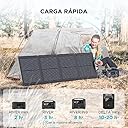
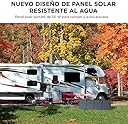
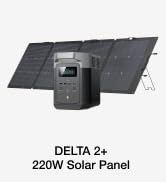
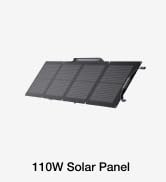
☀️ Power your hustle anywhere, anytime with the ultimate foldable solar panel!
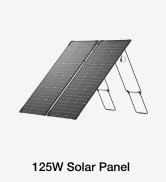
The EF ECOFLOW 110W Portable Solar Panel delivers a robust 110 watts of power with an industry-leading 23% efficiency rate. Its foldable monocrystalline silicon design, combined with an IP68 waterproof and dustproof rating, makes it the perfect companion for camping, RVs, or backyard use. The included adjustable carry case doubles as a kickstand to maximize solar exposure, while compatibility with most solar generators ensures effortless, on-the-go charging.


| Brand | EF ECOFLOW |
| Efficiency | High Efficiency |
| Included Components | solar panel |
| Item Weight | 3.99 Kilograms |
| Material | Monocrystalline Silicon |
| Product Dimensions | 16.5"L x 0.8"W x 20.2"H |
R**!
Let's talk about what you get from these for the premium price
Update and tl;dr. My review of the performance of these panels and their cost per watt still stands, but I can understand the 4 and 5 star reviews better. The company did contact me on their own for my feedback, and worked with me to design a system that met my specifications. The higher rating of this review reflects their customer service. After working with them a bit, I do have a system that is a better value and meets my specifications. You can read this review to understand what you get from the EcoFlow panels. Overall, these panels are for anybody who has limited space and doesn't mind the higher price tag. The integrated kickstand has worked very well for me, and this is a bonus: I don't have to use a rigid panel or construct some wacky stand out of PVC. The whole package stows easily and the kickstand works very well (it doesn't matter that the kickstand doesn't perfectly angle the panels). Still, you can expect only ~65% of the rated power from these panels (other off brands mentioned here deliver ~60% based on my reading of their reviews), making these relatively expensive. Also, I did look at many of the panels available on Amazon, and found that brands such as Bluetti and GoalZero, even if they perform as well as Renogy panels (>70% efficiency), are some of the most expensive on a $/watt basis. Off-brand panels have the disadvantage poor performance (60% of rated power); you can still save money but you'll have to carry more of them. For example, 2 Renogy 200 W panels are an excellent $/watt value if you have the space, but 2 AllPowers 200 W panels won't deliver the same power but are cheaper. If you can work with a flexible panel (I would consider these portable, not flexible), those can be very good values but suffer from needing to be installed somewhere. So, this review I think will help inform how you go about selecting panels to meet your needs. ------------------------------------------------------------------------------------------------------------------ The 4 and 5 star reviews are from the #vanlife crowd that wanted a good looking system, not by those who bought these as part of a system that was going to meet their needs. I live in my truck almost year round and have a system to power my computer and Starlink, as well as my fridge and phone. This is a real review. I wanted external panels because I have limited roof space, and who wants to park in the sun just to charge their system? Up top I have a 100W flexible Renogy panel glued to a piece of corrugated plastic...mainly a supplemental source of power when I don't need a charge too bad or when I'm moving. The EcoFlow 160s were supposed to be the workhorses of my system. I got 2, connected in series with 10 ga cables to handle the amperage from these panels, feeding into a Victron 75/15 MPPT controller. I spent the extra money on the EcoFlow panels because we all know that the rated power isn't the real-world power. I expected that a premium panel would have less exaggeration, and the integrated kickstand was a bonus. In other words, I looked past the "cheap" panels expecting them to deliver less of their rated power than the EcoFlow panels. The screenshots are the monitoring reports from the Victron controllers running the Renogy panel vs the EcoFlow panels. On days when my single Renogy panel...which I'll remind you, is flat mounted, doesn't get repositioned during the day to take advantage of the sun angle or avoid obstructions, and should suffer a greater heat penalty given it's installation...that panel consistently puts out 60-80W. So 60-80% of what Renogy promised they delivered, and I've seen it hit >90W. That's a $160 panel, easily hitting 75% of it's rated power, giving me a watt of power for $2.13. On the same days, I go out and move my EcoFlow panels once mid-morning, once-late afternoon, and once in the evening to take advantage of the morning sun, changing their orientation and angle so that they are directly facing the sun and either flat (during mid-day) or angled (morning and afternoon). They have that kickstand (which for me has actually worked out okay) which helps get a good angle on the sun and should keep them cooler than a rooftop-mounted flexible panel. These panels should have a massive advantage over that Renogy panel, but I have never seen more than 208 W from a system that is rated for 320 W. That is 65% efficiency, giving me a cost per watt of $3.37. That makes these panels almost 60% more expensive for 15% less power. I've heard the arguments and taken them into consideration...the rated power is under optimal conditions, you'll never see the rated power in real life, to get the rated power you need to be at 90 degrees to the sun (+/- 10 degrees), the panels won't perform as well once they heat up, and clouds and shadows and so on. These are all true, and when you are designing a system, you have to take into account that the rated power power is the power Bob in marketing says has to be on the box because everybody else is bloating their power ratings, and anybody who used an honest real-world number wouldn't sell a panel. EcoFlow looks to be one of the worst offenders, and I've gone back to my order several times to make sure I got the 160W panel and not the 110W panel. I'm also not in some oddball arctic desert place...these results hold true in Utah, Texas, New York, and everywhere in between over 2 months now. And even if I was doing something wrong, you can't explain away the EcoFlow's poor performance by any external factor when that Renogy panel (disadvantaged as it is by its installation) under the exact same conditions consistently and easily outperforms the EcoFlow panels every single time, every single day. I would return these if I could. Renogy has a 200W system for $349 (that includes a charge controller). Let's say these only deliver 70% of their rated power...the cost comes out to $2.30 per watt. It's bigger, heavier, and I'd need more panels but it is a better value. Other random but similar panels, if they performed as poorly as EcoFlow, would come in at a similar cost per watt. Dokio has a panel that appears to be similar to EcoFlow in every way except that it doesn't have a kickstand, but comes out at a cost of $1.63 per watt if it only delivered 65% of its rated power. [Update: reading the reviews, these deliver more like 60% of their rated power.] Aside from the poor performance, I'm now really concerned about the reviews (oddly 4+ stars) questioning the durability of these expensive panels. When I go to move them, yeah, they are hot. Like, wear gloves hot. And you hear the panels cracking and creaking in ways that say maybe these aren't going to hold up too well. How long until they crack or become unbonded, delivering another hit to their already weak performance? Again, that Dokio panel or a set of Renogy panels are looking more and more like a better value. When you're looking at the Victron reports, yes, the EcoFlow panels deliver more total power...keep in mind they are moved several times so they see the sun at a better angle for the entire day; the Renogy panel maybe only gets a good angle on the sun for a few hours when the sun is almost directly overhead. Also, FWIW, this review is based on my personal experience. EcoFlow did contact me and did not offer any technical support, but did provide some incentives to bring my system up to the performance I expected.
K**.
⭐️⭐️⭐️⭐️⭐️ Powerful, Reliable, and Truly Portable Solar Panel
Alright, let’s be real—this EF ECOFLOW 220W solar panel? Total game changer. I’ve carted it around to campgrounds, random outdoor parties, and even busted it out during a power outage at home. Never let me down, honestly. First time I pulled it out of the box, I was kind of shocked at how sturdy the thing felt. Like, it’s not flimsy at all. You could probably drop it (not that I’d suggest it) and it’d still work fine. But here’s the kicker: it’s not some heavy, awkward beast. I can actually haul it from the car to the campsite without needing a second wind. And the case? Doubles as a stand. Smart move, EcoFlow. Set up takes two seconds—no fiddling with weird brackets or whatever. Charging? Oh, it delivers. On a good sunny day, it sips up those rays like an overcaffeinated plant. Even when it’s a bit cloudy, you still get juice—enough to keep my EcoFlow power station, lights, and even my tiny blender running. (Don’t judge, sometimes you just need a smoothie in the woods.) That 220W isn’t just for show, either. When paired with a decent battery, you’re basically set. On average, with a sunny, clear day, this thing has put out 200-210W at times. Another thing I love: it doesn’t freak out if the weather turns weird. Some light rain? No problem. It’s water-resistant, so I don’t have to panic and yank it inside at the first sign of a drizzle. And when it’s time to pack up? Just fold it down and toss it in the trunk. No drama, no puzzle-solving required. Downside? Well, it’s a solar panel, not a miracle worker. If you plop it down in the shade or forget to angle it right, yeah, you’re not gonna get much out of it. Sunlight = power. Simple math. Bottom line: this thing slaps. Whether you’re out there living your best #vanlife or just want backup at home, it’s reliable and easy to lug around. Honestly, if you’re even thinking about a portable solar panel, quit overthinking and just get this one. Thank me later.
G**D
Compact and Efficient Solar Panel for On-the-Go Use
The EF ECOFLOW 220W Portable Solar Panel is a solid choice for camping, RV trips, or home backup setups. The bifacial design and N-type solar cells seem to deliver good conversion efficiency, and I noticed decent charging even in partial sunlight. It’s lightweight, foldable, and easy to set up with the adjustable kickstand. The IP68 waterproof rating gives peace of mind for outdoor use, and the build feels durable and high-quality. The only minor drawback is that it’s not huge, so for faster charging of big batteries, you may need more panels. Overall, it’s very portable, reliable, and works well as part of a mobile or emergency solar setup.
D**E
Not sure it’s all it c
I’m new to solar generators and solar panels. So my opinions are based on a first time user. I chose the 220 watt bifacial solar panel because is made sense to garnish extra power from the back scatter. I was anxious for it to arrive. I finally received it I couldn’t wait to try it out. Unboxing was simple with short instructions. Almost none on how to use the case to hold up the panel. I line in Central Texas and my trial was done around 1 pm on a very hot, 101 degrees at the time, cloudless sky. The sun was directly overhead so I laid the panel flat and plug it in to my new EcoFlow River Pro. I watched other YouTubers get 160 to 200 watts out of this panel so I was disappointed to find that I was only getting 107 watts. Perplexed, I tried many configurations and angles. Still I only got 197 watts. Thinking the panel was defective, I called the support number. She led me to turn on and off several features on the app. No success. She told me to continue to try different setups. So I posed my trouble to Amazon customers and Jeremy came through with the answer because he had the same issue. He told me to turn off “slow charging” and that would cure the problem. And it did. So I spent the rest of the afternoon moving the panel to keep it facing the sun at 90 degrees. The highest I reached was 170 watts. I don’t no if the extreme heat was affecting the output, but I can live with it. I did experiment with it though. Since the backside gets more efficient with higher reflective surfaces, I surmised that a reflective blanket was do the best. I used an Arcturus Heavy Duty Survival Blanket. It’s large, 5’x6’, and better built than others. I tried different configurations, panel sitting on it, hanging from the case with curve towards the panel and lying if front of the panel. I didn’t get any increase in wattage from any configuration with the reflective blanket behind the panels. I did get a 5 watt increase with the blanket lying in front of the panel. To make sure that the backside was working, I turned the panel upside down and it was putting out around 55 watts. I have no idea why I’m not getting of extra wattage that this panel was designed for. At least I’m getting adequate from from the 200 watt side. Using the case to hold the panel works, but what a pain! After getting configured for the current sun position was fairly simple. But when it come time to move it, it helps greatly to have two or more hands. By yourself, expect the case to fall, get twisted, and take forever. My best solution was to anchor the bottom, non-rigid side. That helps tremendously. I’m looking for other methods besides that case. The case does simplify the amount of other equipment you have to bring to set the panels. Overall, I think the panels and case work well and with the expense.
2**D
Just got these a few days ago and only brief test
These solar panels are pretty great so far. I’m not comfortable giving a perfect 5 stars until I get them out in the field for proper testing. UPDATE June ‘24: great performance out in the field! So happy with them. Upgraded to 5 stars The carrying case is very durable material and the zippers look good quality (time will tell). The case is also used to hold the panels up at varying angles according to the sun position. One side of the case is solid to protect the panels and to enable the angled positions — good design choice. The overall size packed up is not too big and makes it quite portable. For basic testing, I connected this to my Bluetti EB3A (ordered the proper cable from Bluetti to go from Solar to DC7909..?) and set the panels up at a non-specific angle on my apartment balcony. Without trying to get the perfect angle and with some shading due to balcony railing and supports, I was getting ~85-90 Watts charging. May be a bit on the low side, and I’m hoping to see closer to 120-130 W when out in full sun and pointed directly at the sun. Will update after my next camping trip but only 4 stars until I get more data. The attached cables are good quality and were easy to connect to, but a bit difficult to disconnect from. But that may get better as I find a better way and get use to them. UPDATE June ‘24: was getting a whopping 136 W charging my BLUETTI with this panel out on a camping trip!! Great performance I’m happy with the price to performance ratio, basic charging is good, and the case plus size make these quite versatile for car camping, beach trips, or even just a day trip where you need to power basic electronics. I do wish the panels’ power box where the cable came out had at least one USB port for quick connect charging of peripherals, but that’s not a need .. just a nice-to-have. Will update after more use and a chance to see if the charging stays stable or changes drastically over time.
Y**X
Lighter, cheaper, more efficient than Goal Zero Nomad 200. MUST for high-capacity batteries
Over a year ago, I purchased the Goal Zero Nomad 200 for its large-capacity, 4-pane solar panel that folded down to a 1/4 of its full size. That made it relatively compact, though at 22 lbs it was not exactly lightweight. Where it stood out was its 200W of monocrystalline charging capacity, and when used in combination with other Nomads (or the company's more rigid Boulder panels), quite a large amount of electricity could be produced to quickly charge a battery power station with, such as the Goal Zero Yeti 1500x that can take a whopping 600W! I had been a fan of Goal Zero's products for a few years now, but recently, one of my good Boondocking friends asked me to take a look at the EcoFlow Delta Pro power station for our mountain vacation home. That monster was so packed with features, it literally left me in awe and quickly added the company to the top of my favorite power station brands alongside Goal Zero and Jackery. Fast-forward two months later, and I thought to also take a look at something interesting: "Bifacial solar panel". What the heck is that? BIFACIAL SOLAR PANEL Up until recently, all of the solar panels I had tested were monofacial -- that is, only ONE face captured the sun's energy while the other side did not. Bifacial covers a panel with cells on BOTH faces (front and back) to maximize solar energy production AND use up less space, but tends to cost more than the 1-sided products. Imagine my surprise when EcoFlow's 220W Bifacial Solar Panel only costed $50 more than than Goal Zero's monofacial Nomad 200... So, how did both compare? ANALYSIS EcoFlow's 220W Bifacial Solar Panel amazed me in a number of ways. According to the marketing material, the front-facing side could produce up to 220W of energy and the back up to 155W for a total of 375W. Reality was nowhere close to that: the most I was able to capture in testing was 198W on a bright, sunny, California day on white-painted surfaces and a MPPT controller-equipped Goal Zero Yeti 1500x. The EcoFlow Delta Pro only reached 184W a few minutes prior. Are those numbers good? Yes, absolutely! Monocrystalline solar panels generally lose about 20-25% of efficiency from their stated rating due to loss from solar conversion. The EcoFlow 220W's front face would, therefore, produce only up to 176W on a perfect, sunny day. Yet, my tests captured as much as 198W -- where did that extra 22W come from? Its 155W backside through sunlight reflected by the ground and surrounding area. The back face actually captured roughly 14% of its capacity! Moving the panel to my grassy backyard, however, did not add much: a mere 5W-10W. Was the small increase worth it? That depends. Any additional amount of power can make a difference in certain situations and living arrangements, especially when one was in the middle of nowhere. Whether that augmentation is worth any extra cost, however, is not black and white. The question ultimately comes down to how much the back side could consistently add to the total output, and that, my friend, depends on the surface and surrounding area. The more sunlight is reflected, the more the backside of bifacial solar panels can capture, though it could never reach the 75-80% efficiency the front face would. A dark, non-reflective area would hardly give any extra watts, but a mirrored room would produce a lot more -- especially one that had concave reflectors aimed squarely at the back panels without burning a hole through them. A 22W increase required me to place the panels on and in an area covered in bright white to maximize the amount of reflected sunlight. That kind of exposure is not something I normally come across in my travels, like camp grounds or forests. Even rocky places like Yosemite National Park that is dominated by granite would not provide that reflective power unless the panels were deployed on snow. Alas, if there is snow, the sun is not as strong as in the summer, but that is precisely where bifacial solar panels could make a small amount of difference. CAUTION: Never leave the power station out in the sun! Keep it shaded to minimize the risk of overheating AND use a long cable to connect it to the solar panel. Power aside, the EcoFlow 220W costs nearly the same as the Goal Zero Nomad 200W, but has that additional 155W backside panel thrown in. That makes the EcoFlow a better deal purely from the amount of potential power produced. It also weighs about 1 lb less for nearly the same, overall dimensions. Where the EcoFlow stands out is its IP68 water rating that allows it to be submerged in 5' (1.5m) of freshwater for up to 30 minutes. That means that water could be spilled on it without any damage. It could theoretically also be used in rain, but that idea sounds absolutely ridiculous: does the sun shine strong enough, if at all, in that kind of weather to make any difference? Still, not many consumer manufacturers offer IP68 waterproofing. Both the Goal Zero Nomad 200 and the EcoFlow 220W are coated with tempered glass for better protection against the elements, but the latter uses the MC4 solar cable type connection. I much prefer the Anderson Power Pole (APP) port over MC4 for its ease-of-use, but do not fret: there are adapter cables available that convert between both types. My favorite, lower-cost brand of adapters is iGreely. What this also means is that this EcoFlow solar panel CAN be used with other manufacturers' power stations, including Jackery, Goal Zero, and Bluetti. Check their manuals for maximum input specifications. CAUTION: You should almost NEVER connect multiple solar panels to a battery in series. I generally recommend having them plugged in parallel. Kickstands were built-in to both EcoFlow and Goal Zero solar panels, though the former took a bit longer to set up. Its design reminded me of tablet cases that flip their cover back to prop up the device. Both allowed the panels to be angled at an optimal 45 degrees towards the sun, but neither of them could withstand strong gusts of winds without securing them down. Multiple grommet holes could be found around the edges of both manufacturers' solar panels to accommodate a variety of mounting configurations like off the side of a truck or on rope. Overall, the ability to get up to an actual 198W of solar charging from a single product made the EcoFlow panel portable and convenient, though its 21lb weight could feel a bit heavy to lug around. It took about the same space as a 100W Jackery SolarSaga 100 and the Goal Zero Nomad 200. For charging a high-capacity battery like the EcoFlow Delta Pro (3,600Wh) or Goal Zero Yeti 1500x, however, the EcoFlow 220W Bifacial Solar Panel is an absolute must if you want to maximize its input capability. Note: Goal Zero renamed its Anderson Powerpole (APP) ports in Nov 2020 to High Power Port (HPP) to avoid trademark infringement with its inventor: Anderson Power Products. This is only a name change as the connector works the same way as before. For the purpose of avoiding confusion, I will interchangeably refer to the port as HPP or APP. PROS - Bifacial panels to allow 5-25% additional energy production - Monocrystalline solar panels provide VERY efficient charging at a consumer-friendly price point -- Most panels should expect between 70-80% charging of the stated wattage in near-perfect, sunny conditions -- Monocrystalline generally has a lifespan of 25-30 years, after which efficiency starts to drop - Large-capacity solar charging of 220W (plus up to 40W extra from the backpanels) in a single product negates the need to bring two 100W solar panels -- Can provide higher maximum charging output to compatible battery power stations --- Example: Goal Zero Yeti 1500x power station can take 4 solar panels with a HPP-to-HPP 4x Combiner Cable ---- Keeping in mind that there is a roughly 20% solar conversion efficiency loss and that power stations can accept a limited number of panels: ----- (4) 200W panels = 640W (4 x 200W - 20%). Provides full 600W power to Yeti 1500x ----- (4) 100W panels = 320W (4 x 100W - 20%). Does not maximize Yeti 1500x's charging capability -- Saves on storage space to have a single product instead of two -- Faster to set up and put away than with multiple solar panels - Foldable design makes the panel portable/compact, easy to stow, and protected from dust - Excellent pricing and value -- Costs slightly more than two Jackery SolarSaga 100 (to get 200W) or Goal Zero Nomad 200 - Built-in kickstand (via its briefcase) to help prop the panels towards the sun at a 45 degree angle for optimal exposure - Multiple grommet loops around the edges accommodate a variety of mounting configurations -- Side of truck, along a rope, etc. - IP68 waterproof rating for brief, 30-minute submersion in up to 5' of freshwater or rain - Tempered glass layering makes solar panels stronger - Weight: 21 lbs -- Lighter than Goal Zero's Boulder 200 (42 lbs) panels, but similar to the Nomad 200 (22 lbs) -- Heavier than TWO (to get 200W) Jackery SolarSaga 100 (5.5 lbs each) - Daisy-chainable -- Multiple solar panels can be linked together in PARALLEL (NOT in a SERIES) for even more output (See TIPS section) CONS - Back side of panels heavily depend on the amount of sunlight REFLECTED by the surrounding area to be useful -- A dark, non-reflective surface or environment will hardly add any extra power, for example - Sometimes frustrating to set up on sand (ie. beach) -- Common issue with foldable solar panels - Potentially a single point of failure -- Example: One 220W vs two 100W panels --- If the 220W fails, you are left with no solar charging. If one of the 100W fails, you still have the second to charge with - Weight: 21 lbs -- Heavier than 2 Jackery SolarSaga 100 (5.5 lbs each) for the similar 200W output - Flexible body can potentially cause the panels to snap and break - More expensive than: -- Lesser known brands, such as Rockpals/Paxcess and Suaoki -- Non-foldable, rigid panels like Goal Zero Boulder 200 and Renogy - No built-in USB-C or USB-C PD (Power Delivery) charging port, but that is also what makes the panels IP68 waterproof - No built-in battery to store some of the charge generated by the panel TIPS/NOTES - Panel lifespan: Panels generally die/become inefficient between 25-30 years -- They may last longer, but would produce less energy - Solar panels work best outdoor under full sun exposure -- Although the panels will work under the shade or behind windows, charging efficiency is greatly diminished --- That is ESPECIALLY true for the backside of bifacial solar panels -- Panels will STILL charge under cloudy conditions. So, keep the panels out even if you do not see the sun -- Operating temperature range: 14F to 149F (-10C to 65C) -- ONLY the solar panels can (and should) be directly under the sun while charging a battery power station --- Keep the power station in the shade to prevent overheating - ALL panels must be uncovered to generate a charge -- Do not completely cover one or more panels or the charging will stop - To maintain solar efficiency, the panels should be kept clean -- Remove dust with a soft brush and wipe with a damp (NOT wet) cloth -- Any residue, such as tree sap, should be removed as soon as possible -- Do not submerge the panel under water even though it is capable of doing so for up to 30 minutes in 5' of depth -- Panels will work longer if they are kept away from water altogether - Do NOT bend the panels more than 30 degrees or risk breaking them! - Keep the panels away from fire and heaters SOLAR PANEL - WARNING Some power stations can be charged with one or more solar panels. There are SOME PRECAUTIONS you must take to minimize battery damage and/or injury to life/property: - Never exceed the maximum Voltage (V) or Amperage (A) of a power station’s charging port - If you want to use 2+ solar panels to charge faster: -- Do not mix them with different V or A as the output might get reduced (less energy generated) -- Do not daisy-chain them in sequence/series as that can exceed the power station’s maximum V or A --- Always connect them in PARALLEL with a Y-branch or Combiner cable CALCULATIONS The below calculations are rough ESTIMATES as conditions, battery and solar panel quality, and age can vary. Battery storage capacity is measured in Wh, and power output is in W (Watts). CHARGE TIME WITH SOLAR - Calc: Hours to charge battery = Battery capacity (Wh) / (Panel Wattage x [0.5 or 0.75]) -- In a perfect lab environment, solar panels charge at the listed wattage -- Expect to only receive 50-75% on a good, sunny day (ie. 75W – 113W for a 150W panel), depending on panel’s age, component quality, and weather - 200W solar panel -- EcoFlow Delta Pro: As fast as 13.5 hours [3600Wh / 200W x 0.75)] -- Goal Zero Yeti 1500x: As fast as 10.1 hours [1516 Wh / (200W x 0.75)] -- Goal Zero Yeti 500x: As fast as 3.4 hours [505 Wh / (200W x 0.75)] -- Jackery Explorer 1000: As fast as 6.7 hours [1000 Wh / (200W x 0.75)] - Tips -- Keep charging even when overcast as the panels will STILL collect energy -- Underproduction: If a 200W panel is not making enough (ie. only 50W) due to bad conditions, adding extra ones (ie. two more 200W) can generate a higher, combined output (ie. 50W + 110W from the two panels = 160W total) -- Overproduction: If the panels make more (ie. 400W) than the maximum the power station charge port can take (ie. 120W), only the max (ie. 120W) will go through WATTS USED/PRODUCED BY A DEVICE - Calc: Watts used or produced by device = Voltage x Amperage - Vacuum with 120V @ 9.5A uses 1,140W - Solar panel with 12V @ 10A can produce up to 120W TIME TO CHARGE A DEVICE - Calc: Hours to charge device = Device’s battery capacity (Wh) / Input Wattage - Laptop with 200Wh battery, 200W solar panel, and 75% solar conversion loss: As fast as 1.4 hrs [200 Wh / (200W x 0.75)] USE WITH OTHER BRANDS The EcoFlow 220W solar panel can be used with other manufacturers' power stations, including Jackery, Goal Zero, and Bluetti, as long as their rated input are not exceeded, and the appropriate adapter cable is used (ie. MC4-to-APP or MC4-to-8mm). DIFFERENT SOLAR PANELS As long as the solar panels from different brands or wattage produce the same VOLTAGE, you will be able to safely use them together. The key here is to connect them in PARALLEL. If the panels are NOT the same voltage, then the panel with the highest volts will be used. For example, I was able to connect these four panels with the Goal Zero Yeti 1500x: - Goal Zero Nomad 200 / Jackery SolarSaga 100W / Paxcess Rockman 120W / Suaoki 160W On a cloudy November day, the input values were: - 63W = Nomad only - 212W = Nomad + SolarSaga - 231W = Nomad + SolarSaga + Rockman - 262W = Nomad + SolarSaga + Rockman + Suaoki I expected the panels to produce significantly more during the summer (to as much as 430W combined), though I never repeated the test. CONCLUSION The EcoFlow 220W Bifacial Solar Panel sparked my curiosity on how much better output a second set of panels built into a single product could provide. It did not wow me and required a specific, reflection-optimized environment to add any meaningful energy to the primary, front-facing panels. However, I still came away impressed because it had the potential to increase solar output for nearly the same price as Goal Zero's Nomad 200 or two Jackery SolarSaga 100. Higher-capacity solar panels like this EcoFlow are essential to charging large power stations (like the EcoFlow Delta Pro or Max, Goal Zero Yeti 1500x, or Jackery Explorer 1000), especially if those batteries only accept a limited number of connected panels. The foldable design allows it to be set up and put away quickly and uses up a much smaller amount of space than rigid panels that are meant to be permanently mounted. However, it also makes it more susceptible to damage if the panels are bent at an angle of more than 30 degrees. Overall, I was very impressed by the solar charging efficiency the EcoFlow 220W provided to both the EcoFlow Delta Pro and Goal Zero Yeti 1500x batteries. The panel's 155W backside -- when deployed in an ideal environment -- is a welcome icing on the cake to provide just a little extra charging juice for the traveler or home prepper.
J**Y
Great Quality Solar Panel. Rugged Construction. Carry Case Too Heavy. Alternate Support For Panel.
This is a very well constructed panel that is relatively lightweight. I wanted something that could handle the elements and would be easy to setup. In my testing the panel is very consistent and produces right at 60 watts. As shown by other reviewers the case is setup to act as the support when using the panel. There are some downsides to this since you may not want to place the carrying case in the mud or in the rain or worse it sails off if the wind lifts it. In the pictures I have shown a cheap but effective way to support the panel. I pressed two small pieces of bamboo into the ground and I secured the panel to the bamboo using Nite Ize gear ties on the top panel's grommets. On the ground I used some tent stakes to further secure the panel to the ground. For me the biggest downside of the carry case design is that it weighs 4.4 lbs. Coincidentally the solar panel itself weighs 4.4 lbs. The combined weight of both the case and the panel matches that of a Renogy 50 Watt Glass/Aluminum Traditional Frame panel. The reason the case weighs so much is because there is a thick sheet plastic that spans one entire side of the case which gives the case rigidity when used to support the panel. I would rather carry another panel to produce more power than a heavy case. In the end I would recommend this panel for anyone that wants a well constructed and performing panel given that you may need to improvise a better way to support and carry the panel.
N**.
My Favorite Solar Panels
I bought this solar panel after trying several other brands to be paired with an Ecoflow Delta 2 and several other lifepo4 batteries. I am very pleased with this panel I have 200w Massimo, JJN 200w bifacial, Bluetti, 110w Ecoflow, and 220W bifacial eco flow. So far, this 220w bifacial panel is my favorite. its high-quality build and performance beat other brands. I have been using solar power for most of my electric needs. Whether it be charging my laptops, TV, phones, smart devices, or a way to power all my kitchen needs. Even on cloudy and rainy days, this solar panel doesn't disappoint. This panel really blows those out of the water. Obviously from a shear wattage standpoint but more importantly in less than ideal conditions. The bifacial panels have proven to be awesome in cloudy. The carrying case and stand, while not perfect, do a great job of protecting and carrying the panels. It's rugged and has no concerns about it getting wet or dirty as it's very repellant and easy to clean. When I took it out the first time, I have to bend the panels backward and hold them for several minutes so they can stay straight. The cables are very high quality and very durable. The X60I cable allows for higher amperage on the eco flow and can fully charge the delta 2 in 4-5 hours. I highly recommend this panel. I will buy more when it is on sale again.
Trustpilot
1 month ago
2 weeks ago