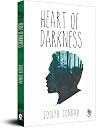
Heart Of Darkness
Product ID: 397015077
📖Durable hardcover edition
📚Timeless literary classic
🛡️Secure, gift-ready packaging
📚 Own the darkness, illuminate your intellect.
Heart of Darkness by Joseph Conrad is a masterful literary work that delves into imperialism and the human condition through a haunting journey in the Congo. This deluxe hardcover edition offers secure packaging and a collector’s quality design, making it an essential addition for literature enthusiasts and professionals seeking a timeless, thought-provoking read.


| Best Sellers Rank | #13,805 in Books ( See Top 100 in Books ) #8 in Sea Stories #13 in Fantasy Anthologies #27 in Military Fantasy |
| Customer Reviews | 4.4 out of 5 stars 4,068 Reviews |
L**C
about the Penguin Deluxe edition
I was aware of the rough edges (they are deliberate - it's a quirk of the anglophone publishing industry to deem them as luxurious) and don't mind them, though they make page turning a bit of a struggle. But the printing quality was sub-par in my copy: a few pages were printed quite faintly and there was variation of ink intensity throughout. None one the pages were unreadable, but given that turning the pages was already going to be a chore, I wasn't willing to also accept the poor printing quality. So I returned the book.
K**N
... is a definite read for college students studying literature like myself. I also see it capturing the attention ...
Heart of Darkness is a definite read for college students studying literature like myself. I also see it capturing the attention of those studying history, but I only see minds matured over the easily-distracted age of fifteen making the most of this experience. Published in 1899 by Joseph Conrad, who was already known for his seafaring career which included travels to Africa, this realistic novel makes for an interesting conversation starter when peeking out of my satchel and therefore well-deserving of 4.9 stars! Conrad employs imagery and dialogue to convey the harsh reality of the times. He describes the death of a humanity corrupted by a deadly one, resulting in an elegiac reflection of his travels. In this novella, Charles Marlow sets sail on the Congo and finds himself searching for the mysterious Kurtz. During his travels, Marlow sees the brutal treatment of starved natives and encounters obstacles like a ship in need of fixing, an attack, and illness. Once Marlow finds Kurtz, Marlow finds himself holding more power and responsibility than the man he sought, much like the power of knowledge peeking out of my satchel and intimidating many. I enjoyed reading this book, despite the verbose descriptions interrupting the plot, a challenge I assume may hinder other readers. I also found myself often relating to Conrad’s strong curiosity. Conrad focuses on action as the key tool to develop his characters. Marlow is an authentic character, and the reader experiences all of his conflicting thoughts as he does. We are also given a mental image through Conrad’s characterization of a tired captain giving into his curiosity. Kurtz is also well described by other characters, thus revealing his extensive education and powerful nature, as well as his talents of painting and music. I can also easily relate to his multitalented nature, proven by the vast array of tools in my satchel. The plot is built on a predictable foundation with the details of mistreated natives learned from the average reader’s advanced history classes, but this novel adds a new dimension to the textbook pages with intense and realistic imagery. The journey down the Congo sets the dangerous setting for interactions with natives and other workers, leading to an easily predictable ending of Marlow meeting Kurtz. However, Kurtz’s untimely death and Marlow’s untruthful delivery of his last words are unforeseen by readers other than myself. This novel is a heavy read and difficult to grasp because of the lack of humanity of all characterized. The native people are portrayed in a heavily critical manner in need of filtering by today’s standards, but like in Charlotte Perkins Gilman’s Herland, those who invade truly opt to make an area their own instead of integrating, also seen by the mistreatment of Native American tribes during the colonization of America. With all this in mind, I reiterate my strong recommendation of reading this timeless novel. Not only is it praiseworthy in the sense of capturing history in its true and brutal form, but it also has great literary merit, a reason why I will forever keep it peeking out from my satchel.
A**A
Everyman's Library is so peak
As always Everyman's Library delivers the peakest of books possible. The pages are so smooth and sewn rather than glued on. I'd recommend everyone to spend a little more than you otherwise might have just to buy this edition cuz lowkey it is worth it.
J**E
Dark & haunting
A reflection of human nature
T**Y
A True Masterpiece for the Centuries
This novel is the masterpiece that people make it to be. In my opinion, this is a novel that will go down teh centuries and will be read and studied hundreds of years from now much like Shakespeare's plays Europeans were colonizing Africa using the weapons of war that had been advanced in the 19th century. The 19th century had seen weapons advancing from single shot muzzle loading weapons to repeating rifles and machine guns. War theorists could calculate the volume of fire that these weapons could produce and know that it was devastating. However, there were no great European wars and Europeans used these weapons on people who could do little to defined themselves in Africa. This was part of the darkness to which they descend in Africa. They did in Africa what they were capable of and that was far darker than their belief in their own righteousness would admit. That is what Kurtz saw at the end. Twenty years after the publication of 'Heart of Darkness', it was Europe's turn to enter the 20th century wars that would destroy it. They used the 19th century weapons of the machine gun and the wire and killed a generation of young men. They used their ingenuity to overcome these weapons and to devise even more terrible ones to replace them in the slaughter. High cultures descended into mass murder and extermination. This is what the novel is about and this is what the novel portrays so powerfully. It anticipates what the 20th century was about. The descent into a profound darkness and horror.
Trustpilot
2 days ago
4 days ago