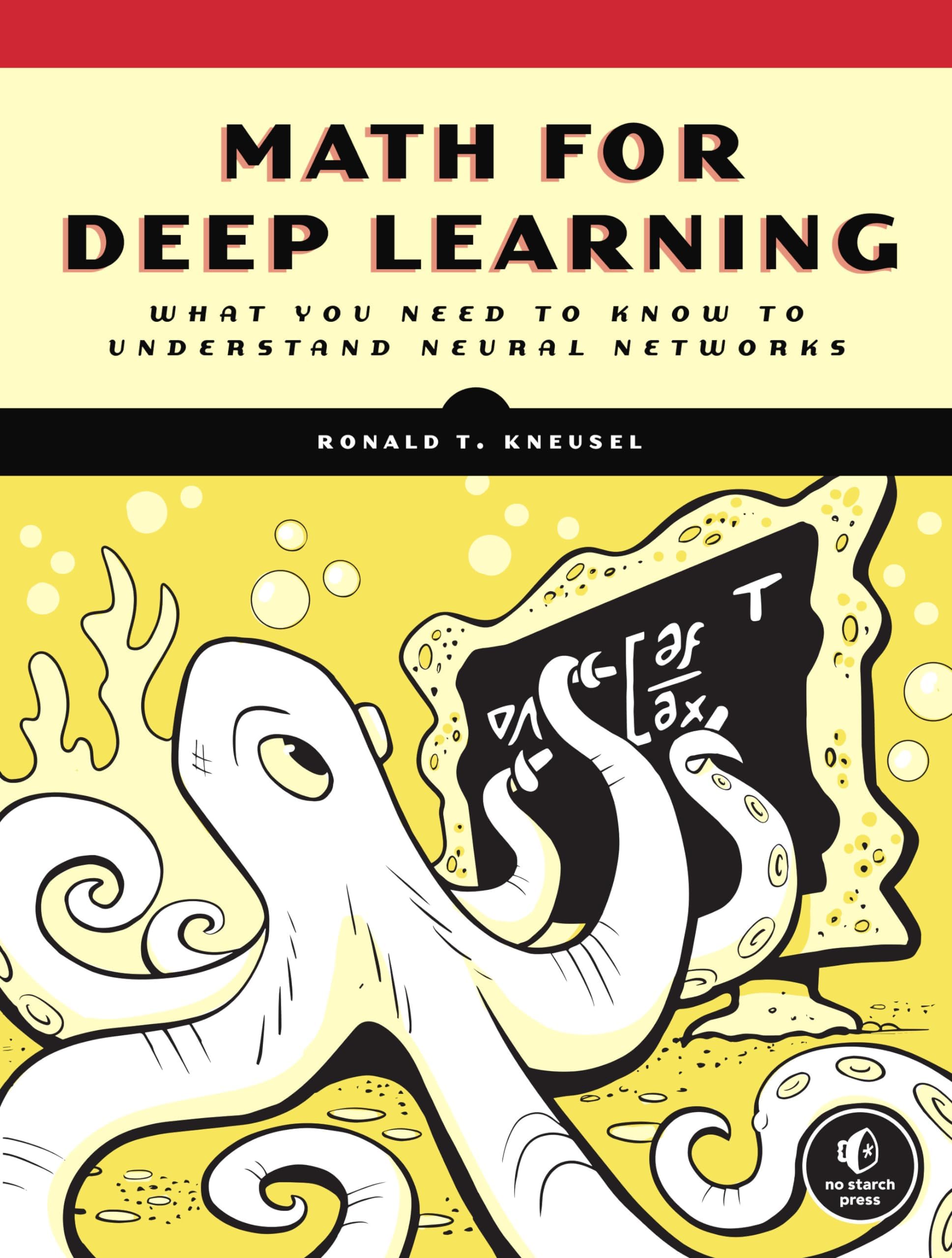
Math for Deep Learning: What You Need to Know to Understand Neural Networks
Product ID: 385865654
Buy anything from 5,000+ international stores. One checkout price. No surprise fees. Join 2M+ shoppers on Desertcart.
Desertcart purchases this item on your behalf and handles shipping, customs, and support to Indonesia.
Math for Deep Learning provides the essential math you need to understand deep learning discussions, explore more complex implementations, and better use the deep learning toolkits. With Math for Deep Learning , you'll learn the essential mathematics used by and as a background for deep learning. You’ll work through Python examples to learn key deep learning related topics in probability, statistics, linear algebra, differential calculus, and matrix calculus as well as how to implement data flow in a neural network, backpropagation, and gradient descent. You’ll also use Python to work through the mathematics that underlies those algorithms and even build a fully-functional neural network. In addition you’ll find coverage of gradient descent including variations commonly used by the deep learning community: SGD, Adam, RMSprop, and Adagrad/Adadelta. Review: Perfect book for understandig math for DL. - I have read several math books for ML and AI. This one surprise me in many ways. Complex concepts made easy to learn, with code examples and use cases. I really recommend this book for begginers. Review: awesome summary - Dr kneusel does an amazing job breaking down neural networks into the fundamental components as well as statistical frameworks . Highly recommend for anyone looking for an intro to or refresher on the math required for ML. It will require some studying though if one does not have a solid maths background .
| Best Sellers Rank | #77,960 in Books ( See Top 100 in Books ) #424 in Computer Science Books |
| Customer Reviews | 4.7 out of 5 stars 80 Reviews |
R**R
Perfect book for understandig math for DL.
I have read several math books for ML and AI. This one surprise me in many ways. Complex concepts made easy to learn, with code examples and use cases. I really recommend this book for begginers.
J**S
awesome summary
Dr kneusel does an amazing job breaking down neural networks into the fundamental components as well as statistical frameworks . Highly recommend for anyone looking for an intro to or refresher on the math required for ML. It will require some studying though if one does not have a solid maths background .
M**H
Brain Friendly Guide
This book is easier to understand and for all samples it uses code the thing which we are going to use on daily life.
K**E
A reasonable summary of the topic with a focus on Python
I've skimmed the entire book and have worked through several chapters in detail. My first reaction is this book covers about 3-4 years of undergraduate math with some graduate school math topics. My CS degree is 30+ years old, but my daughter just finished her CS/Math degree and the undergraduate math requirements have changed very little. My old-school CS degree covered only about 80% of the topics in this book. If you've taken these classes then this is book provides an awesome review put in the perspective of how to use python to help with these problems. If you haven't taken at least statistics, calculus, and linear algebra, you may find that you need books that introduce these topics in a more beginner-friendly way. And then use this book to provide ML context to the math. There are many good intro books and youtube videos that can help start with these topics. An example of a beginner-friendly statistics book might be "The Cartoon Guide to Statistics" which is fantastic. Good videos would be anything by 3blue1brown. I'm reading the Kindle version of the book. The formatting seems quite good for a Kindle book. Kudos to the author for not treating Kindle as an afterthought. I'm finding this to be a very useful book. The title did warn that it's a mathy book. I think to get a good feel of ML right now, this math background is probably necessary. And this book seems quite good.
N**M
This is a Math Book.
This is a Math Book, but does not have anything applicable to Deep Learning! The author spends three pages on the Monty Hall Problem (For those who don't know what the Monty Hall problem is, it was a TV show thirty years ago, called, "Let's Make a Deal".) What has the Monty Hall problem to do with Deep Learning. It would have been useful if the author had taken a single example, say, the recognition of hand-written digits (the famous MNIST), and worked from the beginning to the end, including the back propagation, and introducing the necessary Math as he proceeds, it would have been immensely useful. I can think of at least one use for this book: Use it as a paper weight.
Trustpilot
3 weeks ago
3 weeks ago