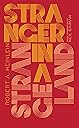
STRANGER IN A STRANGE LAND
Product ID: 35405424
Desertcart purchases this item on your behalf and handles shipping, customs, and support to Indonesia.
A deluxe hardcover edition of the most famous science-fiction novel of all time—part of Penguin Galaxy, a collectible series of six sci-fi/fantasy classics, featuring a series introduction by Neil Gaiman Winner of the AIGA + Design Observer 50 Books | 50 Covers competition A human raised on Mars, Valentine Michael Smith has just arrived on planet Earth. Among his people for the first time, he struggles to understand the social mores and prejudices of human nature that are so alien to him, while his own “psi” powers—including telepathy, clairvoyance, telekenesis, and teleportation—make him a type of messiah figure among humans. Stranger in a Strange Land grew from a cult favorite to a bestseller to a classic in a few short years. The story of the man from Mars who taught humankind grokking and water-sharing—and love—it is Robert A. Heinlein’s masterpiece. Penguin Galaxy Six of our greatest masterworks of science fiction and fantasy, in dazzling collector-worthy hardcover editions, and featuring a series introduction by #1 New York Times bestselling author Neil Gaiman, Penguin Galaxy represents a constellation of achievement in visionary fiction, lighting the way toward our knowledge of the universe, and of ourselves. From historical legends to mythic futures, monuments of world-building to mind-bending dystopias, these touchstones of human invention and storytelling ingenuity have transported millions of readers to distant realms, and will continue for generations to chart the frontiers of the imagination. The Once and Future King by T. H. White Stranger in a Strange Land by Robert A. Heinlein Dune by Frank Herbert 2001: A Space Odyssey by Arthur C. Clarke The Left Hand of Darkness by Ursula K. Le Guin Neuromancer by William Gibson For more than seventy years, Penguin has been the leading publisher of classic literature in the English-speaking world. With more than 1,700 titles, Penguin Classics represents a global bookshelf of the best works throughout history and across genres and disciplines. Readers trust the series to provide authoritative texts enhanced by introductions and notes by distinguished scholars and contemporary authors, as well as up-to-date translations by award-winning translators. Review: A Martian Named Smith - There is no question that Robert Anson Heinlein is one of the Fathers of Science Fiction. There is also no question that STRANGER IN A STRANGE LAND is his most famous work, having been called "the most famous science fiction novel ever written." Is it his best? Perhaps not. But it is a ground breaking classic, one that I enjoy reading again and again. STRANGER IN A STRANGE LAND is the story of Valentine Michael Smith (Mike), a male born of human parents on the first Earth colony ship to Mars. Literally born as the ship landed on Mars, Mike's parents and the rest of the crew died, and Mike was raised by Martians. 25 years later, a second Earth colony ship lands on Mars, and discovers Mike, the native inhabitants of Mars, and a host of unanswered questions. Mike returns to Earth, and STRANGER IN A STRANGE LAND is the detailed chronicle of his introduction to, interaction with, and transformation of human culture. STRANGER IN A STRANGE LAND was Heinlein's first truly adult science fiction novel, and he took on some pretty heady topics. Politics, religion, sex, equality, and the concept of a truly un-human culture (which happened to be superior), to name a few. Heinlein wove these themes into STRANGER IN A STRANGE LAND, each of which contributed to his idealistic vision of a perfect world.He intermixed shock value, logic, and plain good storytelling to get his points across, and I think he did so quite wonderfully. 1. Religion. Heinlein was not an atheist, as some have claimed. He did believe in a higher power; what he did not have any use for was organized religion. He believed in faith. If you had faith, true faith, then the trappings of religion were unnecessary and superfluous. They just did not matter. The Church of All Worlds in STRANGER IN A STRANGE LAND was set up to show that no matter what the religious trapping were, it was faith that really mattered. He also created a religion where happiness and self-belief were the main drivers, rather than fire, brimstone, and fear. Makes great sense to me. 2. Sex. Contrary to popular belief, STRANGER IN A STRANGE LAND did not promote promiscuity or free love. What Heinlein did was to create a world where people were open about sex, where it was enjoyable and exciting, but with it came great responsibility. In this world, sex wasn't hidden, secret, or naughty; rather it was honest and pure and fun. People who could develop this utopian attitude became happier, healthier, less jealous, more caring, and, yes, more sexual. Responsibility to partners, offspring, and an entire extended family became the norm. In his own way, by exploring sexuality, Heinlein was exploring and redefining the meaning of family. He was also trying to define sex as a miraculous union, and to show that humans should treat it as the miracle of bonding and "growing closer" that it is. 3. Equality. Before the sexual revolution and equality for women, Heinlein clearly believed in equality of the sexes, equality of the races, equality of faiths...basically the equality of all humans. Yes, he felt women should be treated with respect and reverence and be protected and nurtured because they gave birth and perpetuated the species, but he clearly believed that they were intelligent and capable. He also believed that women had sexual needs equal to those of men and had the right to pursue those needs. 4. Politics. In STRANGER IN A STRANGE LAND, Heinlein clearly had little use for government, politics, or politicians. He believed that government in general was a necessary evil, but preferred that it be kept small and out of his business. He didn't care what it was based on or what guided it - astrology was the ridiculous example used in STRANGER IN A STRANGE LAND - as long as it left him alone. Works for me. He also had little use for entitlements, and expected human beings to work for what they received. Again, works for me. 5. Un-Human, Superior Culture. Heinlein did a remarkable and revolutionary thing when he created the Martian culture of STRANGER IN A STRANGE LAND. The Martians of this novel are clearly not humanoids from another planet. They do not think like humans, act like humans, look like humans, reproduce like human, live like humans, or do anything like we do here on the planet Earth. There is nothing remotely recognizable about these Martians; they are completely alien. We can't them, and they can't understand us. They are older, more advanced, and can perceive the universe around them in ways that humans do not. But humans can, if properly taught, learn some of the things that Martians do. What a marvelous concept. In 1962 the original version of STRANGER IN A STRANGE LAND won the Hugo Award for the Best Science Fiction Novel of the Year. After Heinlein's death in 1988, his wife Virginia discovered the original uncut manuscript and arranged to have it published in 1991. It is interesting to read the two books side by side, to see the differences, and to compare them. I enjoy both versions very much, and am still not sure which is my favorite. Whatever version you choose, I HIGHLY RECOMMEND STRANGER IN A STRANGE LAND. Whether you have read it before or not, whether you love it or not, you will find it to be an interesting and thought-provoking read. Review: A strange book I don’t grok - I have started to read this book directly after I had read “The Moon is a harsh Mistress” and after the first chapter, I almost stopped reading again. The first chapter starts promisingly enough, after a Mars expedition with only four couples, finding the fitting couples that contained all the required capabilities in themselves had been difficult enough, had failed, years later, another expedition is started, and this time, the flight takes much shorter. They find a young man there and bring him back, but how they treat him here, locked and no women allowed, for the first time really showed me how old Robert Heinlein’s books really are and here, for the first time, it was an annoyance. What would happen if a woman would visit him? We find out in the second chapter, and the answer is, basically, nothing. Then, for about 10% of the book, we get Jill, working in the hospital where the Man from Mars is kept, discussing with Ben, a journalist, about the implication of the Man from Mars. Once he owns the whole Mars, once he owns a majority of Lunar Enterprises. In any case, the government under the Secretary General cannot keep him alive. Then, finally, some action occurs: Ben tries to get the Man released, but fails miserably; Jill subsequently tries to prisonbreak with the Man. They escape to Ben’s place but the henchmen are not far away. They ring at the door, there is a confrontation and... it’s over. They go to another benefactor, Jubal, who keeps Jill and the Man hidden for rest of almost half of the book. There, Jubal thinks about how to help the Man, together with getting Ben back, while he tries to learn as much as possible about the Martian and Mars. Then, the henchmen appear again, ready to arrest everybody, and after the Martian makes the policemen disappear once more, Jubal eventually manages to bluff the Secretary General into calling back the second arresting team and agreeing to meet with the Man from Mars with him, Jubal, as the official delegate for the Martian. At the meeting, Jubal does what he can to make the Man’s live safe: He gives the Secretary General the mandate the manage the money of the Martian with the payment as much money as he sees fit. Having thus secured the Martian’s safety, the Martians keeps living at Jubal’s place and learning. They visit a service of the Fosterite church, where people gamble, visit the bar and have stories with women but when the archbishop wants to have one-to-one talk with the Martian, latter recognizes former’s evilness and discorporates him. Eventually, the Man from Mars has learned all he can at Jubal’s and he and Jill set out for the world. They join a circus troupe where the Martian performs a levitating trick with Jill, only it is not a trick, he really does so. But they are unsuccessful, the marks see right through it. They leave again, but not before they have listened to a snake charmer sermon about the Fosterites and before they make her a water brother. They next move to Las Vegas where Jill works in a show and the Martian as croupier and they elucidate naughty pictures. Thereafter, they go to San Francisco, where the Martian reads all the books about the various religions without grokking anything. They then visit a zoo where the Martian breaks out laughing as he, observing monkeys, finally groks people. They founded their own church, but it’s not a religion. The Martian had hereto shown some extraordinary capabilities, such as being able to enter a trance state where he could stay under water for hours, telekinesis and the ability to discorporate things or beings at will. Had the reader so far been wondering how he could do that, if the Old Ones on Mars has changed him somehow on Mars, now it become clear that this was not the case. Everybody can do it but, in order to facilitate such deeds, which were connected to Martian creed, one had to understand the Martian concepts, which one could only by firstly learning the Martian language. The Martian church was thus foremost a Martian language school. That was however not all it was. The Martian idea was that there was no God than God in everyone of us. All other religions were considered as truths, only that they were kind of hiding that God was each of us, and thus the creed was “Thou are God.” In the Martian church, also free love was practiced. We get hence a chapter where Ben was shocked by this and fled the church most hurriedly to report to Jubal, only to join it again the next chapter. And of course, we get Fosterites who try to start a persecution against their competitors. The end then also makes sense, but I don’t understand why. It was on one hand logical but on the other hand why was it necessary? This is thus not really a work of science fiction and but rather a theological treatise. I think it could have shortened somehow, then realized, that what the original editors thought as well. It was my third book I read from Robert Heinlein, Starship Troopers was a good concept which Joe Haldeman made into a good book, the Moon is a harsh Mistress was a quick read that kept me hooked, but considering, it is basically a story of the American struggle for independence, just on the Moon, and it will also be my last. There are other science fictions authors out there.

| Best Sellers Rank | #71,267 in Books ( See Top 100 in Books ) #60 in Alien Invasion Science Fiction #77 in First Contact Science Fiction (Books) #135 in Science Fiction Short Stories |
| Customer Reviews | 4.3 out of 5 stars 12,059 Reviews |
K**N
A Martian Named Smith
There is no question that Robert Anson Heinlein is one of the Fathers of Science Fiction. There is also no question that STRANGER IN A STRANGE LAND is his most famous work, having been called "the most famous science fiction novel ever written." Is it his best? Perhaps not. But it is a ground breaking classic, one that I enjoy reading again and again. STRANGER IN A STRANGE LAND is the story of Valentine Michael Smith (Mike), a male born of human parents on the first Earth colony ship to Mars. Literally born as the ship landed on Mars, Mike's parents and the rest of the crew died, and Mike was raised by Martians. 25 years later, a second Earth colony ship lands on Mars, and discovers Mike, the native inhabitants of Mars, and a host of unanswered questions. Mike returns to Earth, and STRANGER IN A STRANGE LAND is the detailed chronicle of his introduction to, interaction with, and transformation of human culture. STRANGER IN A STRANGE LAND was Heinlein's first truly adult science fiction novel, and he took on some pretty heady topics. Politics, religion, sex, equality, and the concept of a truly un-human culture (which happened to be superior), to name a few. Heinlein wove these themes into STRANGER IN A STRANGE LAND, each of which contributed to his idealistic vision of a perfect world.He intermixed shock value, logic, and plain good storytelling to get his points across, and I think he did so quite wonderfully. 1. Religion. Heinlein was not an atheist, as some have claimed. He did believe in a higher power; what he did not have any use for was organized religion. He believed in faith. If you had faith, true faith, then the trappings of religion were unnecessary and superfluous. They just did not matter. The Church of All Worlds in STRANGER IN A STRANGE LAND was set up to show that no matter what the religious trapping were, it was faith that really mattered. He also created a religion where happiness and self-belief were the main drivers, rather than fire, brimstone, and fear. Makes great sense to me. 2. Sex. Contrary to popular belief, STRANGER IN A STRANGE LAND did not promote promiscuity or free love. What Heinlein did was to create a world where people were open about sex, where it was enjoyable and exciting, but with it came great responsibility. In this world, sex wasn't hidden, secret, or naughty; rather it was honest and pure and fun. People who could develop this utopian attitude became happier, healthier, less jealous, more caring, and, yes, more sexual. Responsibility to partners, offspring, and an entire extended family became the norm. In his own way, by exploring sexuality, Heinlein was exploring and redefining the meaning of family. He was also trying to define sex as a miraculous union, and to show that humans should treat it as the miracle of bonding and "growing closer" that it is. 3. Equality. Before the sexual revolution and equality for women, Heinlein clearly believed in equality of the sexes, equality of the races, equality of faiths...basically the equality of all humans. Yes, he felt women should be treated with respect and reverence and be protected and nurtured because they gave birth and perpetuated the species, but he clearly believed that they were intelligent and capable. He also believed that women had sexual needs equal to those of men and had the right to pursue those needs. 4. Politics. In STRANGER IN A STRANGE LAND, Heinlein clearly had little use for government, politics, or politicians. He believed that government in general was a necessary evil, but preferred that it be kept small and out of his business. He didn't care what it was based on or what guided it - astrology was the ridiculous example used in STRANGER IN A STRANGE LAND - as long as it left him alone. Works for me. He also had little use for entitlements, and expected human beings to work for what they received. Again, works for me. 5. Un-Human, Superior Culture. Heinlein did a remarkable and revolutionary thing when he created the Martian culture of STRANGER IN A STRANGE LAND. The Martians of this novel are clearly not humanoids from another planet. They do not think like humans, act like humans, look like humans, reproduce like human, live like humans, or do anything like we do here on the planet Earth. There is nothing remotely recognizable about these Martians; they are completely alien. We can't them, and they can't understand us. They are older, more advanced, and can perceive the universe around them in ways that humans do not. But humans can, if properly taught, learn some of the things that Martians do. What a marvelous concept. In 1962 the original version of STRANGER IN A STRANGE LAND won the Hugo Award for the Best Science Fiction Novel of the Year. After Heinlein's death in 1988, his wife Virginia discovered the original uncut manuscript and arranged to have it published in 1991. It is interesting to read the two books side by side, to see the differences, and to compare them. I enjoy both versions very much, and am still not sure which is my favorite. Whatever version you choose, I HIGHLY RECOMMEND STRANGER IN A STRANGE LAND. Whether you have read it before or not, whether you love it or not, you will find it to be an interesting and thought-provoking read.
M**R
A strange book I don’t grok
I have started to read this book directly after I had read “The Moon is a harsh Mistress” and after the first chapter, I almost stopped reading again. The first chapter starts promisingly enough, after a Mars expedition with only four couples, finding the fitting couples that contained all the required capabilities in themselves had been difficult enough, had failed, years later, another expedition is started, and this time, the flight takes much shorter. They find a young man there and bring him back, but how they treat him here, locked and no women allowed, for the first time really showed me how old Robert Heinlein’s books really are and here, for the first time, it was an annoyance. What would happen if a woman would visit him? We find out in the second chapter, and the answer is, basically, nothing. Then, for about 10% of the book, we get Jill, working in the hospital where the Man from Mars is kept, discussing with Ben, a journalist, about the implication of the Man from Mars. Once he owns the whole Mars, once he owns a majority of Lunar Enterprises. In any case, the government under the Secretary General cannot keep him alive. Then, finally, some action occurs: Ben tries to get the Man released, but fails miserably; Jill subsequently tries to prisonbreak with the Man. They escape to Ben’s place but the henchmen are not far away. They ring at the door, there is a confrontation and... it’s over. They go to another benefactor, Jubal, who keeps Jill and the Man hidden for rest of almost half of the book. There, Jubal thinks about how to help the Man, together with getting Ben back, while he tries to learn as much as possible about the Martian and Mars. Then, the henchmen appear again, ready to arrest everybody, and after the Martian makes the policemen disappear once more, Jubal eventually manages to bluff the Secretary General into calling back the second arresting team and agreeing to meet with the Man from Mars with him, Jubal, as the official delegate for the Martian. At the meeting, Jubal does what he can to make the Man’s live safe: He gives the Secretary General the mandate the manage the money of the Martian with the payment as much money as he sees fit. Having thus secured the Martian’s safety, the Martians keeps living at Jubal’s place and learning. They visit a service of the Fosterite church, where people gamble, visit the bar and have stories with women but when the archbishop wants to have one-to-one talk with the Martian, latter recognizes former’s evilness and discorporates him. Eventually, the Man from Mars has learned all he can at Jubal’s and he and Jill set out for the world. They join a circus troupe where the Martian performs a levitating trick with Jill, only it is not a trick, he really does so. But they are unsuccessful, the marks see right through it. They leave again, but not before they have listened to a snake charmer sermon about the Fosterites and before they make her a water brother. They next move to Las Vegas where Jill works in a show and the Martian as croupier and they elucidate naughty pictures. Thereafter, they go to San Francisco, where the Martian reads all the books about the various religions without grokking anything. They then visit a zoo where the Martian breaks out laughing as he, observing monkeys, finally groks people. They founded their own church, but it’s not a religion. The Martian had hereto shown some extraordinary capabilities, such as being able to enter a trance state where he could stay under water for hours, telekinesis and the ability to discorporate things or beings at will. Had the reader so far been wondering how he could do that, if the Old Ones on Mars has changed him somehow on Mars, now it become clear that this was not the case. Everybody can do it but, in order to facilitate such deeds, which were connected to Martian creed, one had to understand the Martian concepts, which one could only by firstly learning the Martian language. The Martian church was thus foremost a Martian language school. That was however not all it was. The Martian idea was that there was no God than God in everyone of us. All other religions were considered as truths, only that they were kind of hiding that God was each of us, and thus the creed was “Thou are God.” In the Martian church, also free love was practiced. We get hence a chapter where Ben was shocked by this and fled the church most hurriedly to report to Jubal, only to join it again the next chapter. And of course, we get Fosterites who try to start a persecution against their competitors. The end then also makes sense, but I don’t understand why. It was on one hand logical but on the other hand why was it necessary? This is thus not really a work of science fiction and but rather a theological treatise. I think it could have shortened somehow, then realized, that what the original editors thought as well. It was my third book I read from Robert Heinlein, Starship Troopers was a good concept which Joe Haldeman made into a good book, the Moon is a harsh Mistress was a quick read that kept me hooked, but considering, it is basically a story of the American struggle for independence, just on the Moon, and it will also be my last. There are other science fictions authors out there.
J**D
Still a good reflection
I first read this book in the 1980s. It's a good extrapolation of the tools of the 1960s into the future. In noticed references to what is now known as cell phones. It also predates and predicted the 1970s fascination with esoterica and Eastern philosophy and practice.
J**T
We Should All Be a Little Stranger.
I understand why this book is often cited as one of the most important sci-fi books of all time. While reading it, you might begin to question why it’s lumped into the sci-fi category because the themes are very human. It is science fiction, that cannot be argued, but it’s also a coming of age story, a religious story and at its very core, a story about love. Valentine Michael Smith was born and raised on Mars, but he is a human. He is brought back to Earth to learn what it means to be a human. This causes the reader to be forced to think outside of the box because Michael is not just coming from a different human culture, he has never learned what it means to be a human so any chapter told from his perspective is like an outsider, looking in on human culture. It’s wildly fascinating to think about ourselves in this manner. As Michael progresses in his grokking of humans, he gets out to explore the world and to challenge it. Our concepts of God/religion and sex/love are strange to him. We tend to not really think about it from an outside perspective because this is just the way life is, but being forced to think about it, makes for a very fascinating read. I’d never really considered myself to be a “prude” but there were times that this book made me feel that way. At times, the reader must take a step back and remember that Heinlein did intend for many of the themes to be viewed as satire of what is commonly accepted. There were a few negatives when reading this book, however. It was written in the sixties, which was a very different time from today in terms of the way women are spoken to/about and how they are treated. Heinlein wasn’t too bad in this regard, but there were a few sentences that made me stop for a second. Heinlein also has some of his characters go on these long drawn-out speech tangents that go on for pages and pages. I felt it was a little unnecessary to go on for that long, especially considered the length of the uncut version. It took me a little while to get through this book and normally I’m a pretty quick reader. Negatives aside, I do feel like this book is important. The story itself is not challenging, but as I stated before, it challenges the reader to think about humans from an outside perspective and that is fascinating. He really doesn’t seem to rely too much on Sci-fi elements, preferring to focus on the human elements of the story (love, religion etc.). If you’re looking for something long and fulfilling, this may just be the sci-fi book for you!
K**R
Wicked Satire, yet Strangely Familiar
Heinlein's satire is wicked and well-placed, reminiscent of Voltaire and Swift. IF you love British comedy, you'll love this book. Both come from the same sarcastic taproot. I'm still debating whether or not the main charter is Smith or Jubal. Maybe it is us, since we need to recognize that we are Juba, and must nurture, and eventually become like Smith. Smith's reflective, contemplative message, reminds of Thomas A Kempis ( The Imitation of Christ (Dover Thrift Editions) ), James Allen ( The Wisdom of James Allen : Including As a Man Thinketh, The Path to Prosperity, The Mastery of Destiny, The Way of Peace, and Entering the Kingdom (Radiant Life) ), Lao Tzu ( Tao Te Ching (Dover Thrift Editions) ). Smith's message is nothing new: as C. S. Lewis pointed out, "Really great moral teachers never do introduce new moralities: it is quacks and cranks who do that... The real job of every moral teacher is to keep on bringing us back, time after time, to the old simple principles which we are all so anxious not to see." Mere Christianity . In fact, Smith's slogan "Thou art God" is merely run-of-the-mill Christianity: * "Inasmuch as ye have done it unto one of the least of these my brethren, ye have done it unto me." * "Be ye therefore perfect, even as your Father which is in heaven is perfect." * "Therefore, what manner of men ought ye to be? Verily I say unto you, even as I am." * "Ye are gods; and all of you are children of the most High." * "God became man so that man might be god." * "It is a serious thing to live in a society of possible gods and goddesses to remember that the dullest and most uninteresting person you may talk to may one day be a creature which, if you saw it now, you would be strongly tempted to worship, or else a horror and corruption such as you now meet if at all only in a nightmare. . . . There are no ordinary people. You have never met a mere mortal, Nations, cultures, arts, civilizations, these are mortal, and their life is to ours as the life of a gnat. But it is immortals whom we joke with, work with, marry, snub, and exploit--immortal horrors or ever lasting splendours." The Weight of Glory . Heinlein seems to have stolen a page from Søren Kierkegaard, who tried to re-Christianize Christianity ( The Essential Kierkegaard , 458). To paraphrase John, "Brethren, I write no new commandment unto you, but an old commandment which ye had from the beginning." As I read this book, Smith struck me as oddly familiar. His first name, Michael, refers to the Archangel, the captain of the Lord's army. The second name, Valentine, is the patron saint of all shades of love, phileo, agape, eros, and romance. The last name, Smith, makes him Everyman. But I wonder if there is something more. What happens to Smith is common to all founders of religions--Abraham, Jesus, Mohammed, and so forth. There is evolution, turns and twists of fate, and eventual triumph. However, there is a deeper nuance. Society begins with vulgarized Christianity, then there was the Fosterite Revolution, and another apostasy and commercialization of religion as a Megachurch. And lastly comes along Smith, with his Martian philosophy. This bears a strong parallel to the life of Joseph Smith Joseph Smith: Rough Stone Rolling . In fact, both have a similar martyrdom: "Thou art God" versus "O Lord My God." The satire can get tedious at time, but I think this flaw is excusable. As I read, I kept thinking that this book could loose about 1/3rd of the text. But on the other hand, the artistry and beauty of the wicked satire forces me to say, "Leave it alone." Note: This book is the Q document for so much other fiction. I see shades of "Dune" here and there. Smith the new prophet is akin to Ender, the Speaker for the Dead. And if you have seen Star Trek: The Original Series episode "Charlie X," some of the elements will seem a bit too familiar. Keep in mind that this book came first, and that it does a much better job of mixing wit and wisdom than Kirk and Spock. There is no comparison--after reading this book, "Charlie X" rolls like a flat tire.
M**L
CLASSIC Science Fiction
In the wide-ranging genre of science fiction, there are plenty of classics, but only a few true CLASSICS. In this elite group are such works as the Foundation Trilogy by Isaac Asimov, Childhood's End by Arthur C. Clarke and Robert Heinlein's Stranger in a Strange Land. It may be one of the revered science fiction books ever, but does it really deserve that reputation? Maybe, maybe not: personally, I like the book, but I don't think of it as one of the best sci-fi novels ever. The Stranger in a Strange Land of the title is Valentine Michael Smith, the son of two of the initial colonists of Mars. The original colonists all died soon after landing, but the infant Michael survived and was raised by the native Martians. Around twenty-five years later, more colonists come to Mars and bring Michael "home" to Earth. Michael is completely naïve to the ways of humans, which makes him the target of all sorts of people. Legally, he has incredible wealth including "ownership" of Mars itself. The government wants to keep him locked away, but the nurse Jill Boardman breaks him free and brings him to attorney/doctor Jubal Harshaw. Harshaw extricates Michael from the worst of his legal problems, but new issues develop. Michael has all sorts of mental powers developed through his Martian schooling, including the ability to vaporize any enemies with a thought. His unique powers and his introduction of Martian culture to Earth - including the ideas of water brotherhood and grokking - help transform Michael into either a prophet or a messiah; he gains a following of other water brothers who have the potential to usher in a new age of mankind. All this is just the briefest of synopses of this satisfyingly complex book. While many might think that Michael is the central character in the novel, I feel it's really Jubal Harshaw. While it's always dangerous to closely link the author with a particular character, I tend to think that Harshaw is the mouthpiece for Heinlein. And if there's a weakness in this book, it's Harshaw's pontificating. He may have good points, but at times, it seems that Heinlein (through Harshaw, and to a lesser extent Michael and other characters) is preaching more than storytelling. This is also the difference between Heinlein and the other two members of the so-called "Big Three" of science fiction, Clarke and Asimov. The other two focus more on science, while Heinlein seems more interested in social issues. (That's not to say that Clarke and Asimov ignore these issues - or Heinlein ignores science - but just where the focus is.) Revisiting my original question, while this may not be the best book ever, it is still really good and deserves its CLASSIC status for its historic impact as much as its quality. Well-written and thought-provoking, this is Heinlein's masterpiece.
A**N
Free Love & Pantheism Overshadow Sci-Fi/Lack of Adventure
This is a very readable novel and I don't have any major complaints with the writing. The story strikes me as almost idyllic: the magic Martian man hanging out with this Hugh Heffner wannabe lawyer, philosopher, novelist and his bunnies at this comfortable estate. One can almost imagine this being written by the poolside. But after a while this feels a bit too indulgent and you wish there were more conflict, more action, more excitement. The conflict ends up being mostly just the nebulous government guys conniving against the magic Martian protagonist. There is some action, which I won't spoil, but there is no adventure. I think people would say "well, it's an adventure for the magic Martian man", and that's true enough, but from the reader's perspective it's an anti-adventure where the protagonists basically hunker down and try to stay safe. Naturally, the magic Martian man is written as a really odd character, innocent and childlike, but he feels too much like a forced spectacle. Ultimately, what redeems this book is just that it's extremely readable and leaves you with enough quirky impressions for it to be memorable (e.g. the term "grok" has entered the collective vocabulary by now). It does seem to have an agenda in promoting free love and pantheism, but it wasn't preachy or heavy-handed so it's hard to be too annoyed by that. Indeed, a huge effort was made to portray the protagonists as innocent victims. While I doubt people would be too bothered by the free love message, the bigger issue is undoubtedly the lack of a robust science fiction atmosphere. And it's not a matter of hard vs. soft science fiction. It's just lack of science fiction content in general. Yes, there is the magic Martian man and his abilities, which are impressive though rarely used. But beyond that there really isn't much going on. It's focused more on dialogue and a sort of anthropological perspective with associated musings on society.
F**H
A classic book from the 60s that is relevant to a recent public offering
This very fine science fiction book by one of the masters of that class of fiction was a major prize winner when it was published in the 1960s.. This well written story about a human male born on Mars and raised by Martians, was a best seller and remains a classic. Of course, it is much more than the one sentence I have written can describe. I picked it up again after reading it 60 or more years ago, because some of what I remember seemed directly relevant to the work and language of Elon Musk and the entry into the public securities markets of his Space X enterprise. Whether you are an investor and pick up the volume because it is very likely that Mr. Musk was influenced by it, or because you enjoy reading great fiction, you will not be disappointed.
S**H
A classical hardcover .
The books came with a excellent shape ,quality of the book is awesome ...Classical reading of one of the gradmasters of sci fiction ,this book must belong to every fan of sci fi genre .
R**A
Well worth a re-read, particularly as you age...
This is a complex and fascinating story that clearly reflects the times it was written in - plus a whole lot more. I thought I knew this story - but as the years pass, perceptions change, and I've found more highlights to ponder this time around that I ever managed in earlier readings during the 70's and 80's. Heinlein is always great, but it's fascinating to be able to compare the various editing techniques that were used on different editions; what some folks call boring, others see as insightful. Always more layers to uncover, that's the thing I love the best about Heinlein stories, no matter who they were written for, or when, or who edited them, and how. Marvelous stuff! :-)
D**S
A Classic with current relevance
This is interestingly the "extended" version that Heinlein wrote before having to reduce it for publishers. Was great to revsit a book that helped shape my life so many years ago.
B**H
It's not what you expect.
There are three ways this book can be taken. 1) You are emotionally developed enough to comprehend it. You may or may not like the writing style, but you'll appreciate the content. You grokked it before you read it. You might grok it in more fullness on a second read. 2) You are not emotionally developed enough to comprehend it when you start reading it, but you are by the time you're done. By the end, you love it and recommend it to everyone. You grok it, but maybe not in fullness. 3) You are not emotionally developed enough to comprehend it, and may never be. You hate the content, and will use that hate to criticize the form. You don't grok it and may never. Every negative review I've read seems to fit into that last slot. It's possible to criticize the science (flying cars for heaven's sake), the dated lingo of the dialogue, the characters (they're not so 3d), but in the end, they do exactly what they're intended to. And they do what science fiction is best used for: exploring the the human condition as it is, and how it might be. To that end, the book is actually quite an accomplishment. Heinlein shows us our fatal flaws. And they are timeless ones. We are all jealous and fearful and flawed and pained. And in ways that we don't need to be if we just grokked each other a little bit more. If you read this book, you will understand humanity a little bit more. Unless you just don't get it. In which case...well, you oughta keep trying. I'd recommend the full version, which is the one published after 1991, with a forward by Virginia Heinlein and 60,000 more words. The ISBN for it is 9780340938348.
J**D
One of humanity's 'must reads'
Engaging characters and an in depth look at humanity, what makes people tick. Heinlein as always writes on two levels; one to make an interesting story to read and another to make you think about society.
Trustpilot
1 week ago
2 days ago