
Buy anything from 5,000+ international stores. One checkout price. No surprise fees. Join 2M+ shoppers on Desertcart.
Desertcart purchases this item on your behalf and handles shipping, customs, and support to Indonesia.
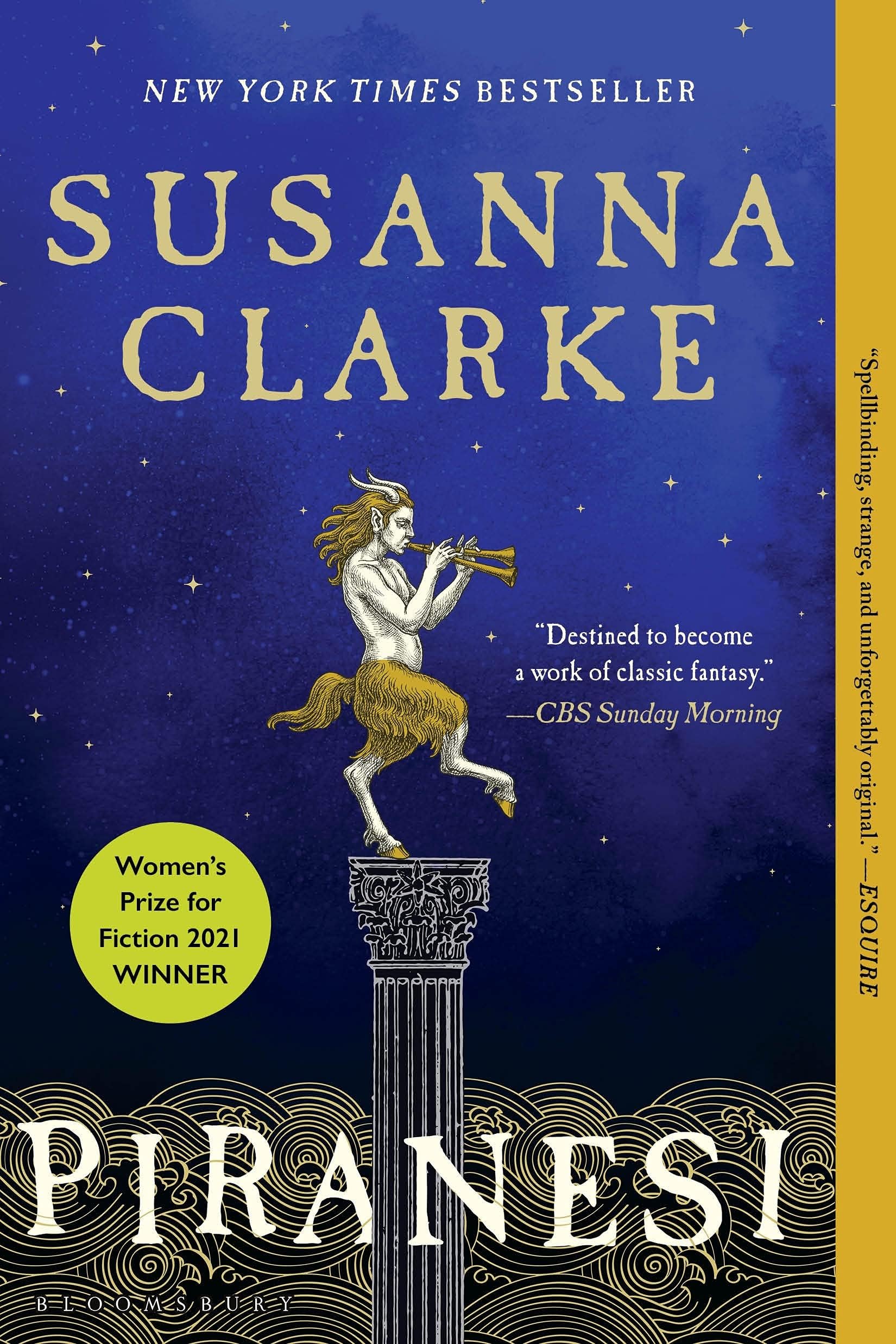
The award-winning , New York Times bestselling fantasy sensation that Madeline Miller called, โa miraculous and luminous feat of storytelling,โ Piranesi is an intoxicating, hypnotic novel set in a dreamlike alternative reality from the author of Jonathan Strange & Mr Norrell. Piranesi's house is no ordinary building: its rooms are infinite, its corridors endless, its walls lined with thousands upon thousands of statues. Within the labyrinth of halls an ocean is imprisoned; and waves thunder up staircases, while rooms are flooded in an instant. But Piranesi is not afraid; he understands the tides as he understands the pattern of the labyrinth itself. He lives to explore the house. There is one other person in the house-a man called The Other, who visits Piranesi twice a week and asks for help with research into A Great and Secret Knowledge. But as Piranesi explores, evidence emerges of another person, and a terrible truth begins to unravel, revealing a world beyond the one Piranesi has always known. โSpellbinding, strange, and unforgettably originalโ (Esquire), Piranesi introduces an astonishing new world, an infinite labyrinth, full of startling images and surreal beauty. Review: The Book That Gaslights You Into Loving It - Piranesi by Susanna Clarke the novel that asks, "What if we took a guy, stuck him in an impossible house, gave him amnesia, and made readers spend 200 pages figuring out what literally everyone else understood by page 30?" It's like a mystery box where the mystery is less "whodunit" and more "why is our protagonist the last person to realize he's been had?" Let's talk about our narrator, Piranesi (spoiler: not his real name, but he doesn't know that because of course he doesn't). He's living his best life in a House of infinite halls and statues, journaling about tides and birds with the enthusiasm of someone who's never heard of Netflix. He's got a whole routine goingโmapping rooms, cataloging statues, befriending birds, avoiding floods. It's all very Walden Pond meets The Twilight Zone, and he's utterly convinced this is normal. The writing is gorgeous in that specific way that makes you feel like you're reading someone's really pretentious dream journal. Everything is Capitalized for Importance. The House. The Sea. The Other. Clarke has created a narrator so earnest and sincere that you almost feel bad for him as he cheerfully describes his captivity like it's a quirky lifestyle choice. And then there's "The Other" the only other person Piranesi sees regularly, who shows up to ask cryptic questions and is so obviously sinister that you'll spend half the book wanting to reach through the pages and shake our protagonist while screaming "DUDE, READ THE ROOM. LITERALLY. READ ANY ROOM IN THIS WEIRD HOUSE." The pacing is... deliberate. Clarke takes her sweet time letting you piece together what's happening, which is either masterful atmospheric storytelling or the literary equivalent of watching someone fail to solve a puzzle you finished an hour ago. Your mileage will vary depending on whether you enjoy feeling smugly ahead of the protagonist or prefer everyone to be confused together. But here's the thing that's infuriating: it works. The slow reveal is actually kind of perfect. The House is legitimately enchanting and creepy. Piranesi himself is impossibly likable despite being aggressively oblivious. And when the pieces finally click together, there's a genuine emotional payoff that sneaks up and punches you right in the feelings. The problem? It's short enough that you'll finish it in one sitting, but slow enough that you'll spend the first half wondering if you're missing something or if Clarke is just really committed to the bit. (It's the latter. She's very committed.) Perfect for readers who enjoyed Jonathan Strange & Mr Norrell but wished it was shorter and weirder. Also perfect for people who like their fantasy served with a side of existential dread and architectural impossibility. Side effects may include: an irrational desire to live in a mysterious house, trust issues with anyone who asks you philosophical questions, and the sudden urge to start capitalizing random Nouns in your own Writing. Bottom line: It's a beautiful, strange little book about memory, identity, and what happens when you're too pure-hearted to realize you're trapped. You'll either love it immediately or spend 100 pages going "is this it?" before suddenly, unexpectedly, loving it anyway. Clarke remains the queen of making you wait for it. And annoyingly, it's worth the wait. Review: It's about modern magic. - Some notes: I bought the eBook $10 and Audible $7. I could not go shopping for the first edition because some of the book stores are closed? Listened and read some last night. the way Clarke uses the month by number instead of the name. But there were Journal titles with November and June. This alters reality. The year is given by specific events such as the year the Albatross came. On earth, we don't have names for years except for the Chinese Zodiacs. This seems to make the narrative an earthbound person but a slightly altered perception. 'The word albatross is sometimes used metaphorically to mean a psychological burden that feels like a curse. ... Therefore, the albatross can be both an omen of good or bad luck, as well as a metaphor for a burden to be carried as penance." So this signals a psychological change in the narrator. The Other calls him Piranesi but he says it's not his name. This suggests that the narrator has an alter ego. The Other sometimes acts as the narrator's psychologist. This year could have easily been named the year the Covid19 virus came. One critic mentioned that Clarke's Piranesi is so very timely. We are sequestered yet we are yearning to explore. Clarke's Piranesi's allows us to do this a little bit. It's a guide to our own psyche. Clarke puts up symbolisms, ancient icons, and myths that echo within the vast hall. We see the statues make an appearance in Clarke's novel 'Strange and Norrel' 16 years ago. Norrel performed the only trick in the book was to make the statues in the cathedral speak bring back ghostly accusations and pleadings. 'I dreamt of him once; he was standing in a snowy forest and speaking to a female child.' This is a reference to Narnia. The epigram from C.S. Lewis also is the frontispiece and the cover is a figure similar to Tumus. Of course, statues are a result of the wicked queen turning her enemies to stone, even the lion got turned. The statues are paralysis, could possibly be a psychological one as experienced by the narrator. In the end, the lion is turned back to flesh. The Medusa also turns flesh into stone. The statue with the beehive. Bee has appeared in 'The Magician' novel by Lev Grossman. What was hinted at in Piranesi is a full-fledged tribute to Narnia in 'The Magician'. As a child, Tumus seems innocent enough. But in the Greek characterization, Pan is a sexual and seductive God that plays with nymphs. Of course, these are just mere guides after we enter through the doorway, wardrobe, and fall into another world that is largely in our heads. The medium here is the book. The journal as a record. The house itself is an expanding world. We are given measurements in meters. It takes the narrator 3 hours to reach a certain hall. It is mentioned that the Hall is created for giants. The statues are larger than human size. If we scale it back, the idea of the house as expansion and is magical is in the novel by John Crowley 'Little, Big'. The house itself is the key, the entry point. The house is magic and so is the Hall. I can't remember how Piranesi showed up on my radar. But the first enticement is that it had to do with architecture. It reminded me of 'Little, Big'. But here was this reference to Piranesi. I also thought of Bolle and his large structures. Piranesi is classical and Boullรฉe is more modern. Bolle created a monument to Newton. The first hint of this expansion is in Norrell's library. When I read this some years ago, I immediately drew some parallels to 'Little, Big'. Norrell left his visitors baffled at the vastness of the library that is bigger than the modest house could contain and also managed to remember very little of what the library contained. I remember reading it as one of my favorite parts of the book. Frankly, when it got to the warfare it was less interesting. Maybe it was my interest in architecture and books. The magic is an expansion of spatial relations. I'm a little disappointed when I read review yearning for the sequel or prequel to Norrel and Strange. People complained because it lacks certain malicious warfare. But to me, Piranesi is a continuation of this theme of spatial expansion and our own mind's capacity for spatial renderings, our yearning to reach far with telescopes and drive on interstates highways. Clarke takes just two elements (statue and spatial expansion0 from Norrel and Strange 16 years later to create Piranesi. When we were studying, Piranesi and Boullee, were presented as paper architects. They fantasized about the possibility of architecture. Their architecture was for the mind to inhabit. The profession also derides architects that didn't build physical buildings. But as you can see Piranesi inspired other creatives and novelists to that it further to link it back to magical practices. In some case, Calvino and now Clarke has something to teach the architects. Sure we were given books to read such as 'Invisible Cities' and Heidegger's 'Being and Time'. Yes, we were encouraged to imagine. The cross-breeding of discipline enriched the work. I guess my point is, Clarke mixed genera in Norrel and Strange by rendering it with Victorian romance languages that read like Wuthering Heights to the fantasy story which contained magic. Here we see a similar cross-breeding of architecture, art, and myths. It could easily be written by Piranesi himself if he attempted a novel. The Other is about to perform ceremonial magic to bring the answer to the secret knowledge. Here we see magik as practical as a modern-day revival of it similar to the Golden Dawn tradition instead of the fantasy kind. Clarke doesn't dwell on this. It's a hint of modern-day era magical practices. The Pan god suggests Paganism. The element of water is pervasive. There is this element of a Protean dream within the space that is destructive and shifting but the narrator tries to record. This vast complex that the character traverses in reminds me of Calvino's Invisible Cities. Perhaps there are other similar structural organisms of this microcosm. There is a stratified layer. At the bottom is the element of water. Also, the pentagram has five directions for the earth, water, fire, air, and spirit. The Drowned Hall is in water and The cloud chamber in air. Mentions of the commonplace method of record-keeping and journaling. Journal keeping as a way to store memory and going back to it restores sanity.


| Best Sellers Rank | #908 in Books ( See Top 100 in Books ) #1 in Magical Realism #21 in Contemporary Fantasy (Books) #52 in Literary Fiction (Books) |
| Customer Reviews | 4.4 out of 5 stars 44,452 Reviews |
D**H
The Book That Gaslights You Into Loving It
Piranesi by Susanna Clarke the novel that asks, "What if we took a guy, stuck him in an impossible house, gave him amnesia, and made readers spend 200 pages figuring out what literally everyone else understood by page 30?" It's like a mystery box where the mystery is less "whodunit" and more "why is our protagonist the last person to realize he's been had?" Let's talk about our narrator, Piranesi (spoiler: not his real name, but he doesn't know that because of course he doesn't). He's living his best life in a House of infinite halls and statues, journaling about tides and birds with the enthusiasm of someone who's never heard of Netflix. He's got a whole routine goingโmapping rooms, cataloging statues, befriending birds, avoiding floods. It's all very Walden Pond meets The Twilight Zone, and he's utterly convinced this is normal. The writing is gorgeous in that specific way that makes you feel like you're reading someone's really pretentious dream journal. Everything is Capitalized for Importance. The House. The Sea. The Other. Clarke has created a narrator so earnest and sincere that you almost feel bad for him as he cheerfully describes his captivity like it's a quirky lifestyle choice. And then there's "The Other" the only other person Piranesi sees regularly, who shows up to ask cryptic questions and is so obviously sinister that you'll spend half the book wanting to reach through the pages and shake our protagonist while screaming "DUDE, READ THE ROOM. LITERALLY. READ ANY ROOM IN THIS WEIRD HOUSE." The pacing is... deliberate. Clarke takes her sweet time letting you piece together what's happening, which is either masterful atmospheric storytelling or the literary equivalent of watching someone fail to solve a puzzle you finished an hour ago. Your mileage will vary depending on whether you enjoy feeling smugly ahead of the protagonist or prefer everyone to be confused together. But here's the thing that's infuriating: it works. The slow reveal is actually kind of perfect. The House is legitimately enchanting and creepy. Piranesi himself is impossibly likable despite being aggressively oblivious. And when the pieces finally click together, there's a genuine emotional payoff that sneaks up and punches you right in the feelings. The problem? It's short enough that you'll finish it in one sitting, but slow enough that you'll spend the first half wondering if you're missing something or if Clarke is just really committed to the bit. (It's the latter. She's very committed.) Perfect for readers who enjoyed Jonathan Strange & Mr Norrell but wished it was shorter and weirder. Also perfect for people who like their fantasy served with a side of existential dread and architectural impossibility. Side effects may include: an irrational desire to live in a mysterious house, trust issues with anyone who asks you philosophical questions, and the sudden urge to start capitalizing random Nouns in your own Writing. Bottom line: It's a beautiful, strange little book about memory, identity, and what happens when you're too pure-hearted to realize you're trapped. You'll either love it immediately or spend 100 pages going "is this it?" before suddenly, unexpectedly, loving it anyway. Clarke remains the queen of making you wait for it. And annoyingly, it's worth the wait.
D**Y
It's about modern magic.
Some notes: I bought the eBook $10 and Audible $7. I could not go shopping for the first edition because some of the book stores are closed? Listened and read some last night. the way Clarke uses the month by number instead of the name. But there were Journal titles with November and June. This alters reality. The year is given by specific events such as the year the Albatross came. On earth, we don't have names for years except for the Chinese Zodiacs. This seems to make the narrative an earthbound person but a slightly altered perception. 'The word albatross is sometimes used metaphorically to mean a psychological burden that feels like a curse. ... Therefore, the albatross can be both an omen of good or bad luck, as well as a metaphor for a burden to be carried as penance." So this signals a psychological change in the narrator. The Other calls him Piranesi but he says it's not his name. This suggests that the narrator has an alter ego. The Other sometimes acts as the narrator's psychologist. This year could have easily been named the year the Covid19 virus came. One critic mentioned that Clarke's Piranesi is so very timely. We are sequestered yet we are yearning to explore. Clarke's Piranesi's allows us to do this a little bit. It's a guide to our own psyche. Clarke puts up symbolisms, ancient icons, and myths that echo within the vast hall. We see the statues make an appearance in Clarke's novel 'Strange and Norrel' 16 years ago. Norrel performed the only trick in the book was to make the statues in the cathedral speak bring back ghostly accusations and pleadings. 'I dreamt of him once; he was standing in a snowy forest and speaking to a female child.' This is a reference to Narnia. The epigram from C.S. Lewis also is the frontispiece and the cover is a figure similar to Tumus. Of course, statues are a result of the wicked queen turning her enemies to stone, even the lion got turned. The statues are paralysis, could possibly be a psychological one as experienced by the narrator. In the end, the lion is turned back to flesh. The Medusa also turns flesh into stone. The statue with the beehive. Bee has appeared in 'The Magician' novel by Lev Grossman. What was hinted at in Piranesi is a full-fledged tribute to Narnia in 'The Magician'. As a child, Tumus seems innocent enough. But in the Greek characterization, Pan is a sexual and seductive God that plays with nymphs. Of course, these are just mere guides after we enter through the doorway, wardrobe, and fall into another world that is largely in our heads. The medium here is the book. The journal as a record. The house itself is an expanding world. We are given measurements in meters. It takes the narrator 3 hours to reach a certain hall. It is mentioned that the Hall is created for giants. The statues are larger than human size. If we scale it back, the idea of the house as expansion and is magical is in the novel by John Crowley 'Little, Big'. The house itself is the key, the entry point. The house is magic and so is the Hall. I can't remember how Piranesi showed up on my radar. But the first enticement is that it had to do with architecture. It reminded me of 'Little, Big'. But here was this reference to Piranesi. I also thought of Bolle and his large structures. Piranesi is classical and Boullรฉe is more modern. Bolle created a monument to Newton. The first hint of this expansion is in Norrell's library. When I read this some years ago, I immediately drew some parallels to 'Little, Big'. Norrell left his visitors baffled at the vastness of the library that is bigger than the modest house could contain and also managed to remember very little of what the library contained. I remember reading it as one of my favorite parts of the book. Frankly, when it got to the warfare it was less interesting. Maybe it was my interest in architecture and books. The magic is an expansion of spatial relations. I'm a little disappointed when I read review yearning for the sequel or prequel to Norrel and Strange. People complained because it lacks certain malicious warfare. But to me, Piranesi is a continuation of this theme of spatial expansion and our own mind's capacity for spatial renderings, our yearning to reach far with telescopes and drive on interstates highways. Clarke takes just two elements (statue and spatial expansion0 from Norrel and Strange 16 years later to create Piranesi. When we were studying, Piranesi and Boullee, were presented as paper architects. They fantasized about the possibility of architecture. Their architecture was for the mind to inhabit. The profession also derides architects that didn't build physical buildings. But as you can see Piranesi inspired other creatives and novelists to that it further to link it back to magical practices. In some case, Calvino and now Clarke has something to teach the architects. Sure we were given books to read such as 'Invisible Cities' and Heidegger's 'Being and Time'. Yes, we were encouraged to imagine. The cross-breeding of discipline enriched the work. I guess my point is, Clarke mixed genera in Norrel and Strange by rendering it with Victorian romance languages that read like Wuthering Heights to the fantasy story which contained magic. Here we see a similar cross-breeding of architecture, art, and myths. It could easily be written by Piranesi himself if he attempted a novel. The Other is about to perform ceremonial magic to bring the answer to the secret knowledge. Here we see magik as practical as a modern-day revival of it similar to the Golden Dawn tradition instead of the fantasy kind. Clarke doesn't dwell on this. It's a hint of modern-day era magical practices. The Pan god suggests Paganism. The element of water is pervasive. There is this element of a Protean dream within the space that is destructive and shifting but the narrator tries to record. This vast complex that the character traverses in reminds me of Calvino's Invisible Cities. Perhaps there are other similar structural organisms of this microcosm. There is a stratified layer. At the bottom is the element of water. Also, the pentagram has five directions for the earth, water, fire, air, and spirit. The Drowned Hall is in water and The cloud chamber in air. Mentions of the commonplace method of record-keeping and journaling. Journal keeping as a way to store memory and going back to it restores sanity.
T**Z
Not what I expected, but nevertheless a great book!
Great story love the mysterious elements of the story and character. I will definitely reread this downstairs something I'm certain I missed, but nice surprising revelations.
S**N
The beauty of this book is immeasurableโฆ
I fell in love with this book immediately, and I read through it ceaselessly. The way it continued to provide just enough to keep you going felt like I too was wandering the halls of the house, receiving what I needed as I needed it. I fell in love with Piranesi, and the way in which he saw the world he lived in. It went much faster than I expected, and at the end, the only thing I wanted was more, which is the highest praise I can ever give a book.
M**S
Sensory Sensitives Beware Uneven Cover
Rating for the physical book: One star. I hate it when paperback books do this: the cover is not flush with the pages on the right edge. It's very distractingโmy hands continually notice it while I'm reading. I'm autistic; I can't ignore sensory information even when I'm trying to focus on something else. I detest hardback and prefer a physical book to my Kindle or to audiobooks, so what am I to do when paperbacks are printed this way? Google Gemini recommended this book for me two separate times, so I really want to read it... Rating for the story: Three stars. The world has a lot of imaginative potential that never gets fully realized. It's a house that's a whole world with tides in the halls. What other impossible things could this world hold? I want to see them. The characters are greatโcomplex and interesting. The ending left me mildly confused and dissatisfied. Who is he? Where is he? Where is he going? I need closure. I would probably read a sequel, if one appeared.
J**1
Worth a read, but not in any way like Jonathan Strange and Mr. Norrell
Piranesi (although he suspects that is not his name) lives alone in a house so huge that it contains an ocean on its lower floors, and lakes in some of its ruined halls. The tides rush up its staircases, drowning the thousands of statues that line the walls. Piranesi lives by fishing in the lakes or the ocean, and cooks on fires made from dried seaweed. He keeps meticulous journals, which help him work out the times when two or more tides will combine and threaten to flood the level where he lives. Twice a week, a man whom Piranesi knows only as โthe Otherโ visits. He occasionally brings Piranesi useful items: shoes, fishnets, cooking utensils, and has enlisted Piranesi in his search for โthe Great and Secret Knowledgeโ โ a method for becoming immortal, reading minds, and moving objects by telekinesis. One day, Piranesi finds words written in chalk on some of the walls and doorways of the house, giving directions to a particular room. On a later night, he sees the glow of a flashlight being used to explore some of the halls, and finds an unknown person has written a message in chalk on the floor. Although the Other has warned Piranesi that any person who comes to the house will try to harm Piranesi, he nevertheless writes a reply to the message. Prompted by the messages which he exchanges with the unknown person, Piranesi discovers that he has completely forgotten large portions of the events described in his journals. He begins re-reading early volumes to recover his memory of the events described. Gradually, with the help of the journals, and from messages exchanged with the unknown person, Piranesi discovers that Laurence Arne-Sayles, an English anthropologist and academic, had a theory that ancient man could communicate with natural forces in the world, and gain assistance from those forces. Several of Arne-Saylesโ students formed something like a cult around his theories. But then some of the students disappeared, and Arne-Sayles was convicted of kidnapping one student, who was found imprisoned behind a false wall in his house. His academic career ended with his conviction, although some of his remaining students continued to pursue his theories. Ultimately, Piranesi realizes that he himself was a newspaper reporter, researching a biography of Arne-Sayles. When he went to interview one of Arne-Sayles former students, now himself an academic, the former student transported Piranesi to the house where he now lives. Something in the nature of the house causes amnesia, and subsequent to his arrival in the house, Piranesi forgot his prior life. The unknown person who has been leaving chalk messages is revealed to be Sarah Raphael, a police officer investigating the disappearances of Arne-Saylesโ students. With her aid, Piranesi recovers his memory, and returns to the real world โ although he still occasionally visits the house, which he finds peaceful and calming. Readers hoping for a return to the world of Jonathan Strange and Mr. Norrell, or of The Ladies of Grace Adieu, will be disappointed by Piranesi, which is not in any way like Clarkeโs earlier books. Jonathan Strange and Mr. Norrell is a historical adventure novel, a love story, and a story of magic, all rolled into one. The book succeeds, in part, because it grafts a detailed magical history โ peopled with uniquely drawn characters and going back to the Middle Ages -- onto the England of the Napoleonic wars. The appearance and use of magic in early 1800s England is shown not as some uncanny aberration, but as a continuation of that history. By contrast, Piranesi is not a historical novel, not a romance, and contains no magic โ except for the ability to pass into the huge house described in the book, which seems to exist in an alternate dimension. Jonathan Strange and Mr. Norrell involved dozens of characters, each individually drawn, all interacting in a complicated plot extending over years and across much of Europe. It was complex, multi-faceted, and intricate. Piranesi has only four speaking characters, and the story โ which extends over only nine months -- has none of the interwoven complexity of Clarkeโs first book. Piranesi is a brilliant novel, but it is not set in the fictional universe that Clarke usually inhabits. It is almost as if George R. R. Martin gave us a hard-boiled detective story set in 1930s Los Angeles. Itโs always a shock when one of your favorite authors changes her oeuvre, but the shock wonโt delay me a minute in buying the next thing that Clarke writes.
O**H
This one left me speechlessโฆ
Please bear with me, this will be long and a little spoilery I went into Piranesi knowing nothing, and Iโm glad I did. I think thatโs the only way this book should be read. What followed felt less like reading a book and more like slowly waking up inside a dream I didnโt know I was having. Every page felt like a revelation, yet the truth stayed out of reach. I was mystified, hypnotized. The House was a world of marble and ocean and impossible beauty, and I didnโt know whether to picture it as a vast temple or a decaying castleโbut I felt it. The statues felt like memories Iโd never had. Around 21%, I began to suspect the truth: that Piranesi was trapped, that The Other was no friend. But by then, I already cared for himโso deeply, so protectively. I didnโt understand him but I admired the way he loved his world with quiet reverence, how he found the silence to be a sacred thing. At 39%, the anxiety set in. He was trapped. I knew it. But how do you escape a prison you think is paradise? The beauty was laced with unease. From that moment on, through all the unraveling, what stayed with me most was Piranesiโs quiet resilience. The pain of remembering. The gentleness in the face of confusion. The way he tried to hold on to his wonder even as it slipped through his fingers. But then came the ending. And I was wrecked in a whole new way. The layers of grief, identity, healingโitโs staggering. I could cry again just thinking about it. Susanna Clarke didnโt just tell a story, she rebuilt my sense of reality. Piranesi is about madness, isolation, wonder, and the sacred. Itโs about how the modern world forgets whatโs important, and how we sometimes have to lose ourselves to see it again. Every detail is a quiet masterstroke.
K**Y
Compelling fantasy novel about a man living in a house containing seas and statues
If I had to describe this fantasy novel in a single sentence, it would be something like this: A childlike man named Piranesi lives alone in a house with wondrous rooms that contain oceans and beaches with statues of figures from antiquity. I say he lives alone, but he is aware that another person lives in the house. Piranesi comes across evidence of this other manโs presence, and over time the man has left him gifts of snacks, shoes, vitamins, and useful tools for which he is grateful. Having learned how to take care of himself, Piranesi leads a simple life. He is curious about his world and documents what he does in journals containing all his observations. He has mapped the tides that flow in certain rooms and has wandered miles to explore different parts of the house. He has the habits of a naturalist or scientist but the naivete of a child. Piranesi has a vague awareness of another life. He knows how to read and write and has a disciplined mind, but he has lost his memories. He spends his time working on his journals, mapping the house, and scavenging for food and shelter. Occasionally, Piranesi will think about other people. He has found human bones, so he knows there have been others before him. These bones he treats reverentially. Piranesi starts communicating with the other man, named by him as the Other, through written messages. When he finally meets the Other, the man tells him of another man who will visit the house and of whom he should be afraid. One day, Piranesi meets the man the Other warned him about. He calls him the Prophet because he seems to know so much about the house, other people's existence, and surprisingly, him. Piranesi reflects on all that the Prophet has told him and begins to realize that answers to the questions he is beginning to have might be found in his earliest journals which now number more than 20. What he finds completely changes everything that he has known to be true about himself and his world. He learns his life is threatened but has an unexpected ally. Susanna Clarke has created a fantastic world that celebrates nature. The reader appreciates this world through the eyes of a gentle man. Itโs a place thatโs unlike any other. It has dreamlike descriptions and takes the reader on a journey. I found the level of detail and the descriptions a little confusing at first. It may take some time to get used to the journal-like format. There are so many rooms it's hard to keep track. At some point, I stopped trying to remember which room was which and let the story take over. It does reward the reader with an engrossing tale. If you are looking to take an armchair journey to an exotic place, this may be your book.
T**S
Maravilhoso
Original, estimulante, misterioso e profundamente filosรณfico. Ao longo da leitura imaginei vรกrias explicaรงรตes para o mundo de piranesi, mas nรฃo cheguei nem perto de adivinhar o final. Jรก entrou na minha lista de "preciso ler de novo".
P**S
Stunningly different
Absolutely LOVED this book. Never read anything quite like it. Fantasy and reality and sadness and betrayal and belonging and mystery, all wrapped up in the most amazingly constructed narrative. I have read Johnathan Strange and Mr Norrell. This is very different, but still engaged me with awe. Every page was a new adventure in thinking and feeling. I would love to read more by this author.
M**L
Bueno
La calidad es buena, llego en buen estado, sin rasgaduras, manchas de tinta ni errores de inpresion. En mi opinion el papel que usaron es algo poroso y se siente aspero al tocarlo. Obviamemte no es un defecto pero hay personas que son muy sensibles a las texturas. La historia es... peculiar. No muy llamativa pero te mantiene lo suficientemente enganchado para querer saber que pasa el final. Si buscas fantasia tal vez no sea la mejor eleccion.
D**D
Lovely read
I feel like I always start my book reviews with "this wasn't what I expected" but it's important for you to know that the majority of books I read are ones that have been recommended to me by friends (a very small circle of readers who I trust to know my personal tastes) or books I've randomly picked up in a shop, read the blurb, and brought home with me. It's also worth noting that for whatever reason a book has made its way to my tbr pile, it usually will sit there for quite some time before I actually sit and read it, simply because I have so many waiting for my attention. Despite this, I'm going to say that while this book wasn't what I was expecting, I'm not sure if I even knew what that was when I first started reading. I genuinely had no idea what the book was about really, I don't even remember buying it (it might have been a gift?) but it was next on the pile, and so, I read it. And I loved it. It's an absolutely magical book, full to the brim with stunning visuals, a unique and beautiful backdrop, and a main character who gets himself lodged straight between your ribs and takes up residence there. It was so cleverly written, where we as readers weren't told very much at all until quite deep into the book, but still feeling so immersed in the world as we followed Piranesi around his peculiar home. The setting is lovely, the house is full of peril and beauty in equal measure, and you can feel the main character's love and admiration all the way through the story. While the story itself takes a dark turn, it's not jarring at all, the narrative leads us from the bright ocean and Piranesi's innocent demeanor, through to themes of manipulation, deceit, betrayal, and eventually faces us with self-belief , what we know to be reality, and our own perceptions of identity. All in all it's a very clever book, and one that hit me emotionally from the first page to the last. If you enjoy speculative fiction with mystery, but written with tenderness for the human condition, I would really recommend this book.
S**R
Tolles und spannendes Buch.
Tolles Buch. Ich bin zufrieden.
Trustpilot
5 days ago
1 month ago