We remain fully operational. Our teams are working around the clock to ensure your deliveries continue safely.

DOWNLOAD THE APP


Copyright © 2025 Desertcart Holdings Limited
DOWNLOAD THE APP
Buy anything from 5,000+ international stores. One checkout price. No surprise fees. Join 2M+ shoppers on Desertcart.
Desertcart purchases this item on your behalf and handles shipping, customs, and support to Indonesia.
⚡ Slice sharper, last longer — the chef’s secret weapon!
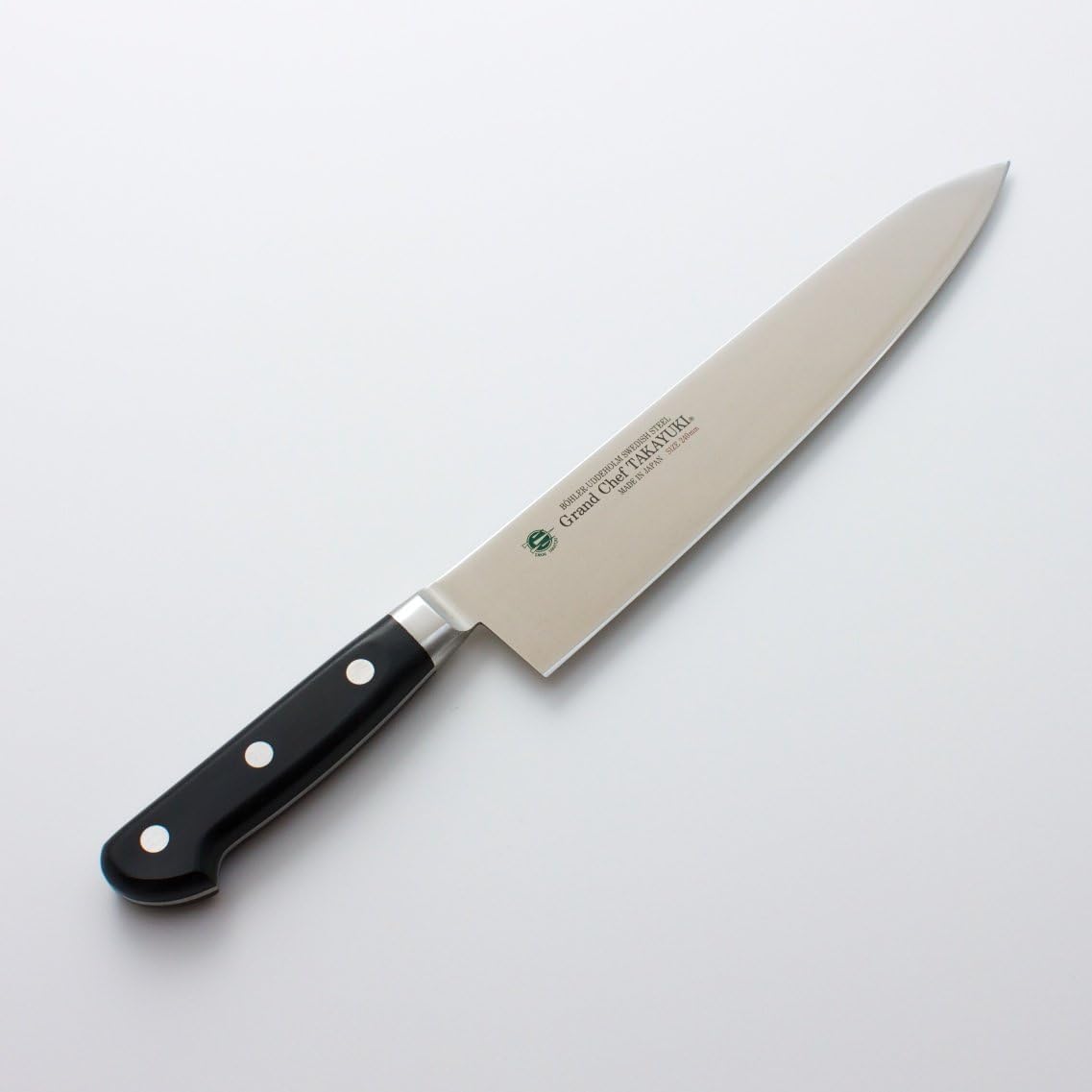
The Sakai Takayuki Grand Chef Gyutou 240mm is a professional-grade Japanese chef knife forged from high-tech Swedish AEB-L steel hardened to HRC 60+, delivering exceptional sharpness and edge retention. Its lightweight, razor-thin 9.4-inch blade pairs with a comfortable pressed wood handle for superior balance and control. Designed for precision and durability, this knife is ideal for millennial culinary pros seeking a blend of Western profile and Eastern metallurgy, crafted with authentic Japanese expertise.
| ASIN | B008UIX50G |
| Blade Color | Silver |
| Blade Edge | Plain |
| Blade Material Type | Alloy Steel |
| BladeLength | 9.4 Inches |
| Brand Name | Sakai Takayuki |
| Color | Silver |
| Construction Type | Forged |
| Customer Reviews | 4.2 4.2 out of 5 stars (7) |
| Handle Material | Wood |
| Is the item dishwasher safe? | No |
| Item Length | 9.4 Inches |
| Manufacturer | Sakai Takayuki |
| UPC | 791090598507 |
D**Y
Product: Sakai Takayuki Grand Chef Gyutou 240mm (9.4") Comment: Modern Super steel (HRC 60) meets classic Western Chef Knife Rating: 4.5/5 (Excellent) This is a detailed comparison between my well worn & much loved 20+ year old Wusthof Trident Classic Chef (TCC) 10", and a brand new Takayuki Grand Chef Gyuto (GCG) 240mm ... a throw down between a classic western style Cadillac, and a state of the art competitor featuring modern super steel and a more aggressive design. This gets a little longwinded, so if you're not a knife geek like me, feel free to skip to the bottom of the review ... First, a little historical perspective on the relevant alloys. The Wusthof TCC uses a monosteel construction (read: uniform rather than clad) of x50CrMoV15 stainless, whereas the Takayuki GCG (also a monosteel construction) uses a more modern formulation from Sweden called "AEB-L". When the former was first developed several decades ago it was considered an excellent steel for surgical tools, because of its superior stain resistance (read: ability to endure repeated trips through medical autoclaves without rusting), toughness and sharpen ability. HOWEVER, metallurgy has come a long way since then, and although still highly rated for stain resistance, x50CrMoV15 now decidedly mid-range in hardness and toughness by current standards. My 10" Wusthof was hardened to HRC 54, which is considered quite soft by today's standards for high-end knives (which range from HRC 60-68). That softness meant it was relatively easy to sharpen, but by the same token it also dulls somewhat quickly, and even faster if you put a more aggressive edge than the 21-24 degree factory one (I switched mine to 18). Thanks to increasingly stiff Japanese competition, Wusthof has since improved their heat treatment results from HRC-54 up to HRC-58 in recent years, but that's still slightly shy of modern super steel territory. The AEB-L in the Takayuki GCG has been hardened to HRC-60+ (which I read as just shy of 61) ... hard enough to fall into the low end of super steel territory (60-68), but not so hard that it's prone to the sort of chipping that some of the harder and more expensive high end knives can be susceptible to if handled carelessly. Ok, let's get to it ... Likes: * Western Profile and Handle: In shopping for a state of the art 'hybrid' chef knife (read: western profile & Eastern metallurgy), my first decision point was whether I wanted a western or eastern profile (read: full or medium bellied western, medium or flat bellied gyuto, medium or flat bellied santoku) and a western or eastern handle. After 20+ years of using a full size medium-bellied 10" chef like the Wusthof TCC, I decided I wanted to stick with the familiar ... although I've acclimated to numerous cutting techniques, I still like the gentle rocking motion of western style `push cutting' rather than Eastern chopping, so I went with a western handle, and a medium-bellied western profile in the blade, and a traditional Western ambidextrous "50:50" single V edge (rather than a left or right handed japanese 'chisel' blade). That narrowed the field down tremendously, but it still left plenty of reputable hybridized 240mm gyuto candidates {e.g., Kikuichi TKC, Akifusa, Tojiro DP F-809, Richmond SRS-15, Hattori FH, Kohetsu HAP40, et al}. * Mono-Constructed High-tech steel: my second decision point was in leaning towards materials and construction that are slightly more forgiving in terms of cost, stain & chip resistance and sharpenability, at the expense of being slightly less aesthetically beautiful and high performing ... that ruled out most hand-forged master crafted high carbon steels & beautiful multi-layered Damascus clad blades, as well as hybrid claddings of dual-alloys. After a fair amount of research, I happened across the Takayuki GCG, which seemed to offer the best of both worlds, and a tremendous bang for the buck at a mere $160 USD. It was a hard deal to beat on paper - similar price range as my drop-forged mono-steel Wusthof and a similar blade profile, but a much harder steel with a sharper edge ... I stopped reading, rolled the dice and ordered one, and a few short days later it arrived in the mail. * Aggressively thin yet strong: Straight out of the box, my first surprise was how THIN the blade is, and also how strong it is despite that thinness. At a svelte 2.45mm at the spine base, the gently flexible GCG is not as thin as some of the "laser" gyutos out there, but it's HALF the thickness of my suddenly hefty Wusthof TCC, and nearly 90 grams lighter. It almost felt like a toy, the first time I held it, and I began to doubt myself ... but after a few days use its unusual prowess quickly won me over. * Exquisite Sharpness: Let's skip the marketing hype and let pure science do the talking here. As measured with my digital "Angle Cube", the factory edge angle on the Takayuki is more than TWICE as sharp as the original factory edge used to be on my Wusthof (10 vs 21 degrees). Straight out the box, the blade was impressively sharp, and the thinness of the blade made it feel positively diabolical. Although it pulled a little, I was able to shave ribbons off an outstretched sheet of paper ... a few swipes on a 4000 grit stone fixed that right up, and it was gliding though the sheet in short order. It even glided though unpeeled yellow onions (try that with a Wusthof). I'm known among friends and family for keeping my edges pretty sharp and immaculate, but this was a whole new level of cutting performance for me, and I've since had to lighten my cutting stroke with the Takayuki, to avoid gouging my cutting boards. * Hardness/Edge Retention: The surprising thinness of the blade, and the aggressiveness of the edge were already impressive enough, but I was equally impressed at how long it's able to retain such an edge, courtesy of the AEB-L steel's greater hardness and durability (re: HRC-60+ vs HRC-54), and the reduced force needed for cutting. To give a practical example, if I had to julienne a half pan of bell peppers with my old Wusthof, I'd typically have to pause and steel at least 3 times during the task in order to maintain separation of the slices. With the Takayuki, I'd probably have to steel at most once or twice during all that, even though it has a thinner blade and edge. Ya gotta love that ... a thinner edge that can hold its edge longer than a thicker one, courtesy of a more advanced steel. Minor Nits: * Minor Performance Limitations: This is not a flaw, but rather recognition of a design trade-off that requires the user to be more aware of choosing "the right tool for the right task" for different types of culinary prep. In this instance, because of the thinner and more aggressive nature of this blade, I don't recommend doing things like using the spine to crack open coconuts, or using a rubber mallet to hammer the blade though hard winter squash, or using the tip and blade to perforate and split large blocks of frozen spinach or cube up boneless salmon fillets straight from the freezer (all things that my sturdy wusthof handled with grace and aplomb). I have a cheap thick-spined plastic handled 8" chef knife for such tasks now (under $20 USD). I also don't recommend using super steel (or ceramic) knives for hacking up bone-in cuts like chicken parts or spare ribs, because cutting bones could chip the edge ... and the harder and thinner the steel, the more susceptible to chipping it is (try to tiddlywink a roofing nail with a razor blade and you'll see what I mean). In this case, the AEB-L steel looks like a clever compromise by the designers ... hard enough to hold a very aggressive edge, but not quite so hard that it overly prone to chipping and hard to sharpen. * Less Stain Resistant: One advantage that the Wusthof's x50CrMoV15 stainless has over Takayuki's AEB-L steel is that the stain resistance of the former is a bit more bulletproof. The former can be run though a dishwasher repeatedly and put away wet without worries, whereas the latter can develop faint rust dots if not dried in reasonably timely fashion, and some faint whorls of a patina will slowly begin to form over time (easily removed with some Bartender's Friend). * Unbeveled Choil: Where the Wusthof Trident has a clumsy antiquated reinforced finger bolster (which actually gets in the way of sharpening after years of heavy wear), the Takayki has a flat featureless choil, the trailing edges of which they neglected to micro-bevel for comfort (unlike the spine, which is properly micro-beveled). However, you can correct this manually with a few minutes use of a diamond steel, held at an angle. * Suction: Not a complaint, but rather a minor quirk - the sides of the blade are so flat/smooth that slices of zucchini will tend to `suck' onto the sides of the knife a bit harder than the more beveled surface of a hefty 10" wusthof. Bottom line: I've been a loyal fan of my trusty 10" Wusthof Trident Classic Chef since I bought it over two decades ago, but long years of use and countless re-sharpenings have worn it out (read: it's lost it's belly curvature), and while shopping for a replacement I've discovered that metallurgy has advanced quite a lot since then, and the Takayuki GCG is just one example of the coming deluge of knives that will combine the best aspects of Western and Eastern knife traditions. The Wusthof is decisively stronger and more versatile, whereas the Takayuki is decisively sharper, more precise, and holds its edge longer ... they're comparable, yet very different. Meanwhile the Takayuki GCG 240mm is an excellent introductory option for aficianados of Western chef knives who are eager to see what the technique and technology obsessed East has to offer, courtesy of the internet and an increasingly global marketplace. In my case, I chose performance over versatility, and I haven't been sorry ... and I have some inexpensive supplemental tools handy for the relatively few tasks my Wusthof used to handle that my Takayuki cannot. Highly recommended. I look forward to seeing how my favorite western brands (like Wusthof) continue to up their game in the coming years, in order to be a part of the technological advances and cross-pollenization of techniques that are currently underway.
J**C
High quality professional knife
Trustpilot
3 weeks ago
1 day ago