Sleep Smarter, Live Better! 🌟
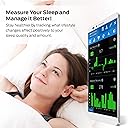
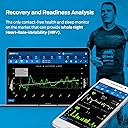
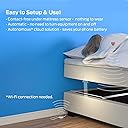
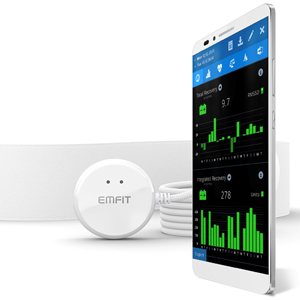
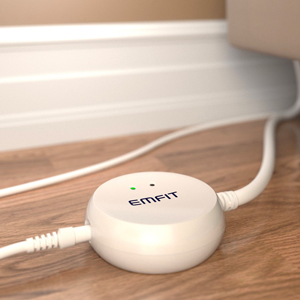
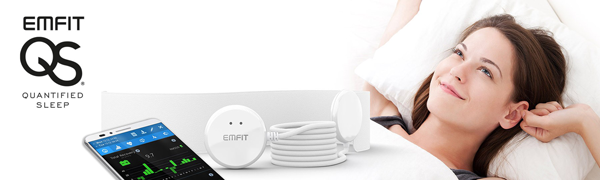
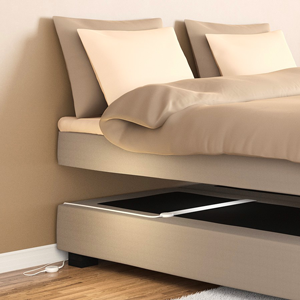
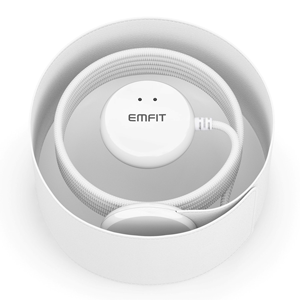
The Under Mattress Sleep Tracker with HRV is a revolutionary contact-free health monitor designed to provide detailed insights into your sleep quality and recovery. With its ultra-thin sensor that slips effortlessly under your mattress, it tracks vital metrics such as heart rate, breathing rate, and sleep cycles, all while being clinically validated for accuracy. Perfect for athletes and health-conscious individuals, this device empowers you to make informed decisions for optimal performance and well-being.


| ASIN | B0158W3E2A |
| ASIN | B0158W3E2A |
| Battery Description | No Battery |
| Brand Name | Emfit QS |
| Color | White |
| Compatible Devices | Smartphones |
| Customer Reviews | 4.0 4.0 out of 5 stars (66) |
| Date First Available | December 8, 2015 |
| Display Size | 0.96 Inches |
| Global Trade Identification Number | 06430029140717 |
| Is Discontinued By Manufacturer | No |
| Item model number | Emfit QS |
| Manufacturer | Emfit |
| Manufacturer | Emfit |
| Manufacturer Part Number | Emfit QS |
| Model Number | Emfit QS |
| Product Dimensions | 8 x 8 x 3.5 inches; 1.85 Pounds |
| Sensor Type | Contact-free |
| Size | 1 Count (Pack of 1) |
| Team Name | Emfit QS |
| Unit Count | 1 Count |
B**N
Effective, Non-evasive Sleep Tracker
I purchased the Emfit QS in January 2018 and have spent the last year sleeping with it. First, it is non-evasive. You don't have to put anything on your body, turn anything on or start/stop anything before and after sleeping. You simply lay in bed, it senses your presence, begins recording and uploads your data during the night to the Emfit servers. When you exit bed in the morning it recognizes it and begins to put together a picture of your night of sleep. By the time I have my coffee made, I can jump on my phone or look at my computer and get all the data. And there is a ton of data it provides: sleep time/score, breakdown of light/deep/REM cycles, HRV w/ nervous system balance, avg and resting heart rate, respiratory rate, movement/restlessness and finally a proprietary recovery score (that probably still needs some work). The next question people ask is: are the metrics accurate? I also wear an Oura Ring 24/7. It, like the Emfit QS, tracks all the metrics mentioned above. When comparing the results of the two devices, while not matching exactly, show a very clear correlation. They are identical in the sense that when one shows a lower HRV or high HR, the other device has recorded the same trend. Then you have to look at the results provided by the QS and compare it to what you think should be happening, I've found they gel. For example, I was in a bad bike vs car accident in April 2018 that knocked me out of triathlon training for about 5 months while I recovered. During that period the Emfit recorded much high HRV values while recording high resting heart rate values as I lost fitness and aerobic conditioning. Weeks after returning to training, HRV numbers began to drop while my resting HR lowered as well. I have tried several different sleep trackers and HRV/HR measuring tools. This and my Oura Ring are 1 and 1a on the list of effective devices. If you are looking for a hands-off biohacking/recovery measuring/sleep tracking tool I would highly recommend this. Let me cover some of the negatives. I had, and others have reported, some connection issues with their home WiFi. I did find it quirky when I first set it up and had difficulty getting it to connect. Once connected though, I have had no drops and there has not been a single night that data was not recorded. Next, there is no option to place it in airplane mode. There is no internal memory to record during the night and then upload the data later. The device it constantly reaching out to your WiFi every six seconds and uploading data while you sleep. For some concerned about having a WiFi signal that close to you every night, this may not be the device for you. Having said that, the Emfit QS does come with a long power cord and a transmitting device that you can place up to six feet from your bed. Nevertheless, a semi-easy update to this device would be a 2.0 model with internal memory that can turns itself off, record your data all night and then turn on and upload the recorded data once you out of bed. Lastly, if you spend a lot of time in your bed, say watching TV or reading before you sleep, the device night confuse it with you attempting to fall asleep unsuccessfully. I read for at least 30 minutes before I turn the lights off. I found that if I just get out of bed to check if the doors are locked after reading, the device recognizes my sleep patterns enough that it does not record the extra time. A couple of other side notes. I have a Tuff N Needle memory foam mattress. It provides no difficulty in getting any bio-metric signals through it. It also does not pick up my wife's signals when she sleeps, even if we are up against each other. Overall it has proved to be a solid device that provides good, valid sleep and recovery data.
A**R
I would recommend, with caution
I would recommend, with caution. I bought this after reading a lot of reviews and determining this was the most accurate sleep monitor. My thinking was, If you can't trust the accuracy of a monitor, the data is going to be useless to you. I bought it for my sleep problems. I am not an athlete so I didn't use the heart rate variability data etc. Setup was super simple. I was able to connect it to WiFi simply by pressing the button on my router, then using a paper clip on the Emfit QS. My sleep info gets sent to the internet automatically and reliably and it is always there in my browser when I wake up. The only problem I had with setup was I have a very thick mattress with no box so I basically had to slice my mattress open and put the sensor in under the mattress pad. It gives you a lot of information, from which you can piece together how you're sleeping. However, as I found, you cannot rely 100% on the total sleep and sleep stage classification. The accuracy of these numbers is questionable. For instance, my child was lying in my bed reading for 2 hours and apparently not only did he get 1.5 hours sleep, but he got 1/2 hour of REM sleep! Pretty good for being awake! Having said that, I have reason to believe the toss & turn data is accurate since the sensor for this is pretty basic so you can use this data to clearly figure out when no sleep is happening and do the math to figure out your total sleep. So in order to keep track of my sleep I need to analyze the data, add up the numbers, and keep a separate spreadsheet. Not everybody's willing to do this, but it works for me (so far). I am planning to buy a Fitbit Alta HR so I can compare results.
R**L
Wonderful device, lots of data - but not for everyone
The Emfit QS is amazing in two ways. One is the amount of data it provides. The other is how it works -- that it can pick up your heart's movement through even a thick mattress! Sure, it's not as accurate as connecting probes to your body, but it seems to as accurate as or better than the less convenient optical arm bands or ring. But it isn't for everyone. Though a sleep "score" is provided, you don't get the full value unless you are willing to invest in interpreting the data. The other issue is that it's become clear that Emfit is a "small" company with a niche (i.e. small) customer base. Very friendly people on the phone, but don't expect a 24x7 team operations team behind the cloud service. I had the misfortune of receiving my unit on a day their servers were down and spent quite a bit of time wondering whether I did something wrong or received a defective unit. Eventually, we concluded that everything is set up correctly and should be working -- but had to wait until morning in Finland for the HQ team to check on the server. Sure enough, things came alive at what looked to be 6'ish AM UTC. So, you need to be willing to deal with a small team of dedicated scientists, etc., instead of a large scale mainstream consumer company.
D**K
Die vielfältigen Auswertungsmöglichkeiten dieses sleep trackers, die weit über die Analysen von Armbändern oder z.B. des Withings-Schlafsensors (die fand ich allesamt nicht sehr zuverlässig) hinausgehen, fand ich sehr spannend und habe das Gerät bestellt. Die Installation in das WLAN war ziemlich holperig; man muss am Router zunächst das 5 GHz-Band abschalten, damit die Erstkoppelung auf 2,4 GHz erfolgt. Dann noch darauf achten, dass die WLAN-Kanäle 12,13 und 14 vom Emfit nicht unterstützt werden - man muss also im Router zumindest bei der Erstinstallation einen Kanal <12 vorgeben. Irgendwann ging es mit meiner Fritzbox, und seitdem scheint die Verbindung stabil zu sein. Für die Auswertungen der Daten gibt es keine App, sondern ausschließlich eine Website. Die passt sich aber den Smartphone- und Tablet-Formaten an, so dass man gut damit zurechtkommen kann. Zu den einzelnen Auswertungen gibt es kurze Erklärungen, die aber nicht immer umfassend genug sind. Z.B. gibt es in Grafiken oft Balkenfarben, die keine Legende haben und deren Bedeutung man nur erraten kann. Das große Problem ist die nächtliche Datensammlung - die hat bisher so gut wie nie funktioniert. In fast allen Nächten brach die Aufzeichnung entweder irgendwann ab (z.B. letzte Nacht ab 03:08 keine Daten mehr, warum auch immer), oder bei nächtlichen Unterbrechungen von zwei- bis drei Minuten wurde zwar das Verlassen des Betts, aber die Rückkehr in dasselbe entweder garnicht oder erst viel später erkannt. Das führt nun dazu, dass die Gesamtzeit im Bett und die Gesamtschlafzeit nicht stimmen, und damit dann fast alle Auswertungen unbrauchbar sind. Ich habe das mit verschiedenen Positionen unter der (übrigens ganz normalen) Matratze probiert, ohne nachhaltigen Erfolg. Der Support hat anfangs freundlich und blitzschnell geantwortet. Eine Aussage war, dass es bei einer Gerätecharge zu vielen Reklamationen kam, und man deshalb versuche, dies über Änderung der Sensitivität nachzujustieren - und dass mein Gerät aber nicht davon betroffen sei. Seit einigen Tagen, in denen ich nun noch Fehlerberichte und Screenshots an den Support sende, kommt leider keinerlei Antwort mehr. Die Idee verdient eine bessere Bewertung, finde ich. Nun hilft aber die interessanteste Auswertung nichts, wenn Daten fehlen - und wenn der Support dann nicht einmal mehr Lösungsvorschläge aufzeigt, ist das Gerät für mich nicht verwendbar. Leider!
A**R
This device is fantastic. As a bioengineer and personal trainer, I love how much information it provides and that it also gives the option to provide the raw data. I'm not an elite athlete or anything, but it allows me to identify problems with my sleep and identify when stress or training is taking its toll. If only more people were aware of the importance of sleep, and how duration does not necessarily equate to quality, I bet we'd live in a much more productive society. Issues: It's a pain to set up (will probably vary based on network provider/ router firmware) but got there in the end and now it connects within a minute every time I turn it on.
S**R
I have bought the monitor but it didn’t work for me. Contact with support team was good. They have somehow managed to change the sensitivity of the device and it started to report data. But it is still not reliable enough. The monitor fails to detect that i am in bed sometimes. Not only for parts of night but for a complete night. All together I do not find the device reliable source for the sleep data.
R**A
Great device. Slightly fiddly set up but once set up you neve really need to do anything. I have a slatted bed and every six months or so the pad slips off the slat which causes failed readings but other than that' no issues. Still seems to be undergoing active development (they launched a new beta site the other week) and as far as i'm aware, tracks pretty well. The only thing missing is any way to overlay this with sports data from another provider (personally would like to see google fit) Without this integration it's difficult to action the data provided
G**S
VERY clever piece of kit, WAY BEYOND anything in the sleep tracker market. I also have the ResMed S+, which is very good and compares favourably to the Emfit re REM, Deep and Light sleep. However, the Emfit also analyses HRV on retiring, then on rising, to determine your recovery from the day's events, illustrating just how restorative your sleep is each night, as well as giving the times spent in the various sleep modes. For those exercise nuts out there, this gives invaluable information re how heavy/light to train that day, in order to maximise performance and/or avoid injury I've got the WiFi model, which was very easy to set up and can store the data onboard if you, like me, turn WiFi off at night. So, on rising, the information automatically uploads, to then be viewed on your device(s) of choice. Sleeping with a partner does not distort readings either - the tech and installation guidelines deal very effectively with that potential issue. If you don't know about HRV, then you should. It's probably one, if not the most important metric we should all be taking notice of in this instant gratification mindset (modern life) we all get sucked into. I am so impressed, I've bought another, for my partner. Haven't yet tried using another WiFi network or my phone hotspot, but I've only had it a week. The tech support is second to none - 3 cheers to Heikki!
Trustpilot
1 month ago
1 week ago