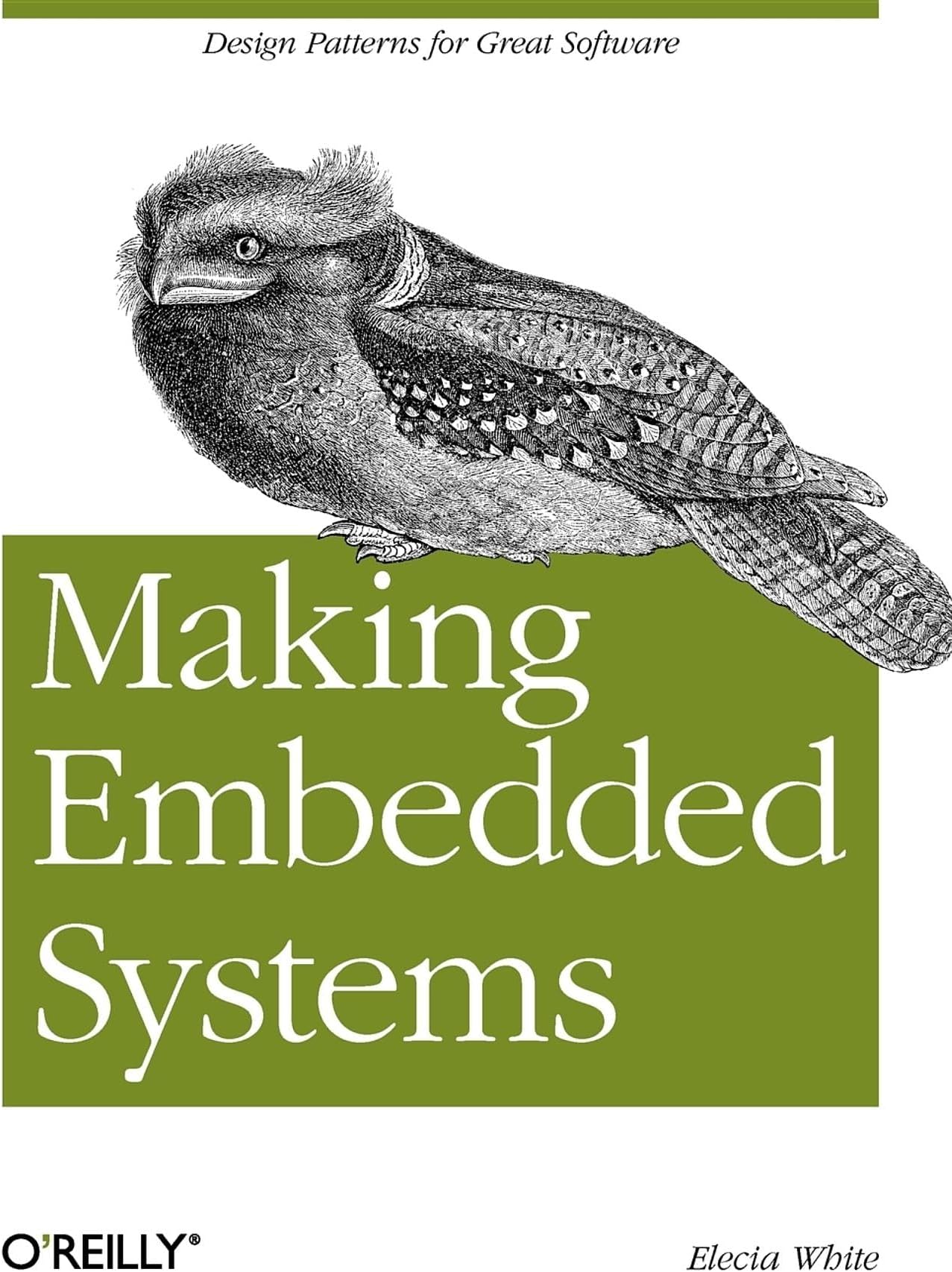
Making Embedded Systems: Design Patterns for Great Software
Product ID: 2445358
Desertcart purchases this item on your behalf and handles shipping, customs, and support to Indonesia.
Interested in developing embedded systems? Since they donâ??t tolerate inefficiency, these systems require a disciplined approach to programming. This easy-to-read guide helps you cultivate a host of good development practices, based on classic software design patterns and new patterns unique to embedded programming. Learn how to build system architecture for processors, not operating systems, and discover specific techniques for dealing with hardware difficulties and manufacturing requirements. Written by an expert whoâ??s created embedded systems ranging from urban surveillance and DNA scanners to childrenâ??s toys, this book is ideal for intermediate and experienced programmers, no matter what platform you use. Optimize your system to reduce cost and increase performance Develop an architecture that makes your software robust in resource-constrained environments Explore sensors, motors, and other I/O devices Do more with less: reduce RAM consumption, code space, processor cycles, and power consumption Learn how to update embedded code directly in the processor Discover how to implement complex mathematics on small processors Understand what interviewers look for when you apply for an embedded systems job " Making Embedded Systems is the book for a C programmer who wants to enter the fun (and lucrative) world of embedded systems. Itâ??s very well writtenâ??entertaining, evenâ??and filled with clear illustrations." â??Jack Ganssle, author and embedded system expert. Review: The book I wish I had starting in embedded systems. - Covers a lot of important topics that every embedded engineer should know. This is a great book in that it gives you background knowledge of things you need to know or go out and learn without getting bogged down with too many details. The idea of describing design patterns is a good one, though some of them seem a little too abstract and like they're trying too hard (like factory patterns) to formalize ideas into some universal pattern or structure. The fact there is a math section and a low power section near the end is really cool and very useful. My main issue with this book is that there are several errata (many are listed on the publisher website) that are known about but they have not bothered doing a reprint. Another issue is that some things are not explained enough so you cant tell if it is an error or intentional. For example in the bootloaders section there is a function pointer that gets cast and set to a static address. However, as well as the casting there is a dereference of the address before assigning to the function pointer which is not explained. Overall though, I highly recommend this book, plus the author comes across as a nice and cool person. Review: This is the best introductory book on embedded systems programming. - This is the best introductory book on embedded systems programming I have ever seen and I have seen a lot of them ! Dec 2018 update : I want to elaborate on that a bit since I have been looking for good books on the topic for many years and this is still the best one I have found. I really liked the specific audience this book is aimed at. It does not try to explain the C programming language or how an "if statement" works or any basics like that, there are plenty of books and online tutorials on how to do that after all. What it does do is cover extremely well the parts of C programming which is DIFFERENT when you work on an embedded system, so the standard C tutorials you will find on the web will explain the semantics for you but will not warn you about how this tends to go wrong specifically in embedded systems. The book is quite thorough so it can also teach even very experienced embedded engineers a thing or two which may be missing from their education - I liked the section on Taylor Series as an example of this. The main areas of focus I felt were also well chosen, start with Architecture and Design first, Basic I/O and Timers, Program Structure, Peripherals, Boot Loaders, Optimization, a very important chapter on Math and then Power Saving. I think that is a great list of topics where approaching them on an embedded system is really very different from doing this on a Laptop or PC running an operating system.

























| Best Sellers Rank | #966,810 in Books ( See Top 100 in Books ) #180 in Computer Hardware Embedded Systems #596 in Software Design & Engineering #611 in Microsoft Programming (Books) |
| Customer Reviews | 4.6 out of 5 stars 367 Reviews |
J**T
The book I wish I had starting in embedded systems.
Covers a lot of important topics that every embedded engineer should know. This is a great book in that it gives you background knowledge of things you need to know or go out and learn without getting bogged down with too many details. The idea of describing design patterns is a good one, though some of them seem a little too abstract and like they're trying too hard (like factory patterns) to formalize ideas into some universal pattern or structure. The fact there is a math section and a low power section near the end is really cool and very useful. My main issue with this book is that there are several errata (many are listed on the publisher website) that are known about but they have not bothered doing a reprint. Another issue is that some things are not explained enough so you cant tell if it is an error or intentional. For example in the bootloaders section there is a function pointer that gets cast and set to a static address. However, as well as the casting there is a dereference of the address before assigning to the function pointer which is not explained. Overall though, I highly recommend this book, plus the author comes across as a nice and cool person.
C**E
This is the best introductory book on embedded systems programming.
This is the best introductory book on embedded systems programming I have ever seen and I have seen a lot of them ! Dec 2018 update : I want to elaborate on that a bit since I have been looking for good books on the topic for many years and this is still the best one I have found. I really liked the specific audience this book is aimed at. It does not try to explain the C programming language or how an "if statement" works or any basics like that, there are plenty of books and online tutorials on how to do that after all. What it does do is cover extremely well the parts of C programming which is DIFFERENT when you work on an embedded system, so the standard C tutorials you will find on the web will explain the semantics for you but will not warn you about how this tends to go wrong specifically in embedded systems. The book is quite thorough so it can also teach even very experienced embedded engineers a thing or two which may be missing from their education - I liked the section on Taylor Series as an example of this. The main areas of focus I felt were also well chosen, start with Architecture and Design first, Basic I/O and Timers, Program Structure, Peripherals, Boot Loaders, Optimization, a very important chapter on Math and then Power Saving. I think that is a great list of topics where approaching them on an embedded system is really very different from doing this on a Laptop or PC running an operating system.
J**E
Written for the software guys.
There's two sides to the embedded coin - hardware and software. On bigger projects, there's often a team of hardware guys and a team of software guys discriminately working on their respective sides. Yin and yang. This book is written for people who want to be the software guys. There's a chapter about hardware and how to read a datasheet and other things that will help a software guy work well with a hardware guy. There's discussions on peripherals and common embedded protocols and other embedded applications. The author assumes the reader knows a decent amount about software. As a hardware guy who was looking into learning more about embedded software, I still took quite a bit from this book. In particular, liked the discussion on state machines and communication protocols. The author's casual tone kept typically-dry material interesting. I only wish this book was longer and went into more depth. I'd reccommend checking out the author's podcast on embedded systems - just seach for "embedded.fm".
N**S
best book for getting started with embedded development
excellent overview of embedded development! perfect for newbies looking to understand what it's all about - and existing embedded devs looking for a reference / refresher... In addition to covering system architecture - it also covers real-world stuff like: -Why some math operations are slow on microcontrollers (and how you can work around that) -How to make a power budget -How to read a spec sheet -How to debug things -How interrupts work This book gets pretty technical - but manages to do so without being brutal / off-putting. It's a fake-it-till-you-make-it world... If you can figure out how to load sample code on an Arduino - studying this book might be enough to convince yourself (and maybe a startup) - that you can do embedded development professionally. If there's anything this book doesn't cover in-depth it might be stuff related to "realtime" (RTOS) / concurrency. Highly recommended!
R**N
Good for newer embedded engineer folk as well as hobbyists
So far, it's a pretty good read. A lot of the examples are "silly," unreal things but still provide some information. Other examples are very good. Mostly pseudocode, but there is also a lot of C and diagrams. I am a "scientific-research oriented" computer scientist (M.S) that recently ended up as an embedded engineer for a company. So, there is a learning curve. This book is pretty good at filling that gap, sometimes it is too simplistic, other times it is just right. But it leans toward the embedded-ignorant while still maintaining a decent technical level. Generally expects the reader to have at least an inclination in technical matters; you need to know a few things about computers before reading this book. It's occasional that they don't sufficiently explain something, however, note the five stars. Recommend pairing it with the Embedded Hardware book by O'Reilly if you need a stronger background on embedded systems / hardware. Now about halfway through and still recommend. Focuses more on understanding concepts than a specific language on a specific OS. Usually uses pseudocode. and black box relationship diagrams.
C**®
I read it cover to cover.
I have done embedded product development for many years, and I write about my craft under the pen name "Chip Overclock". I read a _lot_, and most of what I read is non-fiction. I have an extensive technical library filling several bookcases. But it is extraordinarily rare for me to read a technical book cover to cover. Yet that's exactly what I did with this book by Elecia White. Making Embedded Systems won't make you an expert embedded developer. Only hard work and experience will do that. But it is the best and broadest and most practical introduction to the art and science of how I've made my living for decades that I have ever come across. And I learned a lot from it too, which gives you a hint as to how technically diverse this field is. If you are wondering if embedded development is the career path for you, or if you want a book you can give a colleague as an introduction, or if (like me) you dream of going back to teaching embedded systems design, this is the book I would recommend.
S**K
Solid practical introduction to embedded system design
20 years on from Michael Barr's book on programming embedded systems, we finally have an updated version (well, kind of). Elicia's book is full of real world examples and practical advice, and makes for a quick read. Embedded systems are typically built for a specific set of custom requirements, and are, therefore, all different. That said, they also have a lot in common (IO, interrupts, timers etc. etc.), and this book provides examples of how these things can be implemented. You may be disappointed if you're buying this book to learn about design patterns. She also skips over some other important topics and refers you to a further reading list. So, if you need to know about using an RTOS, or you want details on threading (for example) you may need to look elsewhere. All in all this book provides a good introduction to embedded systems, and contains some great tips for those of us who already work on similar projects.
M**.
If you are into embedded programming, you should read this one for sure!
Excellent book on the subject! It's well-written, has very useful information, and if you are job hunting in this area, even has interview questions...and descriptions of how the author evaluates responses to them, at the end of each chapter. Very interesting view into the mind of a technical manager there! I'm new to embedded programming, but not to programming in general. I've done device drivers for larger systems, worked with OS code, etc., so many of the concepts weren't new to me, but enough were that I learned a lot from this one. The writing style made it enjoyable to read as well. Highly recommended!
S**B
This should be the Bible on embedded system programming
I've been doing embedded programming for 15 years, attended ESC/design west many times , and qualify myself as a professional in the subject matter. I will be purchasing this book for any intern/entry level guy I have to train, and I manage to get quit a bit of nice new knowledge for myself from this book. so wether you are a seasonned embedded developper, or just starting out, if you do embedded programming you NEED to get tis book!
B**O
Ottimo libro per avvicinarsi al mondo embedded
Ho qualche anno di esperienza nel settore embedded, ma nonostante il target di questo libro sia più orientato a un pubblico alle prime armi, sono riuscito a trovare diversi spunti interessanti. Ho apprezzato molto anche le letture suggerite alla fine di ogni capitolo. Do 3 stelle perché quando ero ormai a fine libro le pagine hanno iniziato a staccarsi. Al contrario di quanto avviene con altri editori, comprare l'edizione stampata del libro non dà diritto a scaricare la copia digitale. Peccato.
F**.
Tolles buch zum Thema Embedded Programmierung / Great book about Embedded Programming
Das Buch ist eine tolle Lektüre für alle die sich mit dem Thema Embedded Programmierung beschäftigen (wollen). Es ist angenehm geschrieben, an manchen Stellen mit etwas Humor gewürzt und bietet sowohl für Anfänger als auch erfahrene Embedded-Software-Entwickler interessante Informationen und Denkanstöße. Praxisnahe und leicht verständliche Beispiele runden das Gesamtkonzept ab. In jeder Hinsicht eine Empfehlung! This is a great book for everyone interested in Embedded Programming. It is a nice and easy read and often quite humorous. It contains valuable information patterns for embedded systems newcomers as well as for experienced embedded software engineers. Easy-to-understand and practical examples round up the positive experience. A clear recommendation!
M**J
Best book for ES
I don't buy many hardcopy books. But this one is a keeper, I bought it and would refer for a life time as an Engineer in Electronics. Really interesting and practical.
T**D
Excellent gap-filler. I bought this after listening to Elecia's ...
Excellent gap-filler. I bought this after listening to Elecia's podcast for a while and it's safe to say that her softly spoken tone comes through in the book. Very easy and enjoyable to read. Covers most aspects of embedded systems but should treated as more of an introduction. Used this during my embedded systems course at uni which assumed that students were already very familiar with most of these concepts. If you're doing an embedded class and feel like there's some gaps in your knowledge or you're spending a lot of the time just umming and ahhing then this is absolutely the book to buy! It's important to note however that this book is pretty light on code etc. It covers concepts and uses fairly liberal examples rather than the exact numbers and code that you will tend to see in other embedded books.
Trustpilot
3 days ago
1 month ago