
Buy anything from 5,000+ international stores. One checkout price. No surprise fees. Join 2M+ shoppers on Desertcart.
Desertcart purchases this item on your behalf and handles shipping, customs, and support to Indonesia.
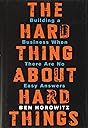
Ben Horowitz, cofounder of the venture capital firm Andreessen Horowitz and one of Silicon Valley’s most respected and experienced entrepreneurs, offers essential leadership advice on building and running a startup―practical wisdom for managing the toughest problems business school doesn’t cover, based on his popular ben’s blog. While many people talk about how great it is to start a business, very few are honest about how difficult entrepreneurship is when it comes to running one. Ben Horowitz analyzes the problems that confront leaders every day, sharing the insights he’s gained developing, managing, selling, buying, investing in, and supervising technology companies. A lifelong rap fanatic, he amplifies business lessons with lyrics from his favorite songs, telling it straight about everything from firing friends to poaching competitors, cultivating and sustaining a CEO mentality to knowing the right time to cash in. Filled with his trademark humor and straight talk, The Hard Thing About Hard Things is an invaluable management book for veteran entrepreneurs as well as those aspiring to their own new ventures, drawing from Horowitz's personal and often humbling experiences. This is not another theoretical management guide. It’s a field manual for the toughest challenges you’ll face as a leader: The CEO Mentality: Learn how to make the right call when there are no good options, from firing loyal friends to knowing the right time to cash in. Startup Advice: Get unflinching, practical wisdom for the real problems business school doesn’t cover, drawn from Horowitz’s own humbling experiences. Wartime Leadership: Understand the hard-won insights gained from developing, managing, and selling technology companies through the dot-com crash and beyond. Unconventional Wisdom: See how lessons from his favorite rap songs can be amplified to solve the most complex business challenges. Review: Solid advice for start-ups and other leaders - If you want to know why The Hard Thing About Hard Things: Building a Business When There Are No Easy Answers is worth buying, here’s the money quote. “Almost all management books focus on how to do things correctly, so you don’t screw up, these lessons provide insight into what you must do after you have screwed up.” If you’re planning to start a company, whether it’s a high-tech company or the kinds of companies that I started and ran, read this book. If you’re going to be someone in charge of anything in any kind of a company, read this book. If all you want are the big ideas, or Horowitz’ philosophy, you can get them from his blog and articles. You don’t need to buy this book. But if you want a handy advisor for that 3 AM moment when you’re thinking about firing someone you like, buy the book. Keep it handy. I’ve had those moments and I wish I’d had it. The Hard Thing About Hard Things has a whole lot of information packed inside it. You can read it from cover to cover and get a lot of value. Or, you can think of it as a series of conversations with bosses and mentors. Horowitz had a lot of those. And his mentors included people like Andy Grove and Jim Barksdale. The wisdom that he shares and credits to them, reminds me of the wisdom that I received from bosses and mentors and which I later shared with protégés. It’s real, it’s practical, and it will help. I think that the discussion of things like firing and laying people off are more than worth the price of the book by themselves. And they’re only a small part of what’s in The Hard Thing About Hard Things. Here are a few quotes from the book to give you an idea of what you’re in for. You don’t have to be a CEO to use what’s here, even though Horowitz aims the book at CEOs. Substitute “leader” for “CEO” in most quotes and use the wisdom. Quotes from The Hard Thing About Hard Things “That’s the hard thing about hard things— there is no formula for dealing with them.” “People always ask me, ‘What’s the secret to being a successful CEO?’ Sadly, there is no secret, but if there is one skill that stands out, it’s the ability to focus and make the best move when there are no good moves. It’s the moments where you feel most like hiding or dying that you can make the biggest difference as a CEO.” “Don’t take it personally. The predicament that you are in is probably all your fault. You hired the people. You made the decisions. But you knew the job was dangerous when you took it. Everybody makes mistakes. Every CEO makes thousands of mistakes. Evaluating yourself and giving yourself an F doesn’t help.” “One of the most important management lessons for a founder/ CEO is totally unintuitive. My single biggest personal improvement as CEO occurred on the day when I stopped being too positive.” “Management purely by numbers is sort of like painting by numbers— it’s strictly for amateurs.” “The first rule of organizational design is that all organizational designs are bad.” “Embrace the struggle.” There are plenty more in The Hard Thing About Hard Things: Building a Business When There Are No Easy Answers. Review: Hardcore truth for passionate CEOs and Traders - Given the author's love of rap - and willingness to include rap lyrics as chapter intros - my only quibble with "The Hard Thing About Hard Things" was not referencing the most motivational rap song of all time: "Till I Collapse" by Eminem featuring Nate Dogg. As the song begins, with Eminem talking over an army drill cadence: "Cause sometimes you just feel tired, feel weak... and when you feel weak, you feel like you wanna just give up... but you got to search within you, and try to find the inner strength... and just pull that s-- out of you... and get that motivation to not give up, and not be a quitter... no matter how bad you wanna just fall flat on your face, and collapse..." It's the ultimate theme song (if you like rap) for Horowitz' time as CEO of Loudcloud and later Opsware, going through hell - and being forged into steel via incredible trials by fire - along the hard, bloody road to success (seeing Opsware acquired for $1.6 billion). Pulling out the incredibly important lessons from that experience is the purpose of the book. In another section, Horowitz distinguishes between okay CEOs and great CEOs by pointing out a difference in perspective on how they made it through killer trials. When Horowitz would ask fellow CEOs "how did you do it," as in "How did you survive that brutal gauntlet," okay CEOs would point to something specific. Whereas the great CEOs would simply boil it down to a simple hardcore essence: "I never quit." They simply refused to give in or give out, as the "Till I Collapse" chorus puts it: Til the roof comes off, til the lights go out Til my legs give out, can't shut my mouth Til the smoke clears out, am I high perhaps I'm a rip this s--, til my bone collapse... You must know what this means, on a deep level, to be a great CEO. And the same goes for traders. Nearly all traders, like nearly all CEOs, face their "time in the wilderness" - when nothing feels easy, everything feels impossible, and killer challenges press on every side. I devoured "The Hard Thing About Hard Things" in less than 24 hours, having heard about it via youtube interview of Horowitz at a tech startup conference. The sense of realness - of someone who has been down in the mud and the blood and fought their way through - was absolutely compelling. This book - basically a series of guidelines for CEOs and building a business - is not some fluffy management tome written by a theoretical management consultant with no personal concept of what brutally hard decisions are like. This is front-line reporting from a CEO who has gone to war... taken severe casualties... made series after series of life-or-death decisions... motivated troops in the trenches... and ultimately won. (As such, the book will almost certainly offend or turn off those with a more 'civilized', and less emotionally raw, perspective on what company leadership.) The book had triple resonance for me on three fronts: Entrepreneur, CEO, and Trader. The "building a business" aspect spoke directly to our plans: Mercenary Trader, our financial publishing and trading education startup built on founder sweat equity, is on the cusp of critical mass after four-plus years of blood, sweat and tears. Our model is built around cultivating a true community of traders - monetizing the research we use to trade and invest our own funds (and those of clients), while educating members in our community (in a way that no one else does) that they might join us, share trading and investing ideas, and take their own trading to greater than ever heights. In terms of hardcore challenges, we have already had to deal with questions like whether to sell a major piece of the business... how to handle joint venture projects (including a major software initiative) gone south... the bloody business of firing people (of course)... and lots of other things, all while managing capital simultaneously. Ultimately we want to provide seed capital to the breakthrough star traders in our community, having trained them and equipped them with shared community resources - our own version of Julian Robertson's "Tiger Cubs" - and use flowback from publishing profits to further deepen and expand our research capabilities, even while creating a shared idea environment that fosters partnerships and even life-long friendships. Think hedge fund incubator crossed with "trader greatness training" and deep community value-add. Not unlike what a great Silicon Valley firm cultivates for tech founders (and hence the tie-in to this review)... the VC model of A16Z (Horowitz' and Andreessen's firm) was compelling in this regard too, in the way they took a bunch of long-standing VC industry conventions and simply decided to blow them up. (I found it hilarious, as an aside, that the historical reason VCs are extremely private, and totally disdainful of publicity, is because this is how the original banking houses did it, like the Rothschilds and whatnot - those guys were publicity-shy because they so often funded both sides of a war.) For the longest time, as Horowitz makes clear, VCs assumed that tech founders needed "adult supervision." Even worse, they would sometimes try to eyeball a founder to decide if they were "CEO material" based on appearance and superficial impressions, not unlike the worst practices of the redneck talent scouts in "Moneyball" pre-Billy Beane. One almost imagines choosing a candidate to lead an organization simply because he (or she) looks a little better in a tailored suit - which is apparently what actually happens, given an utter lack of substantive process. Horowitz and Andreessen, in contrast, realized that great tech CEOs are MADE, not born - shaped and created via community experience and support - and that all the truly great tech companies were led to greatness by the passionate founders who created them in the first place (Jobs, Gates, Hewlett and Packard etc). They thought tech founders would likely be in synch with a vision of empowering founders, rather than expecting to hand their passionate idea over to an empty suit... and they were right. So they set up A16Z, a different kind of VC firm, to facilitate that transition: "Making" the CEO out of the founder, or rather helping the founder to come into his own as CEO, through guidance and support. This view had deep parallels with a great point of frustration, for yours truly, in respect to the trading industry: There are so many books, so much literature, talking about what makes for a "great trader," or what makes someone "trader material," not unlike someone being "CEO material." But great traders, like great CEOs, are also MADE - it is at least partly an unnatural thing, as Horowitz says - and there is a huge amount of psychological and emotional development along the way. There is training needed for this stuff. And not the same old "cut losses and let profits run" stuff either, but real, deep, meaningful training. Having potential is not the same thing as being developed - not by a long shot. If you are serious about building a business, becoming a CEO, or stepping up your game as a trader via leadership lessons with strong cross-application to trading, buy this book. If brutal honesty turns you off and you prefer a rose-colored-glasses view of reality, however, don't buy this book. It pulls no punches, which is fantastic for those with the clear-eyed courage of Thucydides: "The bravest are surely those who have the clearest vision of what is before them, glory and danger alike, and yet notwithstanding, go out to meet it."
| Best Sellers Rank | #4,166 in Books ( See Top 100 in Books ) #13 in Entrepreneurship (Books) #21 in Business Management (Books) #34 in Leadership & Motivation |
| Customer Reviews | 4.6 out of 5 stars 15,679 Reviews |
W**K
Solid advice for start-ups and other leaders
If you want to know why The Hard Thing About Hard Things: Building a Business When There Are No Easy Answers is worth buying, here’s the money quote. “Almost all management books focus on how to do things correctly, so you don’t screw up, these lessons provide insight into what you must do after you have screwed up.” If you’re planning to start a company, whether it’s a high-tech company or the kinds of companies that I started and ran, read this book. If you’re going to be someone in charge of anything in any kind of a company, read this book. If all you want are the big ideas, or Horowitz’ philosophy, you can get them from his blog and articles. You don’t need to buy this book. But if you want a handy advisor for that 3 AM moment when you’re thinking about firing someone you like, buy the book. Keep it handy. I’ve had those moments and I wish I’d had it. The Hard Thing About Hard Things has a whole lot of information packed inside it. You can read it from cover to cover and get a lot of value. Or, you can think of it as a series of conversations with bosses and mentors. Horowitz had a lot of those. And his mentors included people like Andy Grove and Jim Barksdale. The wisdom that he shares and credits to them, reminds me of the wisdom that I received from bosses and mentors and which I later shared with protégés. It’s real, it’s practical, and it will help. I think that the discussion of things like firing and laying people off are more than worth the price of the book by themselves. And they’re only a small part of what’s in The Hard Thing About Hard Things. Here are a few quotes from the book to give you an idea of what you’re in for. You don’t have to be a CEO to use what’s here, even though Horowitz aims the book at CEOs. Substitute “leader” for “CEO” in most quotes and use the wisdom. Quotes from The Hard Thing About Hard Things “That’s the hard thing about hard things— there is no formula for dealing with them.” “People always ask me, ‘What’s the secret to being a successful CEO?’ Sadly, there is no secret, but if there is one skill that stands out, it’s the ability to focus and make the best move when there are no good moves. It’s the moments where you feel most like hiding or dying that you can make the biggest difference as a CEO.” “Don’t take it personally. The predicament that you are in is probably all your fault. You hired the people. You made the decisions. But you knew the job was dangerous when you took it. Everybody makes mistakes. Every CEO makes thousands of mistakes. Evaluating yourself and giving yourself an F doesn’t help.” “One of the most important management lessons for a founder/ CEO is totally unintuitive. My single biggest personal improvement as CEO occurred on the day when I stopped being too positive.” “Management purely by numbers is sort of like painting by numbers— it’s strictly for amateurs.” “The first rule of organizational design is that all organizational designs are bad.” “Embrace the struggle.” There are plenty more in The Hard Thing About Hard Things: Building a Business When There Are No Easy Answers.
M**R
Hardcore truth for passionate CEOs and Traders
Given the author's love of rap - and willingness to include rap lyrics as chapter intros - my only quibble with "The Hard Thing About Hard Things" was not referencing the most motivational rap song of all time: "Till I Collapse" by Eminem featuring Nate Dogg. As the song begins, with Eminem talking over an army drill cadence: "Cause sometimes you just feel tired, feel weak... and when you feel weak, you feel like you wanna just give up... but you got to search within you, and try to find the inner strength... and just pull that s-- out of you... and get that motivation to not give up, and not be a quitter... no matter how bad you wanna just fall flat on your face, and collapse..." It's the ultimate theme song (if you like rap) for Horowitz' time as CEO of Loudcloud and later Opsware, going through hell - and being forged into steel via incredible trials by fire - along the hard, bloody road to success (seeing Opsware acquired for $1.6 billion). Pulling out the incredibly important lessons from that experience is the purpose of the book. In another section, Horowitz distinguishes between okay CEOs and great CEOs by pointing out a difference in perspective on how they made it through killer trials. When Horowitz would ask fellow CEOs "how did you do it," as in "How did you survive that brutal gauntlet," okay CEOs would point to something specific. Whereas the great CEOs would simply boil it down to a simple hardcore essence: "I never quit." They simply refused to give in or give out, as the "Till I Collapse" chorus puts it: Til the roof comes off, til the lights go out Til my legs give out, can't shut my mouth Til the smoke clears out, am I high perhaps I'm a rip this s--, til my bone collapse... You must know what this means, on a deep level, to be a great CEO. And the same goes for traders. Nearly all traders, like nearly all CEOs, face their "time in the wilderness" - when nothing feels easy, everything feels impossible, and killer challenges press on every side. I devoured "The Hard Thing About Hard Things" in less than 24 hours, having heard about it via youtube interview of Horowitz at a tech startup conference. The sense of realness - of someone who has been down in the mud and the blood and fought their way through - was absolutely compelling. This book - basically a series of guidelines for CEOs and building a business - is not some fluffy management tome written by a theoretical management consultant with no personal concept of what brutally hard decisions are like. This is front-line reporting from a CEO who has gone to war... taken severe casualties... made series after series of life-or-death decisions... motivated troops in the trenches... and ultimately won. (As such, the book will almost certainly offend or turn off those with a more 'civilized', and less emotionally raw, perspective on what company leadership.) The book had triple resonance for me on three fronts: Entrepreneur, CEO, and Trader. The "building a business" aspect spoke directly to our plans: Mercenary Trader, our financial publishing and trading education startup built on founder sweat equity, is on the cusp of critical mass after four-plus years of blood, sweat and tears. Our model is built around cultivating a true community of traders - monetizing the research we use to trade and invest our own funds (and those of clients), while educating members in our community (in a way that no one else does) that they might join us, share trading and investing ideas, and take their own trading to greater than ever heights. In terms of hardcore challenges, we have already had to deal with questions like whether to sell a major piece of the business... how to handle joint venture projects (including a major software initiative) gone south... the bloody business of firing people (of course)... and lots of other things, all while managing capital simultaneously. Ultimately we want to provide seed capital to the breakthrough star traders in our community, having trained them and equipped them with shared community resources - our own version of Julian Robertson's "Tiger Cubs" - and use flowback from publishing profits to further deepen and expand our research capabilities, even while creating a shared idea environment that fosters partnerships and even life-long friendships. Think hedge fund incubator crossed with "trader greatness training" and deep community value-add. Not unlike what a great Silicon Valley firm cultivates for tech founders (and hence the tie-in to this review)... the VC model of A16Z (Horowitz' and Andreessen's firm) was compelling in this regard too, in the way they took a bunch of long-standing VC industry conventions and simply decided to blow them up. (I found it hilarious, as an aside, that the historical reason VCs are extremely private, and totally disdainful of publicity, is because this is how the original banking houses did it, like the Rothschilds and whatnot - those guys were publicity-shy because they so often funded both sides of a war.) For the longest time, as Horowitz makes clear, VCs assumed that tech founders needed "adult supervision." Even worse, they would sometimes try to eyeball a founder to decide if they were "CEO material" based on appearance and superficial impressions, not unlike the worst practices of the redneck talent scouts in "Moneyball" pre-Billy Beane. One almost imagines choosing a candidate to lead an organization simply because he (or she) looks a little better in a tailored suit - which is apparently what actually happens, given an utter lack of substantive process. Horowitz and Andreessen, in contrast, realized that great tech CEOs are MADE, not born - shaped and created via community experience and support - and that all the truly great tech companies were led to greatness by the passionate founders who created them in the first place (Jobs, Gates, Hewlett and Packard etc). They thought tech founders would likely be in synch with a vision of empowering founders, rather than expecting to hand their passionate idea over to an empty suit... and they were right. So they set up A16Z, a different kind of VC firm, to facilitate that transition: "Making" the CEO out of the founder, or rather helping the founder to come into his own as CEO, through guidance and support. This view had deep parallels with a great point of frustration, for yours truly, in respect to the trading industry: There are so many books, so much literature, talking about what makes for a "great trader," or what makes someone "trader material," not unlike someone being "CEO material." But great traders, like great CEOs, are also MADE - it is at least partly an unnatural thing, as Horowitz says - and there is a huge amount of psychological and emotional development along the way. There is training needed for this stuff. And not the same old "cut losses and let profits run" stuff either, but real, deep, meaningful training. Having potential is not the same thing as being developed - not by a long shot. If you are serious about building a business, becoming a CEO, or stepping up your game as a trader via leadership lessons with strong cross-application to trading, buy this book. If brutal honesty turns you off and you prefer a rose-colored-glasses view of reality, however, don't buy this book. It pulls no punches, which is fantastic for those with the clear-eyed courage of Thucydides: "The bravest are surely those who have the clearest vision of what is before them, glory and danger alike, and yet notwithstanding, go out to meet it."
M**A
Entrepreneurial Review
Before I start reviewing “The Hard thing about Hard Things” by Ben Horowitz, allow me to briefly explain what entrepreneurial thinking means to me. When asked to define entrepreneurial thinking, I answered by saying, “it is a mindset that embraces self-evaluation and creativity, and always tends to action.” In other words, an effective entrepreneur is always assessing himself to understand who he is, what he can (and cannot) do, and whom he knows (and counts on) so that he may creatively and rigorously devise a plan of action. Of course, there is much more to entrepreneurial thinking than my definition encompasses. Here is a couple of key criteria that I will also use to review the book: (1) effectual reasoning, and the (2) stewardship principle. Entrepreneurial Thinking Definition Ben Horowitz is a great entrepreneur according to my definition. Throughout his book his demonstrates (1) self-awareness and (2) creativity, and (3) how he put these into action. Firstly, self-awareness. In the first chapter, “From Communist to Venture Capitalist” he explains who he is, where he comes from, and what he knows. He explains that “being scared doesn’t mean [being] gutless.” Having enough confidence in yourself to be bold is a key aspect of entrepreneurship; he displayed a great deal of boldness when he bought tangram to secure business with EDS. Then, Ben continues to tell us about his communist background, and how that is an advantage: “I realized that embracing the unusual parts of my background would be the key to making it through. It would be those things that I would bring to the table that nobody else had.” Lastly, he explains his mindset in terms of the following four criteria, which helped him immensely throughout his career: (1) to separate facts from perspective, (2) to “turn your s*** in” which means to be responsible for yourself and your work, (3) to not rely on first impressions, especially those based on appearances, and (4) to “look at the world through priorities.” It is therefore clear from chapter 1 that Ben Horowitz knows himself very well, and because he does, he is both confident and prepared to push himself to the limit. Secondly, creativity. There are many examples of creativity in the book, but I’ll point to one in particular that shows rigorous creativity. After LoudCloud achieved a period of stability, most CEOs would try to remain in that state, but Ben thought differently. He asked himself, “What are we [LoudCloud] not doing?” The answer was well fought, but it eventually came out: they are not being a software company. And so, Ben rigorously devised a plan to save his and his employee’s careers. After selling LoudCloud, he would start a software company called Opsware and focus on systems automatization. To come up with this decision shows how creativity may be the answer to a struggle. Sometimes it is better to think of alternative solutions than just going forward or backwards, and this is exactly what Ben demonstrates time after time in his book – of course, assuming that everything he says he did is true. Lastly, action. At this point I am sure that you have noticed that Ben is a man of action – whenever he says something he immediate acts upon it – but I’ll elaborate to further prove this. To save LoudCloud from going bankrupt, he only had two months to resolve his company’s problems in order to save business with his biggest client, EDS. He did, and on top of that was also able to start a group of ten engineers on a project named “Oxide,” whose goal was to separate the opsware software from LoudCloud. Ben did all of this in the 2 months period he was given, meaning that he – and his company – did not wasting any time. Ben asked his employees to come at 8am and leave at 10pm everyday (of course he also stayed those hours). He made sure that everyone worked diligently when they had to “turn their s*** in.” They accumulated enough momentum during the beginning of the 2-month rally to carry them throughout. So when the time ran out, Ben had successfully saved his company and business with EDS. That is why action – and traction – should always be the result of self-awareness and creativity. Effectual Reasoning Effectual reasoning has three main principles: the (1) bird in the hand, which means understanding the resources that you have at your disposal, (2) crazy quilt, which means building from the bottom up with an end goal in mind, and (3) pilot in the plane, which means that you want to be in control but not always have all the information. In his book, Ben doesn’t talk explicitly about these principles, but he definitely demonstrates them. (1) Bird in the Hand. Ben went to college during the computer boom in Silicon Valley. When and where he studied (the resources) provided him a key advantage over other competitors because he had the knowledge to tap into a market that was underdeveloped and growing exponentially. Moreover, he understood that that point in time would also produce people of likeminded prospective. And so, Ben was able to team up with exceptional individuals such as Marc Andreessen (smartest person, according to Ben), Scott Kupor (director of finance), Mark Cranney (head of sales), Shannon Callahan (head of recruiting and HR), Margit Wennmachers (sultan of networking), and Frank Chen (head of product management) to name a few. This is how Ben demonstrates using the resources available to him. (2) Crazy quilt. Ben’s end goal was to become a successful CEO, but he didn’t know how to get there. And so, he did what any other person would do in his situation: take a step forward and see where that leads him. His first step was to quit his old job and work for Marc Andreessen at Netscape. Circumstances and other people’s involvement lead him to take another step: build Loudcloud with Marc Andreessen. Interesting to note here is that if Ben had not quit his first job, he would not have met Marc Andreeseen and therefore not been able to build LoudCloud. Also, had Marc Andresseen not employed Ben, he would not have recognized Ben’s potential. Again, involvement from other people and circumstances then lead to Ben’s third step: selling LoudCloud and creating Opsware. As you probably guessed, other involvement from other people and circumstances lead to the next step: selling Opsware to HP and creating a venture capital firm with Marc Andreessen. And so, understanding that there are infinite ways of reaching your end goal is important, because it enables you to be flexible with ideas that come along the way. Flexibility to allow other people’s input, and to take advantage of opportunities that you hadn't foreseen. Ben demonstrates this in his journey to become a CEO, and to be honest, he became quite proficient at it. (3) Pilot in the plane. Suffice it to say that Ben delegated work to the executives of his companies, but he always partnered with Marc Andreessen because he knew that Marc Andreessen set of skills complemented his: Marc Andreessen was the public face of the company because he thrived in that environment; Ben stayed in the background managing the company. He then goes to explain that the most important asset of a company is its employees. In light of the-pilot-in-the-plane principle, it makes a lot of sense that you keep your employees motivated because you will distribute the workload to them. Specifically in chapters 5 and 6, Ben explains the importance of taking care of the people, and creating the right in of culture in your company. The reason why the first priority of a company should be to take care of its people according to him is because they are the most knowledgeable individuals of your company. They know what the problems and strengths are because they do the work; managers, executives and CEOs orchestrate from above and may lack on smaller details. In order to have awareness of those smaller details migrate from the employees to the managers and then executive a great company culture has to be created. A great company culture is one in which workers are encouraged to talk about problems and strengths equally. Where they are awarded and recognized based on merit and not on lobbying skills. Where workers are encouraged to “move fast and break things,” meaning that workers should innovate and strive to cause breakthroughs. In this environment, workers like to go to work because it is interesting and genuinely fun. And when a worker wants to work, he/she is the most valuable asset of a company. That is why Ben knows how to delegate work and responsibility among the different hierarchical levels of his company. In analogy, a plane not only needs a pilot to operate satisfactorily. It also needs a co-pilot, stewardesses, a control tower, engineers, an air marshal, and passengers or else flying a plane is: not possible, not profitable and not safe. Ben knows this. Stewardess Principle This principle states that workers are individuals and for that reasons they must be encouraged to use their skills for the better of the company. Just like effectual reasoning has several components to it, so does the Stewardess Principle. Several of the key dimensions of the Stewardess Principle that I wish to discuss are: (1) culture, (2) motivation, and (3) power distance. Ben applies these dimensions to his company, and the result is obvious. (1) Culture. Suffice it to say that Ben dedicates an entire chapter of his book to discuss how important it is to create the right culture in your company. Specifically, one has to minimize politics, encourage the right kind of ambition, and continuously have one-on-ones. By doing this, a company encourages and ensures that its workers have the right work ethics. By minimizing politics (which means lobbying in order to achieve promotions or benefits) one reinforces the notion that if an employee works hard he/she will be rewarded accordingly. But most importantly, working hard becomes the only way to move up the ladder. No slacker will be able to lobby his/her way to the top. As a result, workers will not feel treated unjustly. By encouraging the right kind of ambition, one avoids individual agendas or people trying to gain success at the expense of the company. The right kind of ambition is when a worker genuinely wants the company to succeed, and if the company succeeds he/she succeeds with it. The wrong kind of ambition, by contrast, is when a worker wants to succeed regardless of the company’s success. The way to encourage the right kind of ambition, according to Ben, is to seek out those employees with the wrong kind of ambition and fire them before they can rot others, and to screen possible employers while interviewing. By establishing one-on-ones workers are able to voice any issues to their managers. According to Ben, during one-on-ones managers should do 10% talking and 90% listening. The main point of a one-on-one is for the worker to voice his thoughts and his concerns. This way if there are any problems in the company, the managers become aware of them and may pass the information along to executives and ultimately the CEO. (2) Motivation. Motivation follows a well-established culture. If Ben had not established an excellent culture in his company he would not haven been able to ask his workers to come to work from 8am to 10pm for months at a time. As if that was not enough, Ben asked this of his workers on three consecutive occasions. This is evidence of what well-motivated stewards are capable of doing. (3) Power distance. This dimension explains that because companies are hierarchical systems there is a potential for people to use power to abuse their subordinates. To prevent this from happening in his company, Ben placed top priority on one-on-ones. He almost fired one of his executives because he didn't do his one-on-ones. The point of one-on-ones is mentioned above, but they also an additional psychological effect. When managers listen to works, it shifts the power balance for the duration of the one-on-one. As a result, workers feel that the power distance is bridged, allowing them to work more closely with managers. And that is highly desirable. And so, this is how Ben Horowitz exemplifies what a successful entrepreneur and CEO is. His self-awareness and creativity (and a few other personal traits) took him all the way to where he stands: co-founder of the Andreessen Horowitez venture capital firm valued at $4 billion.
A**G
Fantastic Read; Early Stage Founders, Take Note
"Teacher, teacher, tell me how you do it It looks kinda easy, like there was nothing to it" -Slick Rick, 'Teacher, Teacher' While the first line conveys the mission of this book, you'll find none of the second applies to Ben Horowitz's tenure at Loudcloud. This book is an entertaining, informative read filled with good advice, specifically on how to be an effective CEO. As I describe below you may find many parts of it don't apply to your personal entrepreneurial situation. Ben begins with a brief history of his pre-VC career, largely focused on his leadership of Loudcloud/Opsware. The next five chapters are built of solid, direct advice, devoid of the fluff that balloons most management books to 3x longer than they need to be. He concludes with the founding principles of Andreessen Horowitz. More than half of the book is directed at growth stage companies and tackles issues resulting from scaling, for example: -the entire executive life cycle (hiring, management, firing) -organizational design and processes for effective communication -attributes of effective executive teams -handling multiple aspects of when things go bad If you're running an early stage, <10 person company like me, the above help de-mystify where you want to be but aren't currently relevant (Maserati problem). Instead, I found these parts of the book to be immediately useful: -how to deal with founder psychological issues - self-doubt, reflection on mistakes -what makes a compelling leader -the importance of thoughtful training and onboarding of new employees -how to give effective, authentic feedback Ultimately this book holds true to a chapter title: "Take care of your people, the products, and the profits - in that order." This is a people management book, both of employees and of oneself. I would love a practical Ben Horowitz treatment of the other two aspects - products and profits, especially in early-stage companies. How do you know you've reached product-market fit, and how do you best capitalize on that? When is it appropriate for a bootstrapped, profitable company to seek funding? How do you prioritize further developing your core product vs starting new product lines? Yes, there are plenty of resources already out there on these topics. The same was said about how to be a good CEO, yet this book still offers novel insights. And I'm sure there's a ton of institutional knowledge within Andreessen Horowitz on these subjects. Until that book comes out, we'll have to make do with this book and the many helpful A16Z blogs.
A**R
The Easy Thing About "The Hard Thing About Hard Things" is Reading It
The easy thing about “The Hard Thing About Hard Things,” Andreessen Horowitz co-founder Ben Horowitz’s book about “Building a business when there are no easy answers,” is reading it. That’s because it’s funny, to-the-point, and way more well-informed by real-world experience than most books that give advice ever are. Like the secret to being a successful CEO: “Sadly, there is no secret, but if there is one skill that stands out, it’s the ability to focus and make the best move when there are no good moves.” And, “Managers must lay off their own people. They cannot pass the task to HR or to a more sadistic peer.” And, “The job of a big company executive is very different from the job of a small company executive…big company executives tend to be interrupt-driven. In contrast, when you are a startup, nothing happens unless you make it happen.” But it’s not just catchy phrases and aphorisms that make the book something pretty much anybody who wants to build a company should read, it’s the experience that created them: Horowitz provides in brutal (and, for aspiring entrepreneurs, invaluable) detail the excruciating real-life experiences behind the advice, from his years as a Silicon Valley engineer and then as the CEO of a start-up with more near-death experiences than Keith Richards before its successful sale to HP. Like how to fire people. What to say at the “all-hands” when you just had your first layoffs. What to tell an employee who asks if the company is being sold when it is being sold, but not yet. Why every company needs a “story,” and what makes a great company story (hint: see the letter Jeff Bezos wrote to Amazon shareholders in 1997.) When not to listen to your board. Even, literally, what questions a CEO should ask a prospect being considered for the key, all-important job in any start-up: head of sales. I'm not a fan of “how-to” books, particularly those concerned with managing people, because they tend to be heavy on theory and light on reality, but the chapter emphatically titled “WHY YOU SHOULD TRAIN YOUR PEOPLE" proved the value of the author's experience because it explains the trap in which an engineer I know happens to find himself. He is a software engineer for a start-up that was acquired by a large, fast-growing Silicon Valley company whose name rhymes with “Shalesforce.com.” He is smart, highly motivated, eager to learn, and yet he is miserable at his job for precisely the reason Horowitz spells out as follows in “WHY YOU SHOULD TRAIN YOUR PEOPLE”: “Often founders start companies with visions of elegant, beautiful product architectures that will solve so many of the nasty issues that they were forced to deal with in their previous jobs. Then, as their company becomes successful, they find that their beautiful product architecture has turned into a Frankenstein. How does this happen? As success drives the need to hire new engineers at a rapid rate, companies neglect to train the new engineers properly. As the engineers are assigned tasks, they figure out how to complete them as best they can. Often this means replicating existing facilities in the architecture, which leads to inconsistencies in the user experience, performance problems, and a general mess. And you thought training was expensive.” That line is the exact truth. Just ask the engineer at Shalesforce.com. His managers—if they exist—ought to read this book. In fact, anybody who wants to start a company, or work for a company, or build a company, or invest in a company, ought to read this book, because that’s not the only hard-learned truth in here. Some others include: “In high-tech companies, fraud generally starts in sales due to managers attempting to perfect the ultimate local optimization [i.e. optimize their own incentive pay].” “The Law of Crappy People states: For any title level in a large organization, the talent on that level will eventually converge to the crappiest person with the title.” “The world is full of bankrupt companies with world-class cultures. Culture does not make a company…. Perks are good, but they are not culture.” “Nobody comes out of the womb knowing how to manage a thousand people. Everybody learns at some point.” “The first rule of the CEO psychological meltdown is don’t talk about the psychological meltdown.” And maybe the best of all, because it encapsulates so much of what the book is about: “Tip to aspiring entrepreneurs: If you don’t like choosing between horrible and cataclysmic, don’t become CEO.” This book, on the other hand, is a choice between good and great, so read it. Jeff Matthews Author “Secrets in Plain Sight: Business and Investing Secrets of Warren Buffett” (eBooks on Investing, 2013) $4.99 Kindle Version at Amazon.com
T**N
Required reading for anyone building something that matters
As someone leading initiatives in law, coaching, and systems transformation, The Hard Thing About Hard Things hit me in a way few books do. Ben Horowitz doesn’t offer sugar-coated advice—he delivers hard-earned wisdom from the trenches of real leadership, where the stakes are high and the answers aren’t obvious. What stood out most to me was his honesty. Horowitz doesn’t shy away from the emotional toll of leadership—the fear, the second-guessing, the sheer exhaustion of making decisions when none of the options feel good. And yet, he writes with clarity, courage, and just enough humor to keep you going. I found myself applying these lessons well outside the tech world. Whether you’re managing a company, leading a nonprofit, navigating co-parenting conflict, or building a mission-driven movement—this book will make you braver, sharper, and more grounded. This isn’t a book full of tidy solutions. It’s a companion for doing the hard things, when they matter most.
B**S
Great for Male CEOs (or aspiring CEOs)
I heard so many great things about The Hard Thing About Hard Things by Ben Horowitz when it was released. Naturally, I bought it, and it took me a bit to get to it on my To Be Read list. While I think the book is good and helpful, I am not the right person in the right place to take full advantage of the content. The Hard Thing About Hard Things is a great book filled with hard truths about running a successful tech company. It’s narrow in focus but full of little wisdom nuggets. Never having been a tech company CEO nor working at a tech company in the early 2000s, I couldn’t relate to many of the anecdotes, but the lessons are there when you look for them. The writing was quick and easy to understand. One thing I found myself noticing a lot in this book was how male-dominated everything felt. Again, it feels representative of the time, place, and industry, but today in 2021, some parts feel dated and moments when you say, “that wouldn’t fly today.” I could be wrong! There’s still bro culture in the tech world that has not diminished, but things are changing and improving. I appreciate the recaps at the end of the chapter, which distilled the anecdotes into takeaways and lessons. 3/5 - If you’re a male CEO (or aspiring CEO) in tech, you might get a lot from this book. The shortened recap might suffice for others. Lessons Learned from The Hard Thing About Hard Things by Ben Horowitz Being a jerk never pays off You will die. Are you happy with how you’re spending your days? Confront yourself with a straightforward question: Which is more important: work or family? Act and plan accordingly.
P**R
Fun book, some good advice on working with employees.
First of all, this book is entertaining. There is some good advice in here about dealing with some of the difficult people you'll encounter in start up land. It's not new advice, it's not groundbreaking, and it doesn't offer you much insight into many particular problems outside of dealing with employees. The mean thesis, as I understood it, is pretty simple. The road ahead for start up founders is perilous, filled with anguish, and no one can tell you what to do. As someone who has been working on and for startups for 5+ years now, outside of Silicon Valley, I wholeheartedly agree. If you aren't ready to deal with this stark reality, there are a lot of things you can do to make money that have a much higher probability of success (property management comes to mind). It's no "Lean Startup", it's certainly no "Thinking Fast and Slow", it can't tell you how to discover a market, get into an incubator, get customers, get financing, etc. This book is not supposed to give you that, it's supposed to prepare you mentally for the road ahead and give you some tips about employee's and partners. If that's what you're looking for, grab this book.
E**C
Excelente, directo y resolutivo
Independientemente de ser el fundador y CEO de tu propia empresa, grande o pequeña, como emprendes desde hace poco o te planteas hacerlo, este libro es de lectura obligatoria. Ben empieza el libro contando su historia de manera muy amena y dejándo ver que todo lo que enseña y aconseja es fruto de haberse encontrado con los problemas, haberlos aprontado y haberlos superado, y sigue explicando, de manera metódica, cómo actuar ante los dilemas que suponen ciertas situaciones más o menos habituales pero que desde luego quien apunta alto se encontrará. Ben incluso cita a otros autores y libros que lo guiaron en su andadura y que deberían ser también lectura obligatoria para cualquier emprendedor, y que serán mis próximas lecturas tan pronto termine de releer este libro.
A**A
Book
Excellent
Y**T
Excellent résumé d'une expérience hors du commun
Une tonne de conseils précis par un homme qui a géré une licorne avant, pendant et après les années folles de la bulle. Beaucoup de conseils et une analyse pertinente des challenges inhérents à la gestion d'entreprise. Plein d'ambition et de courage. Egalement, pas mal d'anecdotes et d'histoires, qui permettent de découvrir qui est le co-fondateur d'Andressen Horrowitz. Un régal.
J**S
Honest and insightful
A worthwhile read for any aspiring entrepreneur, founder or executive in a start up. Interesting and candid history of Ben’s own companies, he gives valuable insights that will surely help you on your own journey. It’s also a short read for those who don’t have a lot of time to spare.
M**S
Best of the best
Very practical book. Ben has done it and that is why he is successful. Its like watching a reality business movie on actual events. I wish more authors to follow his writing. However they lack Ben’s experience
Trustpilot
3 weeks ago
1 week ago