Desertcart purchases this item on your behalf and handles shipping, customs, and support to Indonesia.
🎶 Own the analog renaissance with Behringer POLY D – where vintage soul meets modern groove.
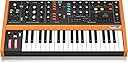
The Behringer POLY D is a robust analog synthesizer featuring 4 ultra-precise VCOs, 37 velocity-sensitive full-size keys, and classic 'D Type' circuitry. Designed for professional musicians and producers, it offers 4-voice polyphony with mono, unison, and polyphonic modes, enhanced by a 32-step sequencer and arpeggiator. Built with high-quality components like 0.1% thin film resistors and polyphenylene sulphide capacitors, it delivers authentic vintage analog tones with modern reliability.


| ASIN | B082BLNRXT |
| Best Sellers Rank | #17,354 in Musical Instruments ( See Top 100 in Musical Instruments ) #26 in Synthesizer & Workstation Keyboards |
| Body Material | Metal and Plastic |
| Brand | Behringer |
| Brand Name | Behringer |
| Color | Black |
| Connector Type | [MIXED] |
| Customer Reviews | 4.5 out of 5 stars 282 Reviews |
| Finish Type | Painted |
| Global Trade Identification Number | 04033653032049 |
| Included Components | Analog 4-Voice Polyphonic Synt |
| Item Dimensions | 31.4 x 19.6 x 6.3 inches |
| Item Type Name | Synthesizer |
| Item Weight | 26.1 pounds |
| Item dimensions L x W x H | 31.4 x 19.6 x 6.3 inches |
| Manufacturer | Music Tribe US |
| Material | Stainless Steel |
| Model Name | POLY D |
| Model Number | 000-D9J01-00010 |
| Number of Items | 1 |
| Part Number | P0D9J |
| Sound Profile | Bass-heavy, warm, rich tones with clear definition |
| Unit Count | 1 Count |
| Warranty Description | Community. Musictribe. Com/support. |
D**Y
Modern version of the Mini Moog
I have been playing synthesizers and other instruments for several decades now and I grew up in the early days of Moog, when they were the original standard for synthesizers. This is, in short, loyal to the legacy of its design, and yet updated for a more modern era. It has a great build quality, excellent sound, and... the price is more than reasonable. If you already are conversant with synthesizers, then my review is pretty simple... This is essentially a modern version of the Mini Moog and comes extremely close to replicating the sounds and behaviors of that celebrated instrument. Unlike the Moog Voyager and other Moog evolutions of the Mini Moog (Sub 37, et al), Behringer elected to stick to the legacy Mini Moog design and layout. It does have a few welcome extras in its design, namely a built in sequencer/arpeggiator, a fourth oscillator (that can also be a secondary LFO), an adjustable keyboard after pressure, and, of course, MIDI and USB connections. It works quite well, the keyboard action is very comfortable, and the knobs and switches have a very satisfying heft to their action. The paraphonic polyphony is exactly what I would expect in this type of synthesizer, although with a quite a bit more flexibility that what I had in the early 1980s with paraphonic synthesizers. I knew what the polyphony of this synthesizer was going into this and I was not disappointed. Some people really want true polyphonic Mini Moog, and I suppose that would be neat, but you would have to have some way to independently trigger and envelope each oscillator output and... well, at that point you might as well look at something else designed in that fashion like the DeepMind, because it will not be a Mini Moog anymore. In any case, I find the paraphonic Poly D quite usable and it gives some abilities to create some beautiful sound and chord structures. It is worth noting that you can configure some elements of the Poly D through an app interface on your phone or tablet. These would include things like high/low/last note priority on the keyboard, MIDI configurations, and some other items. This is very handy and is quite easy to use. Having said that, to just play this thing, all you need is a place to plug it in to the wall and either some headphones or a keyboard amp (I use an old Roland KC-60 that I have had for a long time). I have not tried using this with my DAW or other software, yet, but if its MIDI and software interfaces follow the other Behringer designs (which it does, except for poly-chaining, as I understand), it should be a pretty straightforward process. I have a couple of Neutrons and a Crave and they all seem to work well with my Apple based environment. But, having said that, I have not tried the Poly D with it yet. The sequencer is a nice feature and quite easy to use. It has a lot of flexibility in terms of what you can sequence, and yes, it can sequence in polyphony. Thus, if you record a chord to a sequence in poly mode, that chord will be part of the sequence. You can also ratchet a sequence and add swing rates, plus some basic editing of the patterns. My understanding is that you can synchronize this through MIDI, but I have not tried that yet, obviously. This is essentially the same sequencer you will find on other Behringer products (including my Crave). The filters have a good set of ranges and do their job. The adjustments are nice in that I can put just a subtle curve in a filter envelope to add just the right level of color to a tone. When you are trying to finesse the tone and its articulation for voicing purposes, the ability to make subtle and accurate changes is important, and this is where the control panel and the filter circuit design (as well as the envelope generator) work well. I have not used the distortion tool set much yet, but it seems to work. It is not something that I will likely use much in my music (I tend to focus on more discrete classical music realizations as opposed to ambient sound mixtures, thus I am looking more for patch designs that can be incorporated into a music score. Having said that, I still like to use interesting colorings and sound contours to add expression, similar to what Tomita did in the 1970s). The Poly D has both a Chorus I and Chorus II button. I love this stereo chorus feature and while it is not something I would use all of the time, it can be great one button trick to add some meat to, say an uplifting chorus of a piece (like one would do with a Hammond Leslie). One caveat, do not try to use both buttons at once. It creates a terrifically bad phase interference. The Poly D has multiple inputs and outputs for processing external sound and triggers. Some caveats - Like all analogue circuits of these types, you need to let this warm up before you tune and play. 10-15 minutes and you should be good. - My Poly D scaled pretty well after it warmed up (in other words, the octaves were all in tune with each other and reasonably well tempered). If the tempering does not settle down after it is warmed up, you can adjust and calibrate the tuning across the octaves from some back side controls (potentiometers). This is not difficult but it can be a bit tedious and you must use the right tools and not be hamfisted so as to break the internal mechanisms. Be gentle and patient here if you need to do this. - If you are wanting a system where you can cross patch between modules, this is not your system. Connections between modules are fixed along with the processing flow. You can connect and disconnect modules through switches, but not how they connect. So, for example, if you wanted to somehow connect the LFO to say, trigger the chorus, it will not happen here. - There is no sample and hold. Of course, this was not native to the original Mini Moog, but it would have been a nice addition. - Like the original Mini Moog, there are no presets or a capability to save a patch setting. This is all knobs and switches. - You can hook an external keyboard to the Poly D through its MIDI connector. However, and this may depend upon the keyboard and connection, you may not be able to control such things as the starting note of a sequencer controlled pattern from the external keyboard. You will still have to use the built in keyboard for that. Not a big deal, really, but something of which to be aware. - While you cannot poly-chain to another Behringer synthesizer, you can send a MIDI through connection for the same keyboard signal to another synthesizer (I have done this with my Neutrons). This is a good instrument, especially if you were wanting a Mini Moog and could not afford the high prices. It is not a compromise at all to get this rig. I am having a lot of fun with it and it is nice to be able to quickly dial in a patch and just play with the sounds and music very easily without thinking through the patches and patch cords.
A**S
Amazing synth (when the price is fair)
When I saw that the price dropped back to normal on the Poly D during Amazon Prime days, I had to snap one of these up fast, and I have no regrets, because now the price is way over list price. If you pay more than $500 for one of these you're paying too much, I got mine for $499 plus free shipping! If you want to get one, I strongly advise to wait until the price is normal again. The build quality on this thing is SOLID, and I'm really impressed with it. Just like the classic Mini Moog, only better with modern enhancements. If your sitting on the fence just do it, get one as soon as you see the price drop, because they sell fast.
S**T
I love it.
This is my first synthesizer and I love it. I’ve also purchased a reverb pedal (Black Hole) to accompany it and it adds a whole new dimension of sound.
D**S
Wonderful Take On The Classic Minimoog!
The Poly D is a verry well done recreation of the classic Minimoog. I have one of the original Moog model D synths. I love it and would not get rid of it. However, It's rather heavy and hard to integrate into a modern keyboard set up. You will not have that problem with this inspired recreation. The sound quality is very tru to the original as well as the layout with just the right amount of modern features. The cost/value aspect of this synth is just amazing. I have become a Behringer convert.
C**D
Pro Review - Behringer Poly D
Hello: I'm a semi-pro keyboard player with 45 years experience and my first keyboard was a Yamaha CP30 in 1976. I pretty much have every keyboard I've ever owned and the keyboard farm exceeds 45 keyboards currently. I received the Poly D in a timely manner and when I set it up in the studio, the first issue was a broken knob on Oscillator 1 Range. The inside of the knob had a broken piece of plastic that secures the knob on the flat portion of the rotary switch, so it would only turn the switch in one direction. Turning the other direction, the knob would just spin. I continued on with power up and started creating some patches to see how she sounds and after playing for a while, I noticed the B2 key would sometimes not fully return, but it was intermittent on the full return (see photo). At this point, I opened up a support ticket with Behringer and they replied back the next day and advised I send this back to Amazon for a replacement, which I did and a new one is now on the way as of today. So, here's my first impressions: 1. There appears to be a quality control issue with Behringer, but I have several other Behringer pieces and all have worked well with very good build quality. I don't see how this broken knob was not caught in QC or inspection. The sticky key is most likely a function of the crappy keybed. Yeah, I'm gonna harp on that keybed more... 2. The keybed is pretty bad, even if this B2 key was not sticking. It's cheap, mushy and really sensitive. It feels like you could breath on a key and it would trigger. I'd pay more for a decent Fatar keybed, like $100's more because of the next point. 3. The synth itself sounds amazing. I've owned a Minimoog and I currently own a Moog One. The Poly D is dead on to the Minimoog. If I still had my old Minimoog, I'd run a comparison, but I've been around Moog gear long enough to know what sounds Moogish and what sounds like a digital recreation (and if I still had my Minimoog, I wouldn't be writing this review!). 4. This thing could easily blow out your studio monitors, so be careful. It puts out some serious voltage. 5. You can't beat this thing for the money, it's about as accurate a re-issue of the classic Minimoog I've ever heard and I have two Behringer Model D's, but this thing is different IMHO. With used Minimoog's going for $6000 or more, this is a no brainer. There's only two keyboards out there that I'd second mortgage the farm for and a Minimoog is not one of them (one starts with Jupiter and the other starts with CS). 6. I'd buy this again w/out hesitation because it just sounds so good. If you're considering one, go for it. I only deducted one star for the crappy keybed. The defects will be fixed by a replacement (fingers crossed). I hope this helps somebody decide to buy this thing because it's really worth it. The sound is Sonic Integrity. Rock on, party on Wayne.
D**C
Worth triple the price!!
This thing is so cool. I cannot believe I have this for the price I paid. It does the mini moog thing perfectly for me. I don’t care about what it can’t do. The sounds are just killer. I’m not a tweaker by nature but I will be here. No presets or saves just like back in the day. For sure an old school vibe. I was recording with it within minutes of taking out of the box. I had the sound from the end of Lucky Man by ELP so nailed I cried. What an inspiration to have. Cannot recommend enough. I could give crap about poly or para, or other workstation features, this thing nails the mini moog sound I grew up with, along with a fourth oscillator which is ridiculous.
H**N
I love this synth!
I got this synth for my granddaughter, and it's really amazing. Great price and really great quality as well. Sturdy design, solid buttons and dials, and it has a bunch of features. I'm a bit jealous and might buy one for myself at some point.
A**Y
Great for 4 months. Key died, will not honor warranty.
Hey I really enjoyed playing this synth. I thought that I got a good deal when they dropped the price by 25%. However after 4.5 months of very light use, no gigging, the synth basically staying in my music room a key decided to quit working. One of the G keys no longer functions...seems crucial to have all of the KEYS working on a KEYBOARD. After spending hours trying to track down who the responsible party is for the warranty Music Tribe (Behringer's parent company) said that the seller is responsible. Amazon says that the manufacturer is responsible and now I'm stuck in a circle of major corporations shifting responsibility. The warranty claims to have up to 3 years limited manufacturer's warranty, but good luck speaking with customer service. You'll get an email, but not a call and you'll be directed into circles. Unless this BRAND NEW synth gets fixed I will never spend money on Music Tribe or Behringer. I will 100% disway any of my music friends and many piano students from every purchasing this subpar product from a company that does not live up to its word. I hope this helps someone make a decision to not buy from Behringer. If this ever does get fixed I would certainly enjoy using the synth and change this review, but in no way is this acceptable to have a new $600 instrument lose components and not be covered by warranty.
M**R
Cool Instrument!
Well, the original was a legend. Now I can have it with analog sound AND digital MIDI interface. Just LOVE it!
M**P
Funciona perfectamente!
A**Z
Excelente sintetizador!
Exelente sintetizador! Llegó en buenas condiciones y a tiempo sin decir que está a un super precio el mejor del mercado la compra muy segura y recomendada, el Poly D es perfecto para empezar a comprender la síntesis analogica, tiene un sonido súper gordo,el arpegiador y secuenciador son realmente buenos, el único detalle es su teclado muy sencillo para un gran sintetizador pero de ahí en fuera todo super bien.
C**N
Fantastique instrument
Extraordinaire synthé. Ça envoit "Le" gros son, bien gras, bien épais et riche. Instrument tout simplement génial. Ce suffit à lui même pour faire de la superbe musique, vraiment incroyable. Aucun rapport avec un synthé digital. Ici, c'est presque irganique. Après déjà quelques mois d'utilisation, je découvre de nouvelles possibilités et combinaisons. Et le prix est bien en-dessous de la richesse de cet outil de sons, incroyable. Le chorus de la machine est excellent. Connecté via un Line 6 Hx stomp pour les FX, reverbe, delay, etc synchro en midi.
M**H
Sounds fantastic
I bought this as I wanted a fairly simple synth with large, quick access controls. I had been considering a (Behringer) model D for a while, but liked the idea of being able to use the oscillators individually (paraphonicly) - something I really missed being able to do with the SE-02. So far it has lived up to its hype. Sounds really good (I presume the addition of polyphony hasn't harmed the model D sound!). Yes, its not truly polyphonic (only single filter/adsr etc) unlike the Deepmind with its individual voices, but if you think of it as a monosynth-plus - all the richness with added the added benefit of being able to do simple pads and chords. The simplicity of the layout and huge controls makes this a great learning/starter tool for a beginner in subtractive syntheses (like me!), with absolutely no menu diving or hidden settings. There is a limit to the sounds you can produce, but with the options of using both the LFO and the 4th Oscillator as a modulation source you can still have alot of fun). The chorus modes also adds to the overall final sounds. If you are truly after a polyphonic synth then this might not be the right choice, but for anyone wanting the 'mini moog' sound without the technical issues associated with owning a 45yr old synthesiser or the huge costs of the later Model D, the Poly D has so much to offer. In my opinion there isn't any other analogue keyboard that (in this price range) that can do the same. If Behringer has just stuck their model D onto a keyboard it would have not had the same success and at only 35% more than the original price of their Model D, if you have the space, the Poly D is a great buy. Cons:? I have not had it long enough yet to find any big issues. I am not a massive fan of Behringer's Sequencers and this is the same sequencer that is on the MS1, Crave and ODESSEY. It works, but I don't find it that intuitive and its a shame it is limited by its 32 steps. However, if you own more than one of the Behringer range at least you only need to learn its functions once :)
Trustpilot
1 month ago
2 weeks ago