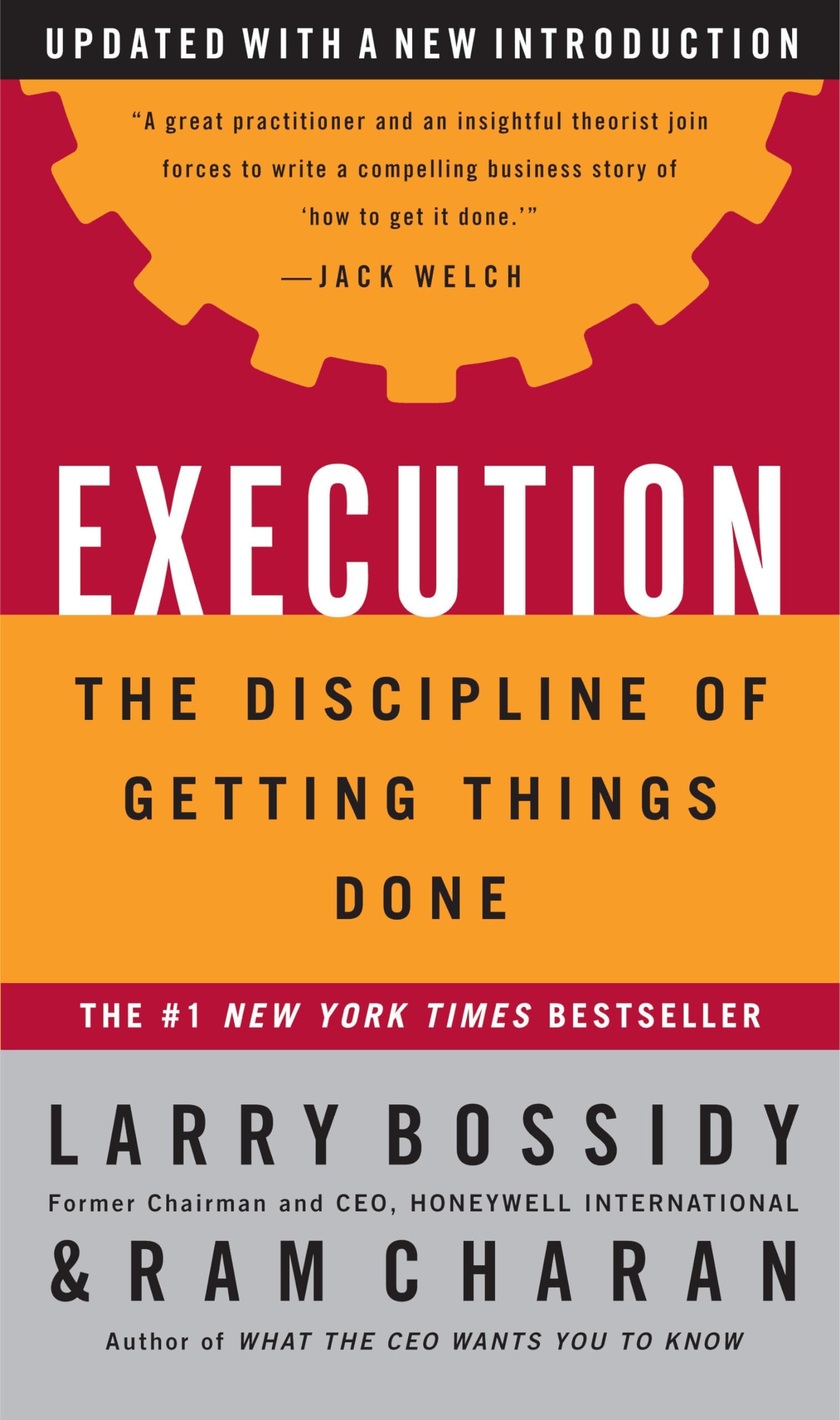
Execution: The Discipline of Getting Things Done
Product ID: 1704854
🏆Top #3 in Business Operations Research
📈2M+ copies sold - proven impact
📚Hardcover - durable, premium edition
Desertcart purchases this item on your behalf and handles shipping, customs, and support to Indonesia.
🚀 Get it done or get left behind: The ultimate playbook for leaders who execute.
Execution: The Discipline of Getting Things Done is a #1 New York Times bestseller with over two million copies sold, authored by business titans Larry Bossidy and Ram Charan. This hardcover edition delivers a hard-hitting, practical guide to mastering execution—the critical skill that turns strategy into results. Packed with real-world case studies, leadership principles, and actionable frameworks, it’s essential reading for managers and executives aiming to thrive in today’s fast-changing, competitive business landscape.


| Best Sellers Rank | #32,257 in Books ( See Top 100 in Books ) #3 in Business Operations Research (Books) #39 in Workplace Culture (Books) #102 in Systems & Planning |
| Customer Reviews | 4.4 out of 5 stars 1,669 Reviews |
R**T
An Important book that captures the basis for corporate successes - EXECUTION
The key point in the whole book is the first word of the title - EXECUTION. There is without question in business in this country, and to a far greater extent overseas, a failure to execute. Businesses, like people have wonderful thoughts, ideas, notions, desires, goals, objectives, and needs. Try finding the company, entity, institution that bottom line, successfully gets things done. It comes back to EXECUTION. The authors are as professional as you can get. Larry Bossidy is a product of the General Electric system of management. He is the man credited with building the division now known as GE Capital into what it is today. GE Capital is one of the most profitable divisions of any corporation in the world, and the envy of every financial institution including Wall Street. Bossidy was one of three men in the running to become Chairman of General Electric. He lost to Jack Welch. It is traditional that when you are passed over as Chairman of GE, you take your time, but you leave. Bossidy left to run Allied Signal, which then was absorbed into Honeywell. It was during that corporate transformation that Bossidy became associated with the techniques that you are reading in his book, "Execution-The Discipline of Getting Things Done". His co-author is Ram Charan, who has taught at both Harvard Business, and the Kellogg School of Northwestern University. Charan has functioned as an international business consultant specializing in management. Without being mentioned, it is obvious that at some point Charan consulted for Bossidy somewhere along the way, and this is how the partnership was formed. Why You Must Read this Book? You read every word in a book like "Execution", because you are getting it from the horse's mouth. Even if other people can say it better, Bossidy is the guy who made the big bucks doing it. Who wouldn't want to read a book on playing golf under pressure by Tiger Woods, or how you should prepare for a big basketball game the day of the game by Michael Jordan. Bossidy is the real deal. He has run a major corporation, and posted major results, for a long period of time. All the major players are in agreement; that this is the man you go to when you want to talk about management. Now having said that, does the book ramble, yes, could it be shorter, yes, could it better written, the answer is of course. It still doesn't make any difference. You have to read Bossidy, because even Jack Welch at GE read this book. Here's what you will learn very quickly 1) Execution isn't everything - it's the ONLY THING You'll remember that Vince Lombardi, the Green Bay Packer's coach use to say that winning isn't everything; it's the only thing. The same thing can be said about EXECUTION. The only purpose bottom line for a business to be in business is to execute the goals, and objectives of the corporation. 2) The difference between Dreams, and Results is how you EXECUTED Businesses started with goals and objectives, and then you have to get to reality. Everything in between is how you execute, and the authors make clear at every opportunity those instances where corporations did well (General Electric, Dell, EDS), and those times when corporations failed (Xerox, Lucent, Kodak, Motorola, AT&T). The examples given are thorough, and make sense. You know all these corporations. 3) The importance of the talent you field Bossidy is so right on this one. He says that he spent 40% of his time picking the players. In the end, how much can a CEO personally do, or deliver? It's true that a CEO can fairly easily blow up a corporate structure in a year or two. The two authors say the same CEO picking the right talent can deliver enviable results. They must be held to high accountable standards. You use the feedback to power the results. 4) Constant involvement with that talent Bossidy is not a guy that leaves things to human resources. Bossidy talks about the importance of the lunch or dinner with his management team members, how he was constantly sizing them up. Could they deliver, would they execute. He is the only CEO I have ever heard of who personally would check referrals on those he hired. That kernel of information tells you everything. One could almost argue that if you put the right players into place, your job is 90% done, providing the system works. I would like to take a moment to tell you how you work with a book like this. You need to write in the margins, you must underline, and you must question, and annotate the entire book. If you are someone that finds himself commuting either to work, or spending significant time in a car, than the audio version is excellent as well because it is in the author's voices. Recognize that this is a book you will read, or listen to many times. There are multiple layers of messages here, and you will not capture them all with the first run through of either the book, or the audio. Bossidy is acknowledged to be one of the most successful businessmen of his era, take advantage of it, and pull everything you can out of his book. Good luck. Richard Stoyeck
N**S
This book is a winner and I recommend it.
My Opinion There is plenty of actionable material and lots of ideas to share with the officers of your company (a dynamic HR department, developing a company budget in three days). I don't care for the style and format that the book was written in. It jumps from straight forward discussions to side commentaries by Larry & Ram. The Big Idea Leadership without the discipline of execution is incomplete and ineffective, plans remain only plans. Organizations of Execution have three things; 1) a strong business Leader, 2) execution must be the core element of an organizations culture, 3) discipline integral to strategy. Business Leader Only the leader can set the tone for an organization. The Leader must be in charge of getting things done by running three core processes; picking other leaders, setting strategic direction and conduction operations. Seven essential behaviors of a leader: 1. Leaders must `live' their business. They have to know more than just the basics because they have to ask the tough questions. 2. Insist on realism. You keep a realistic view of the company by constantly asking questions. 3. Set clear goals and priorities. Focusing on three or four priorities will produce the best results from the resources at hand, K.I.S.S. 4. Follow through. Failure to follow through is the major cause of poor execution. 5. Reward the doers. You have to make clear that rewards and respect are based on execution. 6. Expand People's Capabilities. Coaching is the single most important part of expanding an organization's capabilities. The most effective way to coach is to observe and provide useful feedback. Feedback is both what is being done right and what needs to be changed. 7. Know Yourself. It takes emotional fortitude to be open to people and information. It takes fortitude to deal with those who are not performing. It comes from self-discovery and self mastery. a. Authenticity. Be real. What you see is what you get. b. Self Awareness. Self discipline and self awareness. c. Humility. Learn how to listen. Admit that you don't know everything. Admit mistakes. Culture of Execution An organization's culture is a sum of it's shared values, beliefs, and norms of behaviors. The inability to act decisively is rooted in the corporate culture. The leaders create this culture and they are the only ones that can change it. Cultural change gets real when your aim is execution. Most efforts at cultural change fail because they are not linked to improving the business's outcomes. The foundation of changing behavior is linking rewards to performance and making the linkages transparent. You want differentiation among options, bonuses, and salary increases. The people process is more important than strategy or operations. A good people process evaluates, develops and plans for succession. It requires integrity, honesty, a common approach, common language, frequency and above all candid dialog. The People Process: 1. Companies need to plan out near term, medium term, and long term strategies. a. Hire and train people to meet these strategies. 2. The Leadership Pipeline a. Having succession depth prevents employees from stagnating and prevents people from moving up too quickly. b. Talent reviews - Everyone is reviewed against their current job and potential future jobs. i. Four Basic Competencies to measure are: Functional skills, Business Skills, Management Skills, and Leadership skills. ii. They will fall in one of three categories: Good Fit, A Stretch, or Action Required. c. Managers should also do a retention assessment based on compensation, current role, potential role, effectiveness and risk of loss to the company. 3. Non-performers must be addressed; coached, moved or terminated. Four Elements of a robust People Process 1. A culture of high performance, which makes you demand the best from individuals. 2. A leader who is not only willing but also ready to question a person's assessment. 3. A collegial culture among the top executives of the enterprise, where they hold each other mutually accountable. 4. The Human Resource department that is integrated into the business process. Discipline Integral to Strategy At the Heart of Execution; the people process, the strategy process and the operations process. A strategic plan must be an action plan that business leaders can rely on to reach their business objectives. The substance of any strategy is the key concepts and actions that define it. A business unit strategy defines the direction of the unit. Where it is, where it wants to be, and how it will get there. To be effective a strategy must be constructed by those who are going to execute it. Decide on your objectives: what do you want to get done? What are critical issues to understand? Why in the end is this helpful? A Strong Strategic Plan must address the following questions: 1. What is the assessment of the external environment? 2. How well do we understand existing markets or events? 3. What is the best way to grow the business profitability, and what are the obstacles to growth? 4. Who is your competition? 5. Can the business execute the strategy? 6. What are the important milestones for executing the plan? 7. Are the short term needs balanced against the long term payback? 8. What are the critical issues facing the business? 9. What will the business make money on a sustainable basis? After the Long Term Strategy has been agreed upon, the Operating Plan is created. The Operating Plan breaks down long term output into short term goals. It puts the reality behind the numbers by answering the "hows". Operating Plans are those programs that your company will complete within the year. The leader is primarily responsible for overseeing the seamless transition from strategy to operations. 1. The Operating Plan is a three part process o Setting Targets o Developing an action plan o Get agreement and closure from all participants. 2. Tradeoffs will have to be made between the companies projects; money & A-Players. The out come of the plan must be clear and specific. The plan should be reviewed quarterly to make sure it is still on track. 3. The four flaws of a typical operating plan o Doesn't provide dialog on the assumptions o Built around results that upper management wants and doesn't specify actions to make these results reality o Doesn't provide coaching opportunities for people to learn the totality of the business. o Plan is very rigid and doesn't allow for new opportunities or forces people to `trick' the system to make goal. Quotables and Cool Stories Repeated Failure drains the energy from an organization. The execution is the process of discussing, questioning, following through and ensuring accountability. The hands-off leader is not confronting poor performance, searching for problems to solve and then solving them. They are presiding and only doing half the job. You do not fix a problem by focusing on it's outcome. If you are really executing and you are listening to tomorrow's customers as well as today's and planning for their needs. Typically said of a new management initiative; "This too will pass". Goals don't mean much if no one takes them seriously. A manager who is emotionally weak will avoid hiring people who are smarter than they are. To them, loyalty is most important. Failure to deal with underperformers is an extremely common problem, it is usually the result of a managers blockages. We don't think of ourselves into a new way of acting. We act ourselves in to a new way of thinking. You get what you measure. The harmony - sought by many leaders who wish to offend no one - can be the enemy of truth. Leaders get the employee behavior that they exhibit and they tolerate. "I want bigger margins than anyone else, and to accomplish this we have to have great people and train them better and faster than anyone else. We need educational programs that are focused on key business issues and problems, the things that matter". In general the DNA of the people who can execute the model is fundamentally different from the DNA of the people who run a model. If a strategy does not address the "hows", it is a candidate for failure. Sometimes leaders strategize themselves into the wrong business.
R**E
Valuable information for all companies, all levels
EXECUTION appears to be targeted at the most senior leaders at the largest corporations when in fact much of it is applicable to workers and managers at all levels and in organizations of all sizes. Granted, some of the specifics address issues faced with those at the top of large organizations such as keeping updated on hundreds of vice presidents. For the owner/manager of a smaller business, someone in middle management or someone who just wants to do a great job in their organization, there's a wealth of information. Job seekers can use a lot of the information, somewhat in reverse, to both showcase their capabilities and to evaluate the effectiveness of the organization that's seeking to hire them. There are numerous examples of real-world challenges and how they were met - sometimes successfully, sometimes unsuccessfully. This information isn't everything one needs to be a successful manager, but it certainly addresses the issues of getting things done from personnel selection, coaching, evaluation and either promoting, moving or removing people. The "Letter To A New Leader" which concludes the book is not a synopsis, but does touch on many of the key points.
A**O
Simple Wisdom But Profound
The book that Messrs. Bossidy and Charan have co-authored is a unique blend of practical advice and real business experiences drawn from several industries. It is especially powerful because it is superbly structured, easy to read, and free of jargon. There are many important messages in the book, almost one on every page. The key message is that corporate management has three principal goals: picking other leaders, setting strategic direction, and conducting operations. I believe that companies and organizations can use many of the ideas in this book to re-shape their thinking and to help change their corporate cultures and processes. In my years in corporate management, I came to recognize that the most important leadership challenge is that of identifying, developing, and selecting the future leadership team for a company. Picking great leaders can be a real challenge for any company and for any leader. I encourage all leaders to read this important book and to use it as a catalyst for change. There is much to be learned from this book and much to be reflected upon. Simple but profound.
S**S
Just do it!
For the Christmas Holidays, as we were packing the ski stuff from the basement before we left to VT, I chanced upon some books lying there, and noticed the one titled 'Execution,' by Larry Bossidy and Ram Charan which I had bought almost 8 years ago but never got around to reading it. On a whim, I decided to take it with me and ended up reading it through these holidays. A quick caveat to put aside. I do wish folks would not use company names as examples in books. The original one of these, "In Search of Excellence" by Tom Peters did that. So did Jim Collins in "Good to Great". And this book does it too. What happens is that the authors use some company as an example to cite either a good or a bad practice. And a decade has passed and things have changed (perhaps 180 degrees). And that induces a chuckle in addition to both dating the book and casting doubt on the claim. However, at least for this book, 'Execution', the above is only a caveat, since I found the book quite meaningful. The reason I perhaps did not read it when I first bought it many years ago is that it felt genuinely elementary. I was at the peak of my strategy work and when you are working on projects that are either reshaping a company or positioning oneself in new markets, the discipline of execution seems not only boring, but downright waste of time (not the importance of it mind you, but rather spending time thinking or reading about it). However, now that I have moved on from the strategy function myself and am in a line management role with accountability for business results and accountability for a team and partner-relationships to deliver those results, I view this book in an entirely new light! To share a personal reaction as I read this book ( a feeling I have not had since when I sat for my twelfth grade board examination!) - when I thought about implementing the ideas that Larry and Ram were talking about in their book on Tuesday morning Jan 2nd when I return to work, my stomach tightens into a knot! The level of sustained focus, discipline, follow through, attention to detail they expect in execution is non-trivial to say the least. Again, conceptually easy to grasp; but quite daunting if one thinks about putting them into real practice on a sustained basis throughout an organization! Very briefly, they touch upon the strategic, people and operational processes as three core processes that are building blocks for execution and show how the three are related to each other. And through their experience and examples demonstrate how to implement each of these effectively. One particular insight that I liked that Larry made in particular was, 'just because an executive is good in her current job, does not mean she is ready or capable for the next'. Which is similar to what our Chairman says, "do the job you have been assigned, not your previous one." Of course with a background in engineering (and manufacturing to boot), this whole notion of execution and organizing to execute is not alien to me at all. And in reality, my immersion for a long time in strategic work was what I needed to be more lithe in my thinking. However executing by one self or with a small team in a localized way on a specific deterministic engineering problem is one challenge. But to do the same with large revenues and large teams at stake and working through your teams through other teams with high week-to-week dependence on market conditions is another challenge. This timely book was very worthwhile spending time with. Dated examples notwithstanding, one of the more immediately useful and relevant books in the business genre that I have read in a long time.
M**R
Bossidy Made Me a Lot of Money. More than I ever imagined
For an entIre year, back in 2002, my partner and I implemented the principles in this book and became the number 1 producers at the flagship international office of UBS. We did so well that the branch manager approached us and asked us how we did it. I told Alberto: Dude, your diploma from Wharton is worthless unless you read this. Are you sure? He asked. I answered, I'm 100%. I bought him the book at the local B&N the next day. He read it. Six months later we went from being #5 to #1 for two years in a row until I left to set up my hedge fund. If you're serious about improving your process and optimizing your P&L, don't even think twice. Buy it. Trust me.
J**S
Critical Analysis
Authors Lawrence A. ("Larry") Bossidy (born March 5, 1935) is a businessman and author. He is a retired CEO of AlliedSignal (later Honeywell), and spent over 30 years rising into executive power at General Electric. Ram Charan earned a degree in engineering from Banaras Hindu University and later studied at Harvard Business School: MBA (1965) and doctorate (1967). Be taught at the Harvard Business School, Kellogg School of Management, and Boston University then became a full-time consultant in 1978. CHAPTER 2. THE EXECUTION DIFFERENCE The three examples presented in this chapter are Xerox, Lucent and Exceed. Xerox Xerox hired Thoman as COO in 1997 ad elevated him to CEO in April 1999. In May of 2000 he was told by Chirman Paul Allaire that he was out of a job. Lucent Richard McGinn succeeded Schacht as CEO of Lucent in 1997. Lucent rose from a price of $7.56/share to a high of $84. On January 6, 2000, Lucent made the first of a string of announcements that it had missed its quarterly estimates, and when it was later revealed that it had used dubious accounting and sales practices to generate some of its earlier quarterly numbers, Lucent fell from grace. By October 2002, when its stock price bottomed at 55 cents per share, Henry Schacht had been brought back on an interim basis to replace McGinn. "In November, 2000, Lucent raised questions about its revenue recognition, and a month later revised its fiscal fourth-quarter results down by $679 million. The SEC took no action at the time. Channel stuffing occurs when a company encourages its distributors into taking on excessive inventory, goods for which the distributor is not obliged to pay if they don't sell." [...] EDS The author of this book praises Dick Brown at EDS. However, when the earnings and stock price fell drastically, Brown was asked to leave EDS in 2003, the year following the publication of the book. "In the first quarter of 2002, EDS failed to disclose the cost of certain derivatives contracts. In the second quarter of 2002, EDS failed to disclose adequately the cost of those contracts. In the third quarter of 2002, EDS selectively disclosed to certain analysts the cost and early settlement of the outstanding derivatives contracts. In addition, EDS failed to disclose adequately an extraordinary transaction with a major customer that increased its reported cash flow by $200 million in the second quarter of 2002." [...] Looking at all three of these examples shows that companies normally shortfall in the second building block relating to the company's framework, and the second core process of strategy. This makes it difficult to effectively execute the third building block of hiring the right people and the third core process of operations. At the end of chapter two, Mr. Bossidy states that " The discipline of execution is based on a set of building blocks that every leader must use to design, install and operate effectively the three core processes rigorously and consistently." The key word in that statement is "consistently." That consistency needs to be implemented throughout time and the organizational structure, or individuals in the company's core processes will almost inevitably skew the company's operations. Overview: PART II AND III There are three building blocks and three core process which correspond with one another. "Leaders 7 essential behaviors" in chapter 3 correlates with ''The People Process" In chapter 6. "Creating the framework for cultural change" in chapter 4 correlates with ''The Strategy Process" In chapters 7 and 8. 'Having the right people in the right place" in chapter 5 correlates with ''The Operations Process" in chapter 9. CHAPTER 3. BUILDING BLOCK ONE: 7 Essential Behaviors The leader's seven essential behaviors, outlined in this chapter are: 1. Know your people and your business. 2. Insist of realism. 3. Set clear goals and priorities. 4. Follow through. 5. Reward the doers. 6. Expand people's capabilities. 7. Know yourself. Larry and Ram both provide examples of their own experience relating to these behaviors. CHAPTER 4. BUILDING BLOCK TWO: Framework for Organizational Change This chapter directs on how to operationalize culture by focusing on beliefs and behaviors, which then translate into actions. Strong achievements and desireable behaviors should be rewarded and a robust dialogue should be open, tough, focused and informal. The points covered are: 1. Operationalize culture 2. Link Rewards to Performance 3. Robust Dialogue The end of this chapter states that leaders get the behaviors they exhibit and tolerate. CHAPTER 5. BUILDING BLOCK THREE: Having the Right People in the Right Place The methods outline in this chapter to employ the right people are outline in this chapter are: 1. Energize people 2. Get the right people in the right jobs. 3. Focus on short term accomplishments. 4. Be decisive. 5. Deal with people promoted who don't perform. 6. Outsource. 7. Follow through. The unvarnished truth: were commitments met? PART III: THE THREE CORE PROCESSES OF EXECUTION The three core processes covered in part III are: 1. The People Process: Ch. 6 2. The Strategy Process: Ch. 7 and 8 3. The Operations Process: Ch. 9 CHAPTER 7. THE STRATEGY PROCESS: Making the Link with People and Operations This chapter covers all the questions which need to be answered when building a strategic plan: 1. What is the assessment of the external environment? 2. How well to do understand existing customers and markets? 3. What is the best way to grow th business profitably, and what are the obstacles to growth? 4. Who is the competition? 5. Can the business execute the strategy? 6. What are the important milestones for executing the plan? 7. Are the short and long term balanced? 8. What are the critical issues facing the business? 9. How will the business make money on a sustainable basis? CHAPTER 8. HOW TO CONDUCT A STRATEGY REVIEW The questions which should be raised when conducting a strategy review include: 1. How well versed is each business unit team about the competition? 2. Are the linkages with people and operations clear? 3. How strong is the organizational capability to execute the strategy? 4. Are we choosing the right ideas? 5. Is the plan scattered or sharply focused? CHAPTER 9. THE OPERATIONS PROCESS: Making the Link with Strategy and People This chapter covers how to build a budget in three days: 1. The importance of synchronization and realistic goals with sound assumption. 2. Building the operating plan: the art of making trade-offs and outcomes of the operations process 3. After the meeting: follow through and contingencies including contingency plans and quarterly reviews. (The chapter contains a sample memo outlining details of such a review.) The chapter ends with goals to live by. CONCLUSION: LETTER TO A NEW LEADER This chapter contains a cookie cutter letter which can be beneficial to any reader who has taken on a position of leadership. The letter is outlined as follows: 1. Congratulations 2. Skills required 3. Three core processes: a. Organization i. People under you direction: compare with competition. ii. Are the people under you like minded people? iii. Stewardship b. Strategy: i. Understand customers ii. Look for improvements. iii. Inellectual honesty c. Operations: i. Feedback and coaching. ii. Confident who can be candid. iii. Take care of yourself. iv. Inellectual honesty I found this to be a very effective summary of the points covered throughout the book. I found the concepts and processes described in the book to be very beneficial and effective, when continuously implemented and updated to suit a changing environment. As is often the case, one in a position of power may lose sight of the organization and operations which led to their success, and thereby let the organization lose its strengths. If the concepts are applied to one's activities on a daily and continual basis, I believe the effect can be positive to all involved.
D**R
Strategy, Execution & Results
In this book Larry Bossidy & Ram Charan do a brilliant job of giving the reader the HOW TO of execution. The biggest reason companies fall short is because they cannot keep their promise. This book looks at the reasons why companies fall apart, the process of execution and HOW to execute. Companies must realize it is not about bigger issues. Strategy must be carefully planned and form part of a system-it is called discipline. As the heading of the book indicates - "get things done right the first time." Larry & Ram also discusses The Seven Essential Behaviors of a Leader. As an entrepreneur, investor and sales growth specialist, execution is close to my heart. Without Execution, all the brilliant leadership talk is just that, talk. All the strategy work is just that. One of the biggest difficulties that I see that companies have is "knowing" how to execute. It is a must read for all leaders. This book is part of my "Dantotsu" collection (Best of the Best.) Danita Bye Sales Growth Specialists
U**Y
Strategy, people,processes
Excellent book
9**9
What is written in the book is plausible
Those who lead need to know what should come with the territory, which is execution. The book talks about how to execute with ample examples. Nothing fancy. What is written is not something you have never heard of. However, the authors put their thinking in writing so that their tips sound like something that can be executed.
M**L
Buon libro
Non si tratta del solito "manuale" del manager, ma di una lucida analisi sui GAP che separano l'esecuzione dei progetti dalle parole.
J**A
A must book to have for Business Leaders
I was recommended this book by a friend and How I love this book. I run two companies and was going away from execution and paying the price for it. This book actually helped me to go back to my roots and get more involved in the business.
A**N
A must have book
I saw this book in a LEAN conference training and among a large amount of business books related to business management , this one oriented CEO approach is one of the best books i read in my life. It's a life-changing book that will surely help you reach high management jobs.
Trustpilot
3 weeks ago
1 week ago