We remain fully operational. Our teams are working around the clock to ensure your deliveries continue safely.

DOWNLOAD THE APP


Customer Services
Copyright © 2025 Desertcart Holdings Limited
DOWNLOAD THE APP
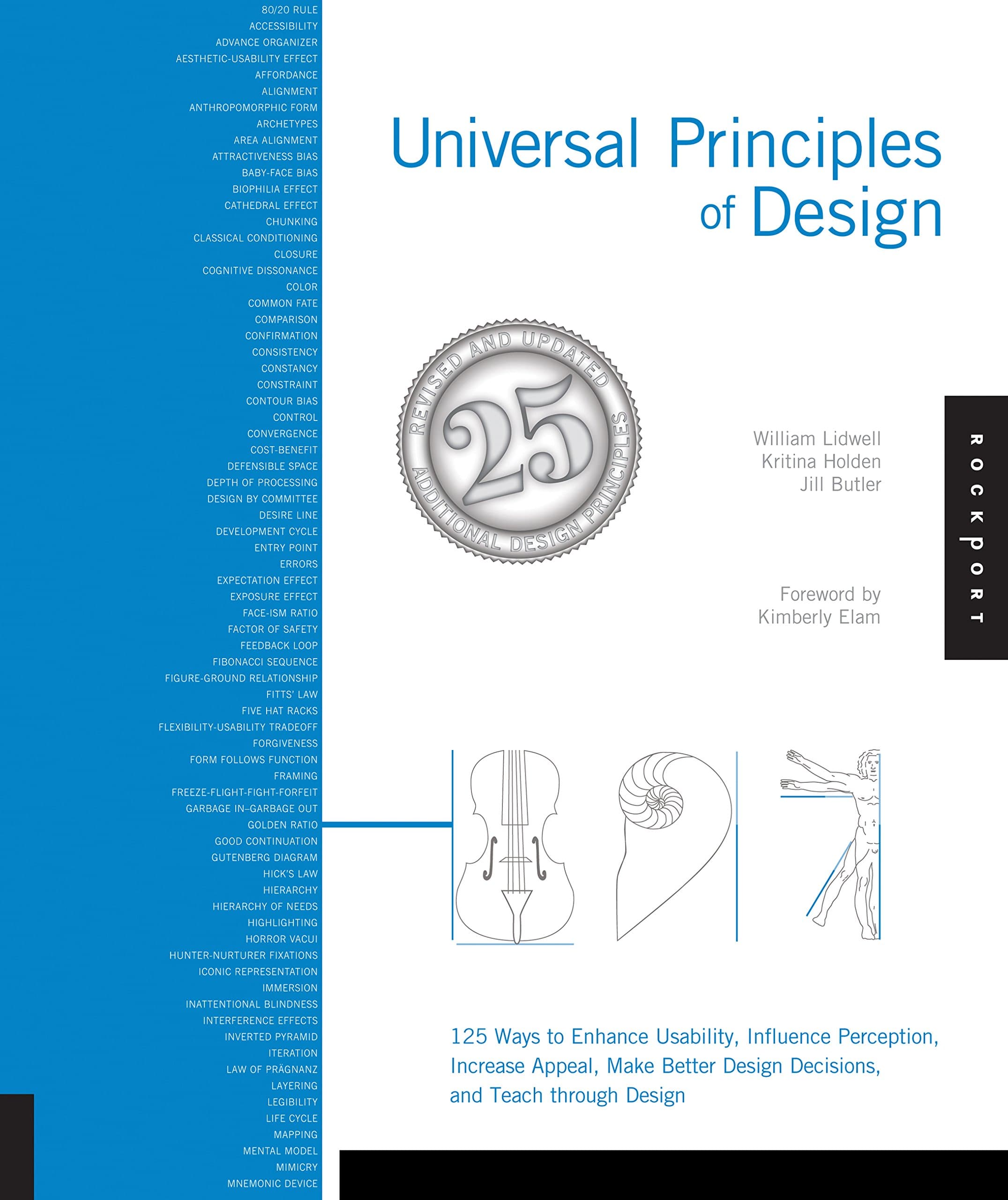
desertcart.com: Universal Principles of Design, Revised and Updated: 125 Ways to Enhance Usability, Influence Perception, Increase Appeal, Make Better Design Decisions, and Teach through Design: 8601200649536: Lidwell, William, Holden, Kritina, Butler, Jill: Books Review: Good high level discussion of Design Principles. - Review is for both the Kindle and hardcover versions of this book. An easy to use, high level reference of various design principles. A good reference for students, designers, user interface experts or anyone involved in creating, maintaining or managing a product. The language is concise, the principles are presented in an easy to understand manner. Each principle is summed up at the highest level in the subtitle with a more detailed description in the body. A list of related principles is included and in some instances visual aids. Footnotes are at the bottom of each section. The hardcover is an attractive book with the blue spine being a glossy finish and the white part being matt. The paper is a medium weight with a nice feel and a matt finish. The Kindle version faithfully follows the book but has the added benefit that e-books have such as search, contents viewable alongside page views, bookmarks, highlights, links, notes etc. which of course makes it much more effective as a reference. I generally use the Kindle version more often on my laptop where the reader is in color and there is greater viewing space for graphics. When reading it on the Kindle Paperwhite the experience is still enjoyable but not to the same level. Pros: - Covers a wide range of design principles - Information is presented in an effective way - Text is concise and clearly written - Related principles are presented for further study - Graphics are informative and directly demonstrate the principle - Hardcover is attractive and has a nice feel to it Cons: - For the hardcover there could be a quicker way to look up principles. The contents do a good job however something like tabs might help for quicker reference without having to return to the contents page - For the Kindle version, the graphics and illustrations often fall well below the text and so lose some of the effectiveness they have in the hardcover edition where they are easily viewed alongside the text. Review: Straightforward primer - A real gem. This book has a very useful structure, almost like an encyclopedia - it takes you to major principles of design in few words per principle, explains them, gives examples, and cites some basic references. I think almost anyone will find something they did not know in there, or something that did at least make them think. This is not a textbook, nor a true professional encyclopedia, but a high level exposition of stuff that works. For what it's worth it obviously takes cues from Christopher Alexander's "A pattern language", by the goal and by the way it is organized. It is less coherent within the realm of design than "A pattern language" is within the realm of architecture - it does not completely form a body of ideas consistent within themselves. But this is simply because the principles covered are of various types and apply across disciplines (say, psychological, physical, etc...). I saw this book in a coffee shop (of all places) and had to buy one for myself almost right away.




| Best Sellers Rank | #334,438 in Books ( See Top 100 in Books ) #461 in Graphic Design Techniques #1,008 in Commercial Graphic Design (Books) #1,193 in Design & Decorative Arts |
| Customer Reviews | 4.6 4.6 out of 5 stars (1,091) |
| Dimensions | 8.8 x 0.5 x 10.25 inches |
| Edition | Updated |
| ISBN-10 | 1592535879 |
| ISBN-13 | 978-1592535873 |
| Item Weight | 2.06 pounds |
| Language | English |
| Print length | 272 pages |
| Publication date | January 1, 2010 |
| Publisher | Rockport Publishers |
A**T
Good high level discussion of Design Principles.
Review is for both the Kindle and hardcover versions of this book. An easy to use, high level reference of various design principles. A good reference for students, designers, user interface experts or anyone involved in creating, maintaining or managing a product. The language is concise, the principles are presented in an easy to understand manner. Each principle is summed up at the highest level in the subtitle with a more detailed description in the body. A list of related principles is included and in some instances visual aids. Footnotes are at the bottom of each section. The hardcover is an attractive book with the blue spine being a glossy finish and the white part being matt. The paper is a medium weight with a nice feel and a matt finish. The Kindle version faithfully follows the book but has the added benefit that e-books have such as search, contents viewable alongside page views, bookmarks, highlights, links, notes etc. which of course makes it much more effective as a reference. I generally use the Kindle version more often on my laptop where the reader is in color and there is greater viewing space for graphics. When reading it on the Kindle Paperwhite the experience is still enjoyable but not to the same level. Pros: - Covers a wide range of design principles - Information is presented in an effective way - Text is concise and clearly written - Related principles are presented for further study - Graphics are informative and directly demonstrate the principle - Hardcover is attractive and has a nice feel to it Cons: - For the hardcover there could be a quicker way to look up principles. The contents do a good job however something like tabs might help for quicker reference without having to return to the contents page - For the Kindle version, the graphics and illustrations often fall well below the text and so lose some of the effectiveness they have in the hardcover edition where they are easily viewed alongside the text.
M**K
Straightforward primer
A real gem. This book has a very useful structure, almost like an encyclopedia - it takes you to major principles of design in few words per principle, explains them, gives examples, and cites some basic references. I think almost anyone will find something they did not know in there, or something that did at least make them think. This is not a textbook, nor a true professional encyclopedia, but a high level exposition of stuff that works. For what it's worth it obviously takes cues from Christopher Alexander's "A pattern language", by the goal and by the way it is organized. It is less coherent within the realm of design than "A pattern language" is within the realm of architecture - it does not completely form a body of ideas consistent within themselves. But this is simply because the principles covered are of various types and apply across disciplines (say, psychological, physical, etc...). I saw this book in a coffee shop (of all places) and had to buy one for myself almost right away.
P**Y
But srsly...
So here's the thing. I'm a UX/Web Designer. But I'm going to speak to designers of all trades. As a designer you have two options: 1) Keep doing what you're doing copying trends and following the crowd or 2) Get this book and be one unique badess mother fluffin design wizard. That's less than half-kidding. I was introduced to this book via a professor a couple of years ago. We had regular assignments where we had to use certain design principles for our assignments. We were using individual pages, so we were only exposed to around 30 of the 125 contained in this book. But man did it help me. It will really challenge your perceptions of design and encourage you to think critically and intentionally. Now by that, I don't mean this book is some informative how-to. It's strictly set up to give you a principle, the definition, and several clear examples. The best part is that these principles are not only universal, but also immortal. They aren't theories or things that can be disproven. They're principles that you'll be using 5, 20, 50 years from now (assuming you're still designing then...). So do yourself a favor and get this book.
B**J
A good supplement for teaching UX design
I have the Kindle ebook version of this book. It looks great on my iPad mini Kindle app, but is so-so on my Windows PC Kindle software. I hear the print version is written with diagrams on opposing pages, with each topic on two pages. But I find most of the topics are explained in text with minimal graphics. I don't think this book would help the novice or practitioner as much as an educator like me. It is all about theory and concepts of user-interface design. I find each topic to be clearly explained. Unfortunately, you have to know the name of the topic to find it...each topic is explained in alphabetical order. For me, this is a good reference book. A book on design patterns would be more appropriate for a practicing UX designer.
J**R
A Must-Have for Any Designer
I'm a college student majoring in interactive media and I bought this book for independent study. My degree courses often deal with specific aspects or applications of design, but I wanted to gain a better understanding of general design principles. I am happy to report that this book is rich with design information that can be utilized by all species of designers! Each topic is given two pages - one page is more text-heavy and the other has visuals that demonstrate or exemplify the design principle at hand. Despite the seemingly brief dedication to each principle, the book is dense, efficient, and favors minimalism so although you may be able to scan over a principle in seconds, you need to take the time and study the information being presented in order to soak all of it in. Lidwell does a fantastic job at providing a survey of some of the most pertinent design principles. I foresee referencing this book throughout the rest of university studies and beyond.
A**X
Um livro extremamente informativo. Cada princípio do design é explicado a cada duas páginas, ou seja, você pode ir lendo aos poucos tranquilamente. Torna-se fácil para consultas posteriores também.
M**L
Aún no lo he leído, pero se ve impresionante y hermoso. Lo único es que el libro no llego taaaan bien como me gustaría. El empaque era una bolsa que sí, traía las bubujitas, pero no protegió lo suficiente. Aún así creo que el contenido es lo importante
J**Y
This book was exactly what I was looking for. It's basically what I'd expect to learn from a design principles course all jammed into a book with quick and interesting examples. The content beyond the pictures and headings is a bit dry, but it doesn't matter. The headings and photos are all that you need. Plus, the index and table contents are organized in a way that can guide you to the most important principles to know depending on your goals/career. It makes navigating the book way easier. I highly recommend this book for any product designers.
S**A
Very good 👍
G**E
It's a must for any designer. I unfortunately didn't have all that range of learning about design in different industries at my design school. There were some principles I did learn, but some I definitely didn't and it's a book to reach out to sometimes :)
Trustpilot
1 month ago
4 days ago