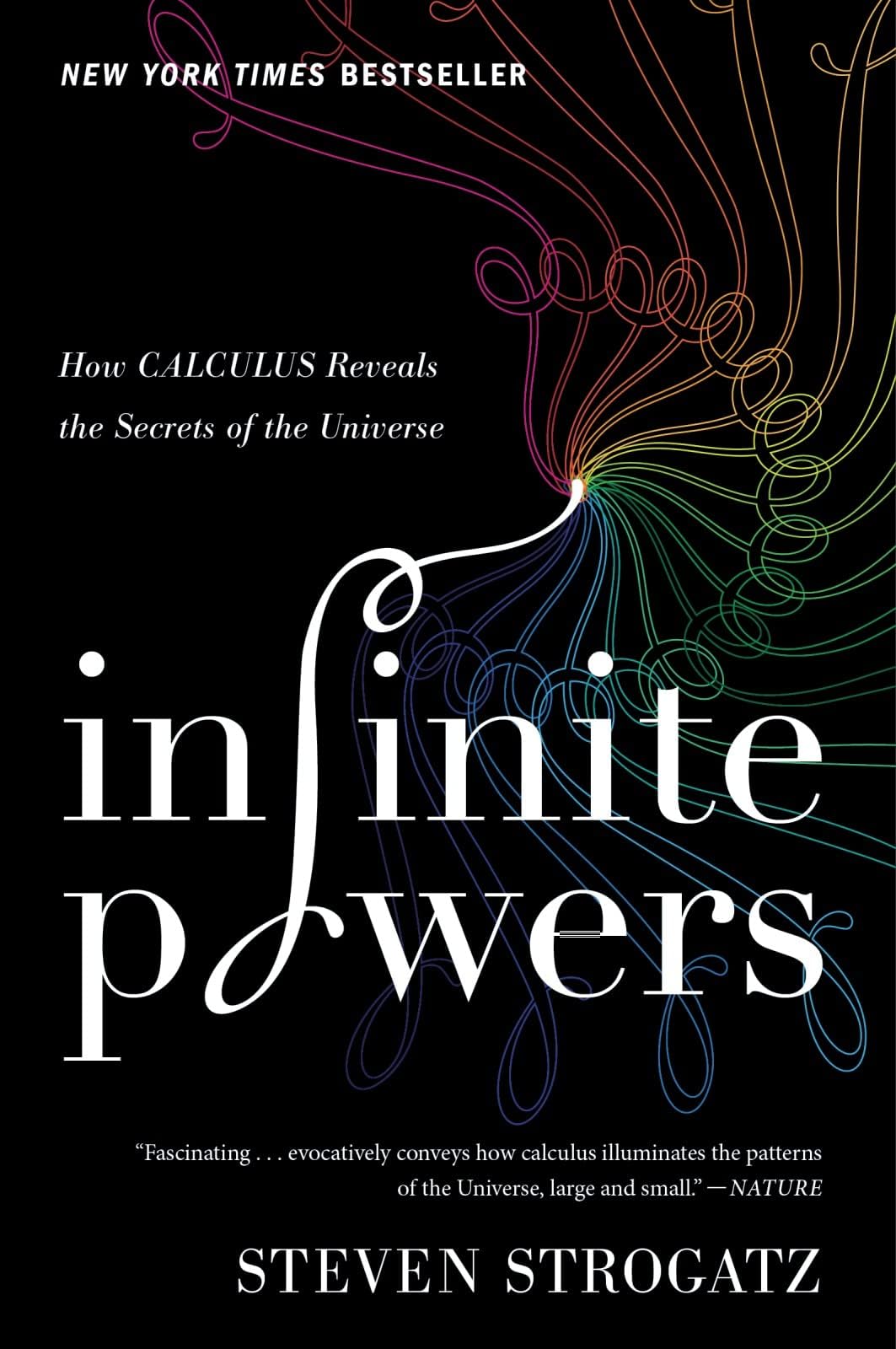
Infinite Powers: How Calculus Reveals the Secrets of the Universe
Product ID: 149346710
Buy anything from 5,000+ international stores. One checkout price. No surprise fees. Join 2M+ shoppers on Desertcart.
Desertcart purchases this item on your behalf and handles shipping, customs, and support to Indonesia.
From preeminent math personality and author of The Joy of x, a brilliant and endlessly appealing explanation of calculus—how it works and why it makes our lives immeasurably better. Without calculus, we wouldn’t have cell phones, TV, GPS, or ultrasound. We wouldn’t have unraveled DNA or discovered Neptune or figured out how to put 5,000 songs in your pocket. Though many of us were scared away from this essential, engrossing subject in high school and college, Steven Strogatz’s brilliantly creative, down-to-earth history shows that calculus is not about complexity; it’s about simplicity. It harnesses an unreal number—infinity—to tackle real-world problems, breaking them down into easier ones and then reassembling the answers into solutions that feel miraculous. Infinite Powers recounts how calculus tantalized and thrilled its inventors, starting with its first glimmers in ancient Greece and bringing us right up to the discovery of gravitational waves (a phenomenon predicted by calculus). Strogatz reveals how this form of math rose to the challenges of each age: how to determine the area of a circle with only sand and a stick; how to explain why Mars goes “backwards” sometimes; how to make electricity with magnets; how to ensure your rocket doesn’t miss the moon; how to turn the tide in the fight against AIDS. As Strogatz proves, calculus is truly the language of the universe. By unveiling the principles of that language, Infinite Powers makes us marvel at the world anew. Review: Calculus: The language that God talks! - Prof. R. Feynman, after an interview with a novelist who was doing research for a book about WW. II, as they were departing, asked him if he knew calculus. No, was the reply, he didn't. ''You had better learn it'' said Feynman. ''It's the language God talks''. Mr. Strogatz starts the Introduction part of his wonderful book by telling this anecdote. He continues, ''For reasons no body understands, the universe is deeply mathematical. May be God made it that way. Or maybe it's the only way a universe with us in it could be, because non-mathematical universes can't harbor life intelligent enough to ask the question. In any case, it's a mysterious and marvelous fact that our universe obeys laws of nature that always turn out to be expressible in the language of calculus as sentences called differential equations.'' ''Such equations describe the difference between something right now and the same thing an instant later. The details differ depending on what part of nature we are talking about, but the structure of the laws is always the same... There seems to be something like a code to the universe, an operating system... Calculus taps into this order and express it.'' ''Isaac Newton was the first to glimpse this secret of the universe... If anything deserves to be called the secret of the universe, calculus is it.'' Mr. Strogatz tells the story behind how humanity discovered this strange language, how they learned to speak it fluently and finally harnessing its forecasting powers, how they used it to remake the world. He has written this book 'in an attempt to make the greatest ideas and stories of calculus accessible to everyone'. I can say that he has greatly achieved this. First, he shows that calculus is one of humankind's most inspiring collective achievements, roots going back to Archimedes, even Zeno, to the concept of infinity. He tells the development of ideas in a comfortable, casual way, demanding only average mathematical knowledge. He gives examples of applications from our time, which is familiar to most of us. He has furnished his story with very informative drawings. What is very important is that, he tries to navigate the reader within the story of development of calculus in the historical, natural order of the development, which makes it much easier for the reader to grasp the ideas. He has added some wise, sense of humor here and there which makes the reading easy and fun. The rich bibliography at the end is very useful. I was able to meet another wonderful book 'The Calculus Gallery' of William Dunham from within that bibliography. I loved the book. No wonder it was a bestseller. I highly recommend this book to everyone who is or was scared of calculus and who wants to approach to understanding 'the language of God.' Review: Cool Discussions of Math History - This is an interesting history of calculus. The writing is entertaining and the historical facts are enlightening. I would point to some considerations on the discussion of Xeno and whether space and time being distinct would mean that movement wouldn't be possible. The author explains that in computer science and in video production, we see pixels moving and thus Xeno is wrong. But, what the author is saying doesn't conflict with Xeno's prediction and in fact supports it. You don't see pixels move. You see new pixels be drawn and give the illusion of them moving but they aren't the same pictures and in fact, each image is still, motionless and while infinity is cool, it doesn't give us any support here. One is still not two even if there are infinite many points between them and so no matter how many still images you draw (changing what we call the frame rate), you won't change the fact that with time and space being distinct, as is the case in video production and pixelated animation, that there is no motion but only a trick of your eyes to make it seem like there is. That said, this book is an interesting read and gives many insights about the math world that we all should learn. Later, there is a discussion of Bolt and getting his speed at instances. That further demonstrates Xeno's point. The reason you can ascertain Bolt's speed at an instance is that it's Bolt that is moving in space time. If space and time were distinct, you could no longer do that because Bolt wouldn't be Bolt anymore. There would have to be a bunch of individual Bolts and each one of them would occupy a space on a time line but none of them would be the previous Bolt whereas Bolt is the previous Bolt since he lives in spacetime and not in a space and a time. I get the sense, however, that the author is either joshing or there's something more that must be missing from the equation as I'm quite sure everyone knows that pixels don't move (they are static is another way to say it) and only have the illusion of movement. What is very fascinating, though, is that Xeno had figured out something that wasn't very intuitive before Einstein. In any case, this is the sort of thought the book provokes and the sort of history it presents as it takes you from the early days of algebra to the sort of calculus that Newton developed and beyond.
| Best Sellers Rank | #20,014 in Books ( See Top 100 in Books ) #3 in Calculus (Books) #4 in Mathematics History #57 in History & Philosophy of Science (Books) |
| Customer Reviews | 4.7 out of 5 stars 2,483 Reviews |
S**L
Calculus: The language that God talks!
Prof. R. Feynman, after an interview with a novelist who was doing research for a book about WW. II, as they were departing, asked him if he knew calculus. No, was the reply, he didn't. ''You had better learn it'' said Feynman. ''It's the language God talks''. Mr. Strogatz starts the Introduction part of his wonderful book by telling this anecdote. He continues, ''For reasons no body understands, the universe is deeply mathematical. May be God made it that way. Or maybe it's the only way a universe with us in it could be, because non-mathematical universes can't harbor life intelligent enough to ask the question. In any case, it's a mysterious and marvelous fact that our universe obeys laws of nature that always turn out to be expressible in the language of calculus as sentences called differential equations.'' ''Such equations describe the difference between something right now and the same thing an instant later. The details differ depending on what part of nature we are talking about, but the structure of the laws is always the same... There seems to be something like a code to the universe, an operating system... Calculus taps into this order and express it.'' ''Isaac Newton was the first to glimpse this secret of the universe... If anything deserves to be called the secret of the universe, calculus is it.'' Mr. Strogatz tells the story behind how humanity discovered this strange language, how they learned to speak it fluently and finally harnessing its forecasting powers, how they used it to remake the world. He has written this book 'in an attempt to make the greatest ideas and stories of calculus accessible to everyone'. I can say that he has greatly achieved this. First, he shows that calculus is one of humankind's most inspiring collective achievements, roots going back to Archimedes, even Zeno, to the concept of infinity. He tells the development of ideas in a comfortable, casual way, demanding only average mathematical knowledge. He gives examples of applications from our time, which is familiar to most of us. He has furnished his story with very informative drawings. What is very important is that, he tries to navigate the reader within the story of development of calculus in the historical, natural order of the development, which makes it much easier for the reader to grasp the ideas. He has added some wise, sense of humor here and there which makes the reading easy and fun. The rich bibliography at the end is very useful. I was able to meet another wonderful book 'The Calculus Gallery' of William Dunham from within that bibliography. I loved the book. No wonder it was a bestseller. I highly recommend this book to everyone who is or was scared of calculus and who wants to approach to understanding 'the language of God.'
M**L
Cool Discussions of Math History
This is an interesting history of calculus. The writing is entertaining and the historical facts are enlightening. I would point to some considerations on the discussion of Xeno and whether space and time being distinct would mean that movement wouldn't be possible. The author explains that in computer science and in video production, we see pixels moving and thus Xeno is wrong. But, what the author is saying doesn't conflict with Xeno's prediction and in fact supports it. You don't see pixels move. You see new pixels be drawn and give the illusion of them moving but they aren't the same pictures and in fact, each image is still, motionless and while infinity is cool, it doesn't give us any support here. One is still not two even if there are infinite many points between them and so no matter how many still images you draw (changing what we call the frame rate), you won't change the fact that with time and space being distinct, as is the case in video production and pixelated animation, that there is no motion but only a trick of your eyes to make it seem like there is. That said, this book is an interesting read and gives many insights about the math world that we all should learn. Later, there is a discussion of Bolt and getting his speed at instances. That further demonstrates Xeno's point. The reason you can ascertain Bolt's speed at an instance is that it's Bolt that is moving in space time. If space and time were distinct, you could no longer do that because Bolt wouldn't be Bolt anymore. There would have to be a bunch of individual Bolts and each one of them would occupy a space on a time line but none of them would be the previous Bolt whereas Bolt is the previous Bolt since he lives in spacetime and not in a space and a time. I get the sense, however, that the author is either joshing or there's something more that must be missing from the equation as I'm quite sure everyone knows that pixels don't move (they are static is another way to say it) and only have the illusion of movement. What is very fascinating, though, is that Xeno had figured out something that wasn't very intuitive before Einstein. In any case, this is the sort of thought the book provokes and the sort of history it presents as it takes you from the early days of algebra to the sort of calculus that Newton developed and beyond.
G**R
Infinite indeed, but what is infinity?
This is not intended to be a textbook on calculus. And, like a lot of calculus itself, it is and it isn’t - quite. It is, however, a book about the history of calculus, which is fascinating, and the degree to which the universe seems to have been coded in a way that calculus seems to have an uncanny ability to explain is, well, somewhat inexplicable. But as the author notes in the beginning, “For reasons nobody understands, the universe is deeply mathematical. Maybe God made it that way. Or maybe it’s the only way a universe with us in it could be, because nonmathematical universes can’t harbor life intelligent enough to ask the question.” How often do you hear a Professor of Applied Mathematics, at an Ivy League school no less, say something even remotely so self-reflective? Steven Strogatz is a great communicator who is both a great mathematician and who, it is easy to tell, gets goose bumps every time he thinks about the wonders of calculus. I am not a professional mathematician but have always found mathematics to be both fascinating and, well, not easy, but very relatable. It’s predictable, and that’s comforting once you can see the pattern. If you don’t feel quite that way you may – spoiler alert – find this book to be a bit more like a textbook than advertised. There are plenty of equations and symbols and the like. That is, after all, the alphabet of calculus. But here’s the thing. Unless you are also a math professor, you can ignore all of that. Just go with the prose. It tells the same story, but in a far more relatable form to the average lover of the written word. Just ignore the symbols. If you do you will miss nothing and you will find the professor’s enthusiasm to be quite contagious. The beauty of the book is that it is written from a perspective of humility. Both in terms of the enormity of calculus (Most people will relate to the subject matter simply as science.), and in terms of how far we have yet to go in terms of truly understanding the universe and the reality that defines it. We’ve only explained the tip of the iceberg. Math is a human convention. It’s not hydrogen or oxygen. It’s not even dark matter, which we “know” makes up most of the universe but which no one has ever isolated, although the Chinese are close. It is very accurate at deciphering reality if getting close to the “real” explanation is close enough. But close is only close. It isn’t reality itself. Reality is, after all, by definition, real. That is, ultimately, the problem with the promise of AI. Because AI is ultimately dependent on calculus and other disciplines of mathematics, it will get very smart, but it will never be human. What it will do, however, if we let it, is dumb down what it means to be smart to a standard perfectly suited to its abilities but ignorant of its shortcomings. That’s why, despite the promises of the silicon gods, we are very unlikely to see fully autonomous vehicles for decades to come. The only way that could happen is if we take all human drivers off the road overnight (The AI isn’t the problem; it’s us. We are unpredictable.), switch every vehicle to an autonomous vehicle all at the same time, and rebuild our infrastructure to accommodate the vulnerabilities of the various disciplines of mathematics on which the technology is based. And that’s obviously not going to happen. Nor do we want it to. Pi, as but one example, despite what you were taught in school, is not a number; it’s a range. It’s a small range, to be sure, but it’s a range nonetheless. In other words, it is precise enough for most things, but it is NOT the fabric of the universe. Science is a methodology for understanding reality; it is not, in the most literal sense, reality itself. Reality is not “waiting” to be discovered. It is. And just as an artist can draw a landscape, science can draw reality. Neither, however, IS reality. The history of calculus is truly fascinating. And that, to me, as a reader, makes it entertaining. Newton and Galileo and all the rest were truly amazing people. It boggles the mind to think of what they concluded when they did. Perhaps the book’s greatest contribution, however, is that it will put Silicon Valley in perspective. You may think your smart phone has changed your life in ways that nothing else possibly could. You’re wrong. I am a great admirer of Steve Jobs but James Clerk Maxwell (a Scot in the 1860s) changed your life in ways that Steve did not come close to. And that is why this book is so timely. Calculus is changing our world, and not entirely in good ways. If ever we needed perspective we need it now. Math is elegant. It was designed that way. (Remember that it is not of the universe, like rain or sunshine.) And it does have an uncanny reliability that helps us to understand the world around us. Take GPS. We all use it. We all rely on it. But did you know that GPS is all about time, not navigation. Those GPS satellites don’t “see” you; they time you. It only works because scientists came to understand the mathematics of what we call time at a very precise level. That’s not reality, of course, because time is a concept (time, even as we understand it, varies with altitude), but it is close enough to give us GPS. And isn’t that an amazing thing. I think so. And that’s why I found this to be such an enjoyable book, beyond the fact that I am simply stimulated by really enthusiastic people and Professor Strogatz is one of the most enthusiastic people I have had the privilege to read in a really long time. If, on the other hand, you prefer a good murder mystery, or something with a little romance, at least, you won’t find it in this book. But that’s just my opinion. A little like pi, if you will. Pretty accurate, but not reality itself. Decide for yourself. You won’t be wasting your time.
A**N
Fun!
I need to psyche myself up to do some math for work. And I have a math sherpa and I arranged to meet him so he can take me through the paper I must tackle. But I’m old and only really remember my high school math well, so there is a genuine task at hand here. So I duck and dive between the paper and my notes from my MSc thesis from at least fifteen years ago and I work out the answer to lesser problems and I write out my questions for my sherpa and I also need to be thinking math the whole time; I need to be in a mood, basically. That’s the task. So I did the sensible thing and went on a bit of a binge and bought a whole bunch of popular math books in one go to read in the tube. “Infinite Powers” I read first, because it looked like it would not challenge me at all and it gets good writeups. It’s bloody awesome! It’s more than an anthology of results and it’s more than a series of mini-portraits of mathematicians, it’s almost got a plot. Surprisingly often, even the obligatory corny applications of the math are (somewhat) related to what the author’s talking about. Huge caveat: I knew both the math and even many of the stories upfront, so perhaps it’s not very well explained. I have no way of knowing. But I bet you it is. Perhaps not well enough that you could hope to learn calculus from here, Jordan Ellenberg’s praise on the back cover notwithstanding. (For that I can refer you to “Quick Calculus” by twin gods Kleppner and Ramsey.) But probably well enough to be a companion to anybody taking calculus for the first time. Steven Strogatz had me from “hello,” of course, because he starts with the Greeks, on whom he lavishes immense praise. He could have left it there and I’d still be basking in the warm glow of my ancestors’ work. Needless to say, it does not stop there, he takes you from them to Fermat and Descartes, before introducing you to Newton and Leibniz, a couple words on Fourier and from him straight to Einstein, taking special care to erase all traces of evil men like the unspeakable inventor of delta-epsilon proofs. You won’t find the C-word here. So there’s a massive hole in the nineteenth century, somewhere, but I’m sure you can buy another book to find out about that. Here you’ll discover a decent definition of e, an intuitive explanation of general relativity, the common cause of death of Leibniz and Newton, a fun game to play with your microwave oven, the first and second derivative of the sine wave, the dimension of the three-body problem, a strong defense of infinitesimals, WHAT’S NOT TO LIKE? Enough from me, I’ll now go buy some extra copies for a few boys and girls I know. If one of them likes it, my job is done. Oh, sorry, one more thing. About the plot: it’s a history of how mathematicians throughout time have sliced hard problems into infinite infinitely-thin slices where the problem has a clear answer and then dealt with infinity to sum up the solutions to the easy problem in order to come up with an answer to the hard problem. Whenever you do that, you’re doing calculus, you’re putting together the answer granule by granule.
P**Y
A Very Special Book
Steven Strogatz has written an outstanding book that presents an overview of Calculus that students, and even professors, often fail to learn. His writing style is both informal and yet precise; the book is very reader friendly. The content covers 2200 plus years of the history of calculus from Archimedes to the present, and beyond - speculating about the future. But this is not a dry history. Strogatz, I believe uniquely connects stories from the past to today's applications. An example would be a section entitled "Archimedes Today: From Computer Animation to Facial Surgery." Here he connects Archimedes polygonal approximation to pi to the construction of the character of Shrek. I teach Honors Calculus and Differential Equations at Pasadena City College. Most of my students are not math majors; they are typically engineering majors. They tend to be practical people. Learning calculus for them tends to be learning the "nuts and bolts" of a 1000 pages of textbook. Mathematics is at best a tool, and at worst a "speed bump" on their way to an engineering degree. They do not see the large view of calculus or how is applies to so much of our world. "Infinite Powers" remedies this situation beautifully. I will try to get this book into the hands of as many of my students as possible. But it's not only for students; professors would greatly benefit from this amazing book. It enriches our teaching. There are many more examples of the wealth of material in the book. For example, Strogatz explains the distinction between "local" and "global" operations with great clarity. We see why integration is hard. He also gives the best explanation of the "birth" of partial differential equations I've ever read. The riches in this volume fill every page. In addition the combination of Endnotes and Bibliography constitute a treasure of wisely chosen pointers to further study. Finally , Strogatz considers the vibrant future of Calculus: applications to biology, increasing work in nonlinear dynamics, and the ramifications of mathematical chaos. The last several pages of the book are written in an eloquent and almost lyrical tone - his passion for his subject and explaining it are evident.
A**E
Really interesting book
Bought for my son who is obsessed with maths. He loves it
M**N
Thoughts on Strogatz's Infinite Powers: Great intuition on calculus, from a master teacher
I enjoyed Steven Strogatz's new work, Infinite Powers: How Calculus Reveals the Secrets of the Universe. The book gives an excellent overview of calculus, which permeates all branches of mathematics and so much of life. I should say at the outset that I had the great opportunity of being taught calculus in college by Dr. Strogatz. After reading this book, I feel even more fortunate for this experience because he's such a gifted communicator. What I liked mainly about the book was the intuitive way Strogatz describes differentials and the development of calculus from Newton and Leibniz onwards. He introduces these concepts in several ways. My favorite was the way he demonstrated simply cubing the number 2 and contrasting it with cubing 2.01, where the latter can be expressed as the cube of a sum (2 + .01) and then expanded out with Pascal's triangle. From merely looking at the multiplication of these numbers, one can immediately get a sense of which terms can be neglected in this specific sum and in the whole process of differentiation. Strogatz also clearly explains many classic equations in mathematics and physics, such as the heat and the wave equations. I particularly liked the way he described the development of the Fourier series and how this series converts differentiation of sine and cosine into a simple multiplication by minus one, making it easy to deal with. I also liked how he explained how one can easily express even very angular shapes such as a triangular waveform in terms of Fourier series. I enjoyed many of the practical examples of how we can see calculus in everyday life, ranging from the oscillations of HIV in people, as tracked by Alan Perelson and David Ho, to the development of CT scans by Hounsfield and Cormack. Strogatz gives an especially hands-on understanding of the fundamental theorem of calculus by describing it in terms of a well-known paint roller analogy and how it can link together the disparate ideas of the slope of a function and the area under a curve. Finally, I enjoyed the discussion of many of the personalities in mathematics, such as Descartes and Fermat. I hadn't appreciated the famous feud between these two until I read the book. Overall, a great read. I'd highly recommend it, especially for anyone studying or using calculus.
K**R
Original non-technical insight on calculus
Claiming to provide an understanding of calculus and its value to the casual reader, the author takes the reader on a historical and mathematical journey. We are about to discover ancient beginnings, technical foundations, a couple of important characters, and modern calculus applications. The beginning of the book describes Archimedes's foreshadowing of the calculus. This part provides some very illustrative examples, giving the impression that one can grasp the subject. This impression surely is about to deteriorate, leaving only minor intuitions of what is happening at the end. This is however not because of the worse quality of explanation, but rather because of the difficulty of the subject. The picture of calculus is built mostly by analogies. Some of them are already cliché, like the one where that zoomed curve appears to be more and more linear, but the author offers also some new insights. In particular, he is good at providing an intuition considering how calculus is applied in practical sciences. I like the reappearing motive of cutting the problem into infinitely many parts and then joining them using appropriate machinery. The author talks about the calculus with historical chronology, with digressions to the recent times from time to time. Various mathematical characters are briefly portrayed, and it is nice that the book pays tribute to other characters responsible for calculus than Newton and Leibniz. The language of the book is usually non-technical, and sometimes it is poetic. There were moments when I thought that the author tried to build understanding in the reader by referring to some transcending, indispensable inner values of the reader. Hence, I would say that the style is sometimes strange. Concluding, the book offers some original non-technical insight on calculus. It also balances between practical applications, theoretical foundations, and historical context.
A**S
Importance of knowing the value of infinite's conception
It is a delicious narrative about the origin of calculus and its importance in our daily life. It is a great book for those not familiar with mathematics.
J**H
Joya
El mejor libro de matemáticas que ahora está en mi biblioteca. En mi humilde opinión debería ser lectura obligada en el último año de preparatoria o en el primero de la carrera, o incluso sin ir a la universidad, es un libro que inspira y le pone encanto al cálculo y a la matemática en general.
A**Y
Just great, fun like a novel, insightful like a math book
Just great, fun like a novel, insightful like a math book.
A**R
A gem
This book is much more than just a history of a branch of mathematics. It's a framework for thinking about calculus. I was mind blown at how Strogatz explains calculus; like I had been blind all those years and now I saw. His 'breaking down and reassembling' analogy may not be the best explanation to the more mathematically inclined, but to me it made perfect sense, at last. This book provided me with a mind model to think about calculus. A gem. "To shed light on any continuous shape, object, motion, process, or phenomenon - no matter how wild and complicated it may appear - reimagine it as an infinite series of simpler parts, analyze those, and then add the results back together to make sense of the original whole."
A**.
Mucho mejor explicado que cuando estudié la carrera
El autor de este libro te explica cálculo diferencial e integral de una manera mucho más clara que mi profesor de primero de carrera en ingeniería. Te deja claro su historia, de donde vienen los conceptos, su utilidad, todo sin usar muchas fórmulas. Este libro no es para aprobar un examen sino para entender de verdad de que va ésta útil herramienta de las matemáticas. Lo recomiendo para cualquiera que quiera comprender de verdad sus bases y no solo memorizar una serie de fórmulas y gráficas, como pasó en mi curso.
Trustpilot
2 weeks ago
4 days ago