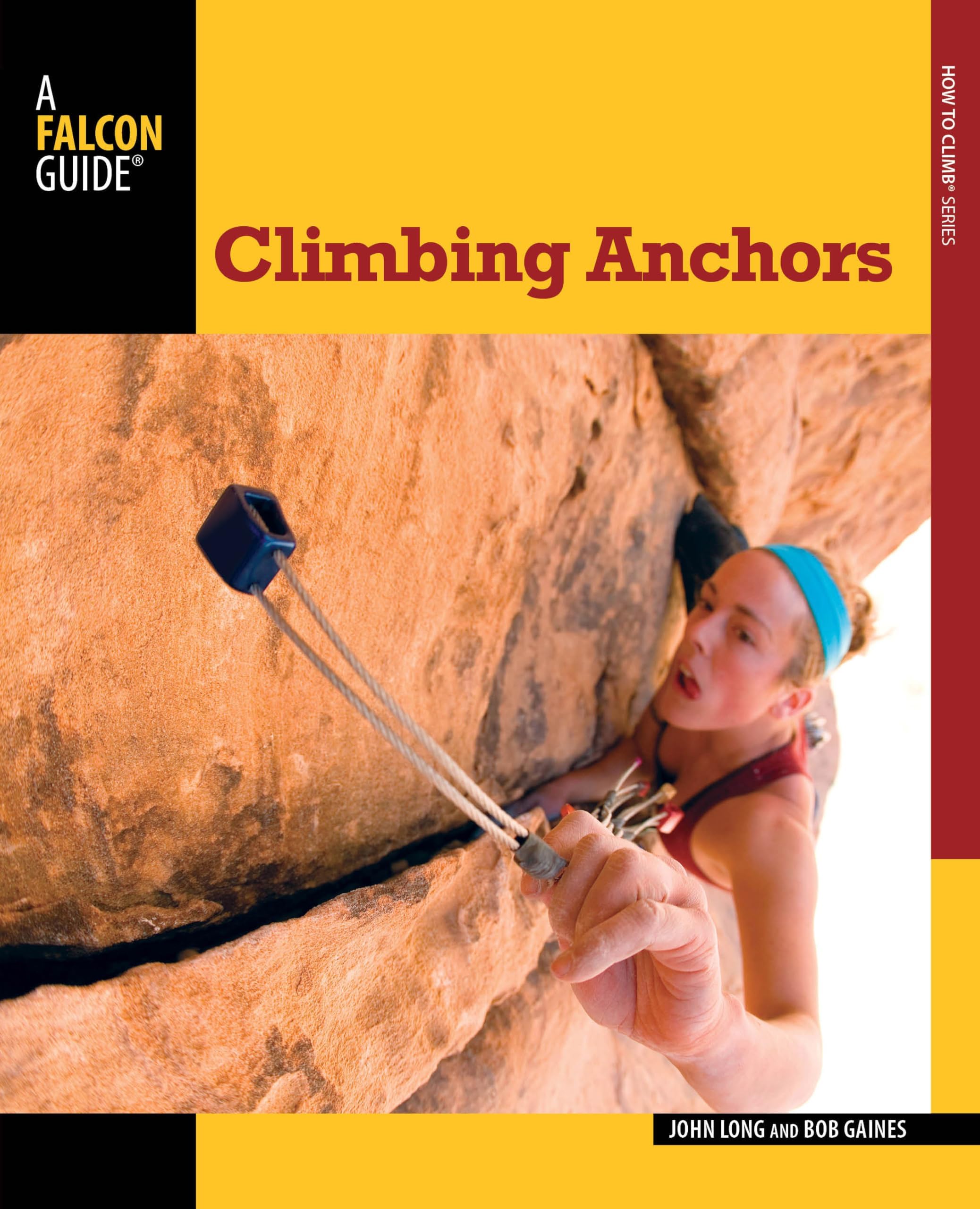
Climbing Anchors (How To Climb Series)
Product ID: 1347168
This completely revised and updated edition with all new color photos brings together in a single volume the anchoring systems most popular among climbers. Most climbers today learn their craft on artificial climbing walls and on sport routes with fixed protection. Their first efforts to lead on trad routes often come as a rude shock--they find that they haven't the skills and training to safeguard the climb or to set up solid belays. This new edition of Climbing Anchors is the climber's complete and authoritative source of information on protection, from fundamental knots to sophisticated rigging and equalizing skills. Review: An indispensable reference guide and wakeup call - Having read the previous two editions and then given them to friends (sorry John, they never returned them!), I'm pleased to see the third edition has been updated with new gear and anecdotes, while continuing to be a great reference guide for climbing efficiently and safely. Most importantly, Long strengthens the case for letting go of the idea that the cordelette is good for general purpose anchor-rigging, reinforcing that it should only be used in limited circumstances (specifically, only when the arms of the cordelette are the same length). He also clearly explains how to minimize loading on anchors, and how to tie in to anchors safely. This s*** is more than theoretical armchair advice...it will save your life one day, and you are better off learning the right way to do things early on, rather than after you've burned in a lot of bad behavior. Climbing Anchors jumps right in to the subject matter and presupposes some basic rock climbing knowledge and vocabulary. This is an ideal book for intermediate climbers starting to lead multi-pitch routes, where you have to build an anchor instead of clipping a couple of bolts, although there is a lot of information on safely rigging and clipping bolted anchors and fixed protection as well. You'll learn a lot about equalizing load on pieces and building anchors that anticipate loading from multiple directions. Long will relentlessly drum into your head the importance of placing protection (the "Jesus Nut") ASAP after starting a pitch to protect you from falling directly on the anchor...because you only get one chance to get this right. You will be surprised at how many assumptions you've made about redundancy and equalization that are likely mistaken...and you'll probably look back at some near misses (we've all had them) and realize how lucky you are that you didn't take a dirt nap. I can pretty much guarantee you will never clip into an anchor with a daisy chain again! Climbing is serious fun, but the serious part shouldn't be overlooked, as the consequences are just too high. Bad anchoring techniques only need to fail once for you to be an example in the AAC's "Accidents" annals. You'll have a lot more fun when your confidence in your anchors is not misplaced! Long's style is light and droll, with a smattering of humorous anecdotes. The book provides many full-page images and illustrations of anchor placements, along with many beautiful shots of classic routes that relate back to the subject matter. Bottom Line: You will climb safer and enjoy more confidence on multipitch routes after reading this book. Review: A comprehensive guiding - This book has a well starting comprehensive list of things to learn for climbing outdoor


| Best Sellers Rank | #975,012 in Books ( See Top 100 in Books ) #695 in Mountain Climbing |
| Customer Reviews | 4.8 out of 5 stars 239 Reviews |
E**R
An indispensable reference guide and wakeup call
Having read the previous two editions and then given them to friends (sorry John, they never returned them!), I'm pleased to see the third edition has been updated with new gear and anecdotes, while continuing to be a great reference guide for climbing efficiently and safely. Most importantly, Long strengthens the case for letting go of the idea that the cordelette is good for general purpose anchor-rigging, reinforcing that it should only be used in limited circumstances (specifically, only when the arms of the cordelette are the same length). He also clearly explains how to minimize loading on anchors, and how to tie in to anchors safely. This s*** is more than theoretical armchair advice...it will save your life one day, and you are better off learning the right way to do things early on, rather than after you've burned in a lot of bad behavior. Climbing Anchors jumps right in to the subject matter and presupposes some basic rock climbing knowledge and vocabulary. This is an ideal book for intermediate climbers starting to lead multi-pitch routes, where you have to build an anchor instead of clipping a couple of bolts, although there is a lot of information on safely rigging and clipping bolted anchors and fixed protection as well. You'll learn a lot about equalizing load on pieces and building anchors that anticipate loading from multiple directions. Long will relentlessly drum into your head the importance of placing protection (the "Jesus Nut") ASAP after starting a pitch to protect you from falling directly on the anchor...because you only get one chance to get this right. You will be surprised at how many assumptions you've made about redundancy and equalization that are likely mistaken...and you'll probably look back at some near misses (we've all had them) and realize how lucky you are that you didn't take a dirt nap. I can pretty much guarantee you will never clip into an anchor with a daisy chain again! Climbing is serious fun, but the serious part shouldn't be overlooked, as the consequences are just too high. Bad anchoring techniques only need to fail once for you to be an example in the AAC's "Accidents" annals. You'll have a lot more fun when your confidence in your anchors is not misplaced! Long's style is light and droll, with a smattering of humorous anecdotes. The book provides many full-page images and illustrations of anchor placements, along with many beautiful shots of classic routes that relate back to the subject matter. Bottom Line: You will climb safer and enjoy more confidence on multipitch routes after reading this book.
M**S
A comprehensive guiding
This book has a well starting comprehensive list of things to learn for climbing outdoor
C**Y
Exactly what I wanted, and much more I didn't realize I needed!
Amazing book. I've been climbing for 16 years but just getting into trad. I was looking for a way to learn about building secure anchors so I'd have an idea of what I was getting myself into as well as have a way to double check any of my mentoring partners work so I wouldn't be blindly following their advice. This gave me that and so much more. This is such a comprehensive guide that yes everything they talk about relates to anchors but since the author makes a point of focuong on the principles of gear placement, fall forces, and equipment the knowledge easily transfers to other aspects of trad climbing. The pictures to go along with the text was great to see what they were talking about. My only less than awesome comment would be a handful of times a term, concept, or gear would get brought up and I wasn't quite sure what it was. These were few and far between and usually the confusion was cleared up a little farther on or by a quick Google search. So happy this was the first book I picked up and can't wait to start putting some of this in to practice with someone willing to help further my knowledge on the rock! Thanks for the amazing book John and Bob :-)
F**R
A fine update to a classic
Technology is always advancing. The world of climbing consisted of "crag men" and "alpinists" when I started. To say that we're a long way away from soft iron pins and hauser-laid nylon ropes is an understatement. Today's tools to protect a climber are better engineered, startlingly lighter, and more versatile than five year old kit! Making safe and efficient use of today's tools involves a much steeper learning curve than at any previous time (that's why this book is on its third edition!). Safe climbers will learn the ropes from other, more experienced, climbers - but, as so many of today's "sport climbers" began climbing indoors with well engineered safety systems and artificial holds - not everybody will have had the advantage of a mentor teaching them the mechanics of building bomb proof anchors. That's where this book and Craig Luebben's Rock Climbing Anchors become invaluable, required, additions to every climber's library. This new edition is, as expected, up to date, including sections dealing with the uses and drawbacks of Aramid "tech cord" as well as nylon and dyneena/spectra ropes and slings. A detailed look at old bolts and bolt hangers is unique to this book and extremely timely material. Many 1/4" bolts and their hangers are found on standard routes and most, if not all, are traps for the unwary. The use and placement of (at least) three pieces of bomber protection to craft Serene / Ernest belay anchors employing the cordelette or Web-O-Let equalization system is the heart of this book. How placements respond to loading direction, avoiding force multiplication by keeping load angles optimal, dealing with shifting loading, and stressing that no leader should ever fall directly onto the belay anchor are central chapters. The bolt and pin (piton) chapters are not guides to the deployment of those tools - the scope of this book is limited in the sense that it does not teach a climber how and where to place a bolt - it teaches how to recognize and use safe bolts and gives a brief bit about the types of fixed pins one might encounter and how to deal with them (as for learning to use pins, the authors suggest an aspiring iron-monger take a rack of pins to an old crag and practice bashing in as many pins in as many places as possible - a fair enough bit of advice). If you climb anywhere outside of a gym, you need this book and you need Luebben's book. Aside from what you can learn away from your nearest vertical playground, these two books will serve you well in bringing enough knowledge to the field that you will not be ignorant of what other climbers are doing right, and, especially, what they are doing wrong.
C**T
Highly recommended!!
Excellent resource for those starting out in outdoor climbing! The information is rich and avoids being “dumbed down” for the newbie, however, plenty of terms are defined and concepts explained to ensure that beginners can follow the authors thought process.
G**E
A good resource for any climber
A good resource for any climber, but especially so beginners. I would recommend this book for any rock climber.
M**3
It's a great source of information to read for the beginning trad ...
This book covers climbing anchors but also provides a lot of information on safe trad placements in general. It's a great source of information to read for the beginning trad leader as well as the beginning multi-pitch leader. Some of the references are a little outdated but funny (Boom box?). I took this book out to a local crag and built anchors from the ground. During that learning session I felt like some details were missing about using the "shelf" of an anchor and the photo wasn't entirely clear on what was going on. But overall this book has been the standard for a long time and I learned a lot from reading it cover to cover.
A**R
Yeah man... It's the $&@%!!! It'll keep your a$$ alive. Get it!
To quote my friend who has over 30 years on the rock... "If you haven't read Climbing Anchors by John Long, start there. You can end there too....everything you need to know and why." I've pinged around as a 'second' on some local crags with a very experienced trad buddy for a few years, this book is well written and easy to understand with answers to questions you don't know that you have. Another instructor friend met the author climbing at Joshua Tree in 1983, this author is a living legend.
K**N
Absolutely awesome guide!
I bought this book and scoured it cover-to-cover. I repeatedly tried all of the various setups demonstrated in the book at home and at the foot of my favourite crags. By the time I took a lead course, I had the basic concepts down pat thanks to this book and was able to really focus on learning the mechanics of leading and what the instructor was saying, instead of getting lost in trying to figure out my anchor and belay placements. Totally recommend!
C**R
Very informative.
Great read. As a beginner this gave good insight into how climbing systems really work and some basic math / science behind it, all very important to understand. More detailed in this regard than a 'general' climbing book.
C**Y
Excellent
An excellent read. Superb flowing, good humoured prose on a subject which should be dear to every climber. My only critique is that the human factors in anchor failures, while constantly alluded to and described was not deemed worthy of a chapter of its own. Excellent writing and I will be reading John Long again.
M**A
Buen libro para lo basico
Libro muy util y práctico para aprender lo basico
D**O
Conteúdo muito bom
LIvro muito bom, com teoria e imagens que exemplificam melhor as colocações, oque fazer e oque se evitar.
Trustpilot
2 weeks ago
4 days ago