📊 Stay ahead of invisible waves—measure, monitor, and master your EMF environment!
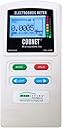
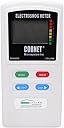
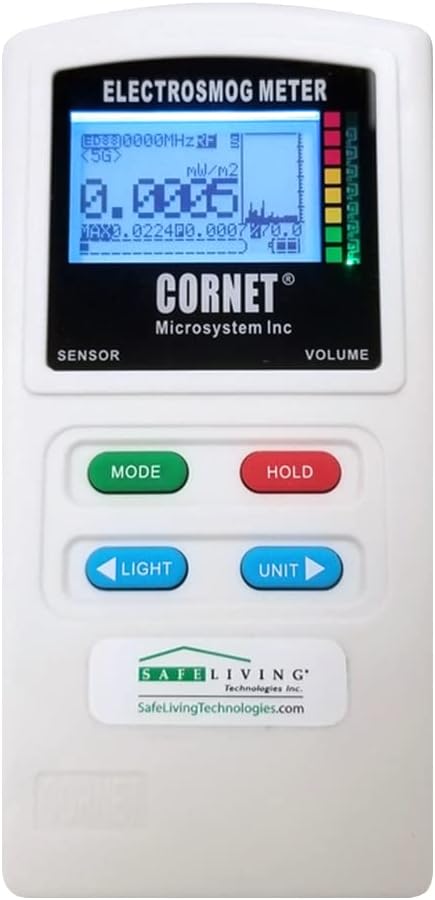
The Cornet ED88TPlus is a versatile trimode meter designed for professionals and enthusiasts to measure RF (100MHz-8GHz), low-frequency magnetic (50Hz-10kHz), and electric fields (50Hz-50kHz). It features high sensitivity (-60dBm to +5dBm), peak pulse detection, and data logging with USB export, making it ideal for identifying and analyzing electromagnetic pollution in homes or workplaces. Compact and portable with included battery and carrying case, it offers a cost-effective solution trusted by EMF mitigation experts.


| ASIN | B07PY4ZRYC |
| Batteries | 1 9V batteries required. (included) |
| Best Sellers Rank | #487,693 in Industrial & Scientific ( See Top 100 in Industrial & Scientific ) #283 in EMF Meters |
| Date First Available | September 2, 2016 |
| Is Discontinued By Manufacturer | No |
| Item Weight | 7.4 ounces |
| Item model number | ED88TPlus |
| Manufacturer | CORNET Microsystems |
| Package Dimensions | 6.42 x 3.35 x 1.54 inches |
W**T
Excellent meter with extensive features, data logging. Outstanding tech support.
If you Google Cornet ED meter on the web (select the videos tab), you will find many recommendations by EMF mitigation experts. They are fond of Cornet meters because at a reasonable price, they offer a huge number of features not even found with meters at twice the cost. I have found Cornet tech support / email response to be stellar, with replies coming back the same day. Such support is not often found with consumer level electronics. What I particularly value with this meter are the three modes (RF, magnetic, and electric), the peak hold feature, and the ability to also capture the RF emitting frequency that produced the peak. This is valuable when dealing with several competing signal sources. This meter also displays signal strength in multiple helpful ways: colored LED bar graph, digital (current and peak), sound output, and HISTOGRAM, which is very useful for seeing intensity patterns over time. A built-in data logging feature can make recordings over a period of time. And then the data can be uploaded to a spreadsheet over the side USB port. This feature is described in a downloadable document on the Cornet website. Such recordings are invaluable for RF signals that are only infrequently transmitting, such as utility "smart meters". PHYSICS NOTE: Several users posting reviews here are confused by what is called the inverse square law for electromagnetic radiation. This dictates that field strength falls off, inversely proportional to the distance from the source, squared. So yes, the measured values do fall off rapidly as you move away from the source. This no deficiency of the meter, it is just plain physics.
S**T
Reasonably accurate RF, not-so-good magnetic.
I have access to various types of equipment I used to test this meter. The ED88Tplus from Cornet accurately reads RF (radio frequency) strength from ~1.5G Hz to ~ 2.5 GHz, and it reads somewhat low outside that frequency range. At a lower frequency of 300 MHz, it reads ~90% low, and it also reads ~90% low at ~ 5 GHz. That is actually reasonable performance for a low-cost meter, and is sufficient to detect most frequencies of RF typically encountered, except TV transmitters below channel 14, and FM and AM radio, which are below 300 MHz. Also not measurable are the not-yet-implemented 5G devices (up to 25 GHz). When placed in an cage that is shielded from all RF, the 88Tplus correctly reads less than .001 mW/m² and it is accurate at frequencies around 2 GHz when the RF level is increased above zero.. There is a peak RF capture feature which displays the height of quick RF pulses (typically from cell towers, wireless devices, etc.). However, there is a problem with the way this peak capture is implemented-- the main displayed number shows each pulse height for 1/2 second before reverting to the actual RF field strength (a lower number) and the pulse height is also "permanently" shown a secondary number underneath the main number. If the pulses of digital information occur faster than 2 per second (typical of cell towers and routers), the main and secondary numbers both show the peak without ever getting a chance to show what the actual RF level is. Even the row of LEDs and the bar graph both remain elevated to the pulse height and there is no indication of what the average is, which is typically 1/10 to 1/100 of the pulse height. There is also no indication of whether the RF that is being measured is pulsing or constant. If you are only interested in the pulse heights (and not the average value) this meter works well on RF. The E-field (AC electric field) measures the E field at 60Hz (North American powerline frequency) fairly accurately. At zero E field, the meter reads 2 V/m (volts per meter) instead of 0 V/m. This error is tolerable because the resolution is 1 V/m. (Oddly, the manual claims that the resolution is a more crude 10 V/m.) The meter is not equally sensitive at frequencies from 50 Hz to 50KHz, as the manual implies. Instead, at 3000 Hz, the meter reads ~1500% too high, dropping back to correct sensitivity at ~800 KHz. The E field is single-axis, in the same direction as the long dimension of the meter. A single axis sensor works well for E field, because the field is created by charged particles, or "monopoles" (electrons and protons). Simply point the top face of the meter outward in the direction you want to measure the E field, and the reading is generally correct. If an E field source is due north of you, the field direction at your location will generally be along a north-south line. That is why you point an E field meter toward the source (north in this example). However, the correct measurement of magnetic field is more tricky, because magnetic monopoles don't exist. If a magnetic field source is due north, the field at your location may be north-south or east-west or up-down or even a diagonal direction. Therefore, if you point a single-axis magnetic meter toward a magnetic source, the meter may just read zero even if the field is strong. In order to measure this field accurately, you would need to point the meter in various directions until you see a maximum. This takes some time. The ED88Tplus is only single-axis in magnetic. It also reads 0.6 milligauss (0.06 uT) in a true zero field, and is therefore not usable below 0.6 mG. It also has a slow response time (~1 second) and the mG readings are only accurate at ~55 Hz (between 50 Hz and 60 Hz). At higher frequencies, it reads up to about 1000% high, and the 10mG overrange limit in the sensitive range is annoying. Overall, the meter is good for measuring the higher-frequency RF, especially the peak height of pulsed signals. The electric field mode works reasonably well and is accurate at 60 Hz. The magnetic field mode, however, has multiple problems. The screen has good visibility in daylight and a backlight can be turned on for indoors. However, the screen is small and is in the form of square pixels. The numerals 0,8, and 5 run together and are difficult to read if next to each other. The manual is incorrect about certain specs and doesn't explain everything about the displayed parameters. Also, it has several grammatical errors and strange phrases. I would guess the writer's primary language is not English, which leads me to question the "Made in USA" printed on the back of the meter. Full disclosure: I am affiliated with a US company that manufactures various lab instruments, including electromagnetic measurement equipment.
M**I
Easy to use, convenient sizing to measure electromagnetic fields anywhere
I've owned a Cornet ED-88TPlus previously and also an older version. I gave away my first to a friend whose young child was complaining of migraines, transient headaches and difficulty sleeping to see if electromagnetic fields in her home may be contributing to those symptoms. This device is my favorite EMF / RF meter, because it is so easy to use. I recommend this meter to anyone who is sensitive to electromagnetic fields or worried about the ever increasing density of electromagnetic frequencies in our world with all of our new and convenient technology. Anyone with chronic symptoms or illness can be helped by a greater awareness of the effect of their environment on their symptoms. We rarely / never think about the effects of a wifi router that is close by or the fields generated by electronic appliances to be of consequence. Simple changes can vastly improve one's quality of life and this meter is one tool that can be very helpful. For those wondering if they are electrosensitive, there are many books available on Amazon that are wonderful resources. I am an MD who became (what felt like) suddenly sensitive three years ago (after 20 years of cell phone use, 8 years of driving a hybrid car, 5 years of installing a smart home). Now much improved with simple lifestyle changes that allow me to still use technology when needed and live and work normally. (Also many chronic symptoms and allergies that I attributed to aging have disappeared with the smarter use of technology and better awareness of my environment.) Highly recommend this meter as a tool to help live a healthier lifestyle!
R**N
You're wondering if it works.. it does!
It's simple enough to pull it out of the box and use. Though you should read the instructions to see what's what. RF mode seems to be very accurate. I sleep much better now that I know I'm not crazy and there was actually ringing in my ears/head from frequencies. Instead of talking about things, do something. Take whatever precautions you can to minimize your exposure and you'll be much happier. As for the the things that are out your control, don't sweat it. My complaint is the EMF mode. It doesn't seem to work properly.
D**L
seems to be good...but It seems to be slightly an outdated design like any technical equipment which is not on high popular demand...but is doing the job is designed to and at an acceptable price...but there is no protective pouch/case, no hard card with reference normal values, the battery door is a bit loose...then the battery inside is shaking si I had to add some tissue paper to hold it stable.
Trustpilot
2 months ago
2 months ago