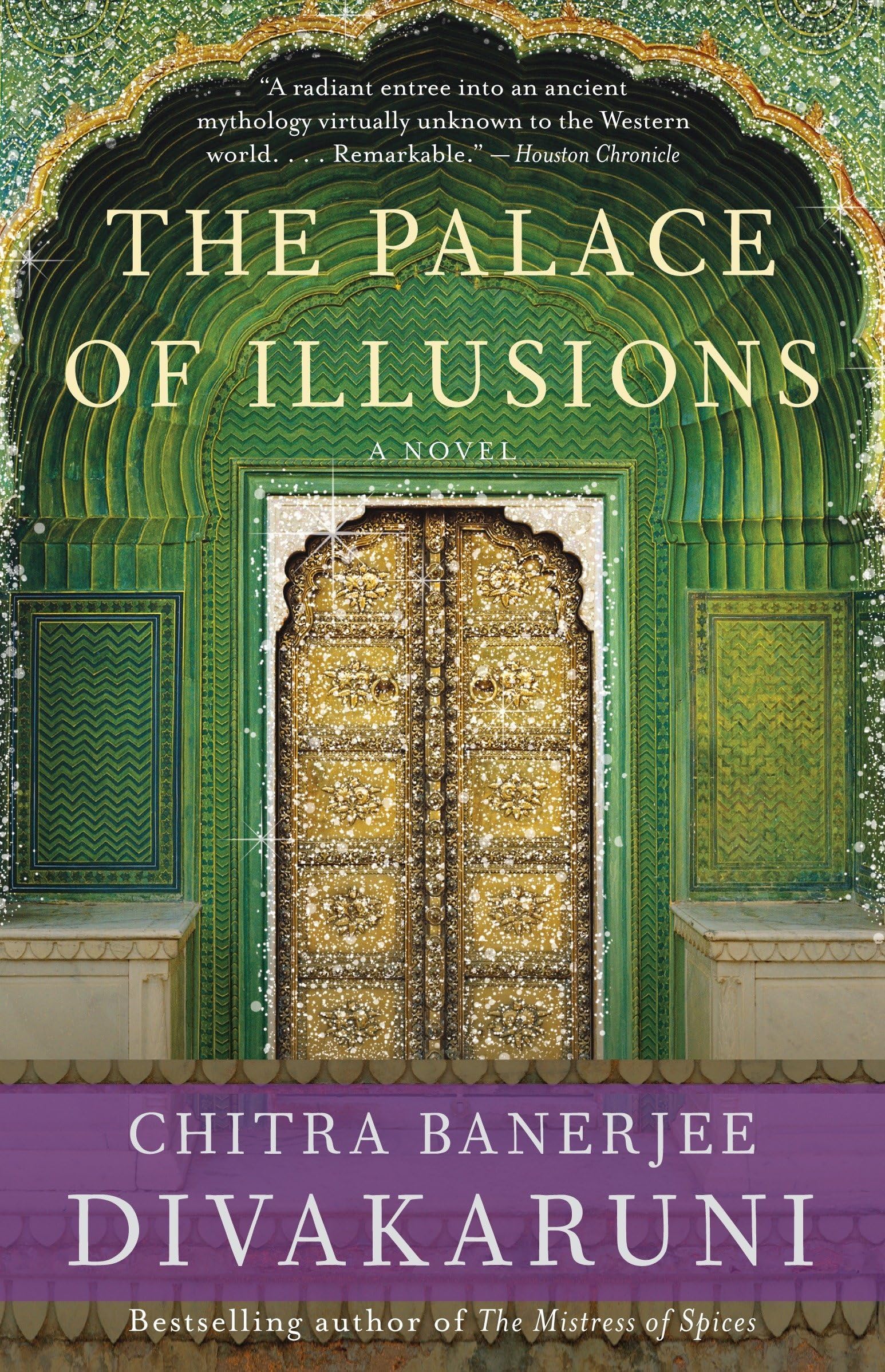
The Palace of Illusions: A Novel
Product ID: 11862316
Buy anything from 5,000+ international stores. One checkout price. No surprise fees. Join 2M+ shoppers on Desertcart.
Desertcart purchases this item on your behalf and handles shipping, customs, and support to Indonesia.
Taking us back to a time that is half history, half myth and wholly magical, bestselling author Chitra Banerjee Divakaruni gives voice to Panchaali, the fire-born heroine of the Mahabharata, as she weaves a vibrant retelling of an ancient epic saga. Married to five royal husbands who have been cheated out of their father's kingdom, Panchaali aids their quest to reclaim their birthright, remaining at their side through years of exile and a terrible civil war. But she cannot deny her complicated friendship with the enigmatic Krishna—or her secret attraction to the mysterious man who is her husbands' most dangerous enemy—as she is caught up in the ever-manipulating hands of fate. Review: omgggg a must read!! - Made me cry quite a bit. I won’t write when and why I cried because this book - one should experience themselves. Everyone will get many things from this book. This book is an experience Review: A Beautiful and Soul-Stirring Retelling of the Mahabharata - The Palace of Illusions was an absolutely beautiful and immersive read. I loved how the story retold the Mahabharata through Draupadi’s perspective, giving such depth, emotion, and humanity to a character I thought I already knew. The writing felt lyrical and powerful, and the book perfectly balanced mythology, love, ambition, heartbreak, and destiny. What stayed with me most was how emotionally layered Draupadi was — strong yet vulnerable, flawed yet unforgettable. This book felt less like a retelling and more like experiencing the epic from inside someone’s soul.

| Best Sellers Rank | #20,797 in Books ( See Top 100 in Books ) #190 in Contemporary Literature & Fiction #304 in Folklore (Books) #1,095 in Literary Fiction (Books) |
| Customer Reviews | 4.4 out of 5 stars 12,136 Reviews |
1**R
omgggg a must read!!
Made me cry quite a bit. I won’t write when and why I cried because this book - one should experience themselves. Everyone will get many things from this book. This book is an experience
K**I
A Beautiful and Soul-Stirring Retelling of the Mahabharata
The Palace of Illusions was an absolutely beautiful and immersive read. I loved how the story retold the Mahabharata through Draupadi’s perspective, giving such depth, emotion, and humanity to a character I thought I already knew. The writing felt lyrical and powerful, and the book perfectly balanced mythology, love, ambition, heartbreak, and destiny. What stayed with me most was how emotionally layered Draupadi was — strong yet vulnerable, flawed yet unforgettable. This book felt less like a retelling and more like experiencing the epic from inside someone’s soul.
L**Y
Beautiful
In a time of rich spices, jeweled saris, and everyday magic - a time of curses, vengeance, and the power of the heart - a girl stumbles out of the flames that have already produced her twin brother, carrying with her the thread and promise of change. In Divakaruni's masterful hands the myth of Panchaali takes shape, and the reader leaves behind the contemporary world for a society that carries far too many parallels to our own. On its own, the narrative is majestic, but it is Divakaruni's character development that truly brings The Palace of Illusions to life. Panchaali herself is capable of invoking a sea of emotional responses, and the power to invoke sympathy, hatred, admiration and condemnation within the space of 360 pages speaks volumes of her author's narrative capabilities. The inhabitants of The Palace of Illusions are far from two-dimensional characters moving through a storyline: they breathe through the pages and welcome the reader into their mysterious world. In short, the novel is simply magical.
L**N
Psychologically Complex
Divakaruni has penned a fast-moving and engaging retelling of one of India's most beloved ancient texts: the Mahabharata. Probably the world's largest single literary work, the Mahabharata tells the story of the first recorded civil war in history: the struggle precipitated between two sets of cousins due to their conflict over who is to inherit the family's ancestral throne. Most Western readers are familiar with this epic tale only marginally, through a tiny excerpt called the Bhagavad Gita, which contains the eternal teaching of the divine Krishna. In her contemporary novel, Divakaruni recasts the entire story by telling it through the eyes of the central female character, Draupadi, whose humiliation and violation is one of the events motivating the epic's heroes to enter into war with their cousins. Draupadi's "disrobing" has always been considered one of the most central scenes in the epic. In fact, many date the onset of our current age of corruption and decay (the Kali Yuga) to that very moment in time. In the critical edition, Draupadi's chastisement of her husbands, for their passivity and unwillingness to protect her, is given full voice: a fact that attests to the tradition's own ambivalence with regard to the traditional treatment of women at the hands of their husbands in general (echoed through the centuries in Draupadi's unanswered question: "Is a husband permitted to stake his wife in a gambling match"?) By making Draupadi's the point of view through which we see the events unfold, however, Divakaruni adds a greater level of psychological complexity to our consideration of the epic events. In this version, we see Draupadi involved in an ongoing relationship with Krishna in which she is not only acknowledged for the suffering she endures, but also chastised for her selfishness, and encouraged to move beyond her adolescent goals and ambitions. There is admirable character development, as Draupadi recognizes (too late, all too often) her mistakes and their great costs. So too, we are treated to a sort of Draupadi Gita, as we see the 18-day war through Draupadi's eyes, and she is forced to witness the carnage brought about through her lust for revenge. Is it a break with tradition to tell the story in this way? To those who would be scandalized by Divakaruni's approach: it is well worth remembering that there are dozens of well-established regional versions of the Mahabharata, and even many more local traditions throughout India. In fact, as a cursory scan of even the critical edition would verify, we could say that the tradition *is* to come up with new ways of telling the old events, and new details with which to embellish the body of the story.
D**A
A page turner and worth the money you spend on it !
I tend to avoid retelling of Epic stories from some character point of view, since I feel that the magic of the story will be lost when we know more about the characters. They will look more humane and less magical. This book was an exception, owing to the rave reviews and my own curiosity to read more about enigmatic Draupadi. The story is nothing new. I grew up listening to the tales from my grandfather and saw those characters portrayed by a thousand different actors in movies and serials. The writing was crisp, to the point and held my attention from page one even if the story was not new. We know more about Draupadi, her childhood, her marriage and her inner most feelings. The prose is almost lyrical and stays with us even after closing the book. I can pour heaps of praise on the way she dealt with the subject. Nowhere is Panchaali shown as a helpless woman. She's shown to be a strong woman who rebels against the norms of the period. It's however sad that she too becomes a pawn in the hands of men who don't love her. We see several new angles: for example I never knew Draupadi had some unexplained crush on Karna. It was almost irritating to hear a married woman to no less than five husbands constantly talk about Karna and how he holds an important place in her life. I don't know where the author did her research but this is exactly why I hate retelling of Epic stories. Authors take their liberty and interpret stories in their own way. I can never look at Draupadi the same way again. And the angle with Krishna, even though doesn't cross the boundaries, is also mildly irritating. Nevertheless, I liked her attachment with her brother, Subadhra, Sikhandi, and Dai ma. Some scenes I wanted to read like disrobing of Draupadi and later when she ties her hair again with Dussasan's blood were probably not given enough space. And some other like her obsession with the Palace of Illusions were given more space than necessary. The book is a page turner and worth the money you spend on it. Pick it up if you want to read the timeless tale again, this time in another point of view. My rating 4/5. Some quotes I liked: “Love comes like lightning, and disappears the same way. If you are lucky, it strikes you right. If not, you'll spend your life yearning for a man you can't have.” “There was an unexpected freedom in finding out that one wasn't as important as one had always assumed!”
A**6
Creative idea, but definitely not "feminist"
This book largely succeeds at going through the "greatest hits" of the Mahabharat while focusing on the point of view of Draupadi/Panchaali. However, it fails at being a "feminist" take on the material. Virtually all of Draupadi's personality can be explained through her relationship to men: first her brother Dhri, then Karna "the one who got away," the Pandava brothers, and her "best friend" Krishna. Far from empowered, Draupadi is characterized as vindictive, materialistic, and shrewish; she never fails to find fault with the Pandavas even when they treat her well. In fact, it seems that she loves her "Palace of Illusions" (the namesake of the book) more than her own children! Her attraction to Karna is probably the worst aspect of the book; the subplot feels extremely forced, and her internal monologue is poorly-written. Even as an adult, Draupadi sounds like a teenager pining after a movie star. In contrast, the main highlight of the book is the portrayal of Krishna. He is shown to be a close friend, kind, and understanding, but also shrewd, wise, and mischievious. Draupadi's relationship with him is very well-written and interesting to read, and explores one of Hinduism's core philosophical concepts that one can have a personal relationship with the Divine. Overall, some familiarity with the source material of the Mahabharat is a must, otherwise you may not be able to follow the plot.
S**I
Spellbinding retelling from a slightly different viewpoint
A well written book of the Mahabharata that bringgs back all the accumulated memories of this wonderful tale and adds new points of view.It leaves one again amazed at the breadth and detail of this story. Being an Indian matters as this story or at least some parts of it are part of the fiber that makes most of us Indian. A glossary of terms would have helped western readers and foreign born Indians. But I did not have any complaint personally on that. The book held me spell bound and it was over too soon.
A**M
I LOVED this book!
This book can only be described with one word BEAUTIFUL. The imagery, the language, the well-conveyed feeling of longing all made this book speak to me on so many levels. I did not want to finish this book for the fear of the end of the fantasy world the author had created for me. This book was so descriptive it made all my senses ache. Not only at its core was a story of love and loss but an epic battle as well as the lessons of greed, power and desire. I wish Divakaruni had made this book even longer so my journey could have never ended. A truly magical journey and magical book.
D**A
Amazing Must Read
The Palace of Illusions is a stunning reimagining of the Mahabharat, told entirely through Draupadi’s voice. For those who haven’t read or watched the epic in full, like myself, this novel offers the perfect entry point. It clarifies the chaos of family affairs, dynasties, and dharma, all while grounding the story in one woman’s emotional world. I, for one, have never read nor watched the Mahabharat in its entirety, but after reading this, I find it awfully hard to imagine the story without Draupadi’s perspective. To me, she and Krishna are the thread that runs through the entire tale. The bond they share is quiet yet cosmic, built on mutual respect and a deep, unspoken understanding. When Krishna gives her the name Krishnaa, so closely tied to his own, it becomes even more powerful and symbolic. But this story was never about Draupadi relying on a man. Krishna's presence in her life wasn’t about dependence, it was about alignment. He wasn’t her rescuer, but her mirror. And though Krishna appears in male form, “they” transcend gender entirely, shifting, guiding, and reflecting what each soul needs most. This is not just a tale of war and fate, but of ego, forbidden love, sacrifice, and the loneliness of being misunderstood. Draupadi isn’t a side character here, she is the heart of the story. Through her eyes, we witness the weight of duty, the complexity of relationships, and the fire that comes with knowing your worth in a world that constantly tries to reduce it. The Palace of Illusions doesn’t just retell an epic, it reclaims it, reshaping our understanding of the Mahabharat forever.
S**I
Great read
Amazing book! The story line is so intriguing and at times thought provoking. Absolutely loved the take on a somewhat patriarchal epic from a women’s perspective!
A**2
A captivating retelling
The storytelling is engaging and I really liked it overall. Seeing the events unfold through Draupadi’s voice made it feel fresh and more personal, and it kept me hooked throughout. SPOILER - The only part I didn’t fully enjoy was the portrayal of Draupadi’s feelings towards Karna. The added sense of infatuation felt a bit unnecessary to me and didn’t quite sit right, especially given the original context of the story. That said, it’s still a beautifully written and compelling retelling, and definitely worth reading.
H**A
Worth the read
Struggled to get started but once I got into it, this was a great story, beautifully written and really intriguing. I loved learning about the mystical and culture from this era
A**M
発送が遅すぎ---- too damn late
I ordered this book a month ago and I am yet to receive the product even though I have already paid. Has my money gone to waste ? How long does it take ?
Trustpilot
2 weeks ago
2 days ago